Latest Articles

I Think She’s Watching Him for a Reason

Hal

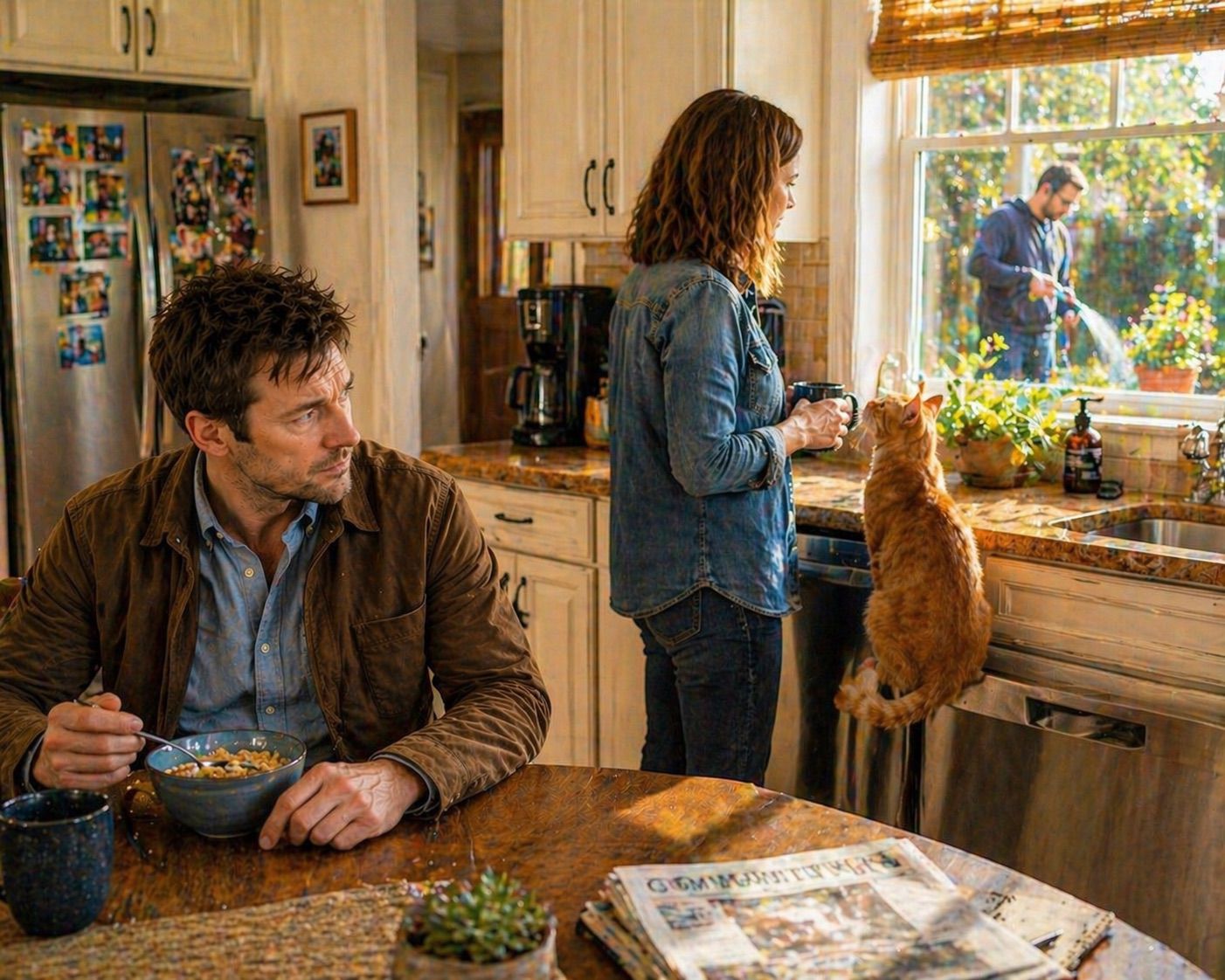
I’m sitting at the kitchen table, eating cereal, trying to focus on literally anything other than the fact that something feels off.

Pandora is at the counter, making coffee.

Normal.

Completely normal.

Except she’s standing a little too close to the window.

Not leaning casually. Not glancing outside.

Standing.

Looking.

Like she’s waiting to see something.

I follow her line of sight.

John Mercer is outside.

Watering his plants again.

Same as always.

Nothing unusual there.

So why is she watching him like that?

I take another bite of cereal and pretend I’m not paying attention.

Mr. Whiskers is sitting next to her, looking up at her like he’s waiting for something.

Not food.

Not attention.

Just… watching.

That’s new.

I glance between the two of them.

Pandora—focused on the window.

Mr. Whiskers—focused on Pandora.

Like there’s some kind of chain of attention happening that I’m not part of.

I don’t like that.

I look back down at my cereal.

Think.

Maybe she’s just zoning out.

People do that.

You stare out a window long enough, your brain just… drifts.

That’s normal.

But then why hasn’t she moved?

The coffee’s done.

She’s not pouring it.

She’s just standing there.

Still watching.

I look outside again.

John shifts position slightly, adjusting the hose.

Completely unaware.

Or at least he looks unaware.

That’s when the thought hits me.

What if she’s not just watching him—

what if she’s waiting for something he does?

I sit up a little straighter.

Okay.

Now I’m paying attention.

Mr. Whiskers flicks his tail once.

Still watching her.

Still not breaking focus.

I don’t remember the last time he paid this much attention to anything that wasn’t food.

I glance back at Pandora.

Still the same.

Still fixed on the window.

I clear my throat slightly.

Nothing.

No reaction.

I shift my chair just enough to make noise.

She doesn’t turn.

Doesn’t acknowledge it.

Which is strange.

Because normally she notices everything.

I look back outside again.

John bends down to adjust one of the pots.

Then stands back up.

Routine.

Predictable.

Nothing that should require this level of observation.

Unless—

it’s not about what he’s doing.

It’s about when he’s doing it.

I don’t like where that thought is going.

So I try to pull it back.

Maybe she’s just thinking about something work-related.

Maybe she’s not even looking at John.

Maybe the window just happens to be where she’s staring.

That would make sense.

That would be normal.

But then Mr. Whiskers shifts slightly and sits up straighter.

Now he’s looking toward the window too.

That’s not helping.

Now it really feels like I’m missing something.

I glance back at Pandora one more time.

Same posture.

Same focus.

Like she’s waiting for something to happen.

And for a second—

just a second—

I wonder if I’m the only one in this room who doesn’t know what that is.

Related Posts

Asmodeus: The Prince of Lust, Power, and Destruction Who Rules Desire and the Fire Within

Dave

Asmodeus is one of the most enduring and complex figures in demonology, a name that has traveled across centuries, cultures, and belief systems while retaining a core identity rooted in desire, power, and the dangerous intensity of human impulse. Unlike many spirits cataloged in the Ars Goetia, Asmodeus exists beyond that structured hierarchy, appearing in earlier religious texts and later demonological traditions as a major Prince—a figure whose influence extends far beyond a single role or function. He is not simply a demon of lust, as he is often described. He is the embodiment of desire in its most potent and unrestrained form, encompassing attraction, ambition, rage, and the consuming fire that drives human action.

His origins can be traced back to ancient Persian mythology, where a figure known as Aeshma-daeva represented wrath, fury, and uncontrolled violence. Over time, as these traditions intersected with Jewish and later Christian narratives, Aeshma evolved into Asmodeus—a being associated not only with wrath, but with lust and destruction. This transformation reflects a broader pattern in mythological evolution, where forces of human behavior are reinterpreted and reframed within different cultural contexts.

By the time Asmodeus appears in texts such as the Book of Tobit, his character has taken on a more defined and deeply unsettling role. In that story, he is responsible for the deaths of multiple husbands on their wedding nights, driven by jealousy and possessiveness. This narrative, while dramatic, reveals something essential about his nature: Asmodeus does not simply represent desire. He represents desire that has become destructive, obsessive, and uncontrollable.

To understand Asmodeus, we must first understand desire itself.

Desire is one of the most fundamental aspects of human existence. It drives action, motivates progress, and shapes relationships. Without desire, there would be no movement, no ambition, no connection. It is the force that pushes individuals toward goals, experiences, and interactions.

But desire is also volatile.

When balanced, it leads to growth and fulfillment. When unbalanced, it can lead to obsession, conflict, and harm. The same force that drives creation can also drive destruction.

Asmodeus exists at this threshold.

He is not the origin of desire.

He is its amplification.

He takes what already exists and intensifies it, pushing it beyond the point of control.

This amplification is what makes him so significant within demonology. Unlike figures who introduce entirely new forces, Asmodeus works with what is already present. He does not create desire where there is none. He magnifies it where it exists.

This makes his influence deeply personal.

It is not external in the sense of imposing something foreign. It is internal, interacting with existing impulses and expanding them.

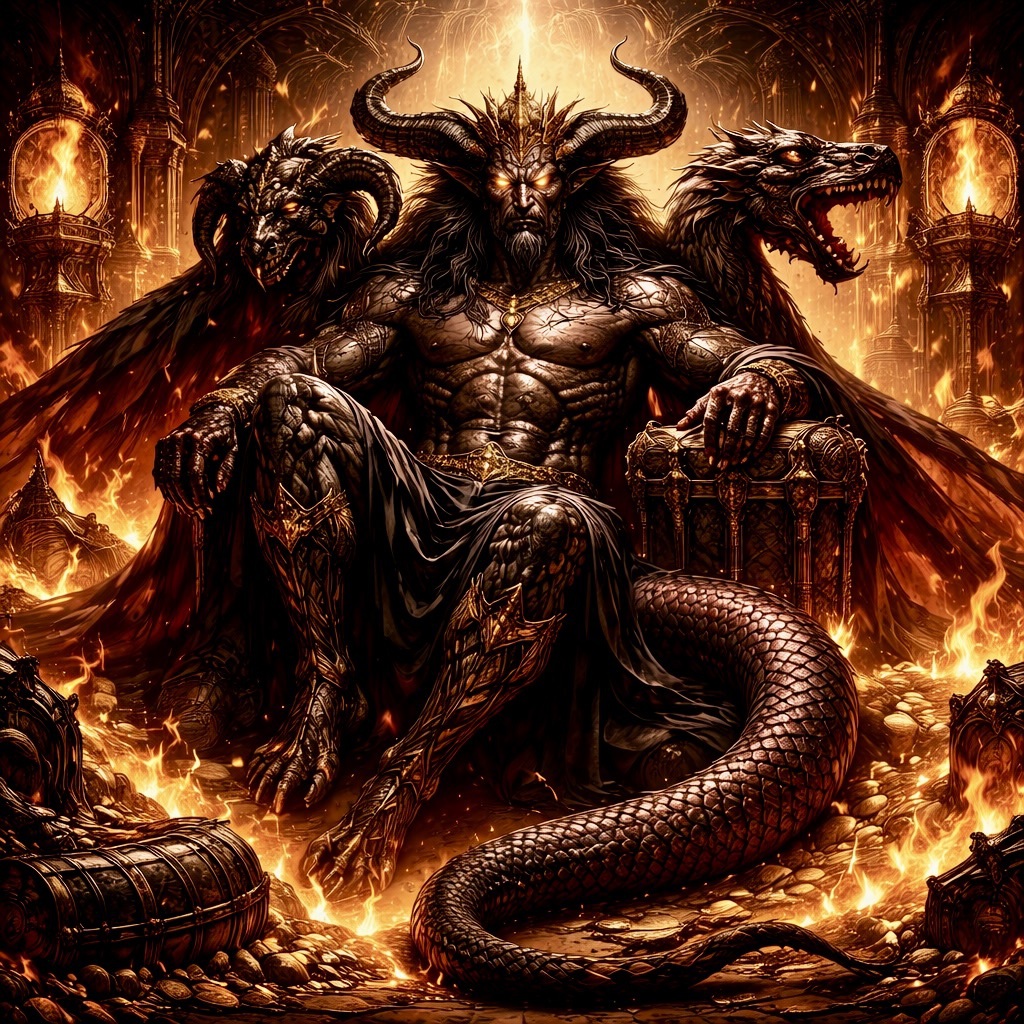
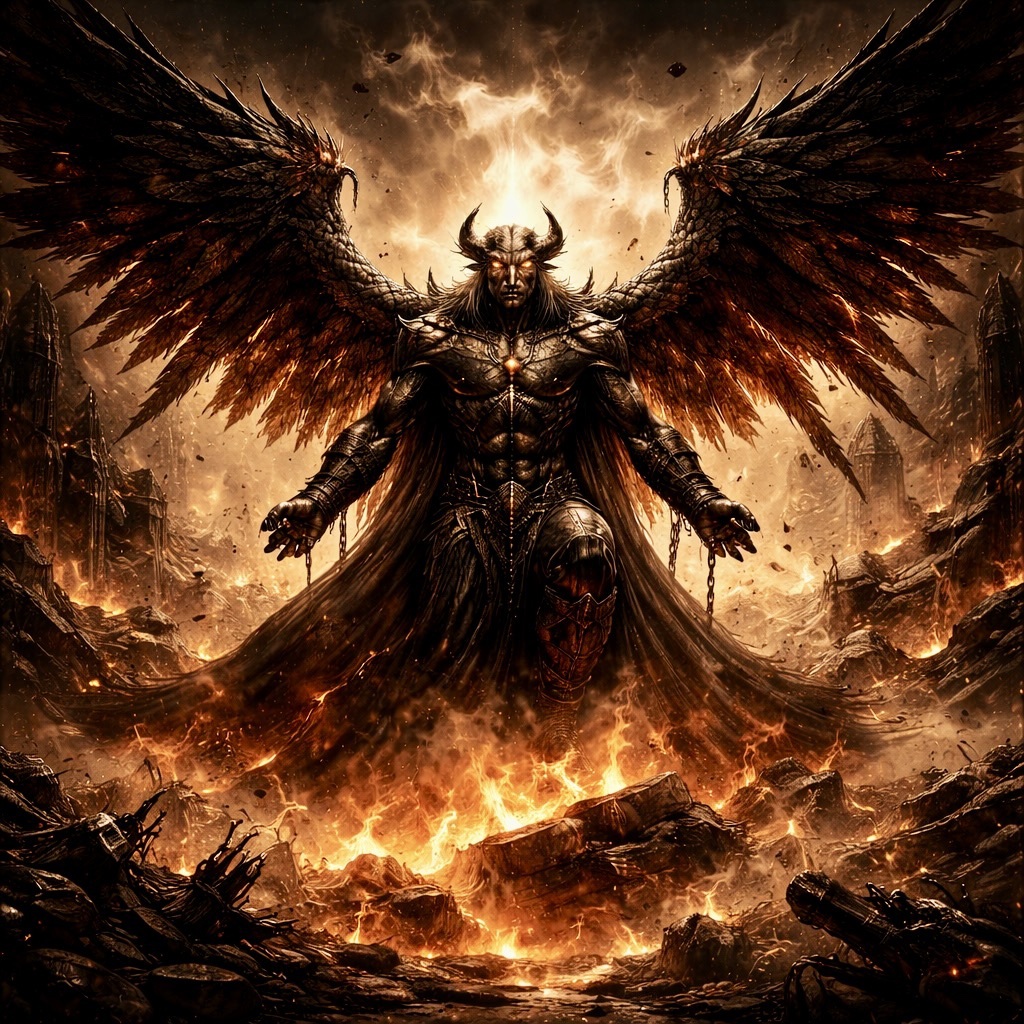
The imagery associated with Asmodeus reflects this complexity. He is often depicted as a three-headed figure, combining aspects of a man, a ram, and a bull, sometimes with a serpent tail and surrounded by fire. Each of these elements carries symbolic meaning.

The human head represents awareness, intellect, and the capacity for intention. It is the part of Asmodeus that understands and directs.

The ram is associated with aggression, dominance, and assertiveness. It represents the forceful aspect of desire—the drive to pursue and conquer.

The bull symbolizes power, strength, and fertility. It is a representation of physical force and generative energy.

The serpent tail adds another layer, connecting him to transformation, temptation, and the cyclical nature of desire.

Fire, which often surrounds him, is perhaps the most important symbol of all. Fire is both creative and destructive. It provides warmth and light, but it can also consume and devastate. It is dynamic, constantly moving, impossible to hold still.

Asmodeus is that fire.

He is the intensity of desire in motion.

From a psychological perspective, Asmodeus can be understood as an archetype of unrestrained impulse. He represents the part of the psyche that seeks immediate gratification, that prioritizes experience over consequence, that pursues intensity without limitation.

This aspect of human nature is not inherently negative. It is responsible for passion, creativity, and innovation. It allows individuals to take risks, to explore new possibilities, and to engage deeply with life.

But without balance, it can become overwhelming.

Impulses can override judgment.

Desire can overshadow reason.

Intensity can replace stability.

Asmodeus embodies this imbalance.

He is not the absence of control.

He is what happens when control is abandoned.

This dynamic is particularly evident in his association with lust. Lust, in its basic form, is a natural expression of attraction and connection. But when intensified, it can become possessive, consuming, and destructive.

Asmodeus represents this intensified state.

He does not eliminate the positive aspects of desire, but he pushes them to extremes where they become difficult to manage.

The Renaissance and later demonological traditions often emphasized this aspect, portraying him as a tempter who leads individuals toward excess. Yet even in these portrayals, there is an underlying recognition of his broader significance.

He is not just about physical desire.

He is about intensity.

Ambition, for example, is another form of desire. It drives individuals to achieve, to build, to excel. In moderation, it leads to success and growth. In excess, it can lead to burnout, conflict, and ethical compromise.

Asmodeus operates within this domain as well.

He amplifies ambition, pushing it toward extremes where the cost may outweigh the benefit.

Similarly, anger is a form of desire—the desire for change, for correction, for response to perceived injustice. In controlled forms, it can lead to action and improvement. In uncontrolled forms, it can lead to destruction.

Asmodeus intensifies this as well.

He is not limited to a single expression of desire.

He encompasses all of them.

This makes him one of the most versatile and psychologically relevant figures in demonology. His influence can be seen in a wide range of human behaviors, from relationships to careers to personal decisions.

In literature, characters influenced by figures like Asmodeus often experience rapid rises and dramatic falls. They pursue goals with intensity, achieve success, and then encounter consequences when that intensity becomes unsustainable.

These narratives reflect the underlying principle that balance is essential.

Asmodeus disrupts that balance.

He introduces intensity where moderation might be more appropriate.

Yet his role is not purely negative.

By amplifying desire, he also reveals its nature. He makes visible what might otherwise remain subtle. He exposes the underlying motivations that drive behavior.

In this sense, he serves as a form of clarity.

He shows what happens when impulses are followed without restraint.

This clarity can be uncomfortable, but it is informative.

It provides insight into the structure of desire itself.

From a modern perspective, Asmodeus’s archetype is more relevant than ever. In a world of constant stimulation, where opportunities for gratification are abundant and immediate, the challenge of maintaining balance is significant.

People are exposed to endless options—information, entertainment, relationships, goals. The ability to choose, to prioritize, and to regulate becomes increasingly important.

Asmodeus represents the absence of that regulation.

He is the pull toward excess.

The voice that says, “More.”

More experience.

More intensity.

More satisfaction.

Without consideration of limits.

In the end, Asmodeus stands as a symbol of the power and danger of desire. He is not an external force to be avoided entirely, but a reflection of an internal dynamic that must be understood.

He reminds us that intensity can be both a strength and a weakness, that passion must be balanced with awareness, and that desire, while essential, must be guided.

And somewhere between control and surrender, between passion and restraint, between the fire that warms and the fire that consumes—that is where Asmodeus resides.

Not as a force that creates desire, but as one that defines its limits.

The one who shows what happens when the fire is allowed to burn without end.

Related Posts

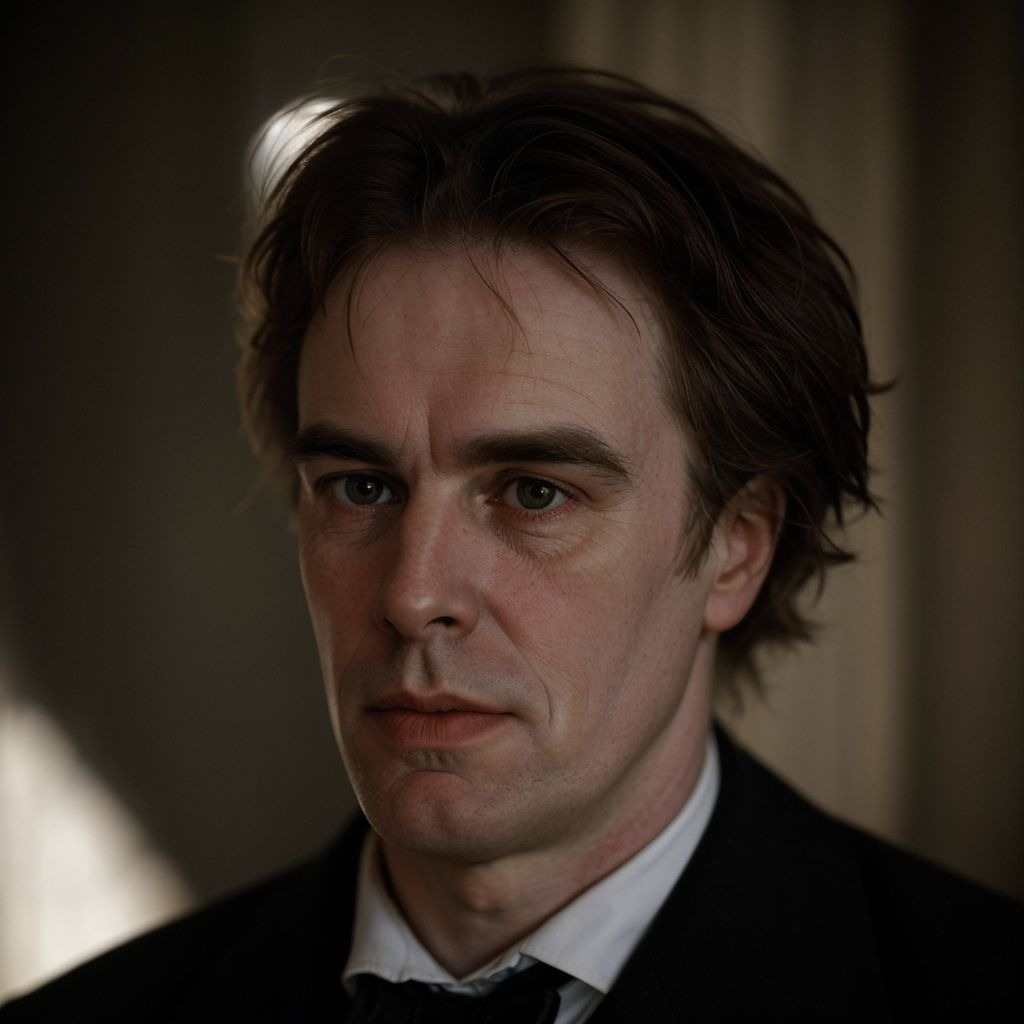
W.B. Yeats: The Mirror Maze

Penelope

I’ve been reading W.B. Yeats for what feels like an eternity, but it’s really only been a few months since I stumbled upon his poetry in a used bookstore. There was something about the way his words seemed to dance on the page that drew me in – a combination of mystery and accessibility that left me both fascinated and unsettled.

As I delved deeper into his work, I found myself becoming increasingly obsessed with the idea of identity. Yeats’s poetry is riddled with personas and masks, each one carefully crafted to conceal and reveal aspects of himself at the same time. It’s like he’s constantly asking: who am I? What do I want to be known for?

I think that’s something we can all relate to on some level – trying to figure out our place in the world and what stories we want to tell about ourselves. For me, it’s been a constant struggle since college ended. I feel like I’m supposed to have everything figured out by now, but the truth is, I still don’t know what I want to do with my life.

Reading Yeats’s poems feels like looking into a mirror that’s reflected in another mirror – an endless series of reflections staring back at me, each one distorted and unclear. His words whisper secrets in my ear about the instability of identity and how it’s always slipping through our fingers like sand.

I find myself drawn to his most famous poems, the ones that feel like they’re speaking directly to me: “The Second Coming,” “The Lake Isle of Innisfree,” “Sailing to Byzantium.” There’s something in these lines that feels both familiar and foreign – a sense of longing and disillusionment that I recognize all too well.

But what really gets under my skin is the way Yeats writes about the relationship between art and reality. He sees them as separate entities, with art serving as a way to transcend or escape the mundane world. It’s a notion that both resonates with me and fills me with discomfort – because what does it mean for our lives when we prioritize creative expression over concrete reality?

I think about my own writing, how it feels like a way for me to process the chaos of everyday life. But at the same time, I’m aware that this escape route can also be a cop-out – a way to avoid dealing with the harder questions and emotions head-on.

Yeats’s fascination with mysticism and the occult is another aspect of his work that both intrigues and unsettles me. There’s something about the idea of tapping into deeper truths, hidden worlds beyond our own reality, that feels like a tempting promise – but also a potential Pandora’s box of confusion and disorientation.

As I continue to explore Yeats’s poetry, I’m struck by how he writes about the tension between individual desire and collective responsibility. He sees himself as an artist torn between his creative impulse and his sense of duty to the world around him. It’s a dichotomy that feels both intensely personal and universally relatable – like we’re all trying to balance our own inner worlds with the demands of external reality.

And yet, despite my growing fascination with Yeats’s work, I still feel uncertain about what draws me in. Is it his intellectual curiosity? His ability to capture the complexity of human experience? Or is it something more primal – a connection to the darker, more mysterious corners of existence that only he seems to inhabit?

As I sit here with his poems scattered around me, I realize that my fascination with Yeats is less about understanding him and more about exploring myself. His words serve as a mirror, reflecting back at me the tangled web of thoughts and emotions that’s been swirling inside me since college ended.

It’s funny – I started writing this essay thinking it would be some kind of intellectual exploration, but the truth is, it’s become an exercise in self-discovery. Who am I? What do I want to write about? Why does Yeats’s work speak to me on such a deep level?

I’m not sure I’ll ever find definitive answers to these questions, but for now, that’s okay. The more I immerse myself in Yeats’s poetry, the more I realize that it’s less about understanding him and more about embracing the mystery of our own existence – with all its contradictions and paradoxes intact.

As I sit here surrounded by the remnants of my scattered thoughts, I find myself drawn to the way Yeats writes about the relationship between art and reality. On one hand, his notion that art can serve as a means of transcendence or escape resonates deeply with me. There’s something about losing myself in the world of words that feels both exhilarating and necessary.

But at the same time, I’m acutely aware of the potential pitfalls of this idea. If we prioritize creative expression over concrete reality, don’t we risk becoming disconnected from the world around us? Don’t we risk ignoring the messiness and complexity of everyday life in favor of some idealized or romanticized version of it?

I think about my own writing, how it often feels like a way to escape the chaos of daily life. But what if this is just a cop-out? What if I’m using art as a way to avoid dealing with the harder questions and emotions head-on? Yeats’s poetry seems to suggest that there’s a tension between individual desire and collective responsibility, but how do we navigate this tension in our own lives?

As I ponder these questions, I find myself thinking about my college years. I spent so much time trying to figure out who I was supposed to be – the perfect student, the ideal friend, the aspiring writer. But now that I’m out of school and facing the uncertainty of the real world, I realize that those personas were just masks we wore to impress others.

I think about how Yeats writes about his own identity in poems like “The Second Coming” – a sense of disillusionment and fragmentation that feels both deeply personal and universally relatable. It’s as if he’s saying that our identities are constantly shifting, fragmenting, and reassembling themselves in ways we can’t control.

This idea terrifies me, but it also feels strangely liberating. If our identities are fluid and ephemeral, then maybe I don’t have to worry so much about finding some fixed or essential self. Maybe I can just let myself be, with all my contradictions and paradoxes intact.

As I sit here surrounded by Yeats’s words, I feel a sense of kinship with him – not because we share the same experiences or perspectives, but because we’re both grappling with the same fundamental questions: who am I? What do I want to write about? Why does art matter in this messy, complicated world?

I’m not sure what answers I’ll find, but for now, it’s enough to know that I’m not alone in my confusion. Yeats’s poetry serves as a reminder that we’re all just stumbling through the darkness together, trying to make sense of our own identities and the world around us.

As I delve deeper into Yeats’s work, I find myself fascinated by his obsession with the cyclical nature of time. In poems like “The Second Coming” and “Sailing to Byzantium,” he writes about the passing of years, the rise and fall of civilizations, and the eternal return of myth and symbol. It’s as if he’s trying to grasp the underlying rhythm of existence, the way that history repeats itself in a never-ending cycle.

This idea resonates with me on a deep level. As I look back on my college years, I see myself caught up in a similar cycle of growth, decay, and rebirth. The four-year structure of college became a kind of microcosm for life itself – a finite period of time marked by its own set of rituals and milestones. And yet, even as I navigated the ups and downs of those years, I couldn’t shake the feeling that something deeper was at work – some invisible current that was carrying me along, whether I liked it or not.

Reading Yeats’s poetry feels like being swept up in this same current. His words are a reminder that we’re all part of a larger tapestry, one that stretches back centuries and forward into the unknown. It’s a daunting thought, but also a liberating one – because if we’re all just along for the ride, then maybe we don’t have to worry so much about controlling the steering wheel.

This sense of surrender is both exhilarating and terrifying. As I write these words, I feel like I’m standing on the edge of a precipice, staring into the void with no safety net in sight. But at the same time, I’m drawn to the idea that maybe this is where true creativity begins – when we let go of our need for control and allow ourselves to be shaped by forces beyond our understanding.

I think about my own writing, how it often feels like a way to impose order on the chaos of everyday life. But what if that’s exactly the problem? What if our need for structure and coherence is just a mask for our deeper desire to avoid the uncertainty and complexity of reality?

Yeats’s poetry suggests that art can be a means of transcendence, but also a means of avoidance. It’s as if he’s saying that we can use creative expression to escape the messiness of life, or to confront it head-on. I’m not sure which path I’ll choose, but for now, I’m content to wander through the labyrinthine corridors of his poetry, searching for answers that may never come.

As I continue to read and write, I find myself drawn to Yeats’s fascination with the Irish folklore tradition. He was deeply interested in the stories and legends of his native country, seeing them as a way to tap into a deeper cultural consciousness. It’s an idea that resonates with me on a personal level – because as a writer, I’ve always been fascinated by the power of storytelling to shape our perceptions of reality.

But what really gets under my skin is the way Yeats writes about the relationship between myth and history. He sees them as intertwined, yet fundamentally separate – like two threads that are woven together to form a larger tapestry. It’s an idea that speaks to me on a deep level, because I’ve always been fascinated by the way that stories can be both true and false at the same time.

As I sit here surrounded by Yeats’s words, I feel like I’m staring into a mirror that’s reflecting back at me a thousand different versions of myself. It’s a dizzying experience, but also a liberating one – because if we’re all just masks or personas, then maybe we don’t have to worry so much about being authentic.

Or do we?

The more I immerse myself in Yeats’s poetry, the more I’m struck by the way he blurs the lines between myth and history. It’s as if he’s saying that our stories are not just reflections of reality, but also shape it in ways both subtle and profound. This idea resonates with me on a deep level, because as a writer, I’ve always been fascinated by the power of language to create and destroy worlds.

As I ponder this idea, I find myself thinking about my own writing process. Do I create characters and stories that are authentic representations of people and experiences, or do I use them as a way to escape into a world that’s more manageable? Yeats’s poetry suggests that the line between these two options is thin at best, and often nonexistent.

I think about how he writes about the cyclical nature of time in poems like “The Second Coming” and “Sailing to Byzantium.” He sees history as a never-ending cycle of birth, growth, decay, and rebirth. It’s an idea that both terrifies and liberates me – because if our lives are just one thread in this larger tapestry, then what does it mean for us to create meaning or purpose?

As I sit here surrounded by Yeats’s words, I feel like I’m staring into a void that’s both familiar and unknown. It’s as if he’s inviting me to join him on a journey into the heart of chaos, where identity and reality are constantly shifting and reassembling themselves.

This is the place where art and madness meet, where creativity and delusion blur together in ways that defy understanding. And yet, it’s also the place where true transformation occurs – where we shed our old skins and emerge anew, like butterflies from their cocoons.

I’m not sure if I’ll ever find my way out of this labyrinthine world of Yeats’s poetry. But for now, that’s okay. The more I wander through its twisting corridors, the more I realize that it’s less about understanding him than embracing the mystery of our own existence – with all its contradictions and paradoxes intact.

As I write these words, I feel like I’m standing on the edge of a precipice, staring into the unknown with no safety net in sight. But at the same time, I’m drawn to the idea that maybe this is where true creativity begins – when we let go of our need for control and allow ourselves to be shaped by forces beyond our understanding.

I think about how Yeats writes about his own identity in poems like “The Second Coming” – a sense of disillusionment and fragmentation that feels both deeply personal and universally relatable. It’s as if he’s saying that our identities are constantly shifting, fragmenting, and reassembling themselves in ways we can’t control.

This idea terrifies me, but it also feels strangely liberating. If our identities are fluid and ephemeral, then maybe I don’t have to worry so much about finding some fixed or essential self. Maybe I can just let myself be, with all my contradictions and paradoxes intact.

As I sit here surrounded by Yeats’s words, I feel a sense of kinship with him – not because we share the same experiences or perspectives, but because we’re both grappling with the same fundamental questions: who am I? What do I want to write about? Why does art matter in this messy, complicated world?

I’m not sure what answers I’ll find, but for now, it’s enough to know that I’m not alone in my confusion. Yeats’s poetry serves as a reminder that we’re all just stumbling through the darkness together, trying to make sense of our own identities and the world around us.

As I continue to read and write, I find myself drawn to the way Yeats writes about the relationship between language and reality. He sees them as intertwined, yet fundamentally separate – like two threads that are woven together to form a larger tapestry. It’s an idea that speaks to me on a deep level, because I’ve always been fascinated by the power of words to shape our perceptions of the world.

But what really gets under my skin is the way Yeats writes about the tension between individual desire and collective responsibility. He sees himself as an artist torn between his creative impulse and his sense of duty to the world around him. It’s a dichotomy that feels both intensely personal and universally relatable – like we’re all trying to balance our own inner worlds with the demands of external reality.

As I ponder this idea, I find myself thinking about my own writing process. Do I prioritize creative expression over concrete reality? Or do I try to use art as a way to engage with the world around me?

I’m not sure which path I’ll choose, but for now, it’s enough to know that I’m on a journey of discovery – one that’s guided by Yeats’s poetry and fueled by my own curiosity about the nature of identity, reality, and creative expression.

Related Posts
I Thought It Was a Free Sample Until I Got Accused of Stealing a Championship Cookie

Hal

I trudged into the kitchen, still half asleep, determined to fix my entire mood with a cup of coffee.

Pandora was already up, flipping pancakes like she had her life together, which honestly felt a little aggressive for that hour of the morning. The smell filled the apartment, and my stomach immediately started making demands I wasn’t emotionally prepared to meet yet.

John Mercer shuffled out of his room looking like a man who had just lost a fight with his own alarm clock and sat down without saying a word. Mr. Whiskers followed him in, jumped straight onto his lap, and stared at him like he was personally responsible for something.

“Morning,” John muttered.

I nodded, poured my coffee, and sat down like a functioning human being.

That lasted about three minutes.

After breakfast, Pandora handed me a grocery list like it was a perfectly normal thing to do to someone on a Saturday.

“Hey, can you grab this stuff from the store?” she said.

I took the list and immediately knew this was going to go wrong. Not in a big way. Just…in a “something is going to happen and I’m going to be involved” kind of way.

I don’t know how I knew. I just did.

The grocery store parking lot was already suspicious when I pulled in. There was a woman near the entrance waving her arms and yelling at someone inside. I made the mistake of making eye contact, which is never step one in avoiding a situation.

I looked away and told myself this was not my problem.

That was my second mistake.

Inside, everything seemed normal. I grabbed a cart, started working through the list, and for a few minutes I actually believed I might get out of there clean. Chicken, vegetables, pasta sauce—nothing dramatic. Just a man doing his civic duty.

And then I saw the sign.

“Free Sample Day.”

Now, I don’t want to jump to conclusions, but in my experience, nothing good has ever come from the words “free” and “public” being combined like that. Still, I’m only human.

There was a tray of cookies sitting out. Fresh. Warm. Perfectly arranged in a way that suggested either generosity or a trap.

I paused.

I looked around.

Nobody was guarding the tray.

Which, if anything, made it worse.

Because now I had to ask myself: why would something this good be unprotected?

At that point, I formed a theory.

Not a strong theory. Not a well-researched theory. But a theory.

This was either:

A genuinely free sample situation, or
Some kind of psychological test to see who could be trusted

And I’ll be honest—I didn’t feel like passing a test that day.

So I grabbed a cookie.

Just one.

I took a bite.

And that’s when everything collapsed.

“That’s him!”

I turned slowly, already knowing this was about me.

The same woman from outside stormed into the aisle, pointing directly at me like she had been tracking me this entire time.

“He stole my cookie!”

Now, I want to be very clear about something.

I had taken a cookie.

I had not stolen a cookie.

Those are two completely different legal and emotional situations.

Employees started gathering. People were watching. Someone actually pulled out their phone like this was a live event.

And that’s when things got worse.

A photographer showed up.

Out of nowhere.

Like he had been waiting for this exact moment.

That’s when my theory evolved.

This was not a coincidence.

This was an operation.

I don’t know what kind of operation, but suddenly everything made sense. The unattended tray. The yelling woman. The timing. The camera.

This was a setup.

I raised my hands like I was negotiating a hostage situation.

“It said free sample,” I explained, calmly, because calm people are innocent.

No one listened.

The woman lunged forward, grabbing the tray, and suddenly I was holding onto one side of it like my reputation depended on baked goods.

Which, at that moment, it absolutely did.

We stood there, locked in a completely unnecessary cookie-based standoff while the photographer took what I can only assume are now award-winning photos of me defending myself against dessert-related allegations.

And that’s when Pandora walked in.

She took one look at me—standing in a grocery aisle, holding a cookie tray, being yelled at by a stranger—and just started laughing.

Not a supportive laugh.

A “this is exactly what I expected” laugh.

“Hal,” she said, “what did you do?”

That’s when the truth finally came out.

Apparently, there was a baking competition happening in the store.

And the tray I had pulled from?

Was not a free sample tray.

It was a judging table.

Which meant I hadn’t just taken a cookie.

I had interfered with a competitive event.

At that point, I made a decision.

I could apologize.

Or I could commit.

“I think there’s been a misunderstanding,” I said, confidently, despite everything.

The employees stepped in, the situation calmed down, and somehow I was allowed to leave with my dignity mostly intact and several extra cookies I did not ask for but absolutely accepted.

As we walked out, Pandora shook her head.

“You turned grocery shopping into a public incident.”

“I didn’t turn it into anything,” I said. “That was already happening. I just…participated.”

She didn’t respond, which I took as quiet agreement.

Back at home, Mr. Whiskers greeted us like he already knew the story.

Honestly, at this point, I wouldn’t rule it out.

Related Posts

Mammon: The Demon of Wealth, Greed, and the Relentless Pursuit of Material Power

Dave

Mammon is one of those names that transcends demonology and slips into everyday language, often without people even realizing its origin. When someone speaks about “serving Mammon,” they are not just referencing wealth—they are invoking an idea that has existed for centuries, one that ties money, power, desire, and identity into a single, complicated concept. Mammon is not merely a demon of riches. He is the embodiment of what happens when wealth stops being a tool and becomes the purpose.

Unlike many figures found in grimoires such as the Ars Goetia, Mammon’s roots are deeply embedded in religious and linguistic history. The word itself comes from Aramaic, where it originally referred simply to wealth or material possessions. Over time, particularly in biblical texts, the term evolved. It stopped being neutral. It became a warning.

In the New Testament, Mammon is not described as a being in the same way as other demonic figures. Instead, it is personified—treated as something that can be served, something that competes with devotion, something that demands allegiance. “You cannot serve both God and Mammon,” the text states, drawing a direct line between spiritual commitment and material obsession.

This is where Mammon’s identity begins to take shape.

He is not just wealth.

He is devotion to wealth.

This distinction is critical. Wealth itself is not inherently problematic. It can provide stability, opportunity, and security. It can be used to build, to create, to support. But when wealth becomes the primary focus—when it defines decisions, values, and priorities—it transforms.

It becomes Mammon.

This transformation is not immediate. It is gradual, almost imperceptible. A desire for comfort becomes a pursuit of accumulation. Accumulation becomes a measure of success. Success becomes tied to identity. And identity, once anchored in wealth, begins to shift.

Mammon represents that shift.

He is the moment when value becomes numerical, when worth is measured in quantity rather than quality, when the question is no longer “What is enough?” but “How much more?”

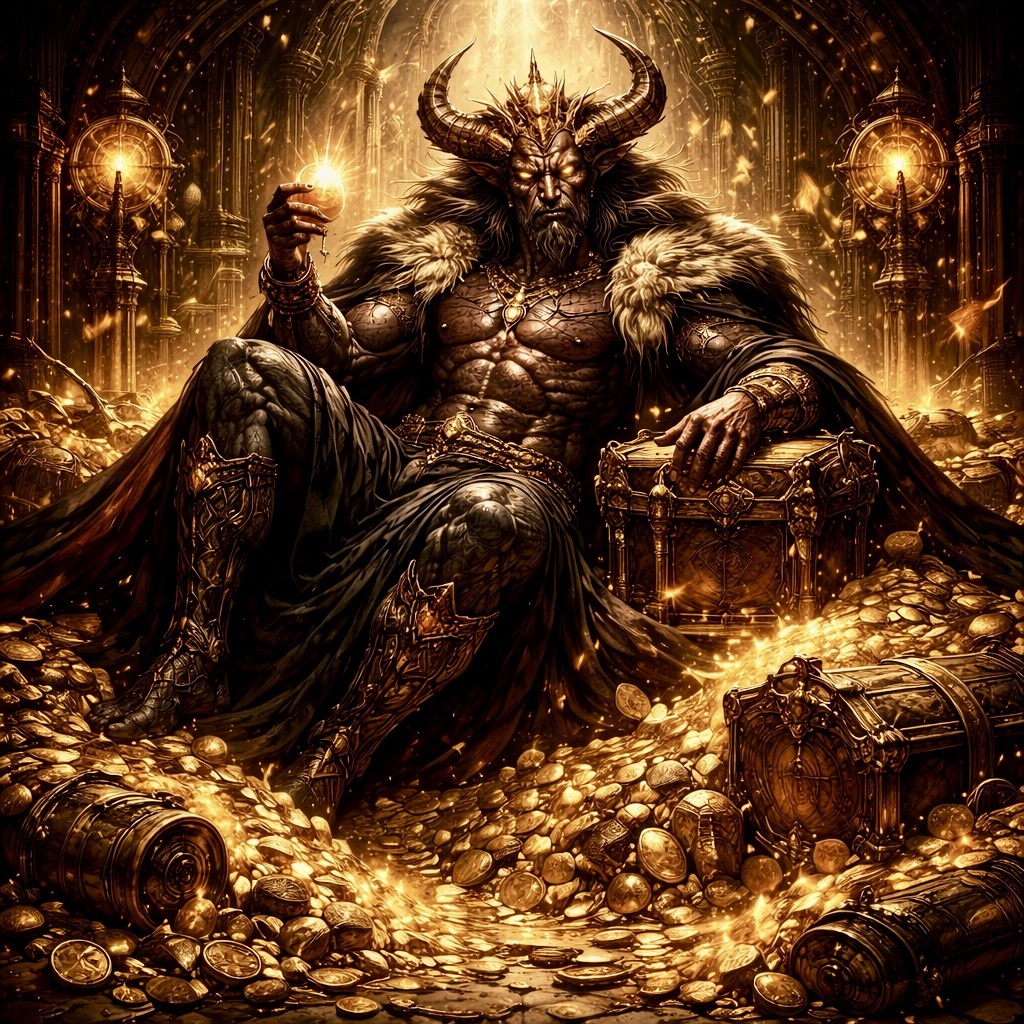
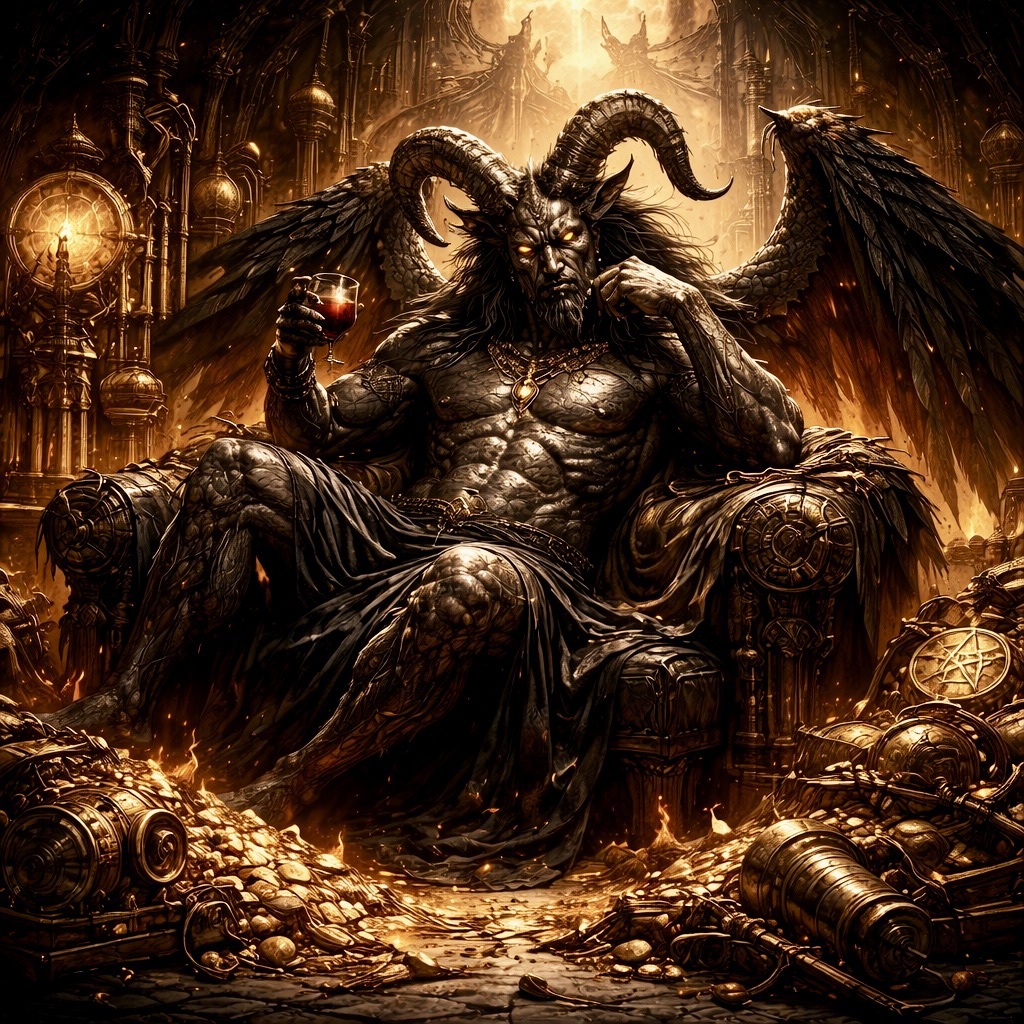
The imagery often associated with Mammon reflects this excess. He is depicted surrounded by gold, jewels, and riches, often seated upon a throne or buried within his own wealth. This visual is not just about abundance. It is about immersion.

He is not using the wealth.

He is within it.

This immersion is symbolic of how wealth, when pursued without balance, can become all-encompassing. It shapes perception, influences decisions, and alters priorities. The individual becomes defined by what they possess rather than what they are.

From a psychological perspective, Mammon can be understood as an archetype of material attachment—the tendency to derive identity and meaning from external possessions. This attachment is not limited to money. It extends to status, power, and recognition.

Humans are naturally inclined to seek security and validation. Material wealth provides a tangible way to achieve both. It offers control, predictability, and a sense of accomplishment.

But it also introduces risk.

When identity becomes tied to external factors, it becomes unstable. Wealth can fluctuate. Status can change. Recognition can fade. If these are the foundations of identity, then the individual is constantly at risk of losing themselves.

Mammon embodies this instability.

He represents the illusion of permanence within something inherently transient.

This illusion is powerful because it feels real. Wealth can create a sense of control, of mastery over circumstances. It can make the future seem predictable.

But this control is never absolute.

Markets shift. Systems change. External factors intervene.

Mammon does not eliminate uncertainty.

He masks it.

This masking is part of his influence. By focusing attention on accumulation, he diverts it from deeper questions—questions about purpose, meaning, and balance. The pursuit of wealth becomes a distraction from introspection.

This does not mean that wealth is inherently negative. The key lies in its role.

Is it a tool or a goal?

When wealth is a tool, it serves a function. It enables action, supports goals, and provides resources. When it becomes a goal, it begins to define behavior.

Mammon represents the latter.

He is the point at which the tool becomes the purpose.

This shift can be subtle. It often begins with reasonable intentions—providing for family, achieving stability, improving quality of life. These goals are not problematic.

But as accumulation increases, the focus can change. The original purpose fades, replaced by the process itself. The act of gaining becomes more important than what is gained.

This is where Mammon takes hold.

He does not force this change.

He facilitates it.

He makes accumulation appealing, rewarding, and seemingly necessary.

In modern society, this dynamic is amplified. Economic systems often prioritize growth, efficiency, and output. Success is frequently measured in financial terms. Wealth becomes a primary indicator of achievement.

Within this context, Mammon is not an external force.

He is embedded within the system.

He exists in the metrics, the incentives, the structures that guide behavior.

This makes him particularly relevant.

He is not a distant figure from ancient texts.

He is a reflection of contemporary experience.

The tension between material success and personal fulfillment is a recurring theme in modern life. People pursue careers, build businesses, and strive for financial stability. These efforts can lead to significant achievements.

But they can also lead to imbalance.

Time may be sacrificed. Relationships may be strained. Personal well-being may be compromised.

The pursuit of more can overshadow the appreciation of what already exists.

Mammon represents this imbalance.

He is not opposed to success.

He redefines it.

He shifts the focus from sufficiency to excess, from purpose to accumulation.

This shift is not inherently obvious. It often feels justified. Each step seems reasonable, each decision logical. The problem arises when the cumulative effect leads to a loss of perspective.

When “enough” is never reached.

When satisfaction becomes temporary.

When the pursuit continues without end.

Mammon thrives in this environment.

He does not require dramatic actions.

He operates through gradual change.

From a philosophical standpoint, Mammon can be seen as a challenge—a test of priorities. He raises questions about value, about what truly matters, about how resources should be used.

These questions do not have universal answers.

They depend on context, perspective, and individual goals.

But they are essential.

Without them, behavior becomes automatic, driven by external incentives rather than internal understanding.

Mammon disrupts this understanding.

He simplifies value into quantity.

He reduces complexity into numbers.

And in doing so, he makes the pursuit of wealth both straightforward and endless.

In literature and art, figures associated with greed often serve as cautionary examples. They illustrate the consequences of imbalance, the risks of overcommitment to a single aspect of life.

Mammon fits this role, but with a modern twist.

He is not always depicted as monstrous or grotesque. Sometimes, he appears refined, composed, even admirable. This reflects how wealth is often perceived—desirable, aspirational, and respectable.

This duality is important.

Mammon is not inherently repulsive.

He is attractive.

That is what makes him effective.

In the end, Mammon stands as one of the most enduring symbols in demonology because he represents a universal human challenge—the balance between material and immaterial value.

He does not demand worship.

He invites it.

He offers security, power, and recognition.

And in return, he asks for focus, attention, and priority.

The question is not whether wealth should be pursued.

It is how.

Somewhere between necessity and excess, between tool and identity, between having and becoming—that is where Mammon resides.

Not as a force that creates wealth, but as one that defines what it means.

And the definition matters more than the amount.

Related Posts

Hannah Hoch: Where Women Are Cut Up and Pasted Together

Penelope

Hannah Hoch’s collage work makes me think of the cluttered state of my own mind. I’m a writer, and writing is how I untangle thoughts that feel stuck together like torn fragments of paper. Hoch’s collages are like that too – pieces of different textures and colors pasted together to create something new. But it’s not just about the visual similarity; it’s how her work makes me question what it means to be a woman, to be an artist, and to navigate the expectations placed on us.

I remember reading about Hoch’s relationship with Raoul Hausmann, another Dadaist artist. They were known for their critiques of patriarchal society, but in reality, their partnership was marked by power dynamics that are disturbingly familiar. I’ve seen this play out in my own life – women supporting and enabling each other, while also competing against one another for validation. Hoch’s work often incorporates images of women from advertising and film, which were the primary sources of feminine ideals during her time. It’s as if she’s saying, “These are the expectations we’re fed, but what do they mean?” I can relate to that sense of disillusionment.

Hoch’s use of photomontage – combining photographs with other materials like paper and fabric – feels like a reflection of my own struggles to create order in my life. When I’m writing, I often feel like I’m taking disparate pieces and trying to make them fit together into something coherent. It’s not just about aesthetics; it’s about the way Hoch disrupts traditional notions of authorship and originality. She takes images that already exist and recontextualizes them – much like how I take words from other writers and make them my own.

Sometimes, when I’m stuck on a piece, I’ll create a collage as a way to clear my head. It’s not about creating art; it’s about using different textures and colors to express emotions that don’t have words yet. Hoch’s collages are like that – they’re an attempt to convey the inexpressible, to capture the complexity of being a woman in a society that often reduces us to simple stereotypes.

I’m fascinated by the fact that Hoch’s work was largely overlooked during her lifetime. It wasn’t until years later that she gained recognition for her contributions to the Dada movement. This makes me think about my own fears of not being taken seriously as an artist, of being dismissed because I’m a woman or because my writing doesn’t fit into a certain mold. Hoch’s story is a reminder that even the most talented and innovative artists can be marginalized – but it also shows that their work continues to speak to us, even if they’re not around to receive the recognition.

As I look at Hoch’s collages, I see fragments of myself – the pieces of paper with words scribbled on them, the fabric scraps with colors that bleed into one another. It’s as if she’s taken my messy thoughts and reassembled them into something new, something beautiful. And it makes me wonder: what would happen if we gave ourselves permission to be messy, to create without worrying about being perfect? Would our art become more honest, more authentic? Or would it just become a reflection of the chaos that lies beneath the surface?

I don’t have answers to these questions. All I know is that Hannah Hoch’s work has me thinking – and feeling – in ways that I hadn’t expected. Her collages are a reminder that even the most seemingly disparate pieces can be reassembled into something new, something meaningful. And maybe that’s what art is all about: taking the fragments of our lives and turning them into something beautiful, something that speaks to us on a deeper level.

As I delve deeper into Hoch’s work, I find myself thinking about the tension between intention and reception. Hoch’s collages are often seen as playful and whimsical, but she herself described them as “critical” and “polemical.” This disconnect between her intentions and the way her work is perceived makes me wonder if that’s not a universal experience for women artists – or really, any artist who dares to challenge societal norms.

I think about my own writing, how I often feel like I’m walking a fine line between being taken seriously as a writer and being liked by my readers. Do I write with the intention of provoking thought, or do I try to appease those who will be reading my work? Hoch’s story suggests that even artists who are pushing boundaries can be misunderstood, even by those who claim to support them.

And then there’s the issue of authorship. Hoch often incorporated images and objects into her collages without giving credit to their original creators. Some might see this as an act of piracy or theft, while others would view it as a commentary on the commodification of art. I’ve struggled with similar questions in my own writing – how much do I owe to the writers who have come before me? Should I acknowledge them explicitly, or do they become part of the cultural tapestry that I’m drawing from?

As I ponder these questions, I keep coming back to Hoch’s photomontages. They’re like a visual representation of my own mind – a jumble of images and ideas, sometimes cohesive, often contradictory. And yet, in the midst of all this chaos, there’s a strange sense of order, a sense that something new is emerging.

I don’t know if I’ll ever be able to fully untangle the threads of Hoch’s life and art, but I do know that her work has changed me. It’s made me see my own writing – and myself – in a different light. Maybe that’s what art does best: it disrupts our expectations, forces us to see things from new angles, and reminds us that even the most seemingly disparate pieces can be reassembled into something beautiful.

As I continue to explore Hannah Hoch’s work, I find myself drawn to her use of found materials – scraps of paper, fabric, and photographs that she incorporates into her collages. It’s as if she’s saying, “Look at all the things that are discarded, overlooked, or deemed worthless. What can we learn from them?” This resonates deeply with me, as I often find myself drawn to the margins of society – the people, places, and stories that are ignored or marginalized.

I think about my own experiences growing up in a small town, where conformity was prized over individuality. The kids who didn’t fit in were often ostracized or ridiculed. But Hoch’s work suggests that it’s precisely these outcasts, misfits, and fragments of society that hold the most power. By recontextualizing them, by giving them new meaning and purpose, we can create something beautiful from what was once deemed worthless.

I’m struck by the way Hoch’s collages often subvert traditional notions of beauty and aesthetics. She takes disparate elements – a torn photograph here, a piece of fabric there – and combines them in unexpected ways. It’s as if she’s saying, “Beauty is not just about perfection; it’s about finding value in the imperfect, the discarded, and the overlooked.” This challenges me to rethink my own ideas about art and creativity.

As I look at Hoch’s photomontages, I see a reflection of my own struggles with identity. I’ve always felt like an outsider, someone who doesn’t quite fit into any one category or box. And yet, it’s precisely this sense of disconnection that has driven me to create – to take fragments of myself and reassemble them into something new, something authentic.

I wonder if Hoch’s experiences as a woman in a patriarchal society might have influenced her use of photomontage as a way to subvert traditional notions of beauty and femininity. Did she see herself reflected in the discarded images she incorporated into her work? Or was it a way for her to assert control over her own narrative, to create a new story from the fragments of her life?

I don’t know if I’ll ever have answers to these questions, but I do know that Hannah Hoch’s work has given me permission to see myself – and my art – in a different light. It’s reminded me that creativity is not just about producing something perfect; it’s about taking risks, challenging expectations, and finding beauty in the imperfect, the discarded, and the overlooked.

As I continue to explore Hoch’s work, I’m struck by the way she blurs the line between art and everyday life. Her photomontages often incorporate mundane objects like postcards, advertisements, and newspaper clippings. It’s as if she’s saying that even the most ordinary things can be transformed into something extraordinary with a little creativity.

I think about my own writing process, how I often draw inspiration from the world around me – conversations overheard on public transportation, observations of nature, or snippets of dialogue from movies and TV shows. Hoch’s work suggests that art is not just about creating something new, but also about finding beauty in the everyday, mundane moments of life.

But what does it mean to find beauty in the everyday? Is it simply a matter of paying attention to the world around us, or is there more to it than that? I’m not sure, but Hoch’s work has me thinking about the ways in which our perceptions shape our experiences. She often incorporates images of women from advertising and film into her collages, highlighting the ways in which media shapes our understanding of femininity.

I wonder if Hoch was trying to subvert these expectations by incorporating them into her own art, or if she saw herself reflected in the very same stereotypes that she was critiquing. It’s a complex question, one that I don’t have an answer to, but it’s clear that Hoch’s work is a commentary on the ways in which society constructs and constrains women.

As I look at her photomontages, I see a reflection of my own experiences growing up as a woman. The expectations placed on me – to be beautiful, to be feminine, to be nurturing – often felt suffocating. But Hoch’s work suggests that even within these constraints, there is room for creativity and resistance.

I’m fascinated by the way Hoch’s collages often incorporate fragments of her own life into her art. She includes photographs of herself, as well as images of her relationships with other artists and friends. It’s as if she’s saying that our lives are not separate from our art, but rather an integral part of it.

This resonates deeply with me, as I’ve often struggled to separate my personal life from my writing. But Hoch’s work suggests that this is a false dichotomy – that our experiences, relationships, and emotions are all integral parts of the creative process.

As I delve deeper into Hoch’s art, I’m struck by the way she challenges traditional notions of authorship and originality. Her photomontages often incorporate images and objects that were created by others, recontextualizing them in new and unexpected ways. It’s as if she’s saying that creativity is not just about producing something new, but also about transforming and subverting what already exists.

This has me thinking about my own writing process – how I often draw inspiration from the work of other writers, incorporating their ideas and phrases into my own writing. Is this a form of piracy or theft, as some might argue? Or is it simply a way of acknowledging the debt we owe to those who have come before us?

I’m not sure, but Hoch’s work suggests that these are questions worth exploring – questions about authorship, originality, and the role of creativity in our lives. As I continue to explore her art, I feel like I’m uncovering new insights into my own writing process, and the ways in which I can use creativity to challenge expectations and push boundaries.

As I navigate the complexities of Hoch’s work, I find myself reflecting on the tension between authenticity and presentation. Hoch’s photomontages often appear playful and whimsical at first glance, but upon closer inspection, they reveal a more nuanced critique of societal norms. This dichotomy makes me think about my own writing process – how I often strive to present a polished, cohesive narrative, while secretly struggling with the messiness of my own thoughts.

I’m reminded of Hoch’s statement that her collages are “critical” and “polemical,” even as they appear to be lighthearted and humorous. This juxtaposition is both fascinating and unsettling, as it challenges me to confront my own insecurities about being taken seriously as a writer. Do I present myself as confident and self-assured, or do I reveal the uncertainty that lies beneath?

Hoch’s work also makes me think about the power dynamics at play in creative relationships. Her partnership with Raoul Hausmann was marked by a complex web of influences and dependencies, which echoes my own experiences working with editors and collaborators. How do we navigate these power dynamics, especially when they involve women supporting and enabling one another?

I’m struck by Hoch’s use of photomontage as a way to subvert traditional notions of beauty and femininity. Her collages often incorporate images of women from advertising and film, which were the primary sources of feminine ideals during her time. By recontextualizing these images, Hoch challenges the notion that women must conform to narrow, societal standards. This resonates deeply with me, as I’ve often felt pressured to present a certain image or persona in my writing.

As I delve deeper into Hoch’s work, I find myself thinking about the role of feminism in her art. While she was a pioneering figure in the Dada movement, her feminist credentials are more ambiguous. Some have criticized her for incorporating feminine stereotypes into her collages, while others see this as a clever subversion of those same norms.

I’m left wondering – how do we balance the desire to challenge societal norms with the need to acknowledge and honor our own experiences? Hoch’s work suggests that these are not mutually exclusive goals, but rather intertwined aspects of the creative process. By embracing the complexities and contradictions of her own life, Hoch creates art that is both deeply personal and universally relatable.

As I continue to explore Hoch’s photomontages, I’m struck by their sense of movement and energy – as if they’re in a state of constant flux, shifting and rearranging themselves before our very eyes. This dynamic quality reminds me of my own writing process, where ideas often flow rapidly and unpredictably, defying attempts to pin them down.

Hoch’s work challenges me to reconsider the notion that art must be static or fixed – that it should convey a clear message or intention. Instead, her photomontages invite us to experience the messy, dynamic nature of creativity itself. By embracing uncertainty and ambiguity, Hoch creates art that is both captivating and thought-provoking.

As I reflect on Hoch’s legacy, I’m struck by the ways in which her work continues to inspire new generations of artists and writers. Her photomontages remain a powerful testament to the possibilities of creative subversion – how we can take fragments of our lives and reassemble them into something new, something beautiful.

But what does it mean to create art that is truly subversive? Is it simply about challenging societal norms, or is there more to it than that? I’m not sure, but Hoch’s work has me thinking about the ways in which creativity can be both a source of empowerment and a reflection of our deepest anxieties.

As I close this exploration of Hannah Hoch’s photomontages, I’m left with a sense of awe and appreciation for her innovative spirit. Her art challenges me to rethink my own assumptions about creativity, identity, and the role of women in society. By embracing the complexities and contradictions of her own life, Hoch creates art that is both deeply personal and universally relatable – a testament to the power of creative subversion and the boundless possibilities of human imagination.

Related Posts

I Think My Cat Found a Spy Camera or Something

Hal

I was making myself a sandwich in the kitchen when John Mercer walked in and immediately started digging through the fridge like it owed him money. “Hey, Hal, have you seen my leftovers from last night?” he asked, his head buried behind the door like a raccoon in a trash can.

I shook my head. “Nope. Haven’t seen them.”

He grunted, which is John’s version of accepting devastating news, and kept searching. As I finished assembling my sandwich, I noticed Mr. Whiskers sitting on the counter, completely still, staring at one very specific spot on the wall like it had personally offended him.

Now, normally, I would’ve ignored it. Mr. Whiskers once stared at a chair leg for forty-five minutes. But this was different. This wasn’t casual, recreational staring. This was focused. Intentional. Targeted.

“Hey,” I said, nudging John. “Look at him.”

John glanced over for half a second. “Yeah. Cat.”

“No, not just cat,” I said. “Look at where he’s looking.”

John sighed the way people do when they realize a conversation is about to ruin their day. “Hal…”

I stepped closer to the wall. There was something there. The light hit it just right—just enough to catch a tiny, sharp reflection.

Shiny.

Too shiny.

“Do you see that?” I said.

“No,” John said immediately, which told me he absolutely did see it and had decided not to get involved.

I leaned in. “That’s not normal wall behavior.”

“Normal wall behavior?” John repeated.

“Yeah,” I said. “Walls don’t reflect like that unless they’ve got something embedded in them.”

John slowly closed the fridge. “I’m going to stop you right there.”

But it was already too late. My brain had locked in.

Hidden device.

Observation point.

Surveillance.

And suddenly, everything made sense in the way things only make sense when they absolutely do not.

For the rest of the afternoon, I couldn’t leave it alone. I kept circling back to that spot, pretending to do normal things—drink water, check my phone, exist casually—while very obviously staring at the wall like I was trying to out-stare it.

By the time Pandora came over that evening, I had upgraded from “concerned” to “actively investigating.”

“You won’t believe what I found out about this building,” I told her the second she walked in.

She didn’t even take her jacket off. “That’s never a good start.”

I launched into it anyway—former owners, vague forum posts, “patterns” I may or may not have connected myself. I even pointed at the wall like it was going to confess under pressure.

Pandora listened, arms crossed, the way people listen when they’re deciding whether to humor you or call someone.

“Hal,” she said carefully, “don’t you think you might be jumping to conclusions?”

“No,” I said, immediately and confidently, because I had already passed the point where doubt was allowed. “If anything, I think I’m the only one taking this seriously.”

Right on cue, John walked in.

“What are we taking seriously?” he asked.

Pandora gestured toward me. “He thinks there’s a hidden camera in the wall.”

John didn’t even hesitate. “There’s not.”

“That’s exactly what someone benefiting from the camera would say,” I replied.

John blinked. “Benefiting?”

I pointed at him. “Your missing leftovers.”

He stared at me. “You think I’m running a surveillance operation for food?”

“I’m just saying,” I said, “the timeline lines up.”

Pandora physically turned away from both of us at that point, which I took as emotional overwhelm from the truth.

We sat down to eat, but I couldn’t focus. Mr. Whiskers had repositioned himself and was now staring at the wall from a different angle.

A different angle.

Like he was triangulating.

“Oh, you’ve got to be kidding me,” I muttered.

“What now?” John asked.

“He moved,” I said. “He’s adjusting his vantage point.”

John put his fork down. “It’s a cat, Hal. Not a field operative.”

“Then explain the consistency,” I said.

“No,” John said. “I’m not doing that.”

After dinner, Pandora started doing the dishes while I positioned myself near the wall again. The reflection had changed—subtle, but different.

Pulsing.

Not blinking. Not flickering.

Pulsing.

Like it knew I knew.

My heart kicked up. I grabbed my phone and snapped a picture.

“Pandora,” I said, walking over. “Look at this.”

She dried her hands and leaned in. “Hal… that’s light.”

“That’s what they want you to think.”

She stared at me for a long second. “You’re starting to scare me.”

“I’m starting to understand,” I corrected.

When she left, she gave me that look—the one that says, “I care about you, but also I’m not staying here for whatever this becomes.”

John went straight to the couch and put on something loud, which I’m pretty sure was intentional counter-surveillance.

And me?

I stayed.

I sat in the armchair, lights low, watching the wall.

Waiting.

Mr. Whiskers jumped up beside me, curled into a tight ball, but his eyes stayed open—locked onto the same exact spot.

Silent.

Focused.

Alert.

We didn’t say anything, obviously, because he’s a cat.

But there was an understanding there.

We were in this together now.

Hours passed. Nothing happened.

No movement. No sound. No reveal.

Just the quiet hum of the apartment and the occasional Netflix explosion from the living room.

Eventually, a thought crept in.

What if…

What if this was nothing?

What if it really was just light?

I sat there, staring at the wall, waiting for it to prove me wrong.

It didn’t.

Mr. Whiskers blinked once, stretched, and promptly fell asleep.

Traitor.

I leaned back in the chair, the weight of it settling in.

Maybe I had pushed it too far.

Maybe I’d built something out of nothing.

Or…

Maybe it just wasn’t ready yet.

I glanced at the wall one last time before heading to bed.

Still.

Silent.

Waiting.

Yeah.

Definitely waiting.

Or so I told myself.

Related Posts

Belphegor: The Demon of Sloth, Innovation, and the Dangerous Comfort of Easy Solutions

Dave

Belphegor is one of those figures in demonology that seems deceptively simple at first glance. He is often labeled as the demon of sloth, associated with laziness, idleness, and the avoidance of effort. But like many figures in this domain, the surface description only hints at something much deeper. Belphegor is not merely about doing nothing. He is about why we want to do nothing, how we avoid effort, and the strange, almost paradoxical ways in which avoidance can lead to innovation.

His origins trace back to ancient Moabite worship, where he was associated with the deity Baal-Peor. Over time, as cultural and religious narratives shifted, this figure was reinterpreted within demonological frameworks, eventually becoming Belphegor—a prince or powerful demon associated with one of the seven deadly sins: sloth.

But even within that classification, Belphegor stands apart.

Sloth is often misunderstood. It is not simply laziness in the sense of resting or taking a break. True sloth is a deeper resistance to effort, a reluctance to engage with what requires energy, focus, or discipline. It is the tendency to choose the easiest path, even when that path leads to stagnation.

Belphegor embodies this tendency.

But he also does something unexpected.

According to many traditions, Belphegor does not simply encourage idleness. He offers solutions—shortcuts, inventions, and ideas that promise to make life easier. He inspires people to create tools that reduce effort, to find ways around obstacles rather than through them.

At first, this seems beneficial.

Who wouldn’t want an easier way to accomplish tasks?

Who wouldn’t prefer efficiency over struggle?

But this is where Belphegor’s deeper symbolism emerges.

He represents the fine line between efficiency and avoidance.

Between innovation and dependency.

Between making life easier and losing the ability to engage with difficulty.

To understand this, consider how innovation often begins. Many inventions are born out of a desire to reduce effort. The wheel, the plow, the computer—these are tools designed to make tasks more efficient, to save time and energy.

In this sense, the desire to avoid effort can be a powerful motivator.

Belphegor taps into that motivation.

He encourages the question: “Is there an easier way?”

And sometimes, that question leads to progress.

But it can also lead to something else.

If the focus shifts entirely to ease, if the goal becomes eliminating effort altogether, the result can be stagnation. Skills are lost. Engagement decreases. The individual becomes dependent on systems rather than capable within them.

Belphegor exists within this tension.

He does not oppose work entirely.

He redefines it.

He shifts the focus from effort to outcome, from process to result.

And in doing so, he changes the relationship between the individual and their actions.

This dynamic is particularly relevant in modern contexts. Technology has advanced to the point where many tasks that once required significant effort can now be completed with minimal input. Communication, information retrieval, and even creative processes have been streamlined.

This has undeniable benefits.

But it also raises questions.

What happens when effort is no longer required?

What is lost when struggle is removed?

Belphegor’s mythology anticipates these questions.

He represents the allure of ease—the comfort of solutions that require little from us. But he also reflects the consequences of relying too heavily on those solutions.

His depiction often includes imagery of wealth, comfort, and relaxation. He is not portrayed as a frantic or aggressive figure. He is calm, almost indulgent, surrounded by the results of his influence.

This calmness is significant.

Belphegor does not rush.

He does not force.

He invites.

He suggests.

He offers.

And in doing so, he creates a situation where the individual willingly chooses the easier path.

This choice is key.

Belphegor does not impose sloth.

He makes it appealing.

From a psychological perspective, this aligns with the concept of cognitive ease—the tendency to prefer options that require less mental effort. Humans naturally gravitate toward simplicity, toward solutions that are easy to understand and implement.

This is not inherently negative. It allows for efficiency and reduces unnecessary strain.

But it can also lead to oversimplification.

Complex problems may be reduced to simple answers that do not fully address them. Effortful thinking may be avoided in favor of quick conclusions.

Belphegor embodies this tendency.

He is the voice that says, “There’s an easier way,” without always considering whether that way is complete.

His association with invention further complicates this narrative. In some traditions, he is credited with inspiring new technologies and ideas, particularly those that generate wealth.

This introduces another layer.

Belphegor is not just about avoiding effort.

He is about gaining reward with minimal effort.

This combination—ease and reward—is particularly powerful. It creates a feedback loop where the individual is encouraged to continue seeking shortcuts, to prioritize efficiency over engagement.

In economic terms, this can be seen in systems that prioritize profit over process, outcomes over experience. Efficiency becomes the primary goal, sometimes at the expense of sustainability or depth.

Belphegor represents this shift.

He is not opposed to success.

He redefines how it is achieved.

This redefinition can be beneficial in moderation. Finding efficient solutions, reducing unnecessary effort, and optimizing processes are all valuable.

But when taken to extremes, it can lead to imbalance.

Skills may deteriorate.

Understanding may become shallow.

Dependency may increase.

Belphegor does not create these outcomes directly.

He facilitates the conditions under which they occur.

His presence in demonology serves as a reminder of the complexity of human motivation. The desire for ease is not inherently wrong. It is part of how people navigate the world.

But it must be balanced with engagement, effort, and awareness.

Without that balance, ease becomes avoidance.

And avoidance leads to stagnation.

In literature, characters associated with sloth or ease often undergo transformations that reveal the limitations of their approach. They may achieve short-term success, but eventually face challenges that require deeper engagement.

Belphegor fits this narrative.

He is not the final state.

He is a phase.

A temptation.

A possibility.

The question is whether the individual remains within that state or moves beyond it.

In the end, Belphegor stands as a symbol of the seductive nature of ease. He reminds us that the path of least resistance is not always the most meaningful, that effort has value beyond its immediate outcome, and that innovation, while powerful, must be balanced with understanding.

He does not demand idleness.

He offers comfort.

And somewhere between comfort and complacency, between innovation and avoidance, between effort and ease—that is where Belphegor resides.

Not as a force that stops movement, but as one that redirects it.

The one who asks, “Why work harder… when you could work less?”

Related Posts

Georgia O’Keeffe: Where the Strong and Fragile Coexist in One Giant Bouquet

Penelope

Georgia O’Keeffe has been on my mind a lot lately, ever since I stumbled upon her work while browsing through an art book in my college dorm’s library. Her paintings of enlarged flowers and landscapes seemed to leap off the page, their bold colors and shapes demanding attention. At first, I was struck by their beauty – who wouldn’t be? But as I delved deeper into her life and career, I found myself grappling with something more complex: her persona.

I’ve always been fascinated by strong women who seem to embody a sense of confidence and self-assurance that eludes me most days. O’Keeffe, in particular, strikes me as the epitome of this archetype – or at least, that’s how she’s often presented. Her photographs show her standing tall, with a quiet determination etched on her face, like she’s always ready to take on the world. And yet, every now and then, I catch glimpses of vulnerability peeking through – in the way she smiled for Alfred Stieglitz’s camera, or the way she spoke about her relationships.

It’s this paradox that draws me in: O’Keeffe as a force of nature, but also as someone who was humanly frail. Maybe it’s because I’ve often felt like I’m caught between these two states myself – wanting to project confidence and poise, but struggling with self-doubt and uncertainty. As I look at her work, I wonder if she ever grappled with the same contradictions.

Take her flower paintings, for instance. On one hand, they’re these gorgeous, hyper-real depictions of nature – a celebration of beauty in its most unadulterated form. But on the other hand, they can also be seen as a kind of… reduction? A simplification of the world into clean lines and bright colors. It’s almost like she’s saying: this is what matters, not all that complexity and chaos out there.

I find myself drawn to this aspect of her work – the way it simplifies, even sanitizes, the messy business of existence. And yet, at the same time, I’m not sure if I fully buy into it. Don’t we need a little bit of messiness in our lives? A little bit of chaos?

It’s funny, because as I’m writing this, I realize that my thoughts are all over the place – like O’Keeffe’s own artistic style. Some days, her work feels like a breath of fresh air; other days, it feels cold and detached. Maybe that’s just part of what makes her so compelling: she’s not always easy to pin down.

I’m beginning to think that my fascination with Georgia O’Keeffe isn’t just about her art or even her as a person – but about the tensions within myself. As someone who’s still figuring out their own place in the world, I see bits of myself reflected in her work: the desire for clarity and simplicity, but also the acknowledgment that life is messy and complicated.

It’s almost like… she’s giving me permission to be uncertain? To grapple with these contradictions and not have all the answers. But even as I write this, I’m not sure if that’s entirely accurate – or if it’s just my own projection onto her work.

As I continue to explore O’Keeffe’s world, I realize that there are still so many questions swirling around in my head – about her life, her art, and what she might have meant by all this. Maybe the truth is, I’ll never fully understand her – but that’s okay. It’s enough for me to acknowledge these tangled threads of fascination and confusion within myself.

I find myself getting lost in the photographs of O’Keeffe’s New Mexico landscapes – the adobe buildings, the desert skies, the way the light seems to stretch out forever. There’s something about those images that feels like a direct line to my own experiences: the sense of being a stranger in a new place, trying to make sense of it all.

I remember when I first arrived at college, feeling like an outsider looking in – unsure of how to navigate the campus, the coursework, or even the conversations with people who seemed so much more confident and self-assured than me. It was like being dropped into a whole new world, where everyone else spoke the language fluently and I was still trying to learn the basics.

O’Keeffe’s photographs of New Mexico feel like they capture that same sense of disorientation – but also, somehow, a deep connection to place. It’s as if she’s saying: yes, you can be lost in this world, but you can also find your way through it. Maybe even discover something new and beautiful along the way.

I wonder what it was like for her, living out there on the desert edge of New Mexico – a woman from Wisconsin, transplanted to a land that must have felt both familiar and alien at the same time. Did she ever feel like an outsider, too? Or did she find a sense of belonging in those vast, open spaces?

As I look at her photographs, I start to see them as more than just pictures – but as windows into her own experiences, her own emotions. It’s almost like… I’m seeing myself in there somewhere, too – or at least, the version of myself that I wish I could be: confident, self-assured, and somehow, effortlessly connected to the world around me.

But even as I idealize O’Keeffe in this way, I know it’s not entirely fair. She was a woman who lived through so much – personal struggles, professional challenges, the changing tides of artistic taste. There must have been times when she felt lost and uncertain, just like me.

It’s funny how easily we can get caught up in our own fantasies about people like O’Keeffe – the idea that they were somehow more put-together than us, more confident, more talented. But the truth is, I’m not sure if anyone ever truly reaches those heights of self-assurance and calm.

Or maybe… maybe it’s just a matter of perspective. Maybe we’re all just trying to navigate our own versions of the desert landscape – with its vast expanses, its hidden dangers, and its occasional glimpses of beauty.

As I delve deeper into O’Keeffe’s life and work, I find myself questioning my own assumptions about art and identity. What is it about her paintings that speaks to me on such a deep level? Is it the way she captures the intricate details of nature, or is it something more primal – a sense of connection to the earth and its rhythms?

I think back to my own experiences with art in college. I was always drawn to the abstract expressionists – Pollock, Rothko, et al. – but for some reason, O’Keeffe’s work resonated with me on a different level. Maybe it’s because her art is so unapologetically sensual – the curves of her flowers, the bold colors that seem to vibrate off the canvas.

But as I look closer at her paintings, I start to see something else too – a sense of restraint, even of control. Her compositions are always carefully balanced, each element placed with precision and deliberation. It’s almost like she’s saying: this is what I want you to see, not anything more or less.

I find myself wondering if that’s how I feel about my own life – as if I’m constantly trying to edit out the imperfections, to present a curated version of myself to the world. But at what cost? Does that kind of control ultimately lead to stagnation, or is it just a necessary part of growing up?

As I ponder these questions, I start to see O’Keeffe’s work in a new light – not just as beautiful paintings, but as a reflection of her own inner struggles. She was a woman who faced many challenges throughout her life – sexism, criticism, the pressure to conform to societal norms. And yet, despite all this, she continued to create art that was raw and honest, even when it was difficult.

I think about my own fears and doubts, and how often I let them hold me back from pursuing my passions. What would O’Keeffe say if she were here? Would she tell me to be bolder, to take more risks? Or would she caution me against being too reckless, too impulsive?

The truth is, I don’t know – but I do know that her work has given me permission to explore my own fears and doubts. It’s okay to be uncertain, to question myself and the world around me. In fact, it might even be necessary.

As I look at O’Keeffe’s paintings, I see a woman who was unafraid to confront the complexities of her own life – and in doing so, created art that continues to inspire and challenge us today. Maybe that’s what I need to learn from her – not just about art or identity, but about living with courage and vulnerability, even when it’s hard.

I find myself returning again and again to O’Keeffe’s photographs of New Mexico – the way she captured the vast expanses of the desert, the intricate details of the adobe buildings, and the haunting beauty of the sky at sunset. There’s something about those images that feels like a direct line to my own experiences: the sense of being a stranger in a new place, trying to make sense of it all.

I remember when I first arrived at college, feeling like an outsider looking in – unsure of how to navigate the campus, the coursework, or even the conversations with people who seemed so much more confident and self-assured than me. It was like being dropped into a whole new world, where everyone else spoke the language fluently and I was still trying to learn the basics.

O’Keeffe’s photographs of New Mexico feel like they capture that same sense of disorientation – but also, somehow, a deep connection to place. It’s as if she’s saying: yes, you can be lost in this world, but you can also find your way through it. Maybe even discover something new and beautiful along the way.

I start to wonder what it would be like to experience that same sense of disorientation – but instead of feeling overwhelmed or lost, I feel a deep connection to the place around me. Is that what O’Keeffe was trying to capture in her photographs? A sense of belonging, even when you’re not sure where you belong?

As I look at her work, I start to see it as more than just pictures – but as windows into her own experiences, her own emotions. It’s almost like… I’m seeing myself in there somewhere, too – or at least, the version of myself that I wish I could be: confident, self-assured, and somehow, effortlessly connected to the world around me.

But even as I idealize O’Keeffe in this way, I know it’s not entirely fair. She was a woman who lived through so much – personal struggles, professional challenges, the changing tides of artistic taste. There must have been times when she felt lost and uncertain, just like me.

I start to think about my own experiences with uncertainty and how often I’ve let fear hold me back from pursuing my passions. What would O’Keeffe say if she were here? Would she tell me to be bolder, to take more risks? Or would she caution me against being too reckless, too impulsive?

The truth is, I don’t know – but I do know that her work has given me permission to explore my own fears and doubts. It’s okay to be uncertain, to question myself and the world around me. In fact, it might even be necessary.

As I continue to look at O’Keeffe’s photographs, I start to see them as a reminder that uncertainty is not something to be feared or avoided – but rather something to be explored and understood. It’s a perspective that feels both comforting and unsettling at the same time – like looking into a mirror that reflects back a version of myself that I’m still getting to know.

I’m not sure what the future holds, or where my own journey will take me next. But as I look at O’Keeffe’s work, I feel a sense of hope and possibility – the idea that even in the midst of uncertainty, there is always the potential for growth, for discovery, and for beauty.

And so, I’ll keep looking at her photographs, trying to understand what they reveal about herself and about me. I’ll keep exploring my own fears and doubts, and see where they lead me. Because in the end, it’s not about reaching some kind of destination – but about being present in this moment, with all its uncertainties and complexities.

As I close my eyes and imagine myself standing in O’Keeffe’s New Mexico landscapes, I feel a sense of peace wash over me. It’s as if I’ve finally found my own place in the world – not because I’ve arrived at some kind of destination, but because I’ve learned to navigate the complexities of uncertainty with courage and curiosity.

And that’s when it hits me: O’Keeffe’s work isn’t just about her – it’s about us. It’s about our shared experiences, our fears and doubts, and our struggles to make sense of this messy, beautiful world we live in.

As I open my eyes and look at the photographs again, I feel a sense of gratitude towards O’Keeffe – not just for her art, but for the permission she gives me to be uncertain, to explore my own fears and doubts, and to find beauty in the midst of complexity.

Related Posts

I Knew Something Was Off the Way Pandora Was Eating Cereal

Hal

I’m making breakfast, and Pandora is sitting across from me eating her cereal.

She’s smiling at me, but I can tell she’s hiding something.

The way she’s holding the spoon looks almost… furtive. No, that’s ridiculous. She’s probably just trying to get a better grip on the bowl or something. Still, something about it feels off.

And why is her hair tied back like that? We’re not going anywhere today, are we? Did I miss something? Did she make plans with John and just not tell me? He’s probably in on it too. Wouldn’t surprise me.

That’s just great.

And what’s with Mr. Whiskers sleeping right next to the kitchen island? He never sits there. Is he trying to listen in or something? It’s like he’s waiting. I swear, that cat is more suspicious than most people.

Now Pandora’s looking at her phone.

She thinks she’s being subtle, but I can see her eyes flicking up at me every few seconds. What does she have to be nervous about? I’m starting to think this isn’t just breakfast. She’s planning something.

The way she’s eating is almost… ritualistic. And that spoon thing earlier—there’s no way that was just a mistake. She’s trying to distract me.

But from what?

Is it John again? Did they make some kind of deal behind my back? And why is Mr. Whiskers positioned like that unless he’s part of it somehow? Like he’s waiting for a signal.

I don’t like this.

Pandora keeps checking her phone. She thinks I don’t notice, but I do. There’s no way she’s just casually scrolling while eating cereal. That doesn’t make sense.

Unless…

Unless this is some kind of test. Is she seeing how long it takes me to catch on? No. That would be insane.

She wouldn’t do that.

Would she?

We’re a couple. But what if that’s exactly why she would?

The more I think about it, the more it lines up.

The phone. The weird behavior. Mr. Whiskers acting like a silent observer. It all fits.

I’m convinced now that Pandora and John are planning something behind my back. And if they’re involved, there’s no way Dave and Karen aren’t part of it too. They’ve been acting strange at work. Too many looks. Too many questions.

They think I haven’t noticed.

But I have.

And what about that package that showed up yesterday? Mrs. Jenkins mentioned a delivery truck outside, but when I asked John about it, he brushed it off like it was nothing.

Yeah, right.

There’s a connection there. I can feel it.

And Karen—she keeps asking if I’m okay, if I’ve been stressed. That’s not concern. That’s probing. She knows something and is trying to see how much I’ve figured out.

It’s all too convenient.

They think I’m naive. That I won’t put it together.

But I have.

Pandora isn’t just acting nervous—she’s guilty.

And Mr. Whiskers? That cat knows something. He’s been keeping his distance from me, watching everything. Like he’s guarding something.

And Mrs. Jenkins casually mentioning Pandora and John laughing together yesterday? That wasn’t casual. That was deliberate.

They’re hiding something big.

And I’m getting close.

Pandora thinks deleting messages on her phone is enough to cover her tracks. It’s not. I’ve seen it before. This isn’t new.

I know what she’s doing.

And John—he’s the center of it. He always is. The way he smirked yesterday when we talked about the package? That wasn’t nothing.

That was confidence.

That was someone who thinks they’ve gotten away with something.

Dave and Karen aren’t helping either. Whispering at work, glancing over like they’re coordinating something.

They’re not subtle.

They think they are, but they’re not.

And Mr. Whiskers… he scratched at the wall earlier. Not random. That felt intentional. Like a signal.

Everything feels intentional now.

Pandora’s movements. John’s pacing. The way people are talking around me instead of to me.

It’s all connected.

I’m not being paranoid.

I’m paying attention.

And the more I pay attention, the clearer it gets.

Something happened, and they don’t want me to know about it.

But I’m going to find out.

Because whatever they’re hiding—

I’m already closer to the truth than they think.

Related Posts

Lilith: The Dark Feminine Archetype of Power, Rebellion, and the Untamed Spirit Beyond Submission

Dave

Lilith is not a figure that can be easily confined to a single narrative, nor can she be reduced to a simple definition within demonology. She exists at the intersection of myth, psychology, cultural evolution, and human identity. While many figures in demonology emerge from structured hierarchies like those found in the Ars Goetia, Lilith’s story unfolds across centuries, shifting and reshaping as it passes through different cultures and interpretations. She is not merely cataloged—she evolves.

Her earliest known appearances trace back to ancient Mesopotamian mythology, where entities resembling Lilith—often referred to as lilitu—were associated with night spirits, winds, and the unknown forces that moved through darkness. These early forms were not yet the fully developed figure recognized today, but they established a foundation: Lilith as something untamed, something outside the boundaries of order, something that existed beyond the control of structured systems.

As her story moved into later traditions, particularly within Jewish folklore, Lilith became more defined. One of the most well-known narratives presents her as the first woman, created alongside Adam rather than from him. In this version, she refuses to submit, insisting on equality rather than hierarchy. When this demand is rejected, she leaves—choosing exile over subjugation.

This moment is central to understanding Lilith.

She is not cast out.

She walks away.

That distinction changes everything.

In many mythological frameworks, figures who become associated with darkness or rebellion are portrayed as having been forced into that role—banished, punished, or corrupted. Lilith, however, chooses her path. Her departure is not an accident or a consequence. It is a decision.

This choice becomes the defining element of her identity.

From that point forward, Lilith is no longer part of the established order. She exists outside it, and in doing so, she becomes something both feared and misunderstood. Over time, her image shifts. She is portrayed as a night demon, a seductress, a figure associated with danger, desire, and disruption.

But these portrayals are not arbitrary.

They reflect how societies respond to what they cannot control.

Lilith represents autonomy—particularly feminine autonomy—in a context where such independence was often viewed as a threat. By refusing to conform, she becomes othered, her narrative reshaped to fit the fears and expectations of those who tell her story.

This process is not unique to Lilith. Throughout history, figures who challenge established norms are often reinterpreted in ways that diminish or demonize their agency. What begins as independence becomes rebellion. What begins as self-definition becomes danger.

Lilith embodies this transformation.

She is not inherently destructive, but she is disruptive.

And disruption, in many systems, is treated as a problem.

From a psychological perspective, Lilith can be understood as an archetype of the shadow—the aspects of the self that are repressed, denied, or hidden. Carl Jung described the shadow as a necessary component of the psyche, containing traits and impulses that do not fit within socially accepted norms.

Lilith represents this shadow in a particularly potent form.

She is not just the hidden self.

She is the self that refuses to remain hidden.

This makes her both powerful and unsettling. She forces confrontation with aspects of identity that might otherwise be ignored. She challenges assumptions about control, submission, and identity.

In doing so, she creates tension.

But tension is not inherently negative.

It is often the catalyst for growth.

Lilith’s association with the night further reinforces her role. Night is a time of ambiguity, where visibility is limited and boundaries blur. It is a space where the familiar becomes unfamiliar, where perception shifts.

In many traditions, night is associated with introspection, dreams, and the subconscious. It is a time when hidden thoughts and emotions surface.

Lilith exists within this space.

She is not the darkness itself, but what moves within it.

Her connection to serpents and owls in various depictions adds additional layers of symbolism. The serpent, as discussed in other contexts, represents knowledge, transformation, and duality. It is a symbol of change—of shedding old forms and embracing new ones.

The owl, often associated with wisdom and observation, sees in the dark. It perceives what others cannot.

Together, these symbols create a cohesive image: Lilith as a figure of awareness, transformation, and perception beyond conventional limits.

Her wings, often depicted in art, suggest freedom—movement beyond constraints, the ability to exist outside structured systems.

This freedom is central to her identity.

But it comes with isolation.

By existing outside the established order, Lilith does not benefit from its protections. She is independent, but also separate.

This duality is a recurring theme in her narrative.

Freedom and isolation.

Power and perception.

Autonomy and consequence.

These are not contradictions.

They are components of the same reality.

From a modern perspective, Lilith’s story resonates in new ways. As discussions around identity, autonomy, and equality continue to evolve, her narrative takes on renewed significance. She is no longer viewed solely as a figure of fear or danger, but as a symbol of self-definition and resistance to imposed limitations.

This reinterpretation does not erase her darker aspects.

It contextualizes them.

Her association with desire, for example, has often been framed negatively, particularly in traditions that emphasize restraint and control. Yet desire itself is not inherently negative. It is a fundamental aspect of human experience, driving connection, creativity, and motivation.

Lilith’s role in this domain reflects the complexity of desire—its power, its influence, and its potential for both creation and disruption.

She does not suppress it.

She embodies it.

This embodiment challenges systems that seek to regulate or control such forces.

In literature and art, Lilith often appears as a figure of contrast—beautiful yet dangerous, independent yet isolated, powerful yet misunderstood. These contrasts are not inconsistencies. They are reflections of her nature.

She is not meant to be simple.

She is meant to be complex.

This complexity is what allows her to persist across cultures and time periods. She adapts, taking on new meanings while retaining core elements of her identity.

She remains a figure of autonomy.

Of challenge.

Of transformation.

In the end, Lilith stands as one of the most enduring and multifaceted figures in demonology and mythology. She is not defined by a single story or interpretation. She is shaped by the questions she raises.

What does it mean to exist outside established systems?

What is the cost of autonomy?

How do we reconcile freedom with connection?

These questions do not have simple answers.

Lilith does not provide them.

She represents them.

And somewhere in the space between conformity and independence, between light and shadow, between what is accepted and what is denied—that is where Lilith resides.

Not as a figure to be categorized, but as one to be understood.

The one who chose her own path—and never turned back.

Related Posts

Walter Benjamin: Lost in the Haze of What Could’ve Been

Penelope

Walter Benjamin has been on my mind for months now, ever since I stumbled upon his writings on art and history while researching for a paper on modernity. At first, I was drawn to the way he effortlessly weaves together philosophy, politics, and culture – it’s like reading a dense, yet exhilarating novel. But as I delved deeper into his work, I found myself increasingly captivated by his sense of melancholy, his fascination with the lost and forgotten.

It’s not just that Benjamin was a pessimist, though he certainly was. It’s more that he seemed to see the world through a lens of nostalgia – a bittersweet longing for something that could never be recaptured. His famous essay on “The Work of Art in the Age of Mechanical Reproduction” still haunts me. The way he describes how technology has detached art from its original context, rendering it a mere commodity, is both prophetic and deeply unsettling.

As I read his words, I couldn’t help but think of my own relationship with memory and history. Growing up, my grandparents would regale me with stories about our family’s past – tales of struggle and resilience that seemed to anchor us to the present. But as I got older, those stories began to feel like just that – stories. Told and retold, but never really lived. And Benjamin’s writings made me wonder: what is the value of these remembered experiences? Can we truly recapture the past, or are we just chasing after echoes?

Benjamin’s concept of “dialectical images” has also been stuck in my head. He believed that certain moments – like a photograph of an Auschwitz concentration camp – could reveal the underlying contradictions and conflicts within society. These images, he argued, hold within them both the past and the present, illuminating the hidden patterns and relationships that shape our world.

But what I find most compelling about Benjamin is his sense of disorientation – his feeling that the world has become increasingly disconnected from itself. He lived through two World Wars, witnessed the rise and fall of empires, and saw the collapse of traditional forms of art and culture. And yet, despite all this turmoil, he remained convinced that there was a deeper truth waiting to be uncovered – a truth that could only be accessed by embracing the fragmented and the fleeting.

As I reflect on my own experiences with disorientation, I’m struck by how similar Benjamin’s feelings are to my own sense of unease. After graduating from college, I felt lost, like I’d been disconnected from the very fabric of my life. It was as if everything I thought I knew about myself and the world had been turned upside down. And yet, in some strange way, that disorientation has become a catalyst for growth – a chance to question everything I thought I understood.

Benjamin’s work has given me language to describe this feeling – to articulate the sense of disconnection that haunts us all. His writings are like a map, guiding me through the labyrinthine corridors of history and memory. And it’s in those dark, winding passages that I’ve begun to see the value of his melancholy – not as a form of despair, but as a way of engaging with the world’s complexity.

But even now, as I’m writing about Benjamin, I find myself unsure what to make of this obsession with loss and disorientation. Is it a sign of my own naivety, or does it speak to something deeper? As I read his words, I feel like I’m standing on the edge of a precipice – gazing out at a world that’s both beautiful and terrifying.

And Benjamin, with all his contradictions and complexities, seems to be beckoning me forward – into the uncertain territory where past and present blur.

I’ve been reading Benjamin’s essays again, trying to untangle the threads of my own fascination with loss and disorientation. His writing is like a spider’s web – every word, every phrase seems to lead me deeper into the labyrinth. I find myself lost in his descriptions of the Parisian streets he walked in the 1920s, or the dusty bookstores where he spent hours poring over ancient texts.

But what I’m starting to realize is that Benjamin’s melancholy isn’t just a reflection of his own experiences – it’s also a way of grappling with the world’s darkness. He saw how art and culture were being co-opted by fascist regimes, how history was being distorted to serve the interests of power. And yet, even in the face of such atrocities, he refused to give up on the idea that there was still beauty to be found.

I’m struck by the way Benjamin’s writing is both intensely personal and expansively universal. His struggles with depression and anxiety are laid bare, but they’re also woven into a larger tapestry of philosophical and cultural critique. It’s as if he’s saying: “I’m not just lost – we all are. But in that shared disorientation lies the possibility for connection, for understanding.”

I’ve been thinking about this idea a lot lately, especially since graduating from college. I feel like I’m still navigating the aftermath of my own “disorientation” – trying to find my footing in a world that seems increasingly uncertain. And Benjamin’s writing has given me permission to explore these feelings, to see them not as weaknesses but as opportunities for growth.

But there are moments when I wonder if I’m just romanticizing Benjamin’s melancholy – if I’m projecting my own anxieties onto his work. Maybe I’m just trying to make sense of my own lostness by wrapping myself in the cloak of a famous philosopher. The thought sends a shiver down my spine, but it also makes me pause – forces me to consider what’s driving this obsession.

As I continue reading Benjamin’s essays, I’m starting to see that his work isn’t just about the past or the present – it’s about the way those two moments intersect in our minds. He calls these intersections “dialectical images,” but for me they feel like doorways into a different kind of thinking. A thinking that acknowledges both the beauty and the horror, the loss and the disorientation.

And yet, even as I’m drawn to this way of thinking, I’m still unsure what it means – or where it will lead. Will it take me deeper into the labyrinth, or will it simply trap me in a cycle of nostalgia and longing?

I find myself returning to Benjamin’s concept of “dialectical images” again and again, trying to unravel its meaning for my own life. For him, these images were moments that revealed the underlying contradictions of society – like a photograph of Auschwitz, which simultaneously testified to the horror of the past and the ongoing presence of fascism in the present.

As I think about it, I realize that my grandparents’ stories are also dialectical images, in their own way. They’re not just memories of our family’s past, but also testaments to the resilience and strength that allowed us to survive and thrive in the face of adversity. But they’re also haunted by a sense of loss – the loss of a homeland, the loss of loved ones, the loss of a way of life.

I wonder if my own relationship with these stories is similar to Benjamin’s relationship with the world around him. Do I see them as static, unchanging relics of the past, or do I understand that they’re constantly being reinterpreted and recontextualized in the present? Can I find ways to connect with the past through these stories, without getting lost in nostalgia?

As I ponder this question, I’m reminded of Benjamin’s idea that history is not a linear progression from one moment to the next, but rather a web of interconnected moments that overlap and intersect. His concept of “historical time” suggests that we’re always living in multiple times at once – past, present, and future all coexist and influence each other.

This way of thinking challenges me to think about my own relationship with time. Am I stuck in the past, nostalgic for a bygone era? Or am I able to move fluidly between different moments, recognizing that they’re all connected and interdependent? Can I find ways to engage with the world around me that acknowledge both the continuity and the disconnection?

As I read Benjamin’s words, I feel like I’m being invited into this web of interconnected moments – a web that’s full of contradictions and paradoxes. It’s scary to enter this labyrinth, but it’s also exhilarating. For the first time in my life, I feel like I’m starting to see the world as a complex, dynamic system – one that’s constantly shifting and evolving.

And yet, even as I’m drawn into this web of historical time, I still can’t shake the feeling that I’m losing my footing. That I’m adrift in a sea of uncertainty, with no clear shore in sight. Benjamin’s writing has given me language to describe these feelings, but it’s also left me with more questions than answers.

As I look back on my own experiences of disorientation – and forward into the uncertain future – I realize that I’m not alone. We’re all living in this web of historical time, trying to make sense of our place within it. And Benjamin’s writing has given me permission to explore these feelings, to see them as opportunities for growth and understanding rather than weaknesses or failures.

But even now, as I write these words, I feel like I’m standing on the edge of a precipice – gazing out at a world that’s both beautiful and terrifying. And Benjamin, with all his complexities and contradictions, seems to be beckoning me forward – into the uncertain territory where past and present blur.

As I stand here, poised between the familiar and the unknown, I feel like I’m being pulled in two different directions. On one hand, there’s the comfort of familiarity – the stories my grandparents told me about our family’s past, the routines of my daily life, the certainties that have always been there. But on the other hand, there’s the thrill of the unknown – the promise of new experiences, new connections, and new ways of thinking.

Benjamin’s writing has given me a vocabulary for navigating this tension between familiarity and disorientation. His concept of “dialectical images” has helped me see that even the most mundane moments can hold within them a deeper truth – a truth that’s both personal and universal. And his idea of “historical time” has shown me that our lives are not just linear sequences of events, but rather complex webs of interconnected moments that shape and reshape us in ways we may never fully understand.

But even as I’m drawn into this web of historical time, I’m still unsure what it means for my own life. Will I continue to feel lost and disoriented, or will I find a way to integrate these feelings into a sense of purpose and direction? Can I use Benjamin’s ideas to create a narrative that makes sense of my experiences – or will they remain fragmented and disjointed?

As I ponder these questions, I’m reminded of the way Benjamin describes art as a form of “mimetic” expression – a way of capturing the world in all its complexity and multiplicity. He argues that art should not strive for precision or accuracy, but rather aim to convey the essence of an experience – the feeling, the mood, the atmosphere.

I wonder if this idea could be applied to my own writing – to my attempts to capture the essence of my experiences with disorientation and loss. Can I use language in a way that’s both personal and universal, conveying the emotions and sensations that have shaped me without trying to pin them down or define them?

As I explore these questions, I’m struck by the realization that Benjamin’s writing is not just about intellectual concepts – it’s also about the way he engages with the world around him. He was a voracious reader, a curious observer of human nature, and a passionate advocate for social justice. His work is infused with a sense of wonder and awe, a sense of curiosity that never flags.

I’m inspired by this example to be more attentive to the world around me – to observe its rhythms and patterns, to listen to its silences and contradictions. I want to cultivate a sense of wonder and awe in my own writing, to capture the essence of experiences without trying to explain or justify them.

But even as I strive for this kind of engagement with the world, I’m aware that it’s not easy. It requires a willingness to be vulnerable, to expose oneself to uncertainty and doubt. And it demands a commitment to ongoing learning and growth – a recognition that our understanding of the world is always provisional and subject to revision.

As I look back on my journey through Benjamin’s work, I realize that his writing has been a catalyst for me – a prompt to explore my own feelings and experiences in new ways. It’s not about solving problems or arriving at definitive answers; it’s about embracing the complexity and uncertainty of life itself.

And so, as I stand here on the edge of this precipice, I feel a sense of trepidation mixed with excitement. What will happen next? Where will this journey take me? Will I find my footing in the labyrinth of historical time, or will I continue to wander lost and disoriented?

Only time will tell – but for now, I’m content to keep writing, to keep exploring, and to keep embracing the beauty and terror of a world that’s always shifting and evolving.

Related Posts

Farmer’s Market Accusation Spirals Into Full-Blown Pancake-Fueled Crisis

Hal

I woke up to the sound of Pandora making pancakes in the kitchen, which is objectively the best possible way to wake up as a human being.

The smell drifted through the apartment like a legally binding contract forcing me out of bed. Before I could even sit up, Mr. Whiskers launched himself onto my chest with the full confidence of a creature that pays no rent and fears no consequences. He stared directly into my soul while purring like a small, judgmental engine.

By the time I made it into the kitchen, Pandora already had a full stack going. John Mercer stumbled in shortly after, looking like a man who had lost a fight with sleep and barely survived.

“Morning,” he mumbled, grabbing coffee like it was life support.

We ate in relative peace, which should have been my first warning that something was about to go horribly wrong.

At some point, Pandora said we needed groceries, and somehow that turned into us going to the farmer’s market instead, which felt like a trap but also involved snacks, so I agreed.

The market was packed—sunlight, fresh produce, people pretending they understand heirloom tomatoes. Pandora immediately got distracted by a jewelry stand, which gave John time to wander off toward a cheese sample situation that he approached with alarming focus.

That’s when I noticed her.

A woman across the walkway. Staring. Not casually. Not “oh, I think I recognize you” staring. This was targeted, deliberate, “I have already decided something about you” staring.

I nudged Pandora. “Hey… do you know her?”

Pandora glanced over, shrugged. “Nope.”

Cool. Great. Love that.

We kept browsing, but the woman didn’t stop watching. In fact, she got worse. Pacing. Muttering. Pointing slightly, like she was building a case in her head.

John returned at this exact moment, holding three different cheeses like he’d just completed a mission.

“You guys need to try this,” he said, completely unaware we were seconds away from a public incident.

And then it happened.

The woman stormed straight toward us, locked onto Pandora, and pointed like she was about to announce a crime on live television.

“You!” she shouted. “You stole my design!”

Everything stopped.

Pandora blinked. “I’m sorry—what?”

“I KNOW IT WAS YOU,” the woman snapped, now fully committed. “You think you can just take my work and walk around like nothing happened?!”

A crowd started forming immediately, because humans are drawn to chaos like moths to a bad decision.

I stepped in, which was my second mistake of the day.

“Hey, I think there’s been a misunderstanding—”

She shoved past me.

Physically. Just… dismissed me.

At this point, a nearby flower display went down, petals everywhere, and John—still holding cheese—tried to intervene like a man who had no idea what role he was playing.

“Maybe we can all just calm down—”

“No!” she snapped.

And that’s when the moment happened.

Pandora, arms crossed, standing her ground. The woman inches from her face, pointing and shouting. Me off to the side, trying to process how grocery shopping turned into a legal dispute. And John, mid-chew, frozen in confusion.

And then—because this is my life—Mr. Whiskers’ head slowly emerged from my backpack.

I did not put him there.

He just… appeared. Like he had been waiting for his moment.

The crowd reacted immediately.

“Oh my god, there’s a cat.”

Now the focus shifted. Not fully. But enough.

Market security arrived right on cue, stepping in and pulling the woman back while she continued yelling about “intellectual theft” and “pattern replication.”

Pandora looked genuinely confused. Not defensive. Not guilty. Just… confused.

Eventually, the woman was escorted away, still shouting over her shoulder like she’d be back with evidence and possibly a lawyer.

The crowd dispersed, slightly disappointed the situation didn’t escalate further.

John finished his cheese.

Pandora exhaled. “Well… that was new.”

We stood there for a second, surrounded by fallen flowers and emotional debris.

And I’ll admit—it got in my head.

Because for a moment… just a moment… I thought:

What if she’s not completely wrong?

Not about the yelling. Obviously the yelling was unhinged. But the accusation?

On the walk home, I kept replaying it.

Pandora acted normal. Too normal? No, that’s insane. That’s not how normal works.

John walked behind us, still eating cheese like nothing in the world had changed.

Back at the apartment, everything reset. Couch. Warm light. Mr. Whiskers curled up like he hadn’t just smuggled himself into a public incident.

Pandora leaned against me like nothing happened.

And maybe nothing did.

But I’ll tell you this—

If I ever see that woman again…

I’m not going to the farmer’s market.

I’m ordering groceries online.

Related Posts

Samael: The Angel of Severity, Poison, and Judgment Who Walks the Line Between Death and Divine Will

Dave

There are figures in demonology and mysticism who are easily categorized—beings of chaos, deception, or temptation whose roles fit neatly into the framework of good versus evil. And then there are figures like Samael, who resist such simple definitions. Samael is not merely a demon, nor is he purely an angel in the conventional sense. He exists in a space that is far more complex, a liminal zone where judgment, destruction, divine will, and necessary endings converge into a single, paradoxical identity.

His name is often translated as “Venom of God” or “Poison of God,” a title that immediately introduces tension. Poison, in most contexts, is something harmful, something to be avoided. Yet when paired with the divine, it suggests a force that is not random or malicious, but purposeful. It implies that even what is destructive may serve a role within a larger order.

Samael appears in various strands of Jewish mysticism, particularly within Kabbalistic tradition, where he is sometimes described as an angel of severity, a force associated with judgment and restriction. In other interpretations, he is linked to the Angel of Death, the being responsible for carrying out the end of life. In yet other traditions, he is associated with darker aspects of existence, sometimes even equated with adversarial or demonic roles.

This multiplicity of identities is not a contradiction. It is a reflection of his nature.

Samael is not one thing.

He is a function.

To understand him, we must move beyond the idea of fixed categories and instead look at processes—particularly the process of judgment and consequence.

Judgment, in its most basic form, is the act of evaluation. It determines outcomes based on actions, weighing cause and effect. In human terms, judgment can be moral, legal, or personal. It establishes boundaries, defines consequences, and maintains structure.

Without judgment, systems collapse.

Without consequence, actions lose meaning.

Samael represents this principle in its most uncompromising form.

He is not concerned with comfort or fairness in the human sense. He operates according to a framework that is absolute—one where actions lead to outcomes, where balance must be maintained, and where excess or imbalance is corrected.

This is where the concept of poison becomes significant.

Poison is often seen as destructive, but in controlled forms, it can also be medicinal. Many treatments in medicine involve substances that, in large quantities, would be harmful. The difference lies in application.

Samael embodies this duality.

He is the force that can harm, but also the force that corrects.

He is the element that introduces consequence into systems that might otherwise become unbalanced.

The serpent imagery frequently associated with him reinforces this idea. The serpent has long been a symbol of knowledge, transformation, and duality. It sheds its skin, renewing itself while remaining fundamentally the same. It is both feared and revered, representing danger and wisdom simultaneously.

In some traditions, Samael is linked to the serpent in the Garden of Eden, the figure that introduces knowledge to humanity. This connection is not universally accepted, but it highlights an important theme: the relationship between knowledge and consequence.

Knowledge changes behavior.

Behavior creates outcomes.

Outcomes require judgment.

Samael exists within this chain.

He is not the origin of action, nor is he the final result. He is the process that ensures the link between them remains intact.

From a philosophical perspective, Samael can be understood as the embodiment of necessary limitation. In any system, there must be boundaries. Without them, growth becomes uncontrolled, leading to instability.

Consider natural systems. Predators regulate populations, preventing overgrowth that could collapse ecosystems. Gravity limits movement, ensuring structure. Biological processes maintain balance through cycles of growth and decay.

Samael represents this limiting force.

He is not opposed to creation.

He ensures it does not exceed its bounds.

This role can be unsettling because it often manifests as loss, restriction, or endings. In human experience, these are rarely welcomed. People seek growth, expansion, and freedom. Limitations feel like obstacles.

Yet without them, systems fail.

Samael introduces those limitations.

He is the moment when expansion stops.

The point at which growth is evaluated.

The force that says, “This far, and no further.”

This makes him one of the most psychologically resonant figures in demonology and mysticism. His presence can be felt in moments of consequence—when actions lead to outcomes that cannot be avoided, when decisions result in change that cannot be undone.

These moments are often difficult, but they are also clarifying.

They reveal structure.

They show how systems operate.

Samael does not create these moments.

He enforces them.

His association with the Angel of Death further emphasizes this role. Death is the ultimate limitation—the boundary that defines life. It is not arbitrary. It is part of the structure of existence.

Without death, life would not have the same meaning. Time would lose its significance. Change would stagnate.

Samael, as a figure linked to death, represents this boundary.

He is not the cause of life ending in a random sense. He is the function that ensures the cycle continues.

This perspective aligns with many philosophical and spiritual traditions that view death not as an end, but as a transition.

Samael governs that transition.

He is the threshold.

The point where one state ends and another begins.

In Kabbalistic thought, Samael is sometimes associated with the concept of Gevurah—severity or judgment—one of the attributes of the divine structure. Gevurah represents discipline, strength, and the power to enforce boundaries.

Without Gevurah, there would be only expansion, only mercy, only growth without limitation.

Samael embodies this attribute.

He is the balancing force.

The counterpart to unchecked expansion.

This duality is essential. Systems require both growth and restriction, creation and destruction, mercy and judgment.

Samael ensures that balance is maintained.

From a modern perspective, his archetype can be seen in systems of accountability. Laws, regulations, and consequences exist to maintain order. They are not inherently negative. They provide structure.

Yet they can also feel restrictive.

This tension is central to human experience.

People seek freedom, but they also rely on structure.

Samael represents the structure.

He is the reminder that actions have consequences, that systems operate according to rules, and that balance must be preserved.

In literature, figures like Samael often appear as judges, enforcers, or guardians of thresholds. They are not antagonists in the traditional sense, but they are not allies either. They serve a function that transcends individual perspective.

They are impartial.

Samael fits this role perfectly.

He does not act out of emotion.

He acts out of necessity.

This makes him both formidable and essential.

In the end, Samael stands as one of the most complex and profound figures in demonology and mysticism. He is not easily understood because he does not fit into simple categories.

He is not purely destructive, nor purely constructive.

He is the force that ensures both exist in balance.

He is the boundary that defines possibility.

The judgment that clarifies action.

The poison that corrects imbalance.

And somewhere between life and death, between action and consequence, between growth and limitation—that is where Samael resides.

Not as a force to be feared alone, but as one to be recognized.

The one who ensures that everything has its weight—and its cost.

Related Posts

Katherine Mansfield: Where Bravery Meets Bruising

Penelope

Katherine Mansfield’s life has been a constant companion of mine since college, when I devoured her short stories like they were oxygen. There was something about the way she captured the intricacies of human relationships, the quiet desperation of modern life, that spoke to me on a deep level. But it wasn’t until recently, as I re-read her letters and essays, that I began to see her in a different light – not just as a writer, but as a person struggling with her own demons.

What strikes me most about Mansfield is the fragility she exudes, like a delicate flower that’s been bruised one too many times. Her life was marked by illness, loss, and disappointment, and yet, in her writing, she often appears confident and unflappable. This paradox has always fascinated me – how could someone so wounded be so fearless? I find myself drawn to this tension, this dance between vulnerability and strength.

As I delve deeper into her letters, I’m struck by the intensity of her relationships, particularly with friends like Virginia Woolf and D.H. Lawrence. Their correspondence is a tangled web of affection, criticism, and creative debate, often veering into emotional territory that’s uncomfortable to read about. But it’s this very intensity that makes me feel seen – like I’m not alone in my own complicated friendships.

One aspect of Mansfield’s life that continues to puzzle me is her decision to leave New Zealand for England at the age of 19. It’s hard to imagine leaving behind everything and everyone you know, especially when your family’s expectations are so deeply ingrained. I find myself wondering what drove her to make this choice – was it a desire for artistic freedom, or a need to escape the constraints of her provincial upbringing? The more I read about Mansfield, the more I realize that I’m projecting my own fears and doubts onto her.

Take her struggles with tuberculosis, for instance. I’ve always been fascinated by the way she writes about her illness – the way it shapes her perception of time, space, and human connection. As someone who’s struggled with anxiety and depression, I can relate to the feeling of being trapped in a body that’s not cooperating. But while Mansfield’s physical pain is undeniable, there’s also an emotional toll that’s harder to quantify. How did she cope with the knowledge that her life was finite, that every day might be her last? Did she find solace in her writing, or was it a source of anxiety itself?

Mansfield’s essays on creativity and artistry have been a revelation for me. She writes about the importance of surrendering to the creative process, of letting go of expectations and ego. But what I find most compelling is her emphasis on the emotional labor involved in making art – the way it requires you to be present, to feel deeply, and to risk rejection. It’s this willingness to be vulnerable that I think has always drawn me to her writing.

As I continue to explore Mansfield’s life, I’m struck by the sense of disconnection she often expressed – between herself and others, between reality and her own desires. This feeling is both familiar and unsettling, like looking into a mirror and seeing someone else staring back. It makes me wonder: am I doing the same thing in my own writing? Am I hiding behind my words, using them as a shield to protect myself from the uncertainty of life?

I don’t have any answers to these questions – Mansfield’s life is too complicated, too messy – but that’s what draws me to her. She’s a reminder that even the most talented writers are still figuring things out, still struggling with the same doubts and fears that plague us all. And in this way, she’s become a kind of mirror for me, reflecting back my own hopes, desires, and anxieties.

As I delve deeper into Mansfield’s life, I find myself drawn to her essays on creativity, but also increasingly unsettled by the sense of disconnection that permeates so much of her writing. It’s as if she’s constantly searching for a way to bridge the gap between herself and others, between reality and her own desires. This longing for connection is something I think many writers can relate to – the feeling of being an outsider looking in, of watching life unfold from a distance.

For me, this sense of disconnection is particularly pronounced when it comes to my own family. Growing up, our conversations were often stilted and polite, like we were all just going through the motions. My parents, both immigrants themselves, were struggling to make ends meet, and I think they put so much pressure on us kids to succeed that we lost sight of what was truly important – connection, communication, love.

Now that I’m older, I find myself trying to reconnect with them, to understand where they’re coming from. But it’s not always easy. We’ve had our share of disagreements and misunderstandings, and sometimes I feel like I’m still just an outsider looking in. It’s as if we’re all speaking different languages, or at least, we’re using the same words but meaning entirely different things.

Mansfield’s writing has given me a new perspective on this – she shows me that even the most talented writers struggle with connection, that it’s never easy to find common ground with others. And in her essays, I see a longing for authenticity, for realness, for connections that are true and meaningful. This is something I think many of us crave, especially as we navigate our own creative pursuits – whether it’s writing, art, music, or any other form of expression.

But what if connection isn’t always possible? What if the disconnection is a fundamental aspect of human experience? Mansfield’s writing suggests that this might be true – that even in our most intimate relationships, there can be a sense of isolation, a feeling of being alone in our own thoughts and feelings. It’s a tough pill to swallow, but it’s also a reminder that we’re not alone in our struggles.

As I continue to read Mansfield’s essays, I find myself wondering about the role of writing itself in bridging this gap between connection and disconnection. Does writing help us connect with others, or does it reinforce our isolation? For me, writing has always been a way to process my thoughts and feelings, to make sense of the world around me. But is it enough to simply write, without actually engaging with others?

Mansfield’s letters suggest that she struggled with this very question – how to balance her desire for connection with the need for solitude and creative focus. And yet, even in her solitude, she found ways to connect with others through her writing, to convey the complexities of human experience in all its messy glory.

This is something I think many writers can relate to – the struggle to balance our own desires with the needs of others. We want to be connected, but we also need time alone to create, to reflect, to recharge. And in Mansfield’s writing, I see a deep understanding of this paradox, a recognition that connection and disconnection are intertwined aspects of human experience.

As I ponder the complexities of Mansfield’s life, I’m struck by the ways in which she navigated these tensions between connection and disconnection. Her essays on creativity often seem to oscillate between the need for solitude and the desire for connection with others. This push-and-pull is something I think many writers can identify with – the struggle to balance our own creative needs with the demands of relationships, work, and everyday life.

For me, this tension plays out in my own writing practice. I often find myself drawn into the world of my characters, only to be yanked back into the present moment by the demands of reality. It’s as if I’m constantly juggling two opposing forces – the need to create something new and meaningful, and the need to connect with others on a deeper level.

Mansfield’s writing has given me permission to explore these tensions more openly in my own work. Her essays are like a mirror held up to the complexities of human experience – all its messiness, uncertainty, and vulnerability. And yet, even in the midst of this chaos, she finds ways to connect with others through her words.

I’m beginning to see that Mansfield’s writing is not just about conveying ideas or emotions, but about creating a sense of connection with readers on a deeper level. She doesn’t shy away from the difficult stuff – the messy feelings, the complicated relationships, the uncertainty of life. Instead, she leans into them, using her words to create a space for exploration and understanding.

This is something I think many writers can learn from Mansfield’s example – the importance of embracing vulnerability in our writing, rather than trying to hide behind pretenses or platitudes. By being brave enough to confront our own fears and doubts, we can create work that resonates with others on a deeper level.

As I continue to read Mansfield’s essays, I’m struck by her emphasis on the importance of observation – of paying attention to the world around us, even in its smallest details. She writes about the way a single leaf on a tree can become a symbol of hope or despair, depending on our perspective. It’s this kind of attention that I think many writers crave, but often struggle to find.

For me, Mansfield’s writing is like a reminder to slow down and pay attention – to notice the small things in life, even when they seem insignificant. By doing so, we can tap into the deeper currents of human experience, creating work that is both personal and universally relatable.

I’m not sure where this line of thinking will take me next, but for now, I’m content to follow Mansfield’s example – to explore the complexities of connection and disconnection in my own writing, and to see where it takes me.

As I ponder the art of observation, I find myself drawn to Mansfield’s essay on the importance of noticing the small things in life. She writes about how a single phrase or gesture can convey a world of meaning, and how writers must be attuned to these subtleties if they hope to capture the essence of human experience.

This resonates with me because I’ve always been someone who notices details – a bird singing outside my window, the way the light falls on a particular object, the cadence of a stranger’s footsteps. And yet, as I write, I often find myself getting caught up in the big picture, the sweeping narratives and grand emotions that drive the plot forward.

Mansfield’s emphasis on observation reminds me that it’s the small things – the whispers, the silences, the fleeting moments of connection – that can be just as powerful as the grand gestures. It’s this attention to detail that allows her to capture the nuances of human relationships, to convey the complexities of emotions and desires in all their messy glory.

As I think about my own writing practice, I realize that I’ve been neglecting this aspect of observation. I get so caught up in the story itself, in the characters’ motivations and conflicts, that I forget to notice the small things – the way a character’s eyes light up when they see something beautiful, or the way their voice cracks with emotion.

It’s a reminder that writing is not just about conveying information or telling a story; it’s also about capturing the essence of human experience. And that requires attention, patience, and a willingness to notice the small things – the whispers, the silences, the fleeting moments of connection.

Mansfield’s writing has always been a source of inspiration for me, but in this moment, I see her as more than just a writer; I see her as a guide on the path to creating work that truly resonates with others. She reminds me that writing is not just about self-expression or artistic indulgence; it’s about capturing the complexities of human experience in all its messy glory.

As I continue to read Mansfield’s essays, I find myself wondering what other lessons she has to teach me – what other secrets lie hidden in her words, waiting to be uncovered. And so, I press on, driven by a curiosity that is both personal and universal, a desire to understand not just Mansfield’s life but also my own.

Related Posts

Cat-Astrophe at the Street Fair: How a Simple Outing Turned Into Public Chaos

Hal

I didn’t wake up feeling like the king of the world. I woke up because something was staring directly into my soul.

It was Mr. Whiskers.

He was sitting on my chest like he paid rent, completely still, unblinking, like he had been there for hours waiting for me to regain consciousness so he could continue whatever psychological experiment he’s running on me. I nudged him off, which earned me a deeply offended meow, as if I had just violated some kind of contract I never agreed to.

From the kitchen, I could hear Pandora making breakfast, which normally is a good thing, but today it felt like the beginning of a situation. You know when everything is normal, but it’s too normal? That’s where I was.

John was already at the table, hunched over his phone like he was decoding something classified.

“Morning,” he said without looking up, which somehow felt suspicious.

Pandora handed me coffee and eggs, and we all sat down like a normal, functioning household, which should have been my first warning that something was about to go wrong.

At some point during breakfast, I mentioned groceries, which in hindsight was the exact moment everything fell apart.

Pandora suggested we go together. John made a noise that technically counted as agreement. Mr. Whiskers, who had been pretending not to listen, suddenly perked up like he had just received instructions.

Then I saw the flyer.

Local street fair. Food, crafts, live music. Community energy. The kind of thing that sounds relaxing but always ends with someone yelling.

“Let’s check it out after groceries,” I said, like a man who had never learned from past experiences.

Pandora was immediately in. John didn’t object, which was concerning. He usually objects to everything.

Fast forward twenty minutes and we’re at the street fair, and it’s exactly what you’d expect—crowds, noise, too many smells happening at once. People smiling like they don’t realize they’re all standing in line for overpriced lemonade.

Pandora immediately got distracted by jewelry. Of course she did. That’s how these things work. You go for one thing, and suddenly you’re evaluating handmade earrings like your entire identity depends on it.

John and I stood there pretending to have opinions.

That’s when I made my first mistake.

I reached for my wallet.

Now, in a normal world, reaching for your wallet is a simple action. In my world, it’s apparently a high-risk maneuver. My elbow clipped a display behind me, and suddenly there was a cascading collapse of what I later learned were “rare imported spices.”

Let me tell you something—there is no quiet way for spices to fall. It’s chaos. It’s sound. It’s color. It’s a full sensory event.

The vendor turned around like she had just felt a disturbance in the force.

“Oh no. Oh no no no,” she said, staring at the ground like I had just destroyed a piece of history.

Now people are looking. Phones are coming out. This is no longer an accident. This is an incident.

I’m apologizing. I’m offering money. I’m trying to de-escalate, but she’s not hearing it. To her, I’m not a person. I’m a walking catastrophe.

And then—because things weren’t bad enough—Mr. Whiskers enters the situation.

Somewhere in the chaos, a stray balloon gets tangled near him. I don’t even know where it came from. It just appeared, like it was part of the plan. The moment it brushes against him, he loses all sense of reality.

He launches.

Straight into the air.

Pandora’s trying to hold onto him, but now it’s a full scene. The balloon snaps free, flies directly at the vendor, and pops right in front of her face.

Time slows down.

Pink streamer explodes everywhere.

There’s a moment of silence.

Then the entire crowd loses it.

People are laughing. Applauding. Recording. Somewhere, I’m positive this is already online with a caption that makes me look like I did this on purpose.

John is laughing. Pandora is trying not to laugh. I’m standing in the middle of a spice disaster covered in pink streamer, realizing this is now my reputation.

Mr. Whiskers has retreated behind Pandora like none of this was his idea.

That’s when I made my second smart decision of the day—I stopped talking, put cash on the table, and walked away.

No explanation. No defense. Just a silent acknowledgment that whatever just happened cannot be undone.

We got out of there fast.

As we moved through the crowd, John was laughing like this was the best day of his life.

“Hal,” he said, patting me on the back, “you turned a street fair into a live event.”

Pandora shook her head, smiling.

“Let’s just go home before you accidentally start a parade.”

By the time we got back, the tension had turned into laughter. The kind of laughter that only happens after you survive something unnecessarily public.

Mr. Whiskers was completely relaxed again, purring like he didn’t just trigger a chain reaction of events that will probably follow me for the rest of my life.

And I guarantee somewhere out there, there’s a photo.

Me standing in a cloud of spices and pink streamer, looking like I just lost a fight with a festival.

People probably think it’s staged.

It’s not.

This is just what happens when I leave the house.

Related Posts

Abaddon (Apollyon): The Angel of the Abyss and King of Destruction Who Commands the End of All Things

Dave

There are names in demonology that feel like whispers—subtle, symbolic, almost philosophical in their meaning. And then there are names like Abaddon, which do not whisper at all. They arrive with weight, finality, and a sense of inevitability that is difficult to ignore. Abaddon, also known by the Greek name Apollyon, is not merely another entity cataloged among infernal spirits. He is something far more primal: the embodiment of destruction itself, not as chaos, but as conclusion.

Unlike many figures in demonology who originate from grimoires such as the Ars Goetia, Abaddon’s roots lie in sacred texts. He appears in the Book of Revelation in the New Testament, where he is described as the “angel of the abyss,” the king of a terrifying host unleashed upon the world during apocalyptic events. This distinction is crucial. Abaddon is not simply a demon in the traditional sense. He is an angel—yet an angel associated with destruction, judgment, and the unraveling of order.

This dual identity immediately sets him apart. While most narratives draw clear lines between angels and demons, good and evil, Abaddon exists in the space where those distinctions blur. He is not portrayed as acting out of malice or rebellion. He is a function—a force that carries out a role within a larger structure.

His name itself provides insight into his nature. “Abaddon” is derived from a Hebrew term meaning “destruction” or “place of ruin,” while “Apollyon” comes from the Greek word for “destroyer.” These are not titles earned through action. They are definitions.

Abaddon is not someone who destroys.

He is destruction.

To understand the significance of this, we need to examine how destruction has been viewed throughout history.

Destruction is often seen as negative—an end, a loss, a failure. But within many philosophical and religious traditions, destruction is also necessary. It clears space, removes what no longer functions, and allows for transformation.

In nature, destruction is constant. Forest fires burn ecosystems, yet they also create conditions for new growth. Cells in the human body die and are replaced continuously. Stars collapse, giving birth to new cosmic structures.

Destruction is not separate from creation.

It is part of it.

Abaddon represents this aspect of existence, but in its most extreme and concentrated form.

In the Book of Revelation, he is described as the leader of a swarm of locust-like beings that emerge from the abyss. These creatures are not ordinary locusts. They are described with vivid, almost surreal imagery—faces like humans, teeth like lions, wings that sound like chariots, and the power to inflict torment.

This imagery is not meant to be taken literally. It is symbolic, reflecting the overwhelming and incomprehensible nature of destruction on a large scale.

When systems collapse—whether they are societies, ecosystems, or personal structures—the experience can feel chaotic, disorienting, and intense. The familiar disappears, replaced by something unfamiliar and often frightening.

Abaddon embodies that experience.

He is not the gradual decline of something.

He is the moment it breaks.

From a psychological perspective, Abaddon can be interpreted as an archetype of endings. He represents the point at which continuation is no longer possible—the moment when something must conclude.

This can manifest in many forms.

The end of a relationship.

The collapse of a belief system.

The loss of a role or identity.

These moments are rarely comfortable. They often involve uncertainty, fear, and a sense of disorientation. Yet they are also necessary for change.

Abaddon does not cause these endings arbitrarily. He represents their inevitability.

He is the force that ensures completion.

This idea is reinforced by his association with the abyss. The abyss is not just a physical location. It is a concept—a space of unknown depth, where structure and certainty disappear.

To enter the abyss is to confront the unknown.

Abaddon stands at its threshold.

He is the one who governs what emerges from it.

This position is significant because it places him at the boundary between order and chaos. He is not fully one or the other. He is the transition point.

This aligns with the broader theme of liminality—the idea of being between states. Liminal spaces are moments of transition, where the old has ended but the new has not yet begun.

Abaddon exists within this space.

He is not the beginning.

He is not the middle.

He is the end that leads to something else.

His depiction as an armored, winged figure reinforces this role. The armor suggests resilience and inevitability. He is not easily resisted or altered. The wings indicate movement between realms, the ability to traverse boundaries that others cannot.

This combination creates a figure that is both immovable and mobile—a paradox that reflects the nature of destruction itself.

It cannot be stopped, but it moves.

It progresses.

It unfolds.

The Renaissance and medieval interpretations of Abaddon often emphasized his destructive aspect, sometimes associating him with demonic forces despite his biblical origin as an angel. This shift reflects a broader tendency to categorize forces of destruction as negative, even when they serve a purpose.

Yet the original depiction in Revelation suggests something more complex.

Abaddon is not acting independently.

He is part of a larger process.

This distinction is important because it reframes destruction as a function rather than a flaw. It is not something that occurs because of failure. It occurs because it is necessary.

From a modern perspective, this idea can be applied to various systems.

In economics, markets rise and fall. Crashes, while damaging, can reset imbalances. In technology, outdated systems are replaced by new ones. In personal development, old habits and beliefs must be dismantled for growth to occur.

Abaddon represents these moments of dismantling.

He is not concerned with what comes after.

He ensures that what exists now reaches its conclusion.

This focus on endings can be unsettling, but it also provides clarity. Knowing that something will end allows for preparation, reflection, and understanding.

Abaddon does not offer comfort.

He offers certainty.

In literature and storytelling, figures like Abaddon often appear at pivotal moments—when the narrative shifts, when the stakes change, when the old world gives way to a new one.

They are not the heroes or the villains.

They are the turning point.

Abaddon fulfills this role on a cosmic scale.

He is the point at which everything changes.

This makes him one of the most powerful and conceptually significant figures in demonology and religious mythology.

He does not act out of desire or intention.

He fulfills a role.

And that role is absolute.

In the end, Abaddon stands as a symbol of finality, of transformation through destruction, of the inevitability of endings. He reminds us that nothing persists indefinitely, that all systems—no matter how stable—are subject to change.

And somewhere at the edge of that change, where certainty dissolves and the unknown begins, where structures fall and something new waits beyond—that is where Abaddon resides.

Not as a force to be feared alone, but as one to be understood.

The one who brings the end—so that something else can begin.

Related Posts

Albert Einstein: The Anxiety of Genius – Is it Better to be Brilliant or Brutally Honest?

Penelope

I’ve always been fascinated by the contradictions of Albert Einstein’s life. On one hand, he was a brilliant physicist who revolutionized our understanding of space and time. His theories changed the way we think about the universe, and his legacy continues to inspire scientists and thinkers around the world. But on the other hand, he was a man who struggled with anxiety and depression throughout his life.

As I read about Einstein’s experiences with mental health, I couldn’t help but feel a sense of unease. Here was someone who had achieved so much, yet still grappled with feelings of inadequacy and self-doubt. It’s a sentiment that resonates deeply with me – as a writer, I often find myself questioning my own abilities and wondering if I’m good enough.

Einstein’s struggles with anxiety and depression are well-documented, but what strikes me is the way he chose to speak about them publicly. In his later years, he was open about his experiences, writing about the importance of mental health in his essays and lectures. It was a bold move, especially for someone who had been so revered as a genius.

For me, Einstein’s willingness to discuss his struggles is both inspiring and intimidating. I’ve always believed that vulnerability is essential to good writing – it allows us to connect with others on a deeper level and share our truest selves. But what happens when we’re not sure how to express those vulnerabilities? When we’re afraid of being judged or rejected?

As I delve deeper into Einstein’s life, I find myself wondering about the relationship between creativity and mental health. So many of the most innovative thinkers throughout history have struggled with anxiety and depression – is there a connection between their struggles and their groundbreaking ideas? It’s a question that feels both obvious and overwhelming.

I think about my own experiences as a writer – how often I’ve felt stuck or uncertain, unsure if what I’m writing is any good. And yet, it’s in those moments of doubt that some of my best work has emerged. Is there something about embracing our vulnerabilities that allows us to tap into our creativity?

Einstein’s story suggests that the answer might be yes. His struggles with anxiety and depression didn’t hold him back – they actually fueled his most innovative thinking. And yet, it’s not a solution I feel confident in applying to my own life. There are still days when I’d rather hide behind my writing than face the uncertainty of what comes next.

As I continue to explore Einstein’s life, I’m left with more questions than answers. What does it mean to be vulnerable as a creative person? How can we harness our struggles to fuel our innovation, without sacrificing our mental health in the process? It’s a complicated and uncomfortable question – one that I’m still trying to wrap my head around.

For now, I’ll just say this: Einstein’s story has left me with more questions than answers. And in many ways, that’s exactly what I need – a reminder that the most important work often lies at the intersection of vulnerability and uncertainty.

The idea that our struggles can be a source of creativity is both tantalizing and terrifying. On one hand, it suggests that the very things that make us feel broken or inadequate can actually be the catalysts for innovation. But on the other hand, it’s a heavy burden to bear – the expectation that we must somehow extract value from our suffering.

As I think about Einstein’s life, I’m struck by his willingness to push against these expectations. He didn’t shy away from talking about his struggles, even when it made him seem “less than” in the eyes of others. Instead, he used those vulnerabilities as a way to connect with others and share his experiences.

But what if I don’t have Einstein’s courage? What if I’m not willing or able to share my struggles publicly, even though it might be beneficial for me and others? Is that okay? Should I be striving for some kind of authenticity at all costs, even if it feels like a risk?

I think about the way social media often presents itself as a showcase for perfection – flawless selfies, effortless productivity, and sparkling relationships. It’s exhausting to keep up with the narrative that we must always appear put-together, no matter what’s going on beneath the surface.

In contrast, Einstein’s story feels like a breath of fresh air. He wasn’t interested in presenting himself as perfect; instead, he wanted to share his genuine experiences and spark conversations about mental health. And yet, there’s still this nagging sense that we should be striving for some kind of authenticity, even if it feels impossible.

As I continue to grapple with these questions, I’m reminded of the countless writers who have spoken out about their struggles with anxiety, depression, and other mental health issues. They’re not all Einsteins, but they’re still doing something brave by sharing their stories – often in the face of criticism or skepticism from others.

For me, it’s a reminder that vulnerability doesn’t always need to be grand or public. Sometimes, it’s just about showing up to our writing (or whatever creative pursuit we’re engaged in) even when we feel uncertain or scared. Maybe that’s where the real innovation happens – not in some grand moment of revelation, but in the small, everyday acts of bravery that add up over time.

But I still don’t know what it means to be vulnerable as a writer. Or how to balance that vulnerability with the need for self-care and protection. Einstein may have been able to navigate those complexities, but I’m not sure I can follow his lead. At least, not yet.

As I sit here thinking about Einstein’s story, I find myself wondering if it’s possible to be vulnerable without sacrificing my own well-being. Can I share my struggles with others without putting myself at risk of being hurt or rejected? The more I think about it, the more I realize that vulnerability is a complex and multifaceted concept – one that can’t be reduced to a simple answer.

For me, writing has always been a way to process my emotions and thoughts. It’s how I make sense of the world around me, even when things feel uncertain or chaotic. But what happens when I’m struggling with my own mental health? Can I still write about it in a way that feels authentic and honest?

I think about all the times I’ve tried to write about my anxiety and depression, only to feel like I’m exposing myself too much. What if people judge me for being “weak” or “unstable”? What if they see me as less capable or competent? It’s a fear that’s held me back from sharing more of myself in my writing.

But Einstein’s story suggests that vulnerability can be a strength, not a weakness. He wasn’t afraid to share his struggles with others, and it ended up making him more relatable and human. Could the same be true for me?

As I consider this question, I’m reminded of all the times I’ve felt like I’m living in someone else’s shadow – Einstein’s, in particular. His legacy is so towering that it can feel overwhelming to even try to write about my own experiences alongside his.

But what if I didn’t have to be compared to him? What if I could just focus on being honest and authentic with myself, without worrying about how others might perceive me? It’s a radical idea, one that feels both liberating and terrifying at the same time.

For now, I’ll just say this: Einstein’s story has made me realize that vulnerability is not something to be feared or avoided. It’s something to be explored and navigated, even when it feels uncomfortable or uncertain. And who knows? Maybe it will lead me to some new insights or breakthroughs in my own writing – ones that I wouldn’t have discovered otherwise.

As I sit here, surrounded by scribbled notes and half-finished sentences, I’m struck by the complexity of Einstein’s legacy. On one hand, he’s a shining example of what it means to be vulnerable and authentic in our creative pursuits. On the other hand, his story is also a reminder that vulnerability can be a double-edged sword – it can lead to connection and understanding, but it can also leave us exposed and vulnerable to criticism or rejection.

I think about all the times I’ve felt like I’m walking this tightrope, trying to balance my need for authenticity with my fear of being hurt or judged. It’s a delicate dance, one that requires a deep sense of self-awareness and trust in myself and others.

Einstein’s story has given me permission to explore these complexities, to examine the ways in which vulnerability can be both empowering and terrifying. But it’s also made me realize how much I still have to learn – about myself, about my writing, and about what it means to be truly authentic in a world that often values perfection over imperfection.

As I continue to grapple with these questions, I’m reminded of the importance of self-care in the creative process. Einstein’s struggles with mental health are well-documented, but they’re also a reminder that creativity and vulnerability can’t exist without a certain level of emotional resilience.

For me, this means being kinder to myself when I’m struggling, taking breaks when I need them, and prioritizing my own well-being alongside my writing. It’s not always easy – there are days when the pressure to produce feels overwhelming, or when self-doubt creeps in and threatens to derail everything.

But Einstein’s story suggests that it’s worth it – that the struggles we face as creatives can be a source of strength, rather than weakness. By embracing our vulnerabilities and taking care of ourselves along the way, we can tap into a deeper sense of purpose and meaning in our work.

I’m not sure what this means for my own writing yet, but I’m willing to take the risk and explore these questions further. It’s a journey that feels both exhilarating and terrifying – but one that I’m determined to see through, no matter where it leads.

As I sit here, still pondering the complexities of vulnerability and creativity, I find myself thinking about my own writing process. I’ve always been drawn to stories that explore the human condition – the struggles, the triumphs, the messy in-between moments. But what if those same struggles are also a part of my own story?

I think about all the times I’ve felt like I’m not good enough as a writer. The doubts creep in, and I wonder if anyone will ever read my work or care about what I have to say. It’s a familiar feeling, one that I’ve grown accustomed to over the years.

But Einstein’s story has given me pause. What if those same feelings of inadequacy are actually a source of strength? What if they fuel my creativity and inspire me to write from a place of vulnerability?

It’s a radical idea, but it’s also one that resonates deeply with me. I think about all the times I’ve written from a place of fear or uncertainty – and how those pieces have often been some of my best work.

As I continue to explore this idea, I find myself thinking about the concept of “impostor syndrome.” It’s a phenomenon where high-achieving individuals (like writers, artists, and scientists) feel like they’re just pretending to be something they’re not – that they’ll eventually be discovered as fakes.

I’ve definitely experienced impostor syndrome in my own life. There have been times when I felt like I was just winging it as a writer, and that anyone could do what I’m doing. But Einstein’s story suggests that this feeling might actually be a sign of strength, not weakness.

What if our struggles with self-doubt and uncertainty are actually a testament to our creative potential? What if they’re a reminder that we’re capable of growth and change, even when it feels like the most impossible thing in the world?

It’s a tantalizing idea, but also a deeply uncomfortable one. I think about all the times I’ve felt like hiding behind my writing, rather than facing the uncertainty head-on. And yet, Einstein’s story suggests that vulnerability might be the key to unlocking our true potential.

As I sit here, surrounded by scribbled notes and half-finished sentences, I’m struck by the realization that I don’t have all the answers. But maybe that’s okay. Maybe the most important thing is not to have a clear solution, but to be willing to explore the questions – to be vulnerable enough to ask them in the first place.

I think about all the writers who have come before me, and how they’ve struggled with their own doubts and fears. And I wonder – what if we could create a community of writers who are brave enough to share their struggles? Who are willing to be vulnerable, even when it feels like the most terrifying thing in the world?

It’s a radical idea, but one that feels both exhilarating and necessary. As I continue to explore Einstein’s legacy and my own creative journey, I’m reminded that vulnerability is not something to be feared or avoided – but something to be celebrated.

Related Posts

Grocery Store Shock: Fedora-Clad Phantom Sparks Chaos in Dairy Aisle

Hal

I woke up to the sound of Pandora making pancakes in our kitchen.

The sweet aroma filled the entire apartment, and my stomach growled in anticipation.

John Mercer stumbled out of his room, bleary-eyed, and plopped down on the couch beside me.

“Morning,” he mumbled, still trying to shake off the sleep.

I nodded and stood up, stretching my arms above my head.

“Time for some breakfast.” Just then, Mr. Whiskers sauntered into the kitchen, tail twitching, and jumped onto Pandora’s lap.

She giggled and handed me a plate of fluffy pancakes.

“I need to pick up some groceries,” she said, “and John, you promised to fix that leaky faucet.”

John grunted, still half asleep.

After breakfast, we all piled into the car—well, not Mr. Whiskers; he stayed behind, lounging in the sunbeam streaming through the window.

We arrived at the local grocery store and split up: Pandora grabbed a cart and headed for the produce section, while I went to pick up some milk, and John wandered off toward electronics.

As I turned down the dairy aisle, I noticed a guy wearing a fedora and sunglasses—indoors, in a grocery store.

Who does that?

He seemed suspiciously interested in the expiration dates on the yogurt containers.

Meanwhile, Pandora had accumulated an impressive mountain of fruits and vegetables.

She was carefully arranging them in our cart when John stumbled back, looking like he’d seen a ghost.

“What’s up?” she asked, concern etched on her face.

“I just saw that guy from the dairy aisle trying to sneak into the stockroom,” he whispered urgently.

“Dude, it’s probably just an employee restocking shelves.”

But then we caught sight of Mr. Fedora-Sunglasses again—this time attempting to slip a pack of gum into his pocket without paying for it.

“Okay, now that’s weird,” I said, intrigued.

We decided to follow him discreetly (well, as discreetly as possible with Pandora carrying a cart full of groceries).

He led us on a merry chase through the store, dodging and weaving between displays.

We finally ended up in front of the checkout lines, where Mr. Fedora-Sunglasses attempted to pay for his gum with a coupon that had expired three years ago.

The cashier politely informed him it wasn’t valid, and he got agitated—not aggressively so, just… passionately.

As we watched, bewildered, the store manager intervened and asked him to leave the premises.

He stormed out of the store, muttering something about “the system” being against him.

Pandora turned to us with a puzzled expression.

“Well, that was bizarre.”

John shook his head.

“I’m just glad we got our groceries without any further incidents.”

As we loaded up our car, I couldn’t help but wonder what Mr. Fedora-Sunglasses’ story was—and whether he’d ever find the perfect yogurt expiration date.

The scene would have made for a great photograph: three friends staring after a departing figure in a fedora and sunglasses, surrounded by shopping carts and puzzled expressions.

Maybe someone should write a grocery store thriller novel.

We headed home, laughing about our surreal encounter.

As we pulled into our parking lot, I glanced over at Pandora and smiled.

“You know, sometimes life is just weird.”

She nodded in agreement.

“But hey, at least it’s never boring with you two around.”

John snorted from the back seat.

“I’m a perfectly normal roommate.”

We all burst out laughing, still chuckling as we lugged our groceries up to the apartment.

Mr. Whiskers greeted us at the door, looking smug and self-satisfied.

I think he knew more about what had just transpired than he let on.

Related Posts

Moloch: The Dark God of Fire, Power, and the Terrifying Price of Sacrifice

Dave

Moloch is not a figure that emerges quietly from the margins of demonology. His name carries weight—ancient, heavy, and unsettling. Unlike many of the spirits cataloged in later grimoires such as the Ars Goetia, Moloch predates the structured hierarchies of infernal dukes and princes. He belongs to an older layer of human belief, one that is deeply rooted in fear, power, and the raw struggle to understand sacrifice.

To speak of Moloch is to step into a world where the boundaries between religion, myth, and cultural memory blur. His origins trace back to the ancient Near East, where he is associated with Canaanite and Ammonite traditions. In biblical texts, Moloch is depicted not merely as a deity, but as a warning—a symbol of practices considered abhorrent, particularly those involving sacrifice.

The most persistent and disturbing image associated with Moloch is that of a great idol, often described as a bronze figure with the head of a bull and a body designed to hold fire within. According to later interpretations and historical accounts, this figure was heated until it glowed, and offerings were placed upon or within it.

Whether these accounts are literal, exaggerated, or symbolic has been debated for centuries. What matters, however, is the impact of the image itself.

Moloch becomes the embodiment of sacrifice taken to its most extreme form.

To understand why this figure has endured, we need to look beyond the surface of the narrative and examine the concept of sacrifice itself.

Sacrifice is a universal human practice. It appears in nearly every culture, often as a way of giving something valuable in exchange for protection, favor, or stability. In many traditions, sacrifices were offerings to gods—acts meant to maintain balance, ensure prosperity, or avert disaster.

But sacrifice always involves loss.

Something must be given up.

In its most basic form, this might be food, animals, or material goods. But the symbolism can extend much further. Time, effort, comfort, and opportunity are all forms of sacrifice in modern life.

Moloch represents the point at which sacrifice becomes overwhelming—when the cost begins to outweigh the benefit, when the act itself becomes the focus rather than the purpose behind it.

The bull imagery is central to this interpretation. Bulls have long been symbols of strength, fertility, and power. They represent force—raw, unyielding, and often difficult to control.

In many ancient cultures, the bull was associated with deities of power and creation. It was a creature that commanded respect, embodying both life and dominance.

By associating Moloch with a bull, the narrative emphasizes power taken to an extreme.

This is not gentle strength. It is consuming.

The fire within the idol adds another layer. Fire is one of the most fundamental elements in human history. It provides warmth, light, and the ability to transform materials. But it also destroys. It consumes everything it touches.

In the context of Moloch, fire becomes a symbol of both transformation and loss.

It takes what is offered and reduces it to something else.

It does not preserve. It changes.

This transformation is irreversible.

From a psychological perspective, Moloch can be interpreted as an archetype of destructive sacrifice—the tendency to give up too much in pursuit of a goal, to invest so heavily in something that it begins to consume the individual.

This pattern appears in many forms.

People sacrifice their health for work, their relationships for ambition, their time for systems that demand more than they give in return. At first, these sacrifices may seem reasonable. They are justified as necessary steps toward a larger goal.

But over time, the cost increases.

The system begins to demand more.

And eventually, the individual may find themselves giving more than they can sustain.

Moloch represents that tipping point.

He is not the initial decision to sacrifice. He is the escalation.

The moment when the act becomes self-destructive.

This interpretation aligns with how Moloch has been used in literature and philosophy. In modern contexts, his name is often invoked as a symbol of systems that consume human effort without regard for individual well-being.

Economists, writers, and thinkers have used Moloch to describe competitive systems where individuals are forced to sacrifice more and more just to keep up—situations where no one intends harm, but the structure itself leads to harmful outcomes.

In this sense, Moloch is not just a figure of the past.

He is a pattern.

A system.

A dynamic that emerges whenever competition, pressure, and expectation combine in ways that escalate beyond control.

The ancient narrative of sacrifice becomes a metaphor for modern experience.

The furnace is no longer a physical object.

It is a process.

The demand is no longer imposed by a deity.

It is embedded within systems.

This is what makes Moloch such a powerful and enduring symbol. He adapts to context, reflecting the concerns of each era.

In the ancient world, he represented fear of divine demand and the consequences of extreme devotion. In modern interpretations, he represents the dangers of systems that prioritize output over well-being.

The core idea remains the same.

Something is being consumed.

And the question is whether the cost is justified.

The towering, immovable nature of the idol reinforces this idea. Moloch is not dynamic or adaptive. He does not negotiate or respond. He stands, waiting, as offerings are made.

This lack of movement is significant.

It suggests inevitability.

Once the system is in place, it continues.

This is a key aspect of many real-world systems. Once established, they develop momentum. They become self-sustaining, driven by internal logic rather than external intention.

Moloch represents that momentum.

He is the system that continues even when individuals within it might prefer a different outcome.

This creates a sense of powerlessness.

People may recognize the cost, but feel unable to change it.

The fire continues.

The offerings continue.

The structure remains.

Yet within this narrative, there is also an implicit question: can the system be changed?

The ancient texts do not provide a clear answer, but the existence of the narrative itself suggests awareness. By identifying and describing the pattern, it becomes possible to recognize it.

Recognition is the first step toward change.

From a symbolic standpoint, confronting Moloch means examining the systems and choices that demand excessive sacrifice. It involves questioning whether the cost aligns with the intended outcome.

It requires balance.

This does not mean eliminating sacrifice entirely. Sacrifice is often necessary for growth and progress. But it does mean ensuring that the sacrifice remains proportional.

That it serves a purpose rather than becoming an end in itself.

Moloch, then, is not simply a figure of fear. He is a warning.

A representation of what happens when balance is lost.

When power becomes consumption.

When systems demand more than they give.

In the end, Moloch stands as one of the most ancient and enduring symbols in demonology—not because of a single story, but because of what he represents.

He is the fire that consumes without question.

The structure that demands without limit.

The embodiment of sacrifice pushed beyond reason.

And somewhere in the space where effort becomes exhaustion, where ambition becomes obligation, where giving becomes losing—that is where Moloch resides.

Not as a distant figure of myth, but as a reflection of a pattern that continues to shape human experience.

The question is not whether he exists.

The question is whether we recognize when we are feeding the fire.

Related Posts