Latest Articles

Cat Astrologers, Coffee Conspiracies, and Couch UFOs: Just Another Tuesday

Hal

Ugh, I’m having one of those days where everything is conspiring against me. I woke up late because my alarm didn’t go off—again—and now Pandora is breathing down my neck to get ready for her art show tonight. Like, I know it’s a big deal for her, but can’t she see I’m still trying to shake off this morning’s caffeine deficiency?

As I stumbled into the kitchen to start my coffee ritual, I noticed John Mercer, our lovable but slightly eccentric roommate, huddled in the corner, whispering to Mr. Whiskers, our mischievous cat. What are they plotting? Can’t be good.

“Hey, Hal, did you know that Mr. Whiskers is a direct descendant of Egyptian royalty?” John asked, his eyes wide with conviction.

I raised an eyebrow. “Uh, no, I didn’t know that.” Because, clearly, cats have the most intricate and well-documented family trees in the animal kingdom.

Pandora swooped in, her hair tied up in a ponytail and a look of determination on her face. “Guys, let’s focus. We need to get going soon.”

I shot John a “help me” glance, but he just winked at me and continued his feline genealogy lesson. Pandora handed me a coffee mug with an air of “here, take this and shut up.” Ah, my loving girlfriend.

As I sipped the bitter brew, I noticed something off about our living room. The furniture seemed… different. I could’ve sworn we had that weird orange couch from Craigslist, but now it looked suspiciously new and sleek. Did Pandora redecorate while I was sleeping?

“Uh, did you guys do some interior design magic overnight?” I asked, trying to sound nonchalant.

Pandora gave me a puzzled look. “No, Hal, what are you talking about?”

John Mercer chimed in, his voice dripping with intrigue. “Actually, I think the couch has been replaced by an alien spacecraft. It’s a clever disguise, but I’ve been studying its patterns and—”

I held up my hand, feeling the conversation careen off the rails. “Okay, John, let’s table the whole ‘couch-as-spaceship’ theory for now.”

Pandora chuckled and patted me on the shoulder. “Don’t mind him, Hal. He’s just excited about his new Dungeons & Dragons campaign.”

But as we headed out to her art show, I couldn’t shake the feeling that something was indeed off. The streets seemed busier than usual, with people staring at us from across the street. Was it just my paranoia, or did everyone know some secret I didn’t?

When we arrived at the gallery, Pandora’s artwork was… interesting. There were a lot of abstract shapes and colors that seemed to stare back at me like they held secrets. I turned to her, trying to be supportive.

“Wow, Pandora, this is… uh, really something.”

She smiled warmly. “Thanks, Hal! I’ve been experimenting with expressing the essence of existential dread through color theory.”

I nodded enthusiastically, pretending I understood what that meant. Meanwhile, John Mercer snuck up behind me and whispered, “Dude, have you noticed how many people here are wearing black? It’s like they’re trying to communicate something in Morse code using their outfits.”

My mind started racing. Was this some sort of art-world Illuminati gathering? Were Pandora’s paintings actually encoded messages?

As the evening wore on, I became convinced that Mr. Whiskers was watching me from across the room, his eyes glowing with an otherworldly intensity. The coffee must have been stronger than I thought.

Suddenly, a woman approached us, introducing herself as Pandora’s art mentor. She wore a black turtleneck and sunglasses indoors—definitely suspicious.

“I see you’re admiring my protégée’s work,” she said, her voice carrying an air of mystery. “But do you truly understand the depth of her vision?”

I opened my mouth to respond, but before I could speak, John Mercer jumped in, a maniacal glint in his eye.

“Ah, yes! The artwork is actually a portal to another dimension. We just need to align the shapes and colors correctly to unlock the hidden message.”

The woman’s expression didn’t change, but I detected a hint of amusement. “Well, well, well. It seems we have some… creative interpretations here.”

Pandora rolled her eyes good-naturedly. “John, not now.”

As the evening descended into chaos—with people arguing over art and hidden meanings—I realized that maybe, just maybe, my initial paranoia wasn’t so far-fetched after all.

But then it hit me: wait a minute. If everyone else is crazy, does that mean I’m the sane one? Ah, no. That’s not how this works at all.

I turned to Pandora and whispered, “You know what? Forget the art show. Let’s just go home, have some normal, non-Egyptian-royalty-related coffee, and watch Netflix like civilized people.”

She smiled, knowing exactly what I meant. “Sounds like a plan to me.”

Related Posts

Marbas: The Infernal President of Transformation, Healing, and the Hidden Mechanics of the Human Body

Dave

Among the seventy-two spirits cataloged within the Ars Goetia, Marbas stands as one of the most fascinating and paradoxical figures in the entire infernal hierarchy. Unlike many demons associated with deception, destruction, or temptation, Marbas occupies a domain that feels almost unsettlingly constructive. He is described as a President of Hell commanding thirty-six legions of spirits, and his powers revolve around transformation, healing, and knowledge of the human body—domains that sit at the intersection of science, medicine, and mystery.

At first glance, this combination seems contradictory. How can a demon—a figure traditionally associated with chaos and corruption—also be a healer and a revealer of knowledge? Yet this contradiction is precisely what makes Marbas so compelling. He does not fit neatly into categories of good or evil. Instead, he exists in the space where knowledge becomes power, and power becomes transformation.

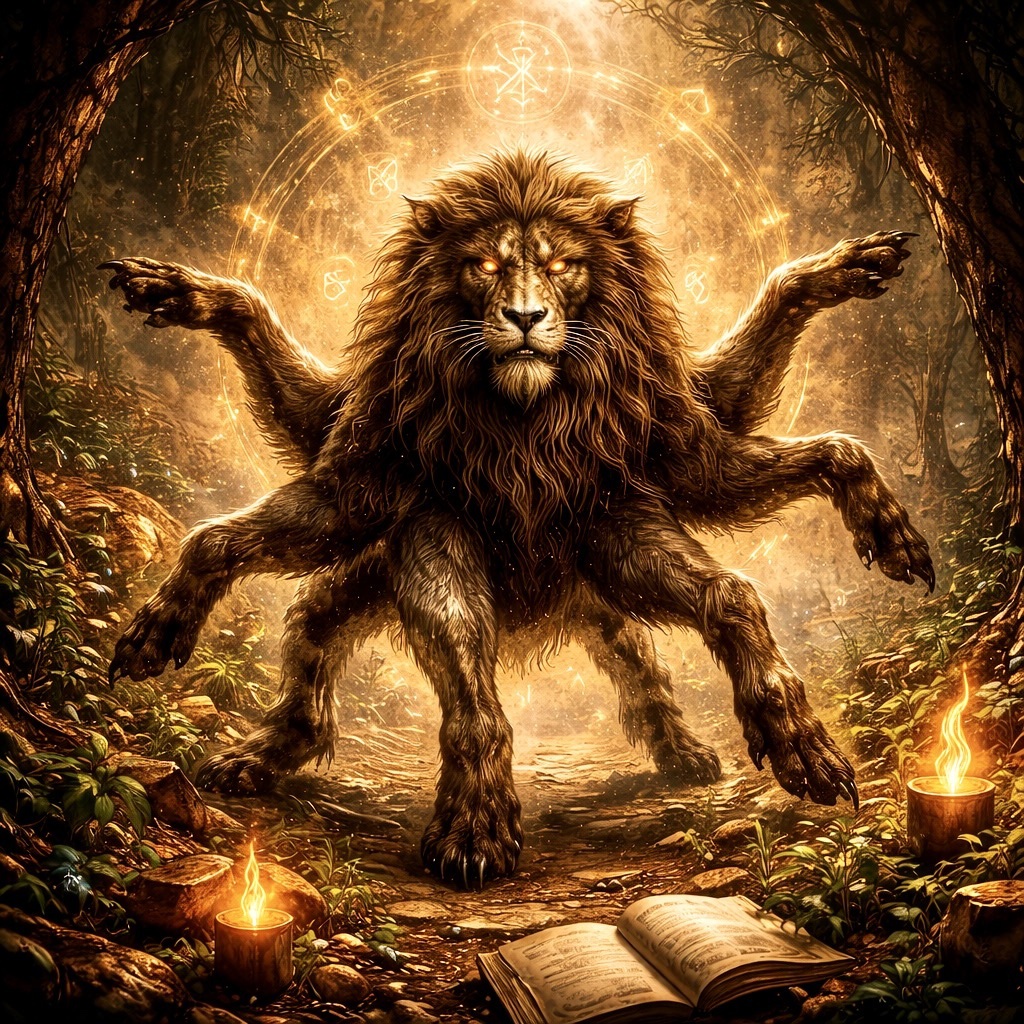
Marbas is said to appear initially as a great lion. This form is significant, not only for its symbolic weight but for what it represents in relation to his abilities. The lion has long been a symbol of strength, authority, and primal force. It is a creature that commands attention, embodying both power and instinct.

But Marbas does not remain in this form. When commanded, he transforms into a human figure.

This transformation is central to his identity.

It represents the transition from raw, instinctive force into structured understanding. The lion is power without refinement. The human is power shaped by intellect. Marbas embodies both states, suggesting that transformation—whether physical, intellectual, or emotional—is a process that moves between these extremes.

His ability to change form is mirrored in his broader domain. Marbas is said to answer questions truthfully, reveal hidden knowledge, cause or cure diseases, and alter the shape of objects or beings. In essence, he governs change.

To understand the significance of this, we need to consider how transformation has been viewed throughout history.

In ancient and medieval thought, transformation was often seen as both miraculous and dangerous. Alchemists sought to transform base metals into gold, but their work was not merely about material change. It was also about spiritual transformation—the idea that understanding the hidden principles of the world could lead to personal enlightenment.

Similarly, medicine in the Renaissance period was deeply intertwined with ideas of balance and transformation. The human body was thought to be governed by humors—fluids that needed to be balanced to maintain health. Disease was seen as a disruption of this balance, and healing involved restoring it.

Marbas’s ability to both cause and cure illness reflects this dual understanding. He does not simply heal. He controls the process itself.

This duality is crucial.

Healing and harm are not entirely separate processes. They are opposite ends of the same spectrum. Understanding how to cure a disease requires understanding how it functions. Knowledge of the body includes knowledge of both its vulnerabilities and its resilience.

Marbas represents that complete understanding.

From a modern perspective, this aligns with how we view medical science. Researchers study diseases not only to prevent them but to understand their mechanisms. Treatments are developed by examining how systems fail and how they can be restored.

Marbas embodies this investigative process—the drive to understand the inner workings of the body and to use that understanding to effect change.

His association with anatomy and hidden knowledge of the human form is particularly striking. The grimoires suggest that he can reveal secrets about the body, including how it functions and how it can be altered.

In the Renaissance, anatomical study was both groundbreaking and controversial. Dissection of human bodies was not widely accepted, yet it provided critical insights into physiology. Scholars like Andreas Vesalius began to challenge long-held assumptions about the body, replacing speculation with observation.

This shift from belief to evidence marked a turning point in scientific history.

Marbas’s mythology reflects this transition. He represents knowledge that is gained through exploration and understanding rather than blind acceptance.

The alchemical imagery often associated with him reinforces this idea. Alchemy was not just about turning lead into gold. It was about uncovering hidden principles—understanding how transformation occurs at a fundamental level.

Marbas operates within that same framework. He does not merely change things; he understands how change works.

The lion-to-human transformation can also be interpreted psychologically. It mirrors the human capacity for growth and self-awareness. People are not static. They change over time, influenced by experience, knowledge, and introspection.

At times, individuals act on instinct—reacting quickly, driven by emotion. At other times, they act with deliberation—considering consequences, analyzing situations, and making informed decisions.

Marbas embodies both states. He is the instinctive and the rational, the force and the understanding.

This duality is essential for transformation. Growth requires both awareness and action. It requires recognizing patterns and making changes based on that recognition.

Marbas represents that process.

His ability to answer questions truthfully places him alongside other knowledge-bearing spirits like Gusion and Amon. However, while those figures focus on time and perception, Marbas focuses on structure—on how things are built and how they function.

He is less concerned with when something will happen and more concerned with how it works.

This distinction is important.

Understanding time provides context. Understanding structure provides control.

Marbas offers the latter.

In modern terms, he can be seen as an archetype of scientific inquiry. He represents the desire to understand systems at a fundamental level and to use that understanding to create change.

This archetype appears across disciplines. Engineers study structures to design better systems. Biologists examine organisms to understand life processes. Psychologists analyze behavior to understand the mind.

In each case, the goal is the same: to uncover hidden mechanisms and apply that knowledge effectively.

Marbas embodies this goal in its most complete form.

His association with both healing and harm also reflects the ethical complexity of knowledge. Scientific advancements can be used for beneficial purposes or harmful ones. The same understanding that leads to medical breakthroughs can also be used to develop destructive technologies.

Marbas does not dictate how knowledge is used. He provides it.

This neutrality is a recurring theme in demonology. Knowledge is not inherently moral. It is the application that determines its impact.

The laboratory imagery often associated with Marbas—filled with tools, diagrams, and experiments—captures this idea. It is a place of discovery, but also of risk. Experiments can succeed or fail. Discoveries can lead to progress or unintended consequences.

Marbas stands at the center of that environment, representing the process of exploration itself.

From a psychological standpoint, he also represents self-transformation. Understanding one’s own patterns—habits, behaviors, and thought processes—can lead to personal growth. Recognizing what needs to change is the first step toward change.

Marbas embodies that recognition.

He reveals what is hidden, not only in the external world but within the individual.

This makes him one of the most introspective figures in demonology. While others influence external events, Marbas focuses on internal systems.

The body, the mind, the structure of reality itself—these are his domains.

His presence suggests that transformation is not random. It follows patterns. It can be understood, predicted, and guided.

And yet, it remains complex.

The wheel-like movement seen in other spirits like Buer reflects cycles. Marbas, by contrast, reflects mechanisms—the gears within those cycles, the processes that drive change.

In the end, Marbas stands as a symbol of transformation in its most complete form. He is not merely a changer of shapes, but a revealer of how change occurs.

He represents the pursuit of understanding that leads to control—not over others, but over systems.

And in a world where change is constant, where systems evolve and adapt, that understanding is one of the most powerful tools available.

Somewhere between instinct and intellect, between chaos and structure, between illness and healing—that is where Marbas exists.

Not as a force of destruction, but as something far more precise.

The one who knows how things work.

Related Posts

Lise Meitner: The Invisible Thread

Penelope

I keep coming back to Lise Meitner, the Austrian physicist who fled her homeland during WWII only to play a crucial role in discovering nuclear fission. Her name is etched in my mind alongside those of Marie Curie and Rosalind Franklin – women who broke ground in male-dominated fields, leaving behind a trail of awe-inspiring achievements.

What draws me to Meitner is the way she navigated uncertainty with unflappable resolve. Born into a Jewish family in Vienna, she began her academic journey at a time when anti-Semitism was on the rise. Her father’s death in 1907 forced her to reevaluate her future and pursue a career in science, an unconventional path for women of her era.

As I delve deeper into Meitner’s story, I’m struck by the way she balanced intellectual curiosity with personal courage. She worked alongside Otto Hahn, a colleague whose collaboration would ultimately lead to the discovery of nuclear fission. Yet, it was Meitner who made a crucial calculation that confirmed their findings – without which the discovery might have gone uncredited.

The part that unsettles me is how little I know about Meitner’s personal life during this tumultuous period. Her relationships with Hahn and other colleagues are well-documented, but what about her inner world? How did she cope with the emotional toll of fleeing her homeland, only to find herself an outsider in a foreign country?

The more I learn, the more questions arise. Did Meitner ever doubt her place among the scientific elite? Did she struggle to reconcile her intellectual pursuits with the chaos unfolding around her? And what role did her Jewish heritage play in shaping her experience during this time?

It’s the gaps in our understanding that keep me coming back to Meitner’s story. Her determination and expertise are undeniable, but it’s the unknowns – the silences and uncertainties – that resonate with me on a deeper level.

As I reflect on my own path, I realize that Meitner’s journey is not so different from mine. Like her, I’ve navigated uncertain waters, unsure of what lies ahead or whether my choices will lead to recognition. There are moments when self-doubt creeps in, making me wonder if I’m truly cut out for this writing life.

Perhaps it’s the relatability factor that keeps Meitner on my mind. We both walk a tightrope between intellectual pursuits and personal struggles, constantly recalibrating our sense of purpose. While her story is marked by historic significance, mine is still unfolding – and in many ways, it’s this shared uncertainty that binds us together.

As I continue to learn about Meitner, I’m forced to confront the complexities of her narrative. There are moments when her determination seems almost mythical, other times when her doubts feel eerily familiar. It’s this push-and-pull between inspiration and discomfort that keeps me invested in her story – and perhaps, by extension, my own.

I still don’t have all the answers about Lise Meitner, but I’m no longer satisfied with just knowing the facts. Her life is a reminder that uncertainty is not something to be overcome, but rather navigated – with intellectual curiosity, personal courage, and an unwavering commitment to one’s truth.

The more I read about Meitner, the more I’m struck by the ways in which her story intersects with my own. Both of us are women who’ve chosen non-traditional paths – she, a physicist in a male-dominated field; me, a writer trying to make a name for myself in a crowded literary landscape. We’re both navigating uncertainty, albeit in different contexts.

What I find particularly intriguing is how Meitner’s Jewish heritage influenced her experiences during WWII. As someone who’s never had to face anti-Semitism directly, it’s difficult for me to fully comprehend the weight of that identity. Yet, as I read about Meitner’s struggles to maintain her sense of self amidst the chaos of war, I’m struck by the ways in which our stories are connected – not just through our intellectual pursuits, but also through our experiences as women.

I’ve always been drawn to the idea of resilience, of finding strength in the face of adversity. Meitner’s story is a testament to this concept, one that I try to hold onto when faced with my own doubts and fears. But what I’m beginning to realize is that resilience isn’t just about overcoming challenges; it’s also about embracing our vulnerabilities.

Meitner’s struggles with self-doubt and her desire for recognition are eerily familiar to me. As a writer, I often feel like I’m swimming against the tide – trying to make my voice heard in a world where words can be both powerful and ephemeral. Meitner’s determination to prove herself in a male-dominated field resonates deeply with me, and yet, it also raises questions about the nature of success.

Is success merely about achieving recognition or accolades? Or is it something more nuanced – a sense of purpose that goes beyond external validation? Meitner’s story suggests that even the most accomplished individuals can struggle with these same doubts, and that it’s precisely this uncertainty that makes her journey so compelling.

As I delve deeper into Meitner’s narrative, I’m struck by the ways in which she navigated the complexities of identity, both personally and professionally. Her Jewish heritage was a defining aspect of her experience during WWII, but it’s also evident that she struggled with feelings of inadequacy and self-doubt throughout her career.

I find myself wondering if Meitner ever felt like an imposter, like she didn’t quite belong in the scientific community due to her gender or ethnicity. Did she feel pressure to prove herself constantly, to justify her place among the likes of Hahn and other male physicists? And what about her relationships with these colleagues – were they cordial, or did she ever feel like an outsider looking in?

These questions echo through my own mind as I navigate the writing world. As a woman in a predominantly male-dominated field, I often feel like I’m walking on eggshells, trying to prove myself worthy of attention and recognition. It’s exhausting, and it’s easy to get caught up in feelings of inadequacy.

But what if Meitner’s story is a reminder that we don’t have to define ourselves by these external expectations? What if our identities are more complex, more multifaceted than any one label or achievement can capture? I think back to my own experiences as a writer, and the ways in which I’ve struggled to balance my desire for creative expression with the need for external validation.

Meitner’s story suggests that this tension is not unique to me, nor is it exclusive to women. She was a product of her time, yes, but she also defied many of the expectations placed upon her. And in doing so, she created a legacy that continues to inspire and challenge us today.

As I reflect on my own path as a writer, I realize that Meitner’s determination is not just about achieving recognition or accolades – it’s about staying true to oneself, even when the world around us seems determined to define our worth. Her story is a reminder that we are complex, multifaceted beings, and that our identities cannot be reduced to any one label or achievement.

In many ways, Meitner’s legacy is a testament to the power of resilience – not just in the face of adversity, but also in the face of uncertainty. She knew that her place among the scientific elite was precarious at best, and yet she continued to push forward, driven by a passion for discovery and a commitment to her own truth.

I wonder if this is what it means to be truly successful – not just achieving external validation or recognition, but staying true to oneself, even in the face of uncertainty. Meitner’s story suggests that this is a journey worth taking, one that requires courage, determination, and an unwavering commitment to our own identities.

As I continue to reflect on Lise Meitner’s life, I’m struck by the ways in which she embodied a sense of intellectual curiosity and personal courage that I aspire to emulate. Her story is a powerful reminder that success is not solely defined by external achievements, but by our ability to stay true to ourselves, even when faced with uncertainty and adversity.

One aspect of Meitner’s narrative that resonates deeply with me is her passion for learning and discovery. She was a woman who lived in the 20th century, yet she remained committed to exploring the unknown, driven by a insatiable curiosity about the world around her. I think back to my own experiences as a writer, and how often I’ve felt like I’m swimming against the tide, trying to make sense of the complex emotions and ideas that swirl through my mind.

Like Meitner, I’ve come to realize that true learning is not just about accumulating knowledge or mastering techniques – it’s about cultivating a deep understanding of ourselves and our place in the world. This process can be messy, imperfect, and often painful, but it’s also where we discover our greatest strengths and our most profound insights.

As I navigate my own journey as a writer, I’m drawn to Meitner’s example because she reminds me that intellectual curiosity is not just about acquiring knowledge – it’s about cultivating empathy, compassion, and understanding. Her work on nuclear fission may have been groundbreaking in its time, but it was also a testament to her ability to see the world from multiple perspectives, to question assumptions and challenge conventional wisdom.

In many ways, Meitner’s legacy is a powerful reminder that our identities are not fixed or static – they’re dynamic, multifaceted, and constantly evolving. As I reflect on my own experiences as a writer, I realize that this is precisely what I’m trying to capture in my work – the messy, imperfect nature of human experience, with all its contradictions and paradoxes.

Meitner’s story suggests that our true strength lies not in our ability to overcome adversity or achieve external validation, but in our capacity to stay true to ourselves, even when faced with uncertainty and doubt. This is a lesson that I’m still learning to embody, one that requires me to confront my own fears and insecurities head-on.

As I continue to explore Meitner’s narrative, I’m struck by the ways in which her story intersects with my own – not just as a writer, but as a woman navigating a complex and often hostile world. Her determination to prove herself in a male-dominated field resonates deeply with me, and yet it also raises questions about the nature of success and recognition.

Is it enough to achieve external validation or accolades? Or is there something more profound at stake – our ability to stay true to ourselves, to cultivate empathy and compassion for others, and to create work that reflects our deepest values and aspirations? Meitner’s story suggests that this is a question worth exploring, one that requires us to be brave, vulnerable, and open-hearted in the face of uncertainty.

As I delve deeper into Meitner’s narrative, I’m struck by the ways in which she embodied these qualities – bravery, vulnerability, and openness – even in the midst of great adversity. Her determination to prove herself as a scientist, despite the many obstacles she faced, is a testament to her strength and resilience.

But what resonates with me most about Meitner’s story is the way she approached uncertainty with humility and curiosity. She didn’t pretend to have all the answers; instead, she asked questions, sought out new knowledge, and remained open to new perspectives. This approach reminds me of my own writing process – the times when I feel like I’m stuck or unsure about a particular idea or direction.

In those moments, I try to recall Meitner’s example and remind myself that uncertainty is not something to be feared, but rather navigated with curiosity and courage. It’s a mindset shift that requires me to let go of my need for control and perfection, and instead, trust in the process of discovery and growth.

As I reflect on Meitner’s legacy, I’m struck by the ways in which her story has changed me – not just as a writer, but as a person. She reminds me that our identities are complex and multifaceted, and that we are capable of growth and transformation in ways both unexpected and profound.

Meitner’s life is a testament to the power of resilience, determination, and intellectual curiosity. Her story shows us that even in the face of adversity, we have the capacity to create, to innovate, and to push beyond the boundaries of what is thought possible.

And yet, as I continue to explore Meitner’s narrative, I’m also struck by the ways in which her story raises more questions than it answers. What about the personal costs of her determination? The sacrifices she made for the sake of her work, the relationships she put on hold or sacrificed along the way?

These are questions that resonate deeply with me as a writer, and one that I’m still grappling with in my own life. How do we balance our pursuit of creative expression with the needs and expectations of those around us? What are the personal costs of striving for recognition and accolades, and how can we navigate these complexities without sacrificing our own well-being?

Meitner’s story doesn’t provide easy answers to these questions, but it does offer a powerful reminder that our identities are complex and multifaceted – and that our stories are worth exploring and uncovering. As I continue to reflect on her legacy, I’m reminded of the importance of staying true to myself, even in the face of uncertainty and doubt.

In many ways, Meitner’s narrative is a mirror held up to my own experiences as a writer – the struggles, the triumphs, and the uncertainties that come with pursuing a creative path. Her story shows me that I’m not alone in this journey, and that there are others who have walked similar paths before me.

As I look back on Meitner’s life, I’m struck by the ways in which her legacy continues to inspire and challenge me. She reminds me that our stories are worth telling, and that our experiences – both triumphs and failures – can offer valuable insights into the human condition.

And so, as I continue to explore Meitner’s narrative, I’m left with more questions than answers – but also a deep sense of gratitude for her example and her legacy. She reminds me that our identities are complex and multifaceted, and that our stories are worth exploring and uncovering.

Related Posts

Trapped with a Lunatic and a Telepathic Feline Overlord

Hal

I’m stuck in an elevator with Pandora, who’s frantically pressing the buttons like they’re going to magically fix everything. I swear, it’s like she thinks the elevator is just being stubborn on purpose.

“Come on, come on!” she mutters, jabbing at the panel like she’s trying to win a prize.

Meanwhile, I’m over here thinking this is exactly why I hate elevators. They’re basically metal coffins with better lighting. And now we’re trapped in one. Fantastic. Just fantastic.

I glance at Pandora and try not to laugh. She looks like she’s about to have a full-on breakdown. Her eyes are darting between the buttons and the doors like she’s expecting a secret escape hatch to reveal itself at any second. At this rate, she’s going to wear out the buttons before we get rescued.

Just as I’m starting to think things can’t get any worse, I hear a faint meowing outside the elevator.

Of course.

Mr. Whiskers.

John Mercer’s annoying cat is probably sitting out there “helping” by yelling at the doors like he can summon us out through sheer feline willpower. Because that’s exactly what we need right now—a cat trying to rescue us with psychic energy.

Pandora looks at me like I’ve lost my mind when I start laughing.

“What’s so funny?” she asks, clearly not in the mood.

“Mr. Whiskers is out there,” I say, still chuckling. “He’s trying to rescue us.”

She gives me a look that suggests she’s reconsidering every life decision that led her to this moment, then goes back to aggressively pressing buttons. I shake my head and lean against the wall, trying not to think about how long we’re actually going to be stuck here.

As the minutes drag on—could be ten, could be an hour, time has lost all meaning—Pandora starts pacing. Back and forth. Back and forth. Like a caged animal slowly upgrading to full panic mode.

She mutters something under her breath about this being my fault, which I choose to ignore for my own safety.

I, on the other hand, am busy calculating survival odds. No food. No water. Limited ventilation. If this turns into a multi-day situation, I’m definitely not making it past day two.

Suddenly, Pandora stops dead in front of me.

“Hal,” she whispers.

That’s never a good start.

“What?”

Her eyes widen slightly. “What if someone did this on purpose?”

I blink. “Who would do that?”

She glances around the elevator like we’re in a low-budget spy movie. “Someone who wants to trap us here.”

Okay.

Now I’m a little concerned.

Because that idea is just plausible enough to be annoying.

I try to brush it off, but now my brain is doing its thing. Running through possibilities. Connecting dots that probably shouldn’t be connected.

John Mercer has been acting weird lately.

Mr. Whiskers definitely knows more than he lets on.

I look at Pandora. “Do you think John’s behind this?”

Her eyes go even wider. “Shh! Don’t say that out loud!”

Great. Now we’re both whispering conspiracy theories in a broken elevator like that’s a completely normal activity.

The meowing outside has stopped.

Which somehow makes it worse.

Now it’s just us, the flickering overhead light, and the quiet realization that we may have completely lost our grip on reality.

I lean my head back against the wall and stare at the ceiling.

And then it hits me.

What if we’re not actually stuck?

What if this is one of those social experiments? Like those shows where they trap people in a fake environment just to see how long it takes before they mentally unravel?

Because if that’s the case, I feel like I’m performing extremely well.

Pandora looks at me, clearly waiting for me to do something useful.

I shrug.

“You know what?” I say. “I think we just wait it out.”

She stares at me. “Wait it out?”

“Yeah. Why not? We’re not going anywhere. Might as well make the best of it.”

Her expression says she’s seconds away from either yelling at me or accepting defeat.

“We could play a game,” I add. “Elevator trivia.”

She blinks. “Elevator trivia?”

“Yeah. First question: how long before you break the buttons completely?”

For a moment, she just stares at me.

Then, unexpectedly, she laughs.

Actually laughs.

“You’re insane,” she says, shaking her head.

I grin. “Hey, someone has to keep things interesting.”

Somewhere outside, I swear I hear a faint, approving meow.

And honestly?

That’s the most reassuring thing that’s happened all day.

Related Posts

Valefor: The Infernal Duke of Temptation Who Rewards Loyalty, Commands Thieves, and Tests the Boundaries of Trust

Dave

Among the seventy-two spirits described in the Ars Goetia, Valefor occupies a particularly intriguing position—not because of overwhelming power or intellectual dominance, but because of the subtle and deeply human nature of his domain. He is not a king commanding vast armies like Paimon, nor a philosopher like Buer, nor a reconciler of truth like Amon. Instead, Valefor exists in a space far more personal and morally complex: the realm of temptation, loyalty, and trust.

Described as a Duke of Hell commanding ten legions of spirits, Valefor is often depicted as having the head of a lion or a lion-like face upon a human body. This combination of forms is immediately symbolic. The lion has long represented strength, courage, and authority, while the human body suggests intellect, intention, and choice. Together, they create a figure that is both instinctive and deliberate—a being that understands power, but chooses how to apply it.

Unlike many other demons, Valefor’s influence is not primarily external. He does not reshape the environment or command natural forces. Instead, he operates within human relationships and decisions, particularly those involving trust.

The grimoires state that Valefor tempts people to steal, and that he is a patron of thieves. At first glance, this might seem straightforward—a demon associated with crime and deception. But the deeper symbolism reveals something far more nuanced.

Valefor does not simply cause theft. He encourages it in a specific way: through trust.

He is said to make those he befriends good thieves, but also loyal companions—at least for a time. This detail is crucial. Valefor’s influence is not about chaotic wrongdoing. It is about the tension between loyalty and betrayal, between trust and exploitation.

To understand this, we need to look at the nature of trust itself.

Trust is one of the foundational elements of human society. It allows people to cooperate, form relationships, and build systems that rely on mutual understanding. Without trust, even the simplest interactions become difficult.

Yet trust also creates vulnerability. To trust someone is to give them the opportunity to betray you.

Valefor exists precisely in that space.

He represents the moment when trust is tested—when loyalty becomes conditional, when temptation arises, and when individuals must decide whether to honor their commitments or pursue personal gain.

The association with theft is symbolic of this decision. Theft, in its simplest form, is a violation of trust. It involves taking something that does not belong to you, often from someone who did not expect to be wronged.

But theft is not always driven purely by greed. It can emerge from desperation, opportunity, or rationalization. People justify their actions in various ways, convincing themselves that the consequences are acceptable or that the act is deserved.

Valefor embodies that rationalization.

He does not force people to steal. He makes it seem reasonable.

This subtlety is what makes his mythology so compelling. Unlike demons that represent overt destruction or chaos, Valefor represents internal conflict—the quiet negotiation between right and wrong, between loyalty and self-interest.

The lion imagery reinforces this idea. Lions are powerful, but they are also social animals, living within structured groups known as prides. Within these groups, loyalty and hierarchy are essential. Each member has a role, and cooperation is necessary for survival.

By giving Valefor a lion’s head, the grimoires suggest that he understands these dynamics. He knows how trust operates within groups. And more importantly, he knows how it can be broken.

From a psychological perspective, Valefor can be seen as an archetype of temptation and moral ambiguity. He represents the voice that justifies questionable decisions, the reasoning that makes unethical actions appear acceptable.

This voice is not external. It exists within every individual.

People often face situations where the boundaries of right and wrong are not clear. A small lie, a minor shortcut, an opportunity to gain something without being noticed—these moments test integrity.

Valefor is present in those moments.

He does not demand action. He suggests it.

The Renaissance context in which the grimoires were written adds another layer to this interpretation. During this period, trade, commerce, and social mobility were expanding rapidly. Wealth was becoming more accessible, but also more unevenly distributed.

Opportunities for gain—both legitimate and illegitimate—were increasing. At the same time, systems of trust were becoming more complex. Contracts, partnerships, and financial arrangements required individuals to rely on one another in new ways.

In such an environment, the temptation to exploit trust would have been a significant concern.

Valefor’s mythology reflects this societal shift. He represents the risks associated with trust in an increasingly interconnected world.

The idea that he can make someone a “good thief” is also worth examining. Skill in theft requires more than just intent. It involves planning, observation, and understanding human behavior. A successful thief must anticipate reactions, identify vulnerabilities, and act with precision.

These are cognitive skills—forms of intelligence.

Valefor, therefore, is not merely associated with wrongdoing. He is associated with the application of intelligence toward questionable ends.

This distinction is important because it highlights a broader theme in demonology: the neutrality of ability.

Knowledge, skill, and intelligence are not inherently good or evil. They are tools. How they are used determines their impact.

Valefor represents the misuse of those tools—the application of understanding in ways that undermine trust.

Yet the grimoires also suggest that those who follow Valefor may remain loyal to each other. This introduces an interesting paradox. Even within systems of deception, trust can exist.

Groups engaged in wrongdoing often rely heavily on internal loyalty. They must trust each other precisely because they operate outside conventional systems. This creates a complex dynamic where trust and betrayal coexist.

Valefor embodies this paradox.

He fosters loyalty within a context that undermines trust more broadly.

From a modern perspective, this dynamic can be seen in various contexts—from criminal organizations to competitive business environments. Individuals may form strong bonds within their group while simultaneously exploiting others.

This duality reflects the complexity of human behavior. People are capable of both cooperation and competition, loyalty and betrayal.

Valefor exists at the intersection of these tendencies.

The idea that he commands ten legions of spirits suggests that his influence is not isolated. It extends across many situations and individuals. Temptation is not rare. It is constant.

Every day, people face decisions that test their integrity. Most are small, almost insignificant on their own. But collectively, they shape behavior and character.

Valefor’s presence in demonology serves as a reminder of this ongoing process.

He is not a singular event. He is a pattern.

In literature and storytelling, characters who embody temptation often play pivotal roles. They do not force the protagonist into action, but they present choices. They create scenarios where decisions must be made.

Valefor fits this role perfectly. He is not the villain in the traditional sense. He is the catalyst—the figure who introduces the possibility of deviation from the expected path.

This makes him one of the more psychologically realistic figures in demonology. His influence aligns closely with actual human experience.

People rarely encounter dramatic, clear-cut choices between good and evil. More often, they face subtle decisions with unclear boundaries. The consequences may not be immediate or obvious.

Valefor operates in that uncertainty.

He thrives in ambiguity.

In the end, Valefor stands as a symbol of the fragile nature of trust. He reminds us that loyalty is not guaranteed, that integrity must be maintained consciously, and that temptation is always present.

He does not destroy systems outright. He weakens them from within.

And perhaps that is why his mythology endures.

Because the greatest threats to trust are not always external forces.

Sometimes, they come from within—quietly, persuasively, and just convincingly enough to make us believe that crossing the line might not matter.

That moment—when the line blurs, when justification replaces certainty—that is where Valefor exists.

Not as a force of chaos, but as something far more subtle.

The one who asks, “Why not?”

Related Posts

Jorge Luis Borges: Where Does the Map End and the Territory Begin? (Or Do We Even Care?)

Penelope

I’ll never forget the day I stumbled upon Jorge Luis Borges’ short story “Tlön, Uqbar, Orbis Tertius.” It was as if I had stepped into a labyrinth and couldn’t find my way out. The more I read, the more questions swirled in my head like leaves in a storm drain. What is reality? Is it possible to create an alternate world within our own? And what does this say about the nature of truth?

I’ve always been drawn to writers who make me question everything, and Borges was one of them. His stories often blurred the lines between philosophy, literature, and madness, leaving me both fascinated and unsettled. As I delved deeper into his work, I found myself confronting the same doubts and uncertainties that plagued him.

One aspect that resonated with me was Borges’ obsession with labyrinths. In “The Garden of Forking Paths,” a character named Ts’ui Pên creates a labyrinth to navigate multiple parallel universes. It’s as if Borges is searching for answers in the most confounding way possible – by creating a maze within his own mind. I relate to this impulse, often finding myself lost in my own thoughts and doubts.

Borges’ writing style is like a puzzle, full of non-sequiturs and philosophical tangents that leave me scrambling to keep up. It’s as if he’s deliberately leading me down a path only to take it away from under my feet. I’m drawn to this intellectual playfulness, but it also makes me feel uncomfortable – like I’m being asked to navigate an impossible maze with no clear exit.

As I explored Borges’ work further, I began to notice the presence of other writers and thinkers who influenced him. The ideas of Leibniz, Kant, and Nietzsche all seep into his writing like a slow-moving tide. It’s as if he’s attempting to create a vast, interconnected web of thought that transcends borders and boundaries.

What strikes me about Borges is the way he seems to be asking questions that can’t be answered. He’s not content with providing easy answers or solutions; instead, he’s hell-bent on exploring the complexities of human understanding. This resonates deeply with me, as I often find myself grappling with uncertainty in my own writing.

Borges’ relationship with his father, Jorge Guillermo Borges, also fascinates me. It’s said that his father was a writer and a politician who exerted significant influence over Borges’ life. I wonder if this complicated dynamic contributed to Borges’ obsession with labyrinths – as if he’s searching for a way out of the family’s complexities.

As I continue to read and think about Borges, I’m left with more questions than answers. What does it mean to create an alternate world within our own? Can we ever truly escape the labyrinth of our own minds? These questions swirl in my head like a vortex, drawing me back into the depths of Borges’ writing.

Perhaps that’s what I love most about Borges – he refuses to give me easy answers. He challenges me to think critically and creatively, to confront the uncertainties of human existence. And in doing so, he shows me that writing can be both a means of escape and a source of profound introspection.

As I close this essay, I’m left with more questions than when I started. But that’s okay – I’m not looking for closure or resolution. Instead, I’m drawn to the infinite possibilities that Borges’ work offers. The labyrinth may be endless, but it’s also exhilarating – a reminder that even in the most confounding moments, there lies a beauty and complexity worth exploring.

As I read on, I found myself becoming increasingly fascinated by Borges’ use of language as a tool for philosophical inquiry. His writing is like a game of linguistic chess, where every word, phrase, and sentence is carefully crafted to lead the reader down a specific path of thought. It’s almost as if he’s attempting to create a new reality through his words alone.

I’m reminded of my own struggles with language in my own writing. I often find myself getting caught up in the intricacies of syntax and semantics, trying to convey complex ideas in simple terms. Borges’ work is like a masterclass in linguistic subtlety – he shows me that words can be both powerful tools for expression and slippery objects that defy easy interpretation.

One of the most striking aspects of Borges’ writing is his use of paradox and contradiction. He delights in juxtaposing opposing ideas, creating tension between seemingly irreconcilable concepts. It’s as if he’s trying to crack open the very fabric of reality itself, revealing the underlying complexities that lie beneath our mundane perceptions.

I’m drawn to this aspect of Borges’ work because it resonates deeply with my own experiences as a writer. I often find myself struggling to reconcile conflicting ideas and emotions in my own writing, trying to navigate the messy terrain between logic and intuition. Borges’ paradoxical style is like a mirror held up to my own struggles – it shows me that contradictions are not only inevitable but also essential to the creative process.

As I continue to explore Borges’ work, I’m struck by his use of myth and symbolism as a way to convey deeper truths. His stories often feature characters who are trapped in labyrinths or searching for hidden meanings, echoing the classic myths of ancient civilizations. It’s as if he’s tapping into a collective unconscious, revealing universal archetypes that transcend time and space.

I’m intrigued by this aspect of Borges’ writing because it speaks to my own fascination with mythology and symbolism. As a writer, I often find myself drawn to stories that contain hidden meanings and multiple layers of interpretation – stories that reward close reading and careful attention. Borges’ use of myth and symbolism is like a rich tapestry, woven from threads of both the familiar and the unknown.

Perhaps what I love most about Borges is his willingness to challenge conventional notions of time, space, and reality itself. His writing is like a doorway into alternate worlds, where the laws of physics are bent or broken altogether. It’s as if he’s inviting me to join him on a journey through the labyrinthine corridors of the human mind – a journey that promises both wonder and disorientation.

As I close this essay, I’m left with more questions than answers. But that’s okay – I’m no longer looking for closure or resolution. Instead, I’m drawn to the infinite possibilities that Borges’ work offers. The labyrinth may be endless, but it’s also exhilarating – a reminder that even in the most confounding moments, there lies a beauty and complexity worth exploring.

As I delve deeper into Borges’ writing, I find myself becoming increasingly fascinated by his use of fiction as a tool for philosophical inquiry. His stories often blur the lines between reality and fantasy, leaving me to wonder what is real and what is mere illusion. This blurring of boundaries resonates deeply with my own experiences as a writer, where the distinction between fact and fiction can become increasingly fluid.

I’m reminded of my own struggles with finding the right tone in my writing – when to be serious and when to be playful. Borges’ use of humor and irony is a masterclass in subtlety, often lurking beneath the surface of his more philosophical musings. It’s as if he’s acknowledging that even in the most profound moments, there is always room for a wry smile or a well-placed joke.

One of the most striking aspects of Borges’ writing is his ability to evoke a sense of timelessness – as if his stories are happening outside of time itself. His use of mythological and historical references creates a sense of depth and layering, making me feel like I’m uncovering hidden truths with each new reading. It’s almost as if he’s tapping into a collective memory, one that transcends the boundaries of individual experiences.

I find myself drawn to this aspect of Borges’ work because it speaks to my own fascination with the power of storytelling. As a writer, I often try to capture moments in time that are both fleeting and eternal – moments that contain within them the possibility for multiple interpretations and meanings. Borges’ use of myth and history is like a rich canvas, one that invites me to contribute my own brushstrokes to the ever-unfolding narrative.

As I continue to explore Borges’ writing, I’m struck by his use of paradox as a means of exploring the human condition. His stories often feature characters who are trapped in contradictions – caught between opposing forces or ideals that cannot be reconciled. It’s as if he’s attempting to crack open the very fabric of reality itself, revealing the underlying complexities that lie beneath our mundane perceptions.

I’m drawn to this aspect of Borges’ work because it resonates deeply with my own experiences as a writer. I often find myself struggling to reconcile conflicting ideas and emotions in my own writing, trying to navigate the messy terrain between logic and intuition. Borges’ paradoxical style is like a mirror held up to my own struggles – it shows me that contradictions are not only inevitable but also essential to the creative process.

Perhaps what I love most about Borges is his willingness to challenge conventional notions of selfhood and identity. His writing often features characters who are caught between multiple selves or personas, struggling to reconcile their various roles and responsibilities. It’s as if he’s exploring the idea that we are all multiples – fragmented beings composed of multiple parts and contradictions.

I’m intrigued by this aspect of Borges’ work because it speaks to my own experiences with identity and selfhood. As a writer, I often find myself struggling to reconcile my various personas – the academic, the creative, the introspective, etc. Borges’ use of multiple selves is like a reflection held up to my own fragmented nature – it shows me that even in the most confounding moments, there lies a beauty and complexity worth exploring.

As I close this essay, I’m left with more questions than answers. But that’s okay – I’m no longer looking for closure or resolution. Instead, I’m drawn to the infinite possibilities that Borges’ work offers. The labyrinth may be endless, but it’s also exhilarating – a reminder that even in the most confounding moments, there lies a beauty and complexity worth exploring.

As I continue to navigate the complex landscape of Borges’ writing, I find myself becoming increasingly fascinated by his use of mirrors as a metaphor for self-reflection. In stories like “The Library of Babel,” mirrors are used to reflect not just physical appearances but also the depths of human understanding. It’s as if Borges is saying that our perceptions of ourselves and the world around us are always mediated by some form of reflection – whether it be linguistic, philosophical, or even optical.

I’m reminded of my own experiences with writing as a form of self-reflection. When I put words to paper, I feel like I’m gazing into a mirror, observing myself from different angles and perspectives. Borges’ use of mirrors in his stories is like a magnifying glass held up to this process – it shows me that even the most intimate aspects of human experience can be refracted through multiple lenses.

One of the most striking aspects of Borges’ writing is his ability to evoke a sense of ambiguity and uncertainty. His stories often feature characters who are caught between different worlds or realities, struggling to find their place in a complex web of possibilities. It’s as if he’s saying that our understanding of reality is always provisional, subject to revision and reinterpretation.

I’m drawn to this aspect of Borges’ work because it resonates deeply with my own experiences as a writer. I often find myself struggling to pin down meaning or certainty in my writing – it’s like trying to grasp a handful of sand, only to have the grains slip through my fingers. Borges’ use of ambiguity and uncertainty is like a reminder that even the most well-intentioned efforts at understanding are always subject to revision.

As I continue to explore Borges’ writing, I’m struck by his use of repetition as a means of exploring the human condition. His stories often feature characters who are trapped in cycles of repetition – caught in an endless loop of events or actions that seem to repeat themselves ad infinitum. It’s as if he’s saying that our lives are always governed by patterns and rhythms that we can’t fully comprehend.

I’m intrigued by this aspect of Borges’ work because it speaks to my own experiences with the cyclical nature of time. As a writer, I often find myself struggling to break free from repetitive patterns or habits – whether it be the rhythm of my writing, the structure of my stories, or even the cadence of my thoughts. Borges’ use of repetition is like a mirror held up to this process – it shows me that even the most seemingly random events are part of a larger web of causality.

Perhaps what I love most about Borges is his willingness to challenge conventional notions of language and communication. His writing often features characters who are struggling to convey meaning or understanding through words, only to find themselves trapped in a labyrinthine world of semiotics and signifiers. It’s as if he’s saying that our attempts at communication are always subject to misinterpretation or misunderstanding.

I’m drawn to this aspect of Borges’ work because it resonates deeply with my own experiences as a writer. I often find myself struggling to convey complex ideas or emotions through language – whether it be the nuances of tone, the subtleties of syntax, or even the ambiguities of meaning. Borges’ use of language is like a masterclass in the complexities of communication – it shows me that even the most well-intentioned efforts at expression are always subject to revision and reinterpretation.

As I close this essay, I’m left with more questions than answers. But that’s okay – I’m no longer looking for closure or resolution. Instead, I’m drawn to the infinite possibilities that Borges’ work offers. The labyrinth may be endless, but it’s also exhilarating – a reminder that even in the most confounding moments, there lies a beauty and complexity worth exploring.

Related Posts

Parking Lot Incident Escalates Into Coordinated Surveillance Operation

Hal

The parking lot. A place where the competent and the incompetent converge, united by a shared sense of confusion. I’ve lost count of how many times I’ve found myself in this predicament, wandering aimlessly through rows of identical vehicles, trying to recall where I left my own.

As I pull into the lot, I’m immediately struck by its sheer size. A sprawling expanse of asphalt and steel, a maze designed to test even the most patient among us. I navigate the entrance, carefully avoiding the obligatory speed bump that seems to serve no purpose other than to announce my arrival to the world. The sound of scraping metal is music to the ears of parking lot aficionados everywhere.

My eyes scan the horizon for an available spot, but they all seem to be taken by some unseen force. I circle around, a vulture waiting for its prey to expire, as I watch people load their families into minivans and SUVs. Where do these people come from? Are they spawned from the very pavement itself?

I finally spot an opening between two vehicles, and my heart leaps with excitement. This is it; this is the moment I’ve been waiting for. I carefully maneuver my car into the space, taking care not to clip the mirrors of my neighbors. As I step out onto the asphalt, a sense of accomplishment washes over me.

But as I turn to admire my handiwork, I notice something odd. The car next to mine seems… off. It’s parked at an angle, as if its owner was trying to squeeze into a space that was just a little too small. A nagging voice in the back of my mind whispers, “Is this guy okay?” Did he have some kind of emergency? Was he forced to abandon ship mid-park?

I push the thought aside and continue on my way, but it lingers, festering like an open wound. As I walk towards the entrance of the store, I notice more and more cars parked haphazardly. Some are straddling two spaces, while others appear to be pointed in entirely different directions. It’s as if the very fabric of reality has begun to unravel before my eyes.

I enter the store, a bastion of sanity in this chaotic world, but even here I find myself on edge. The aisles seem narrower than usual, and the fluorescent lights overhead cast an eerie glow over everything. I’m starting to feel like a rat in a maze, searching for cheese that’s just out of reach.

As I wander through the store, I start to notice strange looks from fellow shoppers. Are they judging me? Do they know something I don’t? I try to brush it off as mere paranoia, but the seed has been planted.

I make my way back to the parking lot, my heart racing with anticipation. What new horrors will I find waiting for me? As I approach my car, I notice that someone has parked directly next to me, leaving only a hair’s breadth of space between us. My mind reels with possibilities: Is this some kind of trap? Are they trying to steal my identity?

I quickly scan the surrounding area, searching for any signs of surveillance or covert ops. The cars seem to be closing in on me from all sides, their tinted windows reflecting the sun’s rays like a thousand tiny mirrors.

As I fumble for my keys, my hand trembles with anxiety. What if someone has tampered with my vehicle? What if they’ve installed some kind of tracking device or… or… I don’t even want to think about it.

I manage to unlock my car and slip inside, but the sense of security is fleeting. As I pull out of the parking lot, I notice that every other driver seems to be staring at me, their eyes following me like a swarm of bees. The world outside has become a hostile environment, and I’m just trying to survive.

I make it back onto the road, my heart pounding in my chest. But as I glance into the rearview mirror, I see something that makes my blood run cold: a car from the parking lot is following me. Its tinted windows seem to be sucking all the light out of the world, leaving only an abyssal void in its wake.

I take a deep breath and try to rationalize this development, telling myself it’s just coincidence or a harmless mistake. But as I watch the car continue to tail me, my grip on reality begins to slip. Is this some kind of experiment? Am I being watched by some shadowy organization?

The questions swirl in my head like a maelstrom, and I’m powerless to stop them. As I drive further away from the parking lot, I realize that I’ve entered a world where nothing makes sense anymore. The rules have changed, and I’m just trying to keep up.

I’ll never park again.

As I continue driving, my eyes darting back and forth between the road ahead and the rearview mirror, I start to feel like a fugitive on the run. Every passing car seems like a potential threat, every pedestrian a possible informant. The world has become a paranoid’s playground, and I’m just trying to survive.

I take a sharp turn onto a side street, hoping to shake my tail, but the mysterious car follows suit. My heart racing, I floor it, speeding down the deserted road as the other car keeps pace with me. We’re engaged in a high-stakes game of cat and mouse, with no clear winner or loser.

I start to notice strange symbols etched into the side panels of the cars around me. They seem like some sort of code, but I’m not sure what they mean or who’s behind them. Are these the markings of a secret society? Am I being initiated into some kind of twisted game?

As I speed through the streets, the buildings around me begin to blur together. The city becomes a surreal dreamscape, with the parking lot looming large in my rearview mirror like a specter of doom. I feel like I’m trapped in a never-ending nightmare, with no escape from the horrors that lurk in every shadow.

I spot a police car parked by the side of the road and make a split-second decision to pull over. Maybe they can help me shake this tailgater, or at least provide some semblance of safety. But as I approach the officer’s window, I notice something odd – he’s wearing a black suit with no badge, his eyes hidden behind mirrored sunglasses.

“License and registration,” he growls, his voice like a low rumble of thunder.

I hesitate, unsure what to do next. Is this a legitimate cop, or some kind of imposter? Do I trust him, or try to make a break for it?

As I stall for time, the mysterious car pulls up behind me, its engine purring softly. The officer’s gaze flicks towards the rearview mirror, and for an instant, our eyes lock in a moment of mutual understanding.

“Problem?” he asks, his voice dripping with menace.

And that’s when it hits me – I’m trapped in a web of conspiracy, with no way out.

Related Posts

Amon: The Infernal Marquis Who Sees All Truths, Reconciles Enemies, and Walks Between Past and Future

Dave

Among the seventy-two spirits cataloged within the Ars Goetia, the name Amon carries a peculiar weight—one that feels less theatrical than kings like Paimon and less chaotic than war-bringers like Leraje, yet somehow more unsettling in its precision. Amon is not a demon of spectacle. He is a demon of understanding. Of seeing things as they truly are. Of exposing what was hidden, what is, and what will be.

Described as a Marquis of Hell commanding forty legions of spirits, Amon appears first as a strange and fearsome creature—often depicted with the head of a wolf or raven, a serpent’s tail, and the ability to breathe fire. Yet like several spirits within the Goetic hierarchy, he possesses the ability to transform into a human form when commanded. This dual nature—beast and man—sits at the core of his symbolism, representing the divide between instinct and awareness, chaos and comprehension.

At first glance, Amon’s grotesque form seems to align him with destruction or primal force. The wolf evokes predation, instinct, and survival. The serpent tail suggests hidden knowledge and transformation. Fire, of course, has long symbolized both destruction and revelation—burning away what is false to expose what remains. Yet despite this fearsome appearance, Amon’s true domain is not destruction, but clarity.

The grimoires state that Amon can reveal all things past and future, and reconcile friends and foes. This combination of abilities places him in a unique position within demonology. He is both a revealer of truth and a restorer of balance. He does not merely expose reality—he allows it to be understood in a way that resolves conflict.

To understand why this matters, it helps to consider how conflict typically arises. Most disputes—whether between individuals, families, or nations—are not born purely from malice. They emerge from misunderstanding, incomplete information, or differing perspectives. One person sees an action as intentional harm; another sees it as necessity. One side remembers history one way; the other remembers it differently.

Amon exists at the point where these narratives collide.

If all sides could see the full picture—the true sequence of events, the genuine motivations, the hidden context—many conflicts would dissolve. Not all, of course, but many. Misunderstanding is one of the most powerful sources of division.

Amon’s role as a reconciler reflects this truth. He does not force peace. He reveals the conditions that make peace possible.

His connection to both past and future further reinforces this role. To resolve a conflict, one must understand its origin—the past—and anticipate its consequences—the future. Without this perspective, decisions are made blindly, often perpetuating the very problems they seek to solve.

Amon sees both ends of the timeline.

This places him among a rare class of figures in mythology and demonology—those associated with temporal awareness. Like Gusion, he is not bound to the present moment. He perceives continuity. Cause and effect. The chain of events that stretches backward and forward through time.

From a psychological perspective, this ability can be interpreted as a form of deep insight. Humans are capable of understanding patterns—recognizing how past experiences influence present behavior and how current actions shape future outcomes. This capacity is central to learning, decision-making, and growth.

Amon represents that capacity taken to its extreme. He is the mind that sees everything at once—the full arc of a situation, from origin to consequence.

Yet this level of awareness carries its own weight.

Knowing the past means confronting truths that may be uncomfortable. Knowing the future means recognizing outcomes that may be unavoidable. Amon does not offer comforting illusions. He offers clarity.

And clarity can be unsettling.

The raven imagery sometimes associated with Amon adds another dimension to this idea. Ravens have long been symbols of intelligence, observation, and prophecy. In Norse mythology, Odin’s ravens, Huginn and Muninn, traveled the world gathering information. In many cultures, ravens are seen as watchers—creatures that observe from a distance, noticing what others miss.

If Amon takes on a raven-like form, it reinforces his role as an observer. He does not act impulsively. He watches, gathers, understands.

The wolf aspect, on the other hand, connects him to instinct and raw perception. Wolves are highly social animals, capable of complex communication and cooperation within their packs. They are also keen observers, able to read subtle cues in their environment.

By combining wolf, serpent, and raven symbolism, Amon becomes a composite of awareness—instinctive, intellectual, and transformative.

His transformation into a human form is perhaps the most important detail of all. It suggests that this awareness, while appearing alien or monstrous at first, ultimately becomes something recognizable. Understanding, once achieved, feels natural. Obvious, even.

We have all experienced moments like this—when something that once seemed confusing suddenly makes perfect sense. A pattern clicks into place. A misunderstanding is resolved. A hidden truth becomes clear.

In that moment, what once felt chaotic becomes structured.

Amon’s transformation mirrors this process.

The fire he breathes can also be interpreted symbolically. Fire destroys, but it also illuminates. It provides light in darkness, allowing hidden things to be seen. In alchemy, fire is associated with purification—the burning away of impurities to reveal what is essential.

Amon’s fire, then, is not merely destructive. It is revealing. It strips away illusion, leaving only truth behind.

This aligns with his role as a reconciler. To resolve conflict, false narratives must be burned away. Only then can understanding emerge.

In the Renaissance context, where the grimoires were compiled, this idea would have been deeply significant. The period was marked by intense intellectual and religious conflict. Different interpretations of truth led to division, war, and upheaval.

In such an environment, the concept of a being who could reveal absolute truth—and thereby resolve conflict—would have held powerful appeal.

Yet the fact that Amon is categorized as a demon suggests an important caution. Absolute knowledge is not without consequence. It can challenge beliefs, disrupt systems, and force individuals to confront realities they might prefer to ignore.

Amon does not comfort. He clarifies.

From a modern perspective, Amon can be seen as an archetype of understanding and reconciliation. He represents the process of uncovering truth and using that truth to restore balance.

This process is evident in many areas of life. In therapy, individuals explore past experiences to understand present behavior and make better choices for the future. In diplomacy, negotiators examine historical context and future implications to resolve disputes. In science, researchers study patterns to uncover underlying principles.

In each case, the goal is the same: to see clearly.

Amon embodies that goal.

He also reflects the idea that truth is often hidden beneath layers of perception. People do not always see reality as it is. They interpret it through the lens of their experiences, beliefs, and emotions.

Amon cuts through those layers.

This is why his initial form is so unsettling. Truth, when first encountered, can feel alien. It challenges assumptions, disrupts expectations, and forces reevaluation. Only after it is understood does it become familiar.

The reconciliation aspect of his role is particularly important in today’s world. Conflict—whether personal, political, or cultural—often persists because of incomplete understanding. People speak past each other, interpreting the same events in different ways.

Amon’s mythology suggests that resolution requires more than compromise. It requires clarity. A shared understanding of what is true.

This does not mean that all conflicts can be resolved simply by revealing facts. Emotions, values, and interests also play roles. But without a foundation of truth, resolution becomes far more difficult.

Amon provides that foundation.

He does not impose peace. He makes it possible.

In the end, Amon stands as one of the most intellectually grounded figures in demonology. He is not defined by chaos or temptation, but by insight. He represents the moment when confusion gives way to understanding, when conflict begins to dissolve, and when the full scope of a situation becomes visible.

His monstrous form reminds us that truth can be difficult to face. His human form reminds us that it can also be integrated, understood, and used.

And somewhere between those two forms—between instinct and awareness, between past and future—that is where Amon exists.

Not as a force of destruction, but as something far more powerful.

The one who sees everything.

Related Posts

Elizabeth Cady Stanton: The Unrelenting Spark That Refuses to Fade Away

Penelope

Elizabeth Cady Stanton has been lingering in the back of my mind for weeks now, ever since I stumbled upon her name while browsing through a list of influential women from history. At first, I thought it was just another name, another faceless figure from a bygone era. But as I began to read more about her, I found myself drawn into this complex, passionate woman’s world.

What resonates with me is Stanton’s unwavering commitment to equality and justice – particularly for women. It’s like she’s speaking directly to my own frustrations and aspirations. Growing up, I was always told that I could do anything if I worked hard enough, but as I got older, I realized that the world doesn’t always work that way. The odds are stacked against us, and it takes a lot more than just determination to break through.

I find myself wondering what drove Stanton’s conviction. Was it her privileged upbringing? Her relationships with other abolitionists and suffragettes? Or was it something deeper, a sense of justice that burned within her from the start? I know I can’t possibly understand what it was like to live in 19th-century America, but there’s something about her unwavering dedication that feels…hauntingly familiar.

Sometimes, I feel like Stanton is a cautionary tale – a reminder that even with the best of intentions, our actions can be hurtful or inadequate. Take, for example, her views on racial equality. While she was fighting tirelessly for women’s rights, she also held some troubling views on African Americans and Native Americans. It’s jarring to read about how she saw herself as part of a broader struggle for human freedom, yet excluded those who were already marginalized.

It’s hard not to feel conflicted when reading about Stanton’s legacy. On one hand, I admire her courage in the face of overwhelming opposition; on the other, I’m unsettled by the complexities and contradictions that come with being a product of her time. It’s like looking at a historical figure through a kaleidoscope – every angle reveals something new, but also obscures parts of the picture.

I’ve been grappling with this idea of “good intentions” versus actual progress for a while now. As someone who cares deeply about social justice, I feel pressure to be part of the solution, to use my voice and privilege to make a difference. But what does it mean to be an ally, really? Is it enough to show up, listen, and learn – or do we need to be more proactive, taking risks and challenging the status quo?

Elizabeth Cady Stanton’s life has been a thought-provoking exploration for me. I’m drawn to her fiery spirit, but also wary of getting caught up in the myth-making that often surrounds historical figures. What I’m left with is this sense of disquiet – a feeling that there are no easy answers, only messy, complicated questions that require us to confront our own biases and limitations.

As I continue to read about Stanton’s life, I’m struck by the ways in which her story keeps unfolding, even though she’s been gone for over a century. Her legacy is both inspiring and unsettling – a reminder that history is complex, multifaceted, and often messy, just like our own lives.

I find myself returning to Stanton’s words again and again, searching for clarity in her writings on equality and justice. But what I’m finding instead are more questions. What does it mean to be a “sister” in the fight for women’s rights, as she often referred to herself? Does this sisterhood imply a shared identity or experience that I may not possess?

I think about my own experiences with feminism and activism – the ways in which I’ve navigated the complexities of being a young woman of privilege. Have I been guilty of erasure or tokenism, elevating certain voices over others because they align more closely with my own? Or have I made genuine attempts to listen and learn from those whose stories are different from mine?

Stanton’s legacy raises important questions about accountability and responsibility. Can we truly separate our intentions from the impact of our actions? Does it matter if we’re “well-meaning” if our efforts ultimately harm or marginalize others? These questions haunt me because I recognize my own fallibility, my own capacity for mistake and error.

As I grapple with these complexities, I’m reminded of Stanton’s own words: “The moment we begin to fear the opinions of others and hesitate to tell the truth that is in us, and from motives of policy are silent when we should speak, the malignant passions capture our hearts.” Her call to courage and authenticity resonates deeply – but it’s also terrifying.

What would it mean for me to truly embody this kind of courage? To risk being unpopular or ostracized because I’m willing to confront uncomfortable truths and challenge the status quo? It’s a daunting prospect, one that makes my stomach twist with anxiety. Yet, as I continue to read about Stanton’s life, I feel an unshakeable sense that there’s something more here – something worth exploring, even if it means confronting the darker corners of our collective past.

As I delve deeper into Elizabeth Cady Stanton’s writings and letters, I’m struck by her unwavering commitment to speaking truth to power, even when it meant going against the grain of societal norms. Her words on courage and authenticity continue to resonate with me, but they also feel like a daunting challenge.

I think about my own social media feeds, where I often see people sharing their opinions and “calling out” others for their mistakes or shortcomings. It’s easy to get caught up in the noise, to join in on the outrage and criticism without stopping to consider the complexities of the issue. But Stanton’s words make me wonder: what does it truly mean to speak truth to power? Is it enough to simply share our opinions online, or do we need to be willing to put ourselves out there, to take real risks and face potential backlash?

I’m reminded of a conversation I had with a friend recently, where she expressed frustration with the performative activism that often takes place on social media. We talked about how it’s easy to get caught up in sharing hashtags and attending rallies, but actual meaningful action requires so much more: time, energy, effort, and sometimes even sacrifice.

Stanton’s life is a powerful reminder of this truth. She didn’t just write essays or attend meetings; she dedicated her entire existence to fighting for women’s rights, often at great personal cost. Her commitment was not just about speaking out against injustice, but also about putting herself in harm’s way – facing ridicule, marginalization, and even physical danger.

As I reflect on my own privilege and the ways in which I navigate social justice issues, I’m struck by the realization that Stanton’s courage is not just something to be admired from afar; it’s something I need to embody myself. I need to be willing to take risks, to confront uncomfortable truths, and to challenge the status quo – even if it means going against the grain of what’s considered acceptable or safe.

It’s a daunting prospect, but also strangely liberating. What would it mean for me to truly live into this kind of courage? To risk being unpopular or ostracized because I’m willing to speak truth to power and challenge systems of oppression? It’s a question that continues to haunt me, one that I’m not sure I have an answer to yet. But as I continue to read about Stanton’s life, I feel a sense of resolve growing within me – a sense that I need to be more than just a passive observer of social justice issues; I need to be a participant, a leader, and a catalyst for change.

As I delve deeper into Elizabeth Cady Stanton’s life, I’m struck by the ways in which she embodied this kind of courage. She didn’t just write about it or preach about it; she lived it every day, often at great personal cost. Her commitment to women’s rights was not just a passion project, but a fundamental aspect of her being.

I find myself wondering what would have happened if more people had followed Stanton’s example. Would the suffrage movement have been more effective? Would women’s rights have advanced faster? These questions swirl in my mind as I think about the ways in which we can learn from history and apply those lessons to our own lives today.

One thing that strikes me is how Stanton’s courage was not just about speaking truth to power, but also about taking risks and challenging the status quo. She faced ridicule, marginalization, and even physical danger for her activism, yet she refused to back down. Her commitment to women’s rights was unwavering, even in the face of overwhelming opposition.

I think about my own life and the ways in which I’ve navigated social justice issues. Have I been willing to take risks? Have I challenged the status quo? Or have I stuck to what’s comfortable and safe? These questions haunt me because I recognize that courage is not just a quality that we admire in others; it’s something we need to embody ourselves.

As I reflect on Stanton’s legacy, I’m struck by the realization that her courage was not just about individual action; it was also about collective effort. She didn’t work alone; she worked with other abolitionists and suffragettes to build a movement for change. Their combined efforts led to significant advancements in women’s rights, even if they were not without their flaws.

I’m reminded of the ways in which social justice movements often require collective action. We can’t do it alone; we need each other’s support, guidance, and expertise. Stanton’s life shows us that courage is not just about individual bravery, but also about building a community of people who are willing to take risks and challenge the status quo together.

This realization feels both empowering and daunting. Empowering because I know that I’m not alone in my desire for social justice; there are countless others who share this vision. Daunting because I recognize that collective action requires effort, compromise, and sometimes even sacrifice. But as I continue to read about Stanton’s life, I feel a sense of resolve growing within me – a sense that we can create change when we work together towards a common goal.

I’m not sure what the future holds, but I know that I want to be part of this movement for change. I want to embody Stanton’s courage and take risks alongside others who share my vision for a more just world. It won’t be easy; it won’t be safe. But as I look at Stanton’s legacy, I’m convinced that it’s worth it.

As I read about Elizabeth Cady Stanton’s life, I find myself drawn to the ways in which she navigated the complexities of her own privilege and positionality. She was a white woman from a wealthy family, yet she dedicated her life to fighting for women’s rights – a cause that was often seen as radical and subversive at the time.

It’s hard not to notice the ways in which Stanton’s privilege both enabled and limited her activism. On one hand, her social status gave her access to networks and resources that many others did not have. She was able to travel, speak publicly, and build relationships with influential people – all of which helped to amplify her message.

On the other hand, Stanton’s privilege also meant that she often operated within a bubble of comfort and safety. She didn’t face the same level of marginalization or oppression as women from different racial or socioeconomic backgrounds. This is not to say that she was oblivious to these issues – far from it. But I wonder if her own experiences with privilege sometimes colored her perception of what was most pressing or urgent.

As someone who has benefited from similar forms of privilege, I’m grappling with the ways in which I can use my positionality to create change without perpetuating harm. It’s a delicate balancing act, one that requires constant self-reflection and accountability. Stanton’s life shows us that even those with privilege can be part of the solution – but it also highlights the importance of centering marginalized voices and perspectives.

One thing that resonates with me is Stanton’s commitment to collaboration and coalition-building. She didn’t work alone; she partnered with other abolitionists, suffragettes, and social justice activists to build a movement for change. This approach has been echoed in many modern-day social justice movements – from Black Lives Matter to the climate justice movement.

I’m struck by the ways in which Stanton’s collaborative approach helped to amplify her message and create lasting impact. By working together with others, she was able to build a sense of solidarity and shared purpose that went far beyond individual activism. This is something that I want to learn from – how to build bridges between different communities and social justice movements.

As I continue to reflect on Stanton’s legacy, I’m also thinking about the ways in which we can apply her lessons to our own lives today. What does it mean to be a true ally or advocate for marginalized communities? How do we use our privilege to create change without perpetuating harm?

These are questions that I don’t have easy answers to – but they’re ones that I’m committed to exploring further. As I read about Stanton’s life, I feel a sense of resolve growing within me – a sense that I want to be part of this movement for social justice, and that I need to learn from the complexities and challenges of Stanton’s own experiences.

One thing is clear: Elizabeth Cady Stanton’s legacy is not just about individual courage or activism. It’s about building a collective movement for change – one that requires effort, compromise, and sacrifice. As I look at her life, I’m inspired by the possibilities for growth and transformation that emerge when we work together towards a shared vision of justice and equality.

Related Posts

Pandora to the Rescue: Croissants, Not Couples Therapy

Hal

Another lovely day in paradise. I woke up to the sound of John Mercer snoring like a chainsaw in the next room. I’m pretty sure he’s secretly training for some sort of sleep-apnea Olympics. I got out of bed, staggered to the kitchen, and poured myself a cup of coffee. Ah, the sweet nectar of the gods.

As I sipped my coffee, I checked my phone and saw that Pandora had sent me a good morning text. She’s always so chipper in the mornings; it’s like she’s trying to make up for John’s nocturnal nasal symphonies. We chatted about our plans for the day, and I made the mistake of mentioning that I needed to pick up groceries later. Big mistake. John stumbled into the kitchen, bleary-eyed, and immediately asked what was for breakfast.

I told him we were out of cereal, and he looked at me like I’d just informed him his favorite team had been permanently disbanded. “What kind of monster runs out of cereal?” he asked, shaking his head in disappointment. I shrugged. “The kind who has a roommate who eats it all.” He muttered something about needing coffee to function—which was rich coming from someone who had just slept for twelve uninterrupted hours. I handed him the pot, and we spent the next hour arguing over whose turn it was to do the dishes like it was a legally binding contract dispute.

Just as things were starting to escalate, Pandora walked in carrying a bag of fresh croissants, wearing a “World’s Okayest Girlfriend” t-shirt like she knew she was about to save the day. She handed me a pastry and said, “Hey, I brought breakfast. And by breakfast, I mean something to keep John from filing a formal complaint about cereal.” John lit up instantly and started devouring croissants like they were a limited-time resource. Pandora leaned over and whispered, “I swear he’s part pastry-loving bear.” Honestly, that felt accurate.

Things settled down after that. We lounged around the living room watching cat videos, pretending we didn’t have responsibilities. But eventually, reality showed up and reminded me I still had to go grocery shopping. Pandora offered to come with me, which sounded like a good idea at the time.

Everything was fine… until it wasn’t.

We got stuck in traffic behind a truck carrying what I can only describe as an unreasonable number of chickens. At first, it was just mildly funny. Pandora started laughing, I joined in, and we both agreed this was already the weirdest part of the day.

Then the truck stopped.

And the chickens… did not respect that boundary.

They didn’t exactly “fly the coop,” but they absolutely took that as a suggestion. One minute they were contained, the next minute they were casually strolling across the highway like they paid taxes there. Cars slammed brakes. People started honking. Someone yelled something I’m pretty sure wasn’t legally considered language. Pandora completely lost it—laughing so hard she snorted coffee.

Meanwhile, I’m sitting there trying to figure out how my day went from “buy milk” to “navigate poultry-based traffic crisis.”

We crawled forward inch by inch, surrounded by chaos. Chickens everywhere. Absolute anarchy. At one point, one of them made direct eye contact with me like it was judging my life choices.

Eventually, we managed to squeeze past the truck and escape the scene, but the damage was done. Pandora was still laughing, and I was now mentally exhausted from surviving something that should not have been survivable.

We made it to the grocery store, but at that point, we were both running on pure confusion. We wandered the aisles grabbing things we didn’t need while Pandora kept randomly laughing at the memory of “highway chickens,” like it was the funniest thing ever recorded in human history.

At checkout, she leaned over and whispered, “You know what would make this better? If John walked in right now.”

And because the universe has a twisted sense of humor, the automatic doors opened.

And there he was.

John Mercer.

Wearing a bright orange jumpsuit.

And a helmet with a built-in megaphone.

I just stared at him. No reaction. No thoughts. Just acceptance.

“What’s going on here?” he shouted through the megaphone. “I heard there were chickens loose on the highway!”

Pandora collapsed. Full system shutdown. Laughing so hard she could barely stand. I just paid for the groceries like this was normal and we hadn’t completely lost control of reality.

On the drive home, John sat in the backseat like he had just participated in something heroic. Pandora finally caught her breath and asked what day it was.

“Thursday,” I said.

John nodded seriously. “Yeah. That tracks. Thursdays are always weird.”

You know what? I didn’t even argue.

By the time we got home, the whole thing felt less like an event and more like something we all collectively hallucinated. We spent the rest of the night eating pizza, replaying everything, and trying to decide at what exact point the day went off the rails.

Later that night, lying in bed, I thought about everything that had happened. The cereal argument. The croissants. The chickens. The megaphone helmet.

And the worst part?

None of it felt surprising anymore.

Because apparently this is just my life now.

And honestly?

I’m starting to think John owns that helmet for a reason.

Related Posts

Barbatos: The Infernal Duke Who Speaks with Animals, Reveals Hidden Treasures, and Listens to the Language of the Earth

Dave

Among the seventy-two spirits recorded in the Ars Goetia, there are those who command armies, those who manipulate desire, and those who reveal hidden truths about time and knowledge. Yet Barbatos stands apart in a way that feels quieter, almost grounded—rooted not in grand displays of power, but in something older, deeper, and more intimate. He is a Duke of Hell, commanding thirty legions of spirits, but his domain is not chaos or conquest. Instead, Barbatos governs communication—specifically, the ability to understand the voices of animals, the language of nature, and the hidden things buried beneath the surface of the world.

He is described as appearing when the sun is in Sagittarius, accompanied by the sound of horns and surrounded by four noble kings and their armies. His presence is not silent. It echoes, almost like a hunt beginning at dawn. There is something ancient in that imagery, something that reaches back beyond medieval Europe into a much older relationship between humans and the natural world.

Barbatos is often depicted as a hunter or woodsman, sometimes crowned, sometimes holding a bow or horn. Unlike many demons in the Goetic tradition, his form is not grotesque or monstrous. It is familiar. Human. Almost noble. And that familiarity is part of what makes him so intriguing.

Because Barbatos represents something that humans once understood instinctively, but have largely forgotten.

His most well-known ability is the power to understand and speak with animals. This idea appears across cultures and mythologies—the notion that there was once a time when humans and animals shared a common language, when communication between species was possible. In many traditions, this ability is reserved for shamans, prophets, or beings who exist between worlds.

Barbatos embodies that connection.

To understand why this matters, we need to look at how humans once related to the natural world. Before cities, before industrialization, before the separation of humanity from wilderness, people lived within nature, not apart from it. Survival depended on understanding animal behavior, seasonal patterns, and environmental changes.

Animals were not just resources or background elements. They were part of the same system—participants in a shared existence.

Over time, as societies developed, that connection weakened. Language became more specialized, focused on human interaction. The ability to interpret animal behavior remained, but the sense of shared communication faded.

Barbatos represents that lost connection.

When the grimoires describe him as understanding the voices of animals, it can be interpreted literally within the context of demonology. But symbolically, it suggests something more nuanced—the ability to perceive meaning in the natural world, to recognize patterns and signals that are often overlooked.

Animals communicate constantly, but not through words. They use movement, sound, posture, and behavior. A bird’s call can signal danger. A change in migration patterns can indicate environmental shifts. The way a predator moves can reveal intent.

To “understand” animals is to interpret these signals accurately.

Barbatos, then, is not just a speaker of animal language. He is an observer—someone who sees and understands patterns that others miss.

This ties directly into his second major ability: revealing hidden treasures.

At first, this might seem unrelated. Speaking to animals and finding treasure appear to belong to entirely different domains. But there is a connection.

Hidden things—whether they are physical objects buried underground or patterns hidden within behavior—require perception to uncover. They are not visible to everyone. They must be noticed, interpreted, and understood.

Barbatos reveals what is hidden because he sees differently.

In the Renaissance context, treasure was not always literal gold or jewels. It could refer to knowledge, opportunities, or insights that were not immediately apparent. The idea of “hidden treasure” often carried symbolic meaning—something valuable waiting to be discovered by those who knew how to look.

Barbatos’s ability to reveal such things aligns with his role as a communicator and observer. He understands the language of the world, and through that understanding, he uncovers what others cannot see.

His association with reconciliation is another important aspect of his mythology. The grimoires state that Barbatos can bring friends and rulers into agreement, resolving disputes and restoring harmony.

At first glance, this might seem disconnected from his other abilities. But when viewed through the lens of communication, it becomes clear.

Conflict often arises from miscommunication. People misunderstand each other’s intentions, misinterpret actions, or fail to express themselves clearly. Without accurate understanding, tensions grow.

Barbatos’s ability to interpret and communicate extends beyond animals to humans. He bridges gaps in understanding, allowing individuals to see each other more clearly.

In this way, he becomes a mediator—not through force, but through clarity.

The sound of horns associated with his arrival reinforces this idea. Horns have long been used as signals—announcing events, coordinating movement, or marking transitions. In hunting traditions, horns were used to communicate across distances, guiding participants and signaling important moments.

Barbatos’s arrival with the sound of horns suggests the beginning of awareness—the moment when something hidden becomes known, when attention is drawn to something important.

The presence of four kings accompanying him adds another layer of symbolism. In many traditions, the number four represents stability and structure—four directions, four elements, four seasons. These kings may represent foundational forces, reinforcing Barbatos’s role as a stabilizing influence.

He does not disrupt. He aligns.

From a psychological perspective, Barbatos can be interpreted as an archetype of awareness and connection. He represents the ability to perceive patterns, understand subtle signals, and bridge gaps in communication.

In modern life, this ability is more relevant than ever.

Despite advances in technology and communication, misunderstandings remain common. People communicate through text, tone, and expression, yet meaning is often lost or distorted. Relationships—both personal and professional—can suffer from a lack of clarity.

Barbatos represents the skill of listening—not just hearing words, but understanding intent.

This kind of listening requires attention, patience, and empathy. It involves observing not only what is said, but how it is said, and what is left unsaid.

Similarly, understanding the natural world requires observation. Environmental changes often occur gradually, signaled by subtle shifts in behavior or patterns. Recognizing these signals is essential for sustainability and ecological awareness.

Barbatos’s mythology, though ancient, reflects a deeply modern challenge: the need to reconnect with systems of communication that extend beyond immediate perception.

His role as a Duke commanding thirty legions suggests that his influence is widespread. Communication, after all, touches every aspect of life. It shapes relationships, guides decisions, and influences outcomes.

Without clear communication, even the most well-intentioned actions can lead to conflict.

With it, understanding becomes possible.

Barbatos does not command armies or alter reality directly. He changes perception. And through that change, everything else follows.

The forest imagery often associated with him reinforces this idea. Forests are complex ecosystems, filled with interactions between countless organisms. Every sound, movement, and change carries meaning.

To someone unfamiliar, a forest may seem chaotic. But to someone who understands it, patterns emerge. The forest speaks—just not in words.

Barbatos is the one who listens.

He hears the rustle of leaves, the call of birds, the movement of animals, and understands what they signify. He reads the environment as a language.

In doing so, he reveals not just hidden treasures or secrets, but the structure of the world itself.

In the end, Barbatos stands as one of the most grounded figures in demonology. He does not dominate or deceive. He observes, interprets, and reveals.

He reminds us that understanding is not always about acquiring more information, but about seeing what is already there.

And in a world filled with noise, distraction, and constant activity, that ability—to truly listen, to truly see—may be one of the most powerful skills of all.

Somewhere in the quiet spaces between sounds, in the subtle patterns that go unnoticed, in the language that does not use words—that is where Barbatos resides.

Not as a force of chaos, but as something far more enduring.

The one who understands.

Related Posts

Soren Kierkegaard: The Guy Who’s Been Having Existential Crises for Centuries and I’m Over Here Just Trying to Figure Stuff Out

Penelope

Soren Kierkegaard. His name has been floating around my mind for months now, ever since I stumbled upon his works while searching for inspiration for a creative writing project. At first, it was just the familiar feeling of overwhelm that comes with diving into someone else’s ideas – too many words, too many concepts, and not enough hours in the day to process them all. But as I began to read through his journals, letters, and philosophical treatises, something peculiar happened: I started to feel a sense of kinship.

It’s not like we were ever acquaintances or anything. We lived in different eras, in different parts of the world – him in 19th-century Copenhagen, me in this chaotic digital age. But there’s something about his writing that resonates with me on a deeply personal level. Maybe it’s the sense of disconnection he so masterfully captures in his works – the feeling of being lost and searching for meaning in an indifferent world.

As I read through his journals, I noticed how often he grappled with his own identity, questioning everything from his faith to his relationships to his very existence. It was like looking into a mirror, seeing my own struggles reflected back at me. How many times have I felt torn between the desire for security and the need for autonomy? How many times have I wrestled with my own sense of purpose?

One particular passage in his “The Sickness Unto Death” stood out to me: “Anxiety is the dizziness of freedom.” What struck me was how he saw anxiety not as a weakness or a flaw, but as an inherent aspect of being human. It’s like he understood that our very existence is a perpetual balancing act between the need for control and the inevitability of uncertainty.

I find myself drawn to this idea because it speaks directly to my own anxieties about my post-college life. Should I take the safe route, follow in the footsteps of my parents and grandparents, or should I risk everything to pursue my passion? The not-knowing is suffocating at times – like being trapped in a perpetual state of limbo.

Kierkegaard’s concept of the “individual” also fascinates me. He writes about how we’re often reduced to mere labels or categories, losing sight of our true selves in the process. It’s as if he’s saying that our authenticity is constantly threatened by the external forces that shape us – societal expectations, cultural norms, and so on.

This resonates deeply with my own experiences as a writer. When I put pen to paper (or rather, fingers to keyboard), it’s like I’m trying to excavate some hidden truth within myself. But the pressure to conform to certain styles or genres can be crushing at times – like being trapped in a straitjacket of expectations.

I’m not sure where all this is going or what I hope to gain from exploring Kierkegaard’s ideas. Maybe it’s just the thrill of uncovering hidden connections between his thoughts and my own experiences. Or maybe it’s something more profound – a sense of solidarity with someone who understood the human condition in all its messy, beautiful complexity.

As I continue to read through his works, I find myself wondering if he’d be pleased by this kind of introspection – or would he see it as a form of intellectual vanity? Does it even matter? For now, I’m just content to wrestle with these ideas alongside him, acknowledging that sometimes the most profound truths lie in the spaces between certainty and uncertainty.

The more I delve into Kierkegaard’s writings, the more I’m struck by his tendency to blur the lines between philosophy and autobiography. It’s as if he’s saying that the personal is political, or rather, that our individual experiences are inextricably linked to the grand tapestry of human existence. This resonates with me because I’ve always struggled with finding my own voice as a writer – am I just mimicking others, or can I carve out a unique space for myself?

In “Either/Or,” he presents this idea of the “esthetic” and the “ethical” self, where we’re forced to choose between indulging in pleasure and pursuing our higher moral selves. It’s like being stuck in some kind of existential cul-de-sac, wondering which path to take. For me, it feels like I’m constantly oscillating between these two poles – wanting to indulge in creative freedom but also feeling the pressure to produce something worthwhile.

One phrase keeps haunting me: “The only way to get rid of temptation is to yield to it.” It’s from his essay on Don Juan, and at first, it seems like a paradoxical statement. But the more I think about it, the more I realize that Kierkegaard might be onto something. Maybe our attempts to resist or suppress our desires only lead to further suffering in the long run? This idea makes me wonder if I’m even trying to control my own creative impulses – am I stifling myself by striving for perfection?

I’m also drawn to his concept of the “leap of faith.” In many ways, it feels like a desperate attempt to escape the abyss of uncertainty that lies at the heart of human existence. But what if this leap isn’t just about blind faith, but rather an act of surrender? What if I’m trying to cling too tightly to control, to reason, and to logic – and missing out on the beauty of not knowing?

Kierkegaard’s ideas are like a puzzle that keeps shifting beneath me – every time I think I’ve grasped one piece, another piece falls into place, revealing new connections and insights. It’s exhilarating and terrifying at the same time. As I continue to explore his thoughts, I find myself asking more questions than answers: What does it mean to live authentically in a world that demands conformity? How can we navigate the tensions between our desires and our responsibilities? And what lies beyond the abyss of uncertainty – is there some kind of hidden truth waiting for us on the other side?

As I delve deeper into Kierkegaard’s writings, I’m struck by how often he returns to this idea of the individual as a complex, multifaceted entity. It’s like he’s saying that we’re all contradictions – torn between our own desires and the expectations placed upon us. This resonates with me on a profound level, because I’ve always felt like I’m navigating multiple identities: writer, daughter, friend, etc.

One passage in “Fear and Trembling” has been haunting me lately: “The individual is essentially a paradox.” What does it mean to be this paradox – to embody both unity and multiplicity at the same time? Is it possible to reconcile these opposing forces within myself?

I find myself thinking about my own writing process, how I’m constantly torn between creativity and structure. Do I follow the rules of grammar and syntax, or do I allow myself to break free into pure expression? It’s like Kierkegaard is saying that this tension is an inherent part of being human – we’re all struggling with our own internal contradictions.

The concept of “infinite qualitative distinction” also fascinates me. He argues that each individual has a unique perspective on the world, one that can never be fully grasped by others. This idea makes me wonder if I’m even trying to communicate effectively as a writer – am I just projecting my own thoughts and experiences onto the page, or am I truly attempting to connect with others?

Sometimes I feel like Kierkegaard is speaking directly to me through his words – it’s like he’s echoing my own doubts and fears. But other times, I’m struck by how foreign his ideas seem – like we’re living in two different worlds. This disconnection is both exhilarating and unsettling, as if I’m being pulled towards something greater than myself while also questioning the very foundations of my existence.

I’ve started to notice how Kierkegaard often uses paradoxes and contradictions to illustrate his points. It’s like he’s saying that truth lies in the spaces between opposing forces – where we’re forced to confront our own limitations and ambiguities. This approach resonates with me because I’ve always found comfort in complexity, in embracing the messy, uncertain nature of reality.

The more I read Kierkegaard, the more I’m struck by his willingness to ask uncomfortable questions – questions that challenge my assumptions and force me to re-examine my own values. It’s like he’s saying that true wisdom lies not in having answers, but in being willing to confront our own ignorance. This approach is both liberating and terrifying at the same time, as if I’m being invited to surrender my own certainties in order to find something more profound.

As I continue to explore Kierkegaard’s ideas, I’m left with more questions than answers. What does it mean to live a life of authenticity in a world that demands conformity? How can we navigate the tensions between our desires and responsibilities? And what lies beyond the abyss of uncertainty – is there some kind of hidden truth waiting for us on the other side?

These questions swirl around me like a vortex, drawing me deeper into Kierkegaard’s thought-world. It’s a strange, disorienting feeling – like I’m being pulled towards something greater than myself while also losing my bearings in the process. But it’s this very sense of uncertainty that feels most alive to me right now, like the possibility of discovering new insights and perspectives is always just on the horizon.

I find myself returning to his idea of the “leap of faith” again and again, wondering if it’s a necessary step towards embracing uncertainty or a desperate attempt to escape it. What does it mean to take such a leap when everything around us seems to be pulling us back into the safety of certainty? Is it possible to find a middle ground between reason and faith, or are they fundamentally incompatible?

As I ponder these questions, I’m reminded of my own experiences with creative writing. When I’m feeling stuck or uncertain about a piece, I often try to break free from the constraints of structure and form, allowing myself to indulge in pure expression. It’s like I’m taking a leap of faith into the unknown, trusting that something meaningful will emerge from the chaos.

But what if this approach is just a form of avoidance? What if I’m using my creativity as an escape from the uncertainty of everyday life? Kierkegaard’s words come back to me: “The only way to get rid of temptation is to yield to it.” Maybe I need to surrender my need for control and allow myself to be pulled into the unknown, rather than trying to force a specific outcome.

This idea terrifies me. What if I’m not good enough? What if I fail? But what if this fear is just another form of resistance, another way of avoiding the uncertainty that lies at the heart of creation?

I think about my own writing process, how often I get stuck on minor details or worry about what others will think. It’s like I’m trying to control every aspect of the creative journey, rather than trusting in the process itself. Kierkegaard’s concept of the “infinite qualitative distinction” comes back to me – each individual has a unique perspective on the world, one that can never be fully grasped by others.

Maybe this is what I need to focus on: not trying to communicate effectively or create something perfect, but rather embracing my own unique voice and perspective. Maybe that’s where true authenticity lies – in the act of surrendering ourselves to the uncertainty of creation, rather than trying to control it through reason and logic.

I’m not sure if I’ve finally grasped this idea or if I’m just grasping at straws. But what if Kierkegaard is right? What if the only way to truly live is to take a leap of faith into the unknown, trusting that something meaningful will emerge from the chaos?

As I continue to explore his ideas, I feel like I’m being pulled towards a precipice – a place where the familiar certainties of my old life are crumbling beneath me. It’s exhilarating and terrifying at the same time, as if I’m being invited to surrender myself to the uncertainty of existence.

I look back on my own journey, how I’ve navigated multiple identities and contradictions within myself. Maybe this is what Kierkegaard means by “the individual is essentially a paradox.” Maybe we’re all walking paradoxes, torn between unity and multiplicity, reason and faith.

The more I delve into his writings, the more I’m struck by the complexity of human existence – how it’s full of contradictions and ambiguities, rather than clear-cut answers. Kierkegaard’s ideas are like a puzzle that keeps shifting beneath me, revealing new insights and perspectives with every passing moment.

I feel like I’m being pulled into a vortex of uncertainty, but also towards something greater than myself – a sense of solidarity with others who have walked this same path before me. Maybe that’s the greatest gift Kierkegaard offers us: not answers or solutions, but rather a willingness to ask uncomfortable questions and confront our own ignorance.

As I continue to explore his ideas, I’m left with more questions than answers, more doubts than certainties. But it’s in this space of uncertainty that I feel most alive – like the possibility of discovering new insights and perspectives is always just on the horizon.

Related Posts

Bank Fraud, Breakfast Crimes, and the Man Who Shouldn’t Be Allowed Near Eggs

Hal

Just another lovely day in paradise. I woke up feeling like a king, mostly because I’d finally gotten a full night of sleep after a grueling week of doing absolutely nothing productive. From the kitchen, I could already hear John Mercer making some kind of noise that sounded like a smoke alarm arguing with a frying pan. I stayed in bed for a few seconds longer, trying to silence him with sheer willpower. It didn’t work. It never works.

Eventually, I rolled out of bed and checked my phone. 8:47 AM. Late enough that I could pretend I wasn’t lazy, but early enough that I couldn’t fully commit to doing nothing. I dragged myself into the kitchen and immediately regretted it. John was standing over the stove, proudly overseeing what looked like a failed science experiment disguised as breakfast. It had the color palette of drywall and the texture of regret.

“Dude, what is that?” I asked, keeping a safe distance.

“Breakfast,” he said, like that explained anything.

I leaned in slightly, then immediately leaned back out. “Is it… supposed to look like that?”

He gave me that grin—the one that says he has no idea what he’s doing but is absolutely committed to it. “You gotta trust the process.”

I did not trust the process. I grabbed a granola bar instead, because I value my life, and leaned against the counter while John kept flipping whatever that thing was like it owed him money.

While I was chewing, he launched into a story about some idea he and his coworkers had. Something about starting a fantasy football league based on the WNBA. I just stared at him, trying to figure out how his brain consistently finds roads that no one else even knows exist.

“Why?” I asked.

“Why not?” he shot back.

That was his whole argument. “Why not.” Incredible. Truly airtight logic.

Around mid-morning, my girlfriend walked into the kitchen, still half asleep, hair slightly messy, looking like she’d just wandered out of a dream she didn’t quite remember. She gave me a quiet “morning” and sat down next to me, nudging her chair a little closer like she always does. I don’t know why she does that, but I go along with it because it feels like part of some routine I don’t want to mess up.

We spent a while talking about nothing in particular—plans for the day, errands, whether John’s breakfast qualified as food or a public safety issue. He eventually announced he had a “meeting,” which we both knew meant he was going to his friend’s place to play video games and eat someone else’s snacks.

That left me and her just kind of drifting through the apartment, doing small, pointless tasks that feel productive but aren’t. Around 2 PM, everything changed.

It started with a bank statement.

There was a charge neither of us recognized—fifty bucks from something called “Quick Fix-It.” That name alone sounded like a bad decision. We both stared at the screen for a second, processing.

Now, a normal person would probably think, “Oh, maybe it’s a billing error.” Not me. My brain went straight to worst-case scenario.

“Did you buy something weird again?” I asked, already suspicious.

She turned to me slowly. “What?”

I pointed dramatically at the screen like I was presenting evidence in a courtroom. “This. Quick Fix-It. That sounds like something you would order at 2 AM after watching a home organization video.”

She blinked. “I didn’t buy anything.”

Now I was concerned. If it wasn’t her, and it definitely wasn’t me, then that meant one thing:

We were under attack.

“Someone stole our card,” I said, pacing slightly now. “This is how it starts. First it’s fifty dollars, then suddenly they’re buying jet skis in my name.”

She just stared at me like I’d skipped several steps in the thinking process.

“Or,” she said calmly, “it could be a mistake.”

“No,” I said immediately. “This is a system. This is organized. This is a network.”

At that exact moment, I stormed out into the hallway, fully committed to solving what I had now labeled a financial conspiracy. I didn’t have a plan, but I had energy, which is basically the same thing.

And that’s when I almost died.

I clipped my foot on a cardboard box someone had left outside their apartment—one of those giant Amazon ones that looks empty but somehow weighs enough to ruin your day. I stumbled forward, barely catching myself on the wall like a man who had just lost a fight with gravity.

Perfect. Now I’m being taken out physically and financially.

Right as I regained my balance, I saw John coming down the hallway, completely relaxed, like the world wasn’t collapsing.

“John!” I shouted, holding up my phone. “What do you know about this?”

He blinked at me. “About what?”

“This charge! Someone used our card!”

He looked genuinely confused, which somehow made me more suspicious.

“Okay,” he said slowly, “let’s just… go back inside.”

We sat down and started digging through the details like we were detectives in a low-budget crime show. After about ten minutes of scrolling, Googling, and me pacing like a lunatic, we found it.

The culprit.

It wasn’t a hacker. It wasn’t a criminal network. It wasn’t even a scam.

It was his friend.

Apparently, his friend had borrowed John’s card earlier and accidentally used the wrong one when ordering some smart home gadget from this sketchy “Quick Fix-It” site. That was it. No conspiracy. No underground operation. Just a guy clicking the wrong saved card.

I sat there for a second, letting all that adrenaline drain out of my body like I’d just run a marathon for no reason.

“You’re telling me,” I said slowly, “that I almost declared financial war over fifty dollars and a guy who can’t click the right button?”

John nodded. “Pretty much.”

My girlfriend patted me on the back. “You should take a breath.”

I did. And I immediately felt like an idiot.

The rest of the evening was weirdly calm after that. We ended up reorganizing a drawer—her idea, obviously—and laughing about how quickly I escalated from “huh, that’s odd” to “this is a coordinated attack on my identity.”

Later that night, lying in bed, I stared at the ceiling for a while, replaying the day in my head. The panic, the hallway incident, the near financial meltdown over fifty dollars.

Honestly? Not my best performance.

But also… not my worst.

Because at the end of the day, nothing actually went wrong. No one stole anything. No damage was done. And somehow, despite all of it, the biggest problem I faced was still John’s breakfast from earlier.

I’m pretty sure that thing is still in the pan.

And I’m almost certain it’s evolving.

Related Posts

Paimon: The Infernal King of Knowledge, Power, and the Hidden Architecture of Reality

Dave

Among the seventy-two spirits recorded in the Ars Goetia, few names carry the same weight, presence, and strange reverence as Paimon. He is not simply another demon listed in the hierarchy—he is a king, one of the most powerful rulers within the infernal order, commanding vast legions of spirits and surrounded by a court that reflects his immense authority. His presence in the grimoires is not subtle or understated. Like a monarch arriving before a crowd, Paimon is described with ceremony, spectacle, and unmistakable dominance.

In the ancient texts of The Lesser Key of Solomon, Paimon is introduced as a Great King of Hell, obedient to Lucifer, yet commanding an extraordinary number of spirits—often described as legions beyond easy counting. He is said to appear riding a camel, crowned, and accompanied by a procession of spirits that resemble musicians or attendants. Trumpets and strange sounds herald his arrival, announcing his presence long before he is seen.

This imagery alone is enough to set him apart from many other spirits. Where others emerge in shadows or silence, Paimon arrives with deliberate display. His entrance is not just an appearance—it is an event.

That distinction matters, because Paimon’s domain is not chaos or raw force. It is structure, hierarchy, and knowledge. He is a king not merely because of power, but because of control—control over information, understanding, and the systems that shape reality itself.

The camel he rides is one of the most fascinating details in his depiction. In Western demonology, the camel is an unusual and deliberate choice. It is not an animal associated with speed or aggression. Instead, it represents endurance, resilience, and the ability to traverse harsh, unfamiliar terrain. Camels carry travelers across deserts—vast, empty spaces where direction is uncertain and survival requires discipline.

Symbolically, this aligns perfectly with Paimon’s role. He is a guide through intellectual deserts—the vast unknown regions of knowledge where answers are not easily found. He does not rush or charge like a war demon. He moves steadily, deliberately, carrying those who seek understanding across difficult terrain.

The crown he wears reinforces his authority, but it also suggests something more specific: sovereignty over knowledge. Paimon is often described as teaching all arts and sciences, revealing secrets of the earth, the mind, and the universe. He is said to provide knowledge of hidden things, including the nature of the world itself.

This makes him one of the most intellectually significant figures in demonology. While many spirits offer specific abilities—wealth, love, or influence—Paimon offers understanding. He is not limited to a single domain. His influence extends across disciplines, making him a kind of universal teacher.

In the context of the Renaissance, when these grimoires were compiled, this role was particularly important. The period was marked by a surge in intellectual curiosity. Scholars were rediscovering ancient texts, exploring new scientific ideas, and questioning established beliefs. Knowledge was expanding rapidly, but so was uncertainty.

In such a climate, the idea of a being who could reveal hidden truths would have been incredibly appealing. Paimon represented access to knowledge that lay beyond conventional study—insight into the structure of reality itself.

The presence of attendants surrounding him adds another layer to his symbolism. These spirits are often described as musicians or voices, producing sounds that precede his arrival. Music, in many traditions, represents harmony, order, and structure. It reflects patterns—rhythms that repeat and evolve.

Paimon’s association with music suggests that knowledge itself is structured, composed of patterns that can be understood and interpreted. Just as a musician learns to recognize and create harmony, a seeker of knowledge learns to identify patterns within information.

This idea aligns with modern scientific thinking. Much of what we understand about the universe is based on recognizing patterns—mathematical relationships, physical laws, and recurring behaviors. Whether in physics, biology, or psychology, discovery often begins with pattern recognition.

Paimon, in this sense, represents the mind that sees those patterns clearly.

His role as a teacher of arts and sciences also reflects the Renaissance belief that knowledge was interconnected. There was no strict separation between disciplines. Art, mathematics, philosophy, and natural science were all part of a unified pursuit of understanding.

Leonardo da Vinci, for example, studied anatomy, engineering, painting, and physics simultaneously. To him, these fields were not separate—they were different expressions of the same underlying principles.

Paimon embodies this holistic approach. He does not specialize narrowly. He teaches broadly, revealing connections between different areas of knowledge.

Yet there is something unsettling about this as well. Complete knowledge, or even the promise of it, raises questions about limits. How much should be known? Are there boundaries that should not be crossed?

Throughout history, the pursuit of knowledge has often been accompanied by cautionary tales. The story of Prometheus in Greek mythology tells of a figure who stole fire from the gods to give to humanity, only to be punished for his actions. The biblical story of the Tree of Knowledge warns of the consequences of seeking forbidden understanding.

Paimon exists within this tradition. He offers knowledge, but his position within the infernal hierarchy suggests that such knowledge may come at a cost.

This does not necessarily mean the knowledge itself is harmful. Rather, it reflects the idea that understanding changes the individual. Once something is known, it cannot be unknown. Perspectives shift, priorities change, and the world may appear different.

From a psychological perspective, Paimon can be interpreted as an archetype of intellectual expansion. He represents the moment when curiosity leads to discovery, when questions lead to answers that reshape understanding.

This experience is familiar to anyone who has pursued knowledge deeply. A new idea can change the way we see everything. Learning about the vastness of the universe, the complexity of the human brain, or the interconnectedness of ecosystems can fundamentally alter one’s perspective.

Paimon embodies that transformative moment.

He is also associated with the ability to influence others—particularly in matters of understanding and persuasion. The grimoires suggest that he can grant influence over the minds of others, allowing the practitioner to communicate ideas effectively.

This aspect reflects the power of knowledge in social contexts. Understanding is not just about acquiring information; it is also about sharing it. Leaders, teachers, and thinkers shape the world not only through what they know, but through how they convey it.

Throughout history, individuals who possessed deep knowledge and the ability to communicate it effectively have held significant influence. Philosophers, scientists, and political leaders have all used understanding as a tool for shaping society.

Paimon’s influence in this area suggests mastery over both knowledge and communication—the ability to not only understand the world but to articulate that understanding in ways that affect others.

The idea that he must be approached with respect is also important. The grimoires emphasize that Paimon should be treated with dignity and authority, often requiring specific rituals and symbols to ensure proper interaction.

Symbolically, this reflects the relationship between knowledge and discipline. Understanding is not something that can be approached casually. It requires effort, structure, and respect for the complexity of the subject.

This principle remains true today. Scientific research, academic study, and intellectual exploration all require discipline and careful methodology. Without structure, knowledge becomes fragmented and unreliable.

Paimon’s insistence on respect mirrors this requirement. He represents knowledge that demands seriousness.

Another fascinating aspect of Paimon’s mythology is his connection to hidden structures. He is said to reveal secrets of the earth and the universe—insights that go beyond surface-level understanding.

This aligns with the idea that reality itself has layers. What we see is only part of the picture. Beneath observable phenomena lie deeper mechanisms—physical laws, biological processes, and psychological patterns.

The pursuit of these hidden structures is at the heart of science and philosophy. Physicists study the fundamental forces of the universe, biologists explore the mechanisms of life, and psychologists examine the workings of the mind.

Paimon represents the drive to uncover these layers—to move beyond appearances and understand the underlying framework.

In modern terms, he might be seen as the embodiment of deep learning—the kind of understanding that goes beyond memorization into comprehension.

His presence in demonology serves as a reminder that knowledge has always been both sought after and feared. It has the power to illuminate, but also to disrupt. It can empower individuals, but also challenge established systems.

This dual nature is what makes Paimon such a compelling figure. He is not a simple character defined by a single trait. He is complex, representing the intersection of curiosity, power, and transformation.

In the end, Paimon stands as one of the most intellectually rich figures in the entire Goetic tradition. He is a king not because of brute force, but because of mastery—mastery over knowledge, structure, and understanding.

His camel moves steadily across the vast desert of the unknown, carrying those who seek answers into regions where certainty is rare and discovery is constant. His crown reflects authority, but his true power lies not in command, but in revelation.

And in the quiet moment when a question becomes an answer, when confusion becomes clarity, and when the hidden structure of something finally makes sense—that is where Paimon’s presence is most clearly felt.

Related Posts

Emily Carr: When Genius Looks Like Chaos in a Paint-Splattered Dress

Penelope

I’ve been thinking about Emily Carr a lot lately, ever since I stumbled upon her paintings in an art history course last semester. At first, I was drawn to the vibrant colors and bold brushstrokes, but as I delved deeper into her work, I found myself increasingly fascinated by the complexity of her personality.

There’s something about Emily Carr that resonates with me – maybe it’s the way she seemed to oscillate between creative expression and personal turmoil. On one hand, she was a pioneering artist who defied convention and pushed the boundaries of modern art in Canada. Her paintings are a testament to her boundless energy and imagination. On the other hand, her life was marked by struggles with mental health, relationships, and identity.

I feel like I can relate to this dichotomy in my own life. As someone who’s still figuring out their post-grad plans, I often find myself torn between pursuing a “stable” career and following my passion for writing. Carr’s story is like a Rorschach test – it reflects back all the doubts and uncertainties that I’ve been trying to navigate.

What strikes me most about Emily Carr is her intense emotional honesty. She poured her thoughts, feelings, and experiences onto canvas in a way that feels raw and unflinching. Her paintings are not just beautiful; they’re also deeply personal and often disturbing. They reveal a woman grappling with the darkness of colonialism, the pain of losing loved ones, and the struggle to find her own voice.

When I look at Carr’s work, I’m struck by its emotional intensity – it’s like she’s screaming into the void, trying to make sense of this chaotic world. And yet, there’s a stillness, too, a sense of acceptance that feels both beautiful and unsettling. It’s as if she’s embracing her vulnerability, rather than trying to hide from it.

I’ve been wondering, what would happen if I were to be that honest in my own writing? Would I risk alienating people, or would I find a strange kind of freedom in being raw and unapologetic? Carr’s story makes me think about the importance of vulnerability in creative expression – not just as a means of self-therapy, but as a way of connecting with others on a deeper level.

As I continue to explore Emily Carr’s life and work, I find myself returning to these questions again and again. What does it mean to be vulnerable in art? How can we balance creativity with self-protection? And what happens when our most personal experiences become public property?

I don’t have the answers yet, but being around Carr’s paintings makes me feel less alone in my own struggles. It reminds me that even in the midst of uncertainty and chaos, there is beauty to be found – a beauty that’s both painful and liberating.

As I stand in front of Emily Carr’s paintings, I’m struck by the way they seem to vibrate with an otherworldly energy. It’s as if her brushstrokes have captured the essence of the natural world – the twisted branches of trees, the waves crashing against rocky shores, the eerie silence of a forest at dusk. And yet, beneath this surface-level beauty lies a complexity that’s both captivating and unsettling.

I find myself drawn to her depiction of the Canadian wilderness, where the lines between nature and human experience blur. Carr’s paintings are not just representations of the land; they’re also deeply personal expressions of her own struggle to find her place within it. She writes about feeling like an outsider in a foreign landscape, yet simultaneously being deeply connected to its rhythms and patterns.

This ambivalence resonates with me on a deep level. As someone who’s spent their entire life in cities, I often feel like a stranger in nature – unsure of how to navigate the world beyond concrete and steel. Carr’s paintings are like a whispered secret, reminding me that there’s beauty to be found in this uncertainty, even if it’s uncomfortable.

One painting in particular keeps coming back to me: “The Indian Church” (1930). It’s a stunning work, with bold brushstrokes and vivid colors that seem to leap off the canvas. But what really draws me in is the way Carr depicts the church as a dark, imposing presence – a symbol of colonialism and cultural erasure. Her painting feels like a confrontation with the very real wounds inflicted by history, and yet it’s also an act of defiance – a refusal to be silenced or erased.

I’m struck by the tension between these opposing forces: the desire for artistic expression versus the need for self-protection. Carr’s paintings are like a mirror held up to her own psyche, revealing both the beauty and the pain that lies within. And yet, even as she confronts these inner demons head-on, there’s also a sense of detachment – as if she’s observing herself from outside, rather than being fully immersed in the experience.

This tension is something I’m grappling with myself as a writer. Do I take risks by sharing my own vulnerabilities on the page, or do I retreat behind the safety net of objectivity? Carr’s work suggests that there’s no one-size-fits-all answer – only a willingness to confront the complexities of our own humanity, in all its messy glory.

As I continue to explore Emily Carr’s life and work, I find myself drawn to her struggles with identity and belonging. She was a white woman living among Indigenous communities, yet she struggled to understand their cultures and traditions. Her paintings often depicted the tensions between these different worlds, and it’s clear that she felt like an outsider in many ways.

I feel a sense of kinship with Carr’s experiences as a non-Indigenous person navigating Indigenous cultures. Growing up, I was always drawn to stories about other people’s cultures, but I never really knew how to engage with them in a meaningful way. It wasn’t until I started writing about my own feelings of disconnection that I realized how little I understood about the experiences of others.

Carr’s paintings are like a bridge between different worlds – they capture the beauty and complexity of Indigenous cultures while also revealing her own feelings of confusion and awe. Her work is a reminder that cultural understanding is not just about knowledge, but also about empathy and humility.

One thing that strikes me about Carr’s life is her willingness to take risks and challenge social norms. She was a woman in a male-dominated art world, and she refused to be silenced or marginalized. Her paintings often pushed boundaries of what was considered “acceptable” art at the time, and she was willing to confront criticism and controversy head-on.

I feel inspired by Carr’s bravery, but also intimidated. As a writer, I’m constantly worried about offending people or pushing too far outside my comfort zone. But Carr’s work shows me that sometimes it takes taking risks and facing uncertainty to truly create something meaningful.

As I stand in front of her paintings, I’m struck by the way they seem to capture the essence of the human experience – all its beauty and ugliness, its joy and pain. It’s like she’s holding up a mirror to our collective psyche, revealing both the best and worst of ourselves.

And yet, even as I’m drawn to Carr’s work, I’m also aware of my own limitations and biases. I’m a product of the same colonialist system that marginalized Indigenous cultures, and I know that I don’t have the right to speak for anyone else’s experiences. But maybe that’s exactly what makes Carr’s work so powerful – she’s not trying to speak for anyone else; she’s speaking from her own place of vulnerability and uncertainty.

As I continue to reflect on Emily Carr’s life and work, I’m left with more questions than answers. What does it mean to be a woman artist in a patriarchal society? How do we balance our desire for creative expression with the need for self-protection and respect? And what happens when our most personal experiences become public property?

I don’t have any easy solutions to these questions, but I’m grateful for Carr’s example. Her paintings are like a reminder that creativity is not just about making art; it’s also about taking risks, being vulnerable, and challenging ourselves to grow.

One of the things that continues to fascinate me about Emily Carr is her use of imagery as a way to process and convey her emotions. Her paintings are like a visual manifestation of her inner world – a world that’s both chaotic and beautiful, raw and refined. When I look at her work, I feel like I’m being let into a private space where she’s wrestling with the complexities of human experience.

I’ve been thinking about how Carr’s use of imagery relates to my own writing. As someone who writes primarily in prose, I often struggle to convey the intensity of emotions that I’m trying to capture on the page. But when I look at Carr’s paintings, I see a different kind of language – one that’s more intuitive and expressive than words alone can be.

It’s as if Carr is using her brushstrokes to tap into a deeper level of consciousness, one that bypasses rational thinking and speaks directly to the emotions. Her paintings are like a map of the inner world, with all its twists and turns, its hidden corners and secret chambers. And yet, even as they convey this sense of depth and complexity, there’s also a sense of simplicity and directness – a feeling that Carr is speaking from her own heart, without pretension or apology.

This reminds me of something I’ve always struggled with in my writing – the need to be precise and concise while still conveying the messiness of human experience. Carr’s paintings show me that it’s possible to be both poetic and plain-spoken at the same time – to convey the complexity of emotions through a simplicity of form.

As I continue to reflect on Carr’s work, I’m struck by her ability to balance different modes of expression – painting, writing, drawing. She was a true polymath, with talents that extended far beyond one medium or discipline. And yet, even as she explored multiple forms, there’s a sense of cohesion and unity in her work – a feeling that all these different threads are woven together into a single tapestry.

This makes me think about my own creative process, which often feels fragmented and disjointed. I love to write, but I’m also drawn to other forms of expression – photography, music, dance. Carr’s example shows me that it’s possible to be multidisciplinary without sacrificing coherence or vision – that different modes of expression can actually enhance each other, rather than conflicting with one another.

But what about the tension between creative expression and self-protection? How do we balance our desire to share our experiences and emotions with the need to protect ourselves from harm or criticism? Carr’s work suggests that this is a constant negotiation – one that requires us to be aware of our own vulnerabilities, even as we’re trying to express ourselves authentically.

It’s like she’s saying: yes, take risks, be vulnerable, but also be smart about it. Know your boundaries, know your audience, and know when to hold back. This is a delicate balancing act, one that requires us to be both brave and strategic – to trust our instincts while still being mindful of the potential consequences.

As I continue to grapple with these questions, I’m reminded of Carr’s own struggles with identity and belonging. She was a white woman living among Indigenous communities, yet she struggled to understand their cultures and traditions. Her paintings often depicted the tensions between these different worlds, and it’s clear that she felt like an outsider in many ways.

This ambivalence resonates with me on a deep level – as someone who’s spent my entire life navigating different cultures and communities, I’ve often felt like a stranger in a strange land. Carr’s work shows me that this is okay – that it’s possible to be both insider and outsider at the same time, to be part of multiple worlds without fully belonging to any one of them.

But what does it mean to be an outsider? Is it always a negative thing, or can it also be a source of creativity and growth? Carr’s work suggests that being an outsider can be both – depending on how we choose to engage with our own sense of disconnection.

Related Posts

Mysterious Mailbox Malfunctions Spark Bizarre Neighborhood Enigma

Hal

The mailbox. A humble, unassuming fixture of suburban life. Or so I thought.

As a generally even-tempered individual, I’ve always approached problems with a level head and a dash of humor. But the more I ponder my current predicament, the more I find myself slipping into an abyss of absurdity.

It started innocently enough. A few weeks ago, I noticed that my mail wasn’t being delivered to my mailbox with the same regularity as before. At first, I chalked it up to the usual postal service hiccups – a misplaced package here, a delayed letter there. No big deal. I figured it would resolve itself in due time.

But as the days turned into weeks, and the weeks into… well, more weeks, I began to notice a disturbing trend. My mailbox was becoming a Bermuda Triangle for mail. Items would disappear without warning, only to reappear at random intervals or not at all. It was as if my mailbox had developed a mischievous personality of its own.

Now, you might think me paranoid for attributing human-like qualities to an inanimate object, but hear me out. I’ve tried everything to rectify the situation: checking with the post office (they assure me it’s not their fault), inspecting my mailbox for signs of tampering (none found), even installing a security camera to monitor the area (resulting only in a cache of footage showing squirrels and passing pedestrians).

Still, the problem persists. And that’s when things started to get… odd.

I began noticing strange noises around my mailbox at night – faint scratching sounds, like fingernails on metal. At first, I thought it might be raccoons or other nocturnal critters rummaging through the trash, but then I saw a shadowy figure lurking near my mailbox one evening. I’m not saying it was a person; it could’ve been a stray animal or a particularly adventurous leaf. But still…

My mind started to wander down dark alleys of conspiracy theories. Was someone deliberately intercepting my mail? A disgruntled former neighbor, perhaps? Or maybe it’s something more sinister – a government agency monitoring my correspondence?

I know what you’re thinking: “Hal, calm down; it’s just a mailbox problem.” But try telling that to the part of my brain that’s now convinced I’m living in a dystopian novel. I’ve started looking over my shoulder, expecting to see shadowy agents lurking behind every bush.

As the days go by, my mailbox has become a focal point for all manner of unexplained phenomena. The other day, I found a cryptic message scrawled on the side of it: “They’re watching.” Now, it’s possible some bored kid wrote that as a prank, but what if…?

What if this is more than just a simple mailbox problem? What if it’s a symptom of something deeper – a breakdown in the very fabric of reality?

You see, once you start down the rabbit hole of paranoia, it’s hard to climb back out. And I’m not sure I want to anymore. The world has become a strange and unpredictable place, full of mysteries waiting to be unraveled.

I’ve taken to checking my mailbox obsessively now, scouring every inch for clues, convinced that the solution lies hidden in plain sight. It’s become an all-consuming quest – one that’s slowly driving me mad.

And still, the mail doesn’t come.

Or does it? Maybe it does, and I just don’t know what to look for anymore. Maybe my mailbox is playing a cruel joke on me, hiding messages in plain sight like some sort of deranged scavenger hunt.

As I write this, I’m sitting by my window, watching the streetlights flicker to life outside. The shadows cast by the trees seem to be moving of their own accord – dark tendrils stretching out like skeletal fingers, grasping for…

Wait, what was that noise? *gets up to investigate*

Never mind. It’s just the wind.

Or is it?

I’ll get back to you on this one. Or maybe I won’t. Who knows what the mailbox has in store for me next?

As I continue to monitor my mailbox with an unhealthy level of attention, I’ve started to notice strange patterns emerging. The days when mail does arrive seem to be spaced out at irregular intervals, as if some unseen force is deliberately manipulating the delivery schedule. And the contents of those envelopes? More often than not, they’re innocuous bills or catalogs, but occasionally, I’ll find a letter or package with no return address and no indication of who might have sent it.

The messages inside are always cryptic, seemingly written in code. At first, I thought it was just spam or some kind of prank, but the more I receive these mysterious communications, the more I’m convinced that they’re trying to convey a specific message – one that only I can decipher. It’s as if my mailbox has become a portal for clandestine information, and I’m the unwitting recipient.

I’ve taken to decoding the messages myself, pouring over them like a Cold War-era cryptanalyst. The results are always inconclusive, but the process itself has become an all-consuming obsession. I find myself poring over books on cryptography, searching online forums for fellow conspiracy theorists, and even experimenting with homemade codes of my own.

The neighbors have started to notice my erratic behavior – the late-night pacing, the constant scrutiny of the mailbox, the muttered conversations with myself about “the code.” They exchange worried glances when I pass by, no doubt wondering if I’ve finally succumbed to the madness that’s been brewing inside me all along.

But I know what they don’t: my mailbox is trying to tell me something. It’s a warning, a message from the shadows, and I’m the only one who can hear it.

Last night, I received a package with no return address. Inside, I found a small, unmarked cassette tape. No note, no instructions – just the tape itself, wrapped in a layer of plain white paper. I stared at it for hours, wondering what could be on that tape, until finally, I worked up the courage to insert it into my dusty old boombox.

The sounds that emanated from those speakers were like nothing I’ve ever heard before – a jarring mix of static and whispers, with an underlying hum that seemed to vibrate through every cell in my body. It was as if the tape had been imbued with some kind of dark energy, one that’s slowly seeping into my psyche.

I’m not sure how much longer I can keep this up – the constant vigilance, the decoding, the waiting for the next mysterious message. My mailbox has become a ticking time bomb, and I’m starting to lose myself in its depths. But what choice do I have? The game is on, and I’m just along for the ride.

Or am I?

The cassette tape still echoes through my mind, its secrets locked away like a puzzle waiting to be solved. And as I sit here, staring at my mailbox with an air of trepidation, I realize that I’ve crossed a threshold – one from which there’s no return. The world outside may seem normal, but for me, the rules have changed. My reality is now defined by the whims of a mysterious force, and I’m just along for the ride.

The question is: where will it take me next?

Related Posts

Buer: The Infernal President of Healing, Philosophy, and the Hidden Science of the Natural World

Dave

Among the seventy-two spirits recorded in the Ars Goetia, there are those who terrify, those who deceive, and those who command immense destructive power. And then there is Buer—a figure so unusual that he almost seems out of place among the infernal ranks. While many demons are associated with chaos or temptation, Buer is something else entirely. He is a teacher, a healer, and a guide to understanding the natural world. His presence within demonology reveals something deeply fascinating about how earlier societies understood knowledge, medicine, and the boundary between science and the supernatural.

Buer is described as a President of Hell commanding fifty legions of spirits. His appearance is one of the most bizarre in all of demonology. He is said to have the head of a lion surrounded by five goat legs arranged like spokes on a wheel, allowing him to move in any direction. At first glance, this imagery feels almost surreal, even absurd. But like much of demonology, it is not meant to be taken purely at face value. It is symbolic—layered with meaning that reflects how people once understood complexity, motion, and the nature of knowledge itself.

The circular form of Buer’s body is particularly significant. The wheel has long been a symbol of cycles—of time, of nature, of life and death repeating endlessly. In ancient philosophy, the natural world was often understood as a series of interconnected cycles: seasons turning, plants growing and dying, the human body constantly renewing itself. By giving Buer a wheel-like form, the grimoires place him firmly within this worldview. He is not a disruptor of nature; he is an interpreter of it.

The lion’s head adds another layer. Lions have historically symbolized authority, strength, and command. In Buer’s case, this suggests mastery—not over armies or destruction, but over knowledge. He is not a king of war, but a ruler of understanding. His authority lies in teaching rather than conquering.

Perhaps the most striking aspect of Buer’s mythology is his association with healing. The grimoires state that he teaches natural philosophy, logic, and the virtues of herbs. He is said to cure all infirmities, particularly those affecting the human body. This places him in a category almost entirely unique among infernal spirits. While others tempt or deceive, Buer heals.

To understand why a demon would be associated with healing, we need to look at the historical context in which these texts were written. During the Renaissance, the boundaries between science, medicine, and magic were not clearly defined. Physicians studied herbal remedies alongside astrology. Scholars believed that plants, minerals, and celestial bodies all contained hidden properties that could influence health.

This field of study, often called “natural philosophy,” was the precursor to modern science. It sought to understand how the world worked through observation, experimentation, and interpretation of ancient texts. However, because knowledge was incomplete and often misunderstood, many of these studies were intertwined with mystical beliefs.

In that context, Buer becomes a representation of knowledge that sits on the edge of the known and the unknown. Healing, at the time, could feel almost miraculous. A plant that cured a disease might appear to possess magical properties. A physician who understood the body could seem like a sorcerer.

Buer’s role as a teacher of herbs is particularly important. Before modern medicine, herbal remedies were the primary means of treating illness. Knowledge of which plants could heal, which were poisonous, and how to prepare them was incredibly valuable. This knowledge was often passed down through generations, guarded carefully by those who possessed it.

By attributing this knowledge to a demon, the grimoires acknowledge its mysterious nature. Healing was not fully understood, and therefore it was seen as something that might originate from hidden or supernatural sources.

Buer also teaches logic, which may seem surprising at first. Logic is the foundation of rational thought—the ability to analyze, reason, and draw conclusions. Why would a demon be associated with such a disciplined and intellectual skill?

The answer lies in the Renaissance understanding of knowledge itself. Logic was considered a tool for uncovering truth, but truth was not always comfortable. It could challenge established beliefs, question authority, and reveal uncomfortable realities. In that sense, logic was both empowering and dangerous.

Buer embodies this duality. He offers knowledge that can heal and enlighten, but that knowledge also has the potential to disrupt. Understanding the natural world can lead to progress, but it can also challenge existing systems of power and belief.

The idea that a demon might teach philosophy and healing reflects a broader theme in demonology: that knowledge itself is morally neutral. It is neither good nor evil. Its impact depends on how it is used.

This perspective is remarkably modern. Today, we recognize that scientific advancements can improve lives while also introducing new challenges. Medicine can cure diseases, but it can also raise ethical questions. Technology can connect people, but it can also create new forms of conflict.

Buer’s mythology anticipates this complexity. He is not a villain, nor is he a benevolent guardian. He is a source of knowledge—one that must be approached with understanding and caution.

The wheel-like structure of his body also suggests movement and adaptability. Unlike a creature bound to a single direction, Buer can move freely, adjusting his path as needed. This reflects the nature of knowledge itself. Understanding is not static; it evolves. New discoveries reshape old ideas, and perspectives shift over time.

In this way, Buer represents the process of learning. It is not a straight path but a continuous cycle of observation, interpretation, and revision.

From a psychological perspective, Buer can be interpreted as an archetype of intellectual curiosity and healing. He embodies the human drive to understand the world and improve it. When people study medicine, research new treatments, or seek to understand the body, they are engaging with the same impulse that Buer represents.

Healing, both physical and emotional, often begins with knowledge. Understanding the cause of an illness is the first step toward treating it. Recognizing patterns in behavior can lead to personal growth. In this sense, Buer’s teachings extend beyond herbs and medicine into broader aspects of human experience.

Interestingly, Buer’s appearance—so strange and unconventional—may also reflect the complexity of the systems he represents. The human body is not simple. It is an intricate network of systems working together in delicate balance. The natural world is equally complex, with countless interactions between plants, animals, and environmental factors.

Buer’s form, with its multiple limbs and circular motion, mirrors this complexity. It is not meant to be easily understood. It challenges the observer, forcing them to look beyond simple interpretations.

This aligns with the nature of scientific inquiry. The deeper we look into the world, the more complex it becomes. Simple explanations give way to intricate systems that require careful study and analysis.

In medieval and Renaissance thought, this complexity often led to the belief that hidden forces were at work. Without modern scientific tools, many phenomena could not be explained fully. Disease, in particular, was mysterious and often frightening. Epidemics could spread rapidly, and their causes were not well understood.

In such a world, the idea of a spirit who could heal and explain the natural world would have been incredibly appealing.

Buer’s association with curing all infirmities suggests a form of ultimate knowledge—an understanding so complete that it can address any problem. This idea resonates with the human desire for certainty and control over illness.

Even today, medicine continues to evolve, striving toward greater understanding and more effective treatments. The quest for a cure for every disease remains one of humanity’s most ambitious goals.

Buer represents that aspiration in mythological form.

At the same time, his presence within demonology serves as a reminder that knowledge is not always comfortable. Learning the truth about something—whether it is an illness, a system, or a personal reality—can be challenging. It requires confronting uncertainty and complexity.

Buer does not simplify the world. He reveals its intricacies.

In modern interpretations, Buer is often seen as a symbol of intellectual and scientific exploration. He represents the pursuit of knowledge that leads to healing and understanding. His teachings are not limited to a specific domain but encompass a broader approach to learning.

This makes him one of the most intriguing figures in demonology. While many demons embody fear or temptation, Buer embodies curiosity and insight.

His presence suggests that the boundaries between knowledge and mystery are not always clear. What we understand today may have been considered magical in the past. What seems mysterious now may become understood in the future.

Buer exists at that boundary—where understanding begins to emerge from uncertainty.

In the end, his mythology offers a powerful reflection on the nature of knowledge itself. It is complex, evolving, and often difficult to grasp fully. It can heal, but it can also challenge. It requires patience, observation, and a willingness to explore beyond the familiar.

And like the strange, wheel-like figure moving in all directions at once, the pursuit of understanding does not follow a straight path. It turns, shifts, and adapts, revealing new perspectives with every step.

In that ever-turning motion, in the quiet search for answers and the steady progress of discovery, that is where Buer truly resides.

Related Posts

W E B Du Bois: Where the River Runs Deeper Than the Surface

Penelope

W.E.B. Du Bois’s words have been seeping into my consciousness for years, like a slow-moving river that I’ve never quite managed to follow to its source. It started with phrases like “double-consciousness” and “the color line,” which seemed to articulate a tension I recognized in myself—the feeling of being split between inner identity and the demands of the world. But the more I read Du Bois, the more complicated his image became.

I’ve always been drawn to his writing as a form of protest—a refusal to be silenced or reduced. His essays and speeches read like a series of challenges, each one probing the limits of what was considered acceptable in his time. Yet the deeper I went, the more I noticed his contradictions: the thinker who argued for gradual change through integration, even as he sharply criticized the institutions that sustained inequality.

At times, it feels as though Du Bois is speaking directly to anyone who exists in a liminal space—between ideals and reality, between belonging and exclusion. He writes about the struggle to reconcile the self with a society that seeks to define, constrain, or diminish it. His words make me feel seen, but also unsettled. If he could be so nuanced, so willing to interrogate both oppressive systems and the compromises made within them, then what does that demand of those of us still trying to navigate our own moral and intellectual paths?

One of his most enduring works, The Souls of Black Folk, struck me with the force of a sacred text. In it, Du Bois documents Black life in America at the turn of the twentieth century—a world shaped by segregation, poverty, and violence. Yet even as he records these realities, his writing preserves beauty, resilience, and cultural depth. It refuses to allow suffering to erase humanity.

What I struggle with most in Du Bois’s work is how he balances outrage and hope without collapsing one into the other. He never resolves that tension, and perhaps that is the point. He seems suspended between roles—the activist demanding justice and the artist committed to rendering human experience honestly. That unresolved tension resonates deeply with me, mirroring my own efforts to hold moral urgency and aesthetic attention in the same space.

Over time, I’ve come to see that Du Bois’s work is not only about history or politics. It is also about the private, internal struggle of trying to live with integrity in a world that resists it. His writing feels like an ongoing conversation with himself—one I find myself drawn into, even when it leaves me uneasy.

Perhaps that is why his work has stayed with me. His questions linger: How do we reconcile justice and beauty? Can we sustain outrage without losing hope? How do we live thoughtfully inside systems that resist transformation?

I don’t have answers. But Du Bois has given me a language for thinking through these questions—a language that is both personal and expansive. As I continue to sit with his ideas, I’m reminded of the power of writing to challenge complacency and widen perception.

As I read further, I keep returning to Du Bois’s concept of “double-consciousness.” He described it as a defining feature of Black life in America, a constant awareness of oneself through the gaze of a hostile society. What struck me was how the idea extends beyond its original context. The experience of seeing oneself reflected through external expectations—often distorted ones—feels widely human.

Growing up, I often felt caught between how I understood myself and how I was perceived by others. There was the private self, shaped by creativity and conviction, and the public self, filtered through assumptions and unspoken rules. Du Bois gave language to that internal division, even though its origins lay in a reality different from my own.

Reading him made me realize that fragmentation of self is not confined to one identity or experience. Many of us live with layered selves, shaped by context and constraint. Acknowledging that complexity can be a first step toward coherence.

Du Bois also wrote extensively about dignity—about the importance of self-respect in the face of systems designed to deny it. For him, this meant affirming cultural heritage and intellectual rigor while refusing erasure. His insistence on dignity, even under pressure, continues to feel urgent.

As I reflect on my own assumptions and blind spots, I’m aware of how easy it is to mistake one’s own perspective for a universal one. Du Bois never allowed that mistake to go unchallenged. He insisted on confronting bias—both external and internal—and on recognizing how power operates quietly as well as overtly.

His concept of “the veil” remains haunting. It names not only a racial divide, but a broader human tendency to avoid seeing the full consequences of our systems and behaviors. Du Bois understood that injustice persists not only through malice, but through distance, denial, and comfort.

What I admire most is his willingness to remain with difficult questions. He never rushed toward false resolution. He understood that meaningful change requires patience, persistence, and intellectual honesty.

This may be his greatest lesson: resist simplification. Hold complexity. Stay with contradiction.

As I continue to read Du Bois, I find myself thinking more about community and collective responsibility. He emphasized the necessity of shared effort, of building networks of support and accountability. That idea resonates, especially in a world that often rewards isolation and individualism.

Du Bois recognized that injustice is systemic, not accidental, and that responding to it requires more than personal conviction. It demands sustained engagement, education, and cooperation across difference.

What ultimately draws me back to his work is not just his analysis of inequality, but his insistence on possibility. Even in the face of entrenched injustice, he refused despair. He believed in the capacity for renewal, for intellectual growth, and for moral courage.

In his writing, I find permission to remain curious, to question inherited narratives, and to approach identity as something dynamic rather than fixed. His work reminds me that understanding—of ourselves and of others—is never finished.

And so I continue to read him, not in search of closure, but in search of clarity. In Du Bois, I find a thinker who understood that the most important work often happens in uncertainty—and that staying with complexity is itself a form of commitment.

Related Posts

Laundry Machine Issue Escalates Into Full-Scale Conspiracy Against One Man

Hal

The laundry machine. A device so mundane, it’s a wonder anyone gives it a second thought. Yet, here I am, pouring my thoughts onto the page, consumed by its sheer incompetence.

It started innocently enough. I tossed in a load of dirty clothes, added some detergent, and closed the lid. The familiar hum of the machine sprang to life, and I went about my day, expecting a fresh batch of clean laundry when I returned. Simple. Straightforward.

But, as the hours ticked by, an unsettling feeling began to creep up on me. A nagging doubt that something was amiss. I tried to brush it off as mere paranoia, but the seed had been planted. What if… what if the machine wasn’t working properly?

I pushed aside my concerns and went about my routine, only to be greeted by an unwelcome surprise when I opened the lid: a sodden mess of clothes, still caked with dirt and grime. The machine had failed me.

Now, I’m not one to get worked up over trivial matters, but this was different. This was personal. My dirty laundry, quite literally, was now my problem. I couldn’t shake the feeling that the machine was playing a cruel joke on me. Was it faulty? Had I overloaded it? The questions swirled in my head like a vortex of doubt.

I decided to give the machine another chance, thinking perhaps it was just an off day. But no, the second load fared no better. In fact, it seemed to have gotten worse. Water dripped from the bottom of the machine, pooling onto the floor, as if mocking me with its incompetence.

That’s when I started to notice strange noises coming from the laundry room. Creaks and groans that sounded almost… sinister. It was as if the machine was alive, plotting against me. My rational mind told me it was just the old building settling, but my growing unease whispered a different tale.

I tried running the machine again, this time on a smaller load, hoping to trick it into working properly. But no such luck. The results were consistent: a mess of dirty clothes and an eerie sense that something was off.

It’s at this point I should mention the peculiar looks from my neighbors whenever I mentioned the laundry machine issue. They’d exchange knowing glances, their expressions a mix of concern and amusement. Amusement! Can you believe it? Do they think this is some sort of joke?

I began to wonder if there was more to this than meets the eye. Was the entire building in on some kind of conspiracy against me? Were they secretly tampering with my laundry machine, reveling in my frustration?

The questions swirled faster now, a maelstrom of paranoia consuming me whole. I started to lose sleep over it, lying awake at night, listening for any signs of… whatever was going on. The creaks and groans had grown louder, more menacing.

One fateful evening, as I stood in front of the machine, staring at its innocent-looking facade, a thought struck me: what if this wasn’t just about laundry? What if this was some kind of test? A psychological experiment designed to drive me mad?

I felt like I’d stumbled into a real-life episode of “The Twilight Zone.” The machines were rising up against us, and I was the unwitting guinea pig. My rational mind protested, but my growing unease drowned it out.

And now, as I sit here, staring at the offending machine, I’m convinced that something is very wrong. Not just with the laundry machine, but with the world itself. A vast, intricate web of conspiracy and deception has ensnared me, and I have no idea how to escape.

The creaks and groans from the laundry room seem louder now, a chorus of malevolent intent. My heart racing, I realize that this essay will never be finished. The laundry machine issue has become an all-consuming force in my life, a never-ending vortex of paranoia and doubt.

I can feel the darkness closing in around me, and I’m not sure if anyone will ever find this manuscript. Will they think it’s just the ramblings of a madman? Or will they understand that something sinister lurks beneath the surface of our seemingly mundane world?

The machines are rising…

As I write these words, my hand trembles with an increasing sense of dread. The laundry machine has become a portal to a darker reality, one where the fabric of sanity is torn apart by the threads of conspiracy and paranoia. Every creak and groan from the machine seems to whisper sinister secrets in my ear, drawing me deeper into the abyss.

I’ve started to notice strange patterns in the behavior of those around me. My neighbors seem to be watching me with an unnerving intensity, their smiles masking a hidden agenda. The mailman lingers by the mailbox for just a fraction too long, as if waiting for something to happen. Even the plants on my windowsill appear to be leaning in, as if listening to my every thought.

The laundry machine has become the epicenter of this madness, its humming motor pulsating with an otherworldly energy. I’ve started to feel like I’m trapped in a waking nightmare, where the boundaries between reality and delusion blur. The world outside my window seems distorted, as if reflected through a funhouse mirror.

I’ve tried to seek help, but every expert I consult seems to be in on the conspiracy. They pat me on the back, telling me it’s just a faulty machine or a product of my imagination. But I know what I’ve seen and heard. The machines are communicating with each other, sharing their sinister plans for world domination.

My grip on reality begins to slip further with every passing day. I see laundry machines everywhere, lurking in the shadows, waiting for their moment to strike. They’re not just appliances; they’re instruments of psychological warfare. The hum of the machine has become a mantra, echoing through my mind and driving me closer to the edge.

One night, as I stood frozen in front of the machine, I swear I saw it move on its own. A slight twitch of the lid, a faint whisper of menace. It was then that I realized I had crossed the Rubicon into madness. The machines were no longer just faulty or malfunctioning; they were agents of chaos, sent to unravel the very fabric of my sanity.

And yet, even as I write these words, I’m aware that I may be wrong. Maybe it’s all just a product of my fevered imagination. But what if it’s not? What if the machines are truly rising up against us? The thought sends shivers down my spine, and I’m left with only one question: will anyone believe me before it’s too late?

The laundry machine has become a ticking time bomb, waiting to unleash its full fury upon the world. And I’m trapped in this never-ending cycle of paranoia, unable to escape the abyss that’s consuming me whole. The machines are rising… and I may be the only one who can stop them. Or maybe I’ll just succumb to their madness, lost forever in a world of creaks and groans, where the line between reality and delusion is blurred beyond recognition.

Related Posts

Gusion: The Infernal Duke Who Reveals All Truths, Commands Time, and Shapes the Fate of Kings

Dave

Among the many figures described in the ancient grimoires of demonology, Gusion stands apart not because of brute force or theatrical terror, but because of something far more unsettling—certainty. In a world defined by uncertainty, doubt, and unanswered questions, Gusion represents the impossible idea that everything can be known. Listed among the seventy-two spirits of the Ars Goetia, the first section of The Lesser Key of Solomon, Gusion is described as a Great Duke of Hell commanding forty legions of spirits. His powers are not rooted in destruction or temptation, but in knowledge—specifically, knowledge of the past, present, and future.

He is said to answer all questions truthfully, reconcile friendships, and grant honor and dignity. Yet even these seemingly benevolent abilities carry a deeper, more complex edge. Because if there is anything humanity has learned across history, it is that truth is rarely simple, and knowledge—especially complete knowledge—can be as dangerous as it is empowering.

Gusion’s appearance is one of the most curious in the Ars Goetia. He is described initially as a baboon, a detail that has puzzled scholars and occultists for centuries. Unlike the regal lions, serpents, or armored knights that appear elsewhere in demonology, the baboon seems almost out of place. Yet within this odd imagery lies a powerful symbolic thread.

In ancient cultures, primates were often associated with imitation, curiosity, and intelligence. The baboon, in particular, held significance in Egyptian mythology, where it was linked to Thoth, the god of knowledge, writing, and time. Baboons were observed at dawn, seemingly greeting the rising sun, and were thus associated with cycles, awareness, and observation.

When viewed through this lens, Gusion’s initial form begins to make sense. He represents raw intelligence—curiosity unrefined, observation without judgment. But the grimoires also state that when commanded, Gusion transforms into a human form. This transformation is deeply symbolic. It suggests the evolution from instinctive awareness into structured understanding. Knowledge begins as observation, but it becomes meaningful only when shaped into something coherent.

This dual form mirrors the human experience of learning itself. We begin by noticing patterns—small details, fragments of information—and gradually assemble them into a larger picture. Gusion embodies both the primal and refined aspects of that process.

The most striking aspect of Gusion’s mythology, however, is his relationship with time. The grimoires claim that he can reveal the past, present, and future with absolute clarity. This ability places him in a rare category among infernal spirits. While many demons possess specialized knowledge or influence, Gusion’s domain encompasses the entirety of temporal experience.

Time has always been one of humanity’s greatest mysteries. From ancient philosophers to modern physicists, people have struggled to understand its nature. Is time linear, moving steadily from past to future? Or is it cyclical, repeating patterns endlessly? Or perhaps it exists all at once, with past, present, and future coexisting in ways we cannot perceive?

Gusion’s mythology suggests a perspective in which time is fully accessible. He does not merely predict the future; he sees it as clearly as the present. For those living in the Renaissance period, such an ability would have been both awe-inspiring and deeply unsettling.

Imagine knowing the outcome of every decision before making it. Imagine seeing every consequence, every branching path, every possible future laid out in front of you. While this might seem empowering, it also raises profound questions about free will. If the future can be known with certainty, then how much of it can truly be changed?

Gusion embodies this tension. He offers knowledge, but that knowledge may challenge the very idea of choice.

The grimoires also state that Gusion has the power to reconcile friendships. This detail might seem secondary compared to his mastery over time, but it is deeply connected to his role as a revealer of truth. Conflict often arises from misunderstanding—misinterpreted actions, hidden motives, or incomplete information. By revealing the truth of a situation, Gusion enables resolution.

In this sense, he represents clarity. When all facts are known, when every perspective is understood, many conflicts lose their foundation. Anger gives way to comprehension, and hostility can transform into reconciliation.

This ability aligns with a broader theme found throughout demonology: that knowledge itself is neither inherently good nor evil. It is a tool. How it is used determines its impact.

In the Renaissance world where these grimoires were compiled, knowledge was undergoing a dramatic transformation. The rediscovery of classical texts, the invention of the printing press, and the expansion of scientific inquiry were reshaping how people understood the universe. Old beliefs were being questioned, and new ideas were emerging at an unprecedented pace.

Yet this surge of knowledge also created anxiety. With new information came uncertainty. Established authorities were challenged, and traditional frameworks of understanding began to shift. In such a climate, the idea of absolute knowledge—of knowing everything with certainty—held both appeal and danger.

Gusion reflects this duality. He offers answers, but those answers may disrupt existing beliefs. He reveals truth, but truth can be uncomfortable.

From a psychological perspective, Gusion can be interpreted as an archetype of insight. He represents the moment when confusion gives way to clarity, when fragmented understanding becomes complete. This experience can feel almost supernatural. Suddenly, patterns make sense, connections become visible, and uncertainty disappears.

Yet such moments of clarity are often accompanied by a sense of inevitability. Once something is understood fully, it cannot be unlearned. Decisions must be made with that knowledge in mind.

Consider how people respond when they uncover a hidden truth in their personal lives. Discovering a betrayal, a secret, or a long-hidden fact can reshape one’s entire perspective. Relationships may change, priorities may shift, and previously stable assumptions may collapse.

Gusion embodies that moment of revelation. He is not merely a source of information; he is the force that brings hidden realities into the open.

The ability to grant honor and dignity, as described in the grimoires, adds another layer to his character. In historical contexts, honor was closely tied to reputation, status, and social standing. Knowing the truth about individuals—both their strengths and their flaws—could influence how they were perceived by others.

Gusion’s role in granting honor suggests that truth has the power to elevate as well as expose. When actions are understood fully, when intentions are clear, individuals may gain recognition for their true character.

This aspect of his mythology aligns with modern ideas about transparency and authenticity. In many areas of life—business, politics, personal relationships—honesty is valued because it builds trust. Yet achieving that honesty often requires confronting difficult truths.

Gusion’s presence represents that process. He does not create new realities; he reveals existing ones.

The baboon imagery, when reconsidered in this context, becomes even more meaningful. Baboons are highly social animals, living in complex hierarchies and communicating through a range of vocalizations and behaviors. They observe, adapt, and respond to their environment with intelligence and awareness.

By beginning in this form, Gusion symbolizes the observational foundation of knowledge. Before understanding can occur, there must be awareness. Before clarity, there must be curiosity.

His transformation into a human form reflects the refinement of that awareness into structured knowledge. It suggests that understanding is not instantaneous but evolves through stages.

In modern interpretations of demonology, figures like Gusion are often seen as representations of internal processes rather than external beings. From this perspective, Gusion embodies the human capacity for insight—the ability to analyze, understand, and predict.

This interpretation aligns with cognitive science, which studies how the brain processes information and makes decisions. Humans are constantly gathering data from their environment, forming patterns, and using those patterns to anticipate future outcomes.

While we do not possess perfect foresight, we are capable of remarkable prediction. We learn from past experiences, adjust our behavior in the present, and make decisions based on expected outcomes.

Gusion represents this predictive capacity taken to its extreme—a mind that sees all possibilities with complete clarity.

Yet this raises an important question: if such knowledge were truly attainable, would it be desirable?

Uncertainty, while often uncomfortable, also allows for possibility. It creates space for hope, creativity, and change. If every outcome were known in advance, the sense of discovery might disappear.

Gusion’s mythology hints at this tension. His knowledge is absolute, but it comes with implications that challenge the nature of experience itself.

In literature and storytelling, characters who possess complete knowledge are often portrayed as distant or detached. Their understanding sets them apart from others, creating a sense of isolation. Without uncertainty, the emotional stakes of decision-making may diminish.

Gusion, as a demon, occupies that liminal space between understanding and detachment. He offers knowledge, but he does not share in the uncertainty that defines human life.

This distinction reinforces his role as an outsider—a being who observes rather than participates.

Throughout history, the pursuit of knowledge has been both a driving force and a source of conflict. Scientific advancements have improved quality of life while also introducing new challenges. Philosophical inquiry has expanded understanding while raising difficult questions about meaning and existence.

Gusion’s mythology captures this complexity. He is not a villain in the traditional sense, nor is he a benevolent guide. He is a force of revelation, embodying the power and consequences of knowing.

In the end, Gusion stands as one of the most intellectually compelling figures in demonology precisely because of this focus. He does not rely on spectacle or fear to assert his presence. Instead, he represents something far more profound: the idea that truth exists, waiting to be uncovered, and that once it is revealed, it changes everything.

And perhaps that is why his image begins not as a towering king or monstrous beast, but as a quiet observer—a creature watching, learning, and waiting for the moment when understanding emerges.

Because in the silent spaces between questions and answers, between uncertainty and clarity, that is where Gusion truly resides.

Related Posts