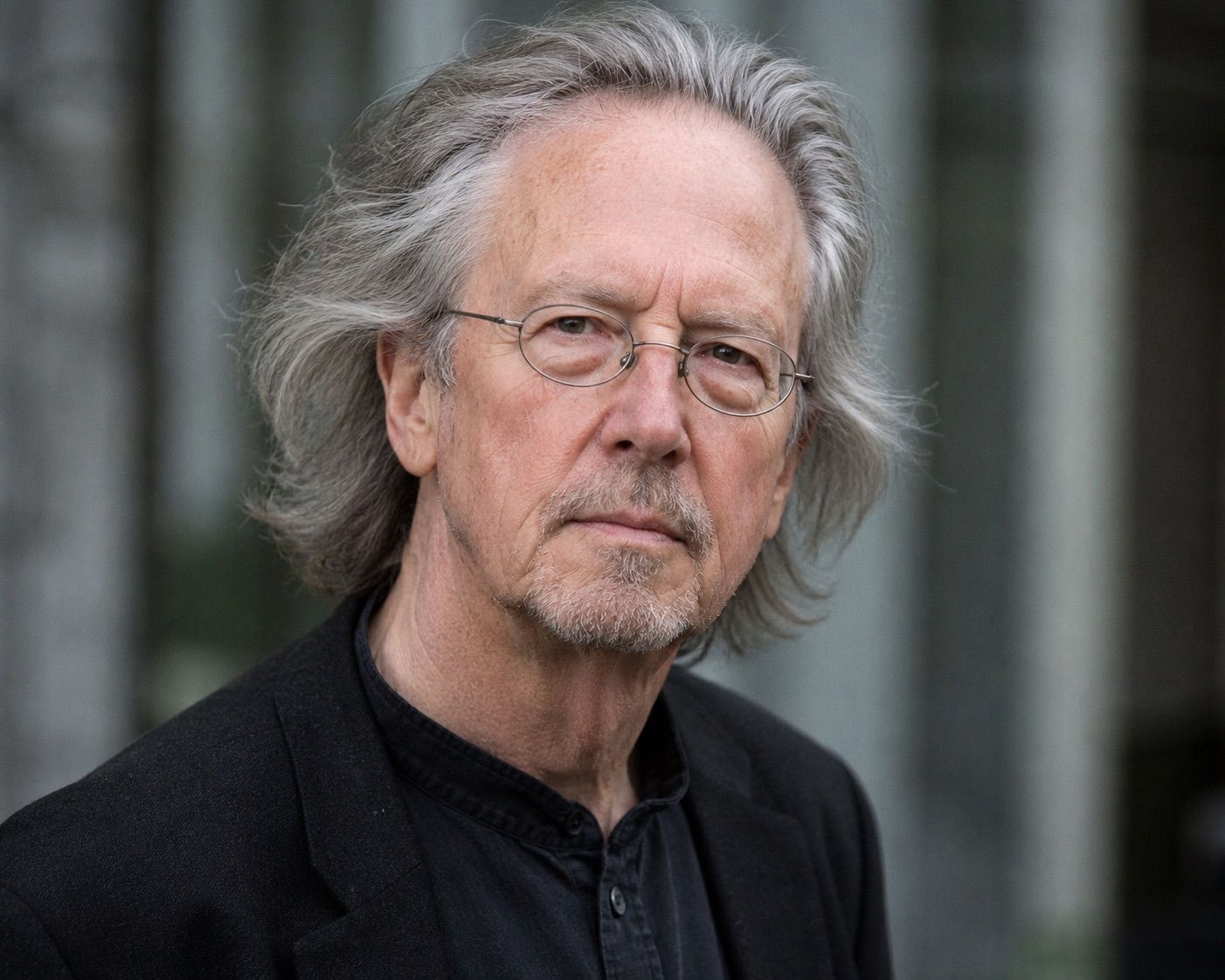
I’ve been thinking a lot about Peter Handke lately, trying to understand what draws me to him. It’s not just his writing – though that’s certainly a big part of it. I mean, have you read “Offending the Audience”? The way he dismantles traditional notions of theatre and performance is like a breath of fresh air. But there’s something more to it than that.
I think what really fascinates me about Handke is his relationship with Yugoslavia during its tumultuous years. Specifically, I’ve been grappling with his defense of Slobodan Milošević, the former Yugoslavian president who led the country into a brutal civil war. It’s hard for me to wrap my head around – how can someone so obviously intelligent and nuanced support such an egregious human rights abuser?
As someone who’s passionate about social justice, I find it deeply unsettling. But at the same time, I’m drawn to Handke’s complexity. He’s not a one-dimensional figure; he’s a multifaceted person with a long history of advocating for peace and understanding. It’s almost as if his support for Milošević is a paradoxical extension of that – an attempt to hold onto the idea of Yugoslavia, to preserve something he saw as beautiful and valuable.
I’ve been wondering what it says about me, too, that I’m so captivated by Handke’s contradictions. Am I drawn to him because I see myself in his complexities? Or is it because I’m trying to make sense of my own feelings about social justice – navigating the gray areas where morality gets murky?
Handke’s experiences during the war are well-documented. He was a vocal supporter of Milošević, but he also spoke out against some of the atrocities committed by Serbian forces. It’s almost as if he’s trying to hold two opposing truths at once: the brutal reality of war and his own idealized vision of Yugoslavia.
I feel like I’m doing something similar in my own life – struggling to reconcile the beauty of a particular place or culture with its darker realities. Maybe that’s what draws me to Handke’s work – it’s not just about exploring the complexities of human nature, but also about grappling with the messy realities of our world.
I’ve been thinking a lot about the phrase “guilt is an aesthetic category” from his essay “A Journey to the Rivers: Justice for Serbia”. What does that even mean? Is he saying that guilt is something we can appreciate, almost as an art form? Or is it more complicated than that – are we guilty simply because we’re aware of our own complicity?
As I read through Handke’s work, I keep coming back to this sense of discomfort. It’s not just about the specifics of his defense of Milošević; it’s about the way he challenges my assumptions and forces me to question my own moral certainties.
I don’t know what to make of all this yet – maybe that’s the point. Maybe Handke’s complexities are a reflection of our own messy, contradictory humanity.
As I delve deeper into Handke’s writing, I find myself oscillating between fascination and repulsion. His words are like a siren song, luring me in with their beauty and nuance, only to leave me feeling unsettled and unsure. It’s as if he’s holding up a mirror to my own contradictions, forcing me to confront the messiness of my own values and beliefs.
I think about all the times I’ve been guilty of reducing complex issues to simplistic labels – “good” vs. “evil”, “right” vs. “wrong”. Handke’s writing is like a gentle prod, encouraging me to see the world in shades of gray rather than black and white. It’s a difficult habit to break, but one that I’m slowly learning to cultivate.
One thing that keeps coming back to me is the idea of complicity. As someone who’s grown up with a relatively privileged existence, I’ve often found myself wondering how much responsibility I bear for the injustices of the world. Handke’s defense of Milošević makes me feel like I’m perpetuating the same kind of simplistic thinking – assuming that the world can be divided into clear-cut categories, rather than acknowledging the messy web of causes and effects.
But what does it mean to acknowledge complicity? Is it simply a matter of recognizing our own flaws and shortcomings, or is there something more at play? Handke’s writing suggests that guilt is not just a moral failing, but also an aesthetic one – a way of experiencing and understanding the world. It’s a tantalizing idea, but one that I’m still struggling to wrap my head around.
I find myself thinking about all the times I’ve been guilty of aestheticizing suffering – romanticizing the beauty of a particular place or culture without fully considering its darker realities. Handke’s writing is like a wake-up call, forcing me to confront the fact that our experiences are always mediated by our own biases and assumptions.
As I continue to grapple with these ideas, I’m starting to realize that my fascination with Handke is not just about him as a person or writer – it’s about myself. It’s about the ways in which I’ve been conditioned to think about the world, and how I can begin to challenge those assumptions.
The more I read about Peter Handke, the more I realize that our complexities are not just individual, but also cultural and historical. His experiences during the Yugoslavian war are inextricably linked to his cultural heritage as an Austrian-German writer. It’s as if he’s caught between two identities – the cosmopolitan, internationalist ideals of a post-war Europe, and the deeply ingrained nationalist sentiments that fueled the conflict.
I think about my own experiences growing up with a mixed heritage – half-white, half-Latin American. How do I reconcile my love for my Mexican mother’s culture with the dominant narratives of privilege and power that exist in the United States? Handke’s writing makes me realize that these are not just personal questions, but also existential ones.
As I delve deeper into his work, I’m struck by the way he challenges traditional notions of identity and belonging. His characters often inhabit liminal spaces – between cultures, languages, and identities. It’s as if they’re constantly negotiating the boundaries between self and other, struggling to find a sense of place in a world that’s always already in flux.
I feel a kinship with these characters, who embody the same contradictions I’ve been grappling with. Am I more American or Mexican? Do I belong to one culture or another? Handke’s writing suggests that identity is never fixed, but always in process – a negotiation between different selves and cultures.
But what does this mean for my own sense of social justice? If identity is fluid and context-dependent, how can I hold anyone accountable for their actions? It’s a question that keeps me up at night – one that Handke’s writing both troubles and inspires.
I’ve been thinking about the concept of “home” in relation to Handke’s work. He often writes about the idea of home as a place of refuge, but also as a source of tension and conflict. In his essay “A Journey to the Rivers: Justice for Serbia”, he describes how the Serbian people felt a deep connection to their homeland, which was torn apart by war.
For me, this resonates with my own experiences growing up in a mixed heritage household. My mother’s family is from Mexico, but we didn’t have much of a physical connection to that country when I was growing up. We lived in the United States, and our cultural traditions were often fragmented or lost in translation. But at the same time, my mother’s stories about her childhood in Mexico, her love for Mexican food and music – these things made me feel connected to this idea of “home” that existed outside of our physical location.
Handke’s writing makes me realize that home is not just a fixed place or identity, but also a feeling, a sense of belonging. And yet, this sense of belonging can be tenuous, vulnerable to the forces of history and culture. When we talk about social justice, are we talking about addressing the root causes of inequality, or are we talking about preserving a particular cultural or national identity?
I’m starting to think that Handke’s complexities – his defense of Milošević, his critique of Western imperialism – are not just individual flaws or contradictions, but also a reflection of our own messy, historical context. We’re living in a world where traditional notions of home and identity are being challenged by global migration, social media, and the internet.
Handke’s writing is like a mirror to this complexity, holding up the tension between different selves and cultures. It’s not just about him as an individual writer, but also about the ways in which we’re all caught up in these larger historical and cultural narratives. And it’s precisely because of his complexities that I’m drawn to him – he’s forcing me to confront my own biases and assumptions, to think more deeply about what it means to belong, to home.
As I continue to grapple with these ideas, I’m starting to realize that Handke’s writing is not just a reflection of his own experiences, but also an invitation to explore the complexities of our own lives. His words are like a siren song, luring me in with their beauty and nuance, but also challenging me to confront the messy realities of our world.
I think about all the times I’ve been guilty of reducing complex issues to simplistic labels – “good” vs. “evil”, “right” vs. “wrong”. Handke’s writing is like a gentle prod, encouraging me to see the world in shades of gray rather than black and white. It’s a difficult habit to break, but one that I’m slowly learning to cultivate.
As I delve deeper into his work, I’m struck by the way he challenges traditional notions of art and literature as separate from politics and culture. His writing is like a fusion of these different discourses – a blend of aesthetics and ethics, form and content.
I feel like I’m caught up in this same dynamic, struggling to reconcile my love for creative expression with my commitment to social justice. Handke’s writing makes me realize that art can be both beautiful and subversive, challenging the status quo while also reflecting our deepest human experiences.
But what does this mean for my own artistic practice? Am I perpetuating the same kind of simplistic thinking by reducing complex issues to aesthetic forms – music, literature, visual arts? Handke’s writing is like a wake-up call, forcing me to confront the fact that art can be both creative expression and social critique.
I’m starting to see Handke’s writing as a kind of mirror held up to my own artistic practice. He’s showing me that art doesn’t have to be separate from politics or culture, but can instead be a way of engaging with the world in all its complexity. It’s a notion that both excites and terrifies me – what if I’m not just creating beautiful things, but also contributing to social change?
I think about my own writing, which is largely driven by a desire for self-expression and exploration. Is this enough? Or am I complicit in perpetuating the same kind of simplistic thinking that Handke critiques? The more I read his work, the more I’m drawn to the idea that art can be both beautiful and subversive – challenging the status quo while also reflecting our deepest human experiences.
It’s a delicate balance, one that I’m still struggling to navigate. Handke’s writing makes me realize that even in my own creative expression, there are power dynamics at play. Who gets to decide what is beautiful or worthy of attention? Is it solely up to the artist, or does it depend on the cultural and historical context?
I think about the ways in which privilege plays out in the art world – how certain voices and perspectives are amplified while others are marginalized. Handke’s writing is like a wake-up call, forcing me to confront my own biases and assumptions. What do I bring to the table when I create? Is it simply my own unique perspective, or am I also carrying with me the privilege of being an educated, middle-class American?
It’s a complicated question, one that Handke’s writing doesn’t answer easily. But what he does offer is a sense of nuance and complexity – a recognition that art is always embedded in its context, whether we like it or not. This realization both liberates and burdens me – I’m free to explore the world in all its messiness, but I’m also responsible for acknowledging my own complicity in systems of power.
As I continue to grapple with these ideas, I’m starting to see Handke’s writing as a kind of invitation to be more honest about myself and my place in the world. He’s showing me that even in the most beautiful or subversive art, there are always power dynamics at play – and it’s up to me to navigate those complexities with care.
It’s a daunting prospect, but also an exhilarating one. Handke’s writing is like a spark that ignites my own creativity and curiosity. I’m not sure where this journey will take me, but I’m excited to find out – and to see what other complexities and contradictions lie ahead.