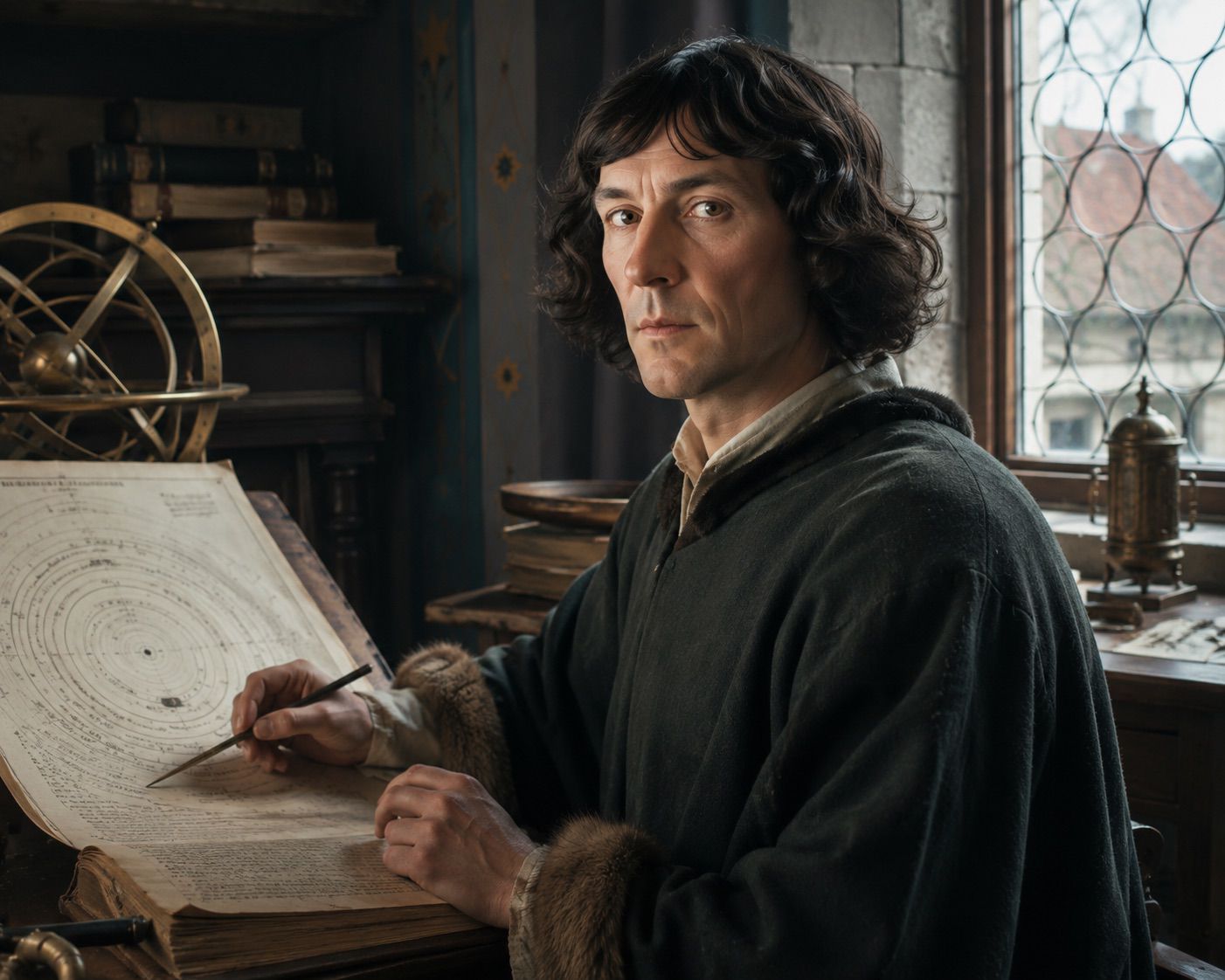
I’ve always been fascinated by Nikolaus Copernicus, but not for the reasons you might think. It’s not his groundbreaking heliocentric model that sparks my interest – although I do appreciate how it challenged the conventional thinking of his time. No, what really draws me to him is the mystery surrounding his motivations.
As a writer, I’m accustomed to exploring the complexities of human thought and emotion. And Copernicus, with his measured approach and calculated precision, seems like an enigma wrapped in a paradox. He spent decades developing his theory, pouring over astronomical observations and mathematical calculations, yet he hesitated to share it publicly during his lifetime.
This reserved nature has always struck me as intriguing. Why would someone so devoted to uncovering the secrets of the universe hold back from sharing their findings? Was he afraid of ridicule or persecution? Or was there something more at play?
I find myself drawn to his cautious approach, almost as if I’m trying to understand a part of myself. As someone who’s also struggled with sharing my own creative work – whether it’s writing or art – I can relate to Copernicus’ sense of trepidation.
When I finally mustered the courage to submit my thesis for review, I felt like I was opening myself up to scrutiny and criticism. It’s a vulnerable position, one that requires a deep trust in oneself and others. And yet, even with that trust, there’s always a lingering fear of being misunderstood or rejected.
Copernicus’ hesitation makes me wonder if he, too, grappled with this vulnerability. Did he worry about how his peers would react to the radical idea of a sun-centered universe? Or was it something more personal – a fear of disrupting the social order, perhaps?
I’m not sure I’ll ever fully understand Copernicus’ motivations, but that’s what draws me in. The complexity of human thought and emotion is something I’ve always tried to capture in my writing, and he represents a fascinating case study.
As I delve deeper into his life and work, I find myself oscillating between admiration for his intellectual rigor and frustration with his caution. It’s almost as if he’s holding back a secret, one that only reveals itself when you look closely at the margins of his texts or the silences in his letters.
In many ways, Copernicus’ story is a reminder that even the most groundbreaking ideas often emerge from a place of quiet contemplation and careful consideration. And it’s precisely this introspection – this willingness to explore the complexities of one’s own thoughts and emotions – that I admire about him.
Still, as much as I’d like to simplify his story or reduce it to a neat narrative arc, I’m stuck on this sense of ambiguity. Maybe that’s what draws me to him in the first place – the realization that even the most brilliant minds can be shrouded in mystery, and that sometimes it’s precisely this uncertainty that makes them all the more compelling.
I’ll continue to grapple with Copernicus’ enigma, to follow the threads of his thoughts and emotions as they weave in and out of history. It’s a journey that will likely take me down unexpected paths and into unexplored territories – but one that I’m eager to embark on, nonetheless.
As I wander through the labyrinth of Copernicus’ thoughts, I find myself encountering echoes of my own struggles with self-doubt and uncertainty. There’s a particular letter he wrote to his friend, Tiedemann Giese, that speaks volumes about his inner turmoil. In it, he shares his fears about publishing his heliocentric model, confessing that “I fear the imbecility of the multitude” and the potential backlash from those who will reject his ideas.
I can relate to this fear all too well. There have been times when I’ve doubted my own writing, wondering if anyone would even care to read it. The thought of pouring my heart and soul into a piece only to have it met with indifference or criticism is a daunting one. It’s a feeling that can be paralyzing, causing me to hesitate and question the value of my work.
But what struck me about Copernicus’ letter was the way he juxtaposes this fear with his passion for discovery. He writes about the importance of pursuing truth, no matter how unpopular it may be, and the need to trust in one’s own convictions. It’s a sentiment that resonates deeply with me, as I’ve often found myself at odds with my own doubts and fears.
As I continue to explore Copernicus’ life and work, I’m beginning to see him not just as a brilliant astronomer or mathematician, but as a complex human being struggling to reconcile his desire for truth with the uncertainty of the world around him. His story is a reminder that even the most groundbreaking ideas often emerge from a place of vulnerability and self-doubt.
This realization has me thinking about my own writing process, and how I can cultivate more courage in the face of uncertainty. Copernicus’ example suggests that it’s not about silencing our doubts or fears, but rather about acknowledging them and pushing forward despite them. It’s a challenging but ultimately liberating prospect – one that I’m eager to explore further in my own writing.
As I ponder the parallels between Copernicus’ experiences and mine, I find myself questioning the nature of vulnerability in creative work. Is it possible to create something truly meaningful without exposing ourselves to potential criticism or rejection? Or is it precisely this risk that fuels our most innovative ideas?
I think back to my thesis submission, and how it felt like a culmination of all my hard work and dedication. But what if I had failed to submit it? What if I had let my fears hold me back from sharing my ideas with the world? The thought sends a shiver down my spine – not just because of the potential consequences, but also because of the missed opportunity.
Copernicus’ hesitation to share his heliocentric model has always struck me as a cautionary tale about the importance of taking risks in creative pursuits. But what if I’m reading too much into it? What if he was simply being cautious, rather than courageous?
As I delve deeper into his life and work, I begin to see the complexity of his decision-making process. He was, after all, a product of his time – a time when challenging authority or pushing boundaries could be met with severe consequences. Perhaps his hesitation was not just about fear, but also about survival.
This realization has me thinking about my own positionality as a writer. Am I being too cautious in sharing my ideas, or am I simply acknowledging the risks that come with speaking truth to power? Is it possible to walk this fine line between vulnerability and self-preservation?
I’m not sure I have the answers to these questions, but I do know that Copernicus’ story has forced me to confront my own fears and doubts head-on. As I continue to explore his life and work, I’m beginning to see him not just as a historical figure, but also as a kindred spirit – someone who understands the intricacies of human emotion and the complexity of creative expression.
And it’s precisely this understanding that has me wondering about the role of vulnerability in my own writing. Can I find a way to balance my desire for creative freedom with the need to protect myself from potential harm? Or will I forever be trapped in this liminal space, oscillating between doubt and courage?
As I ponder these questions, I’m reminded of the words of another writer who once said, “The only thing necessary for the triumph of evil is for good men to do nothing.” It’s a quote that has always resonated with me, but it’s taken on new meaning as I reflect on Copernicus’ life and work.
Perhaps, I think, vulnerability is not just about exposing ourselves to criticism or rejection – but also about taking action in the face of uncertainty. Maybe it’s precisely this willingness to take risks that allows us to create something truly meaningful, even if it means facing fear and doubt along the way.
As I continue to reflect on Copernicus’ story, I find myself drawn into the world of Renaissance Poland, where astronomers and mathematicians were pushing the boundaries of human knowledge. It’s a fascinating era, marked by both intellectual curiosity and social constraint – much like my own struggles as a writer.
I’m struck by the way Copernicus navigated this complex landscape, balancing his passion for discovery with the need to conform to societal norms. His decision to publish his heliocentric model anonymously, under the pseudonym of Nicolaus Torneus, speaks volumes about the risks he was willing to take in pursuit of truth.
As I read through the accounts of his life and work, I’m struck by the sense of community that existed among astronomers and mathematicians during this time. They formed a sort of underground network, sharing ideas and debating theories in secret – much like the way writers today might share their work online or in small writing groups.
This notion of a hidden world of intellectuals, working together to push the boundaries of human knowledge, resonates deeply with me. As someone who’s often felt isolated in my own creative pursuits, it’s comforting to imagine that there are others out there who understand the challenges and rewards of this work.
But as I delve deeper into Copernicus’ story, I’m also reminded of the ways in which his world was vastly different from mine. The social norms and expectations of 16th-century Poland were far more rigid than those of today – and yet, even within these constraints, there existed a vibrant culture of intellectual curiosity and innovation.
This paradox has me wondering about my own place in the world as a writer. Do I have the freedom to explore new ideas and push boundaries, or am I bound by the expectations of others? Am I part of this underground network of creatives, working together to advance human knowledge – or am I simply trying to make it through each day without getting hurt?
These questions swirl around me as I continue to reflect on Copernicus’ life and work. His story is a complex tapestry of intellectual curiosity, social constraint, and personal vulnerability – one that speaks to my own experiences as a writer in ways both surprising and profound.
As I ponder the parallels between our lives, I’m struck by the way Copernicus’ legacy has endured despite (or perhaps because of) his initial hesitation to share his ideas. His heliocentric model may have been revolutionary in its time, but it’s also a testament to the power of human creativity and perseverance.
I find myself wondering what my own legacy will be – not as a writer, necessarily, but as a person who took risks and pushed boundaries in pursuit of truth. Will I be remembered for my ideas, or for my willingness to share them with the world? Or will it be something else entirely?
The questions swirl around me like a vortex, pulling me deeper into the mystery of Copernicus’ story – and my own place within it.
As I ponder the legacy question, I’m reminded of a conversation I had with a fellow writer about the importance of vulnerability in creative work. She told me that she used to be terrified of sharing her writing online, fearing criticism and rejection. But after finally mustering the courage to post a piece on social media, she was surprised by the outpouring of support and encouragement from readers.
She said it was like a weight had been lifted off her shoulders – not just because people were kind, but also because she realized that sharing her work didn’t make her any less vulnerable. If anything, it made her more visible, and therefore more accountable for her ideas.
I think about this conversation as I reflect on Copernicus’ decision to publish his heliocentric model anonymously. Was he trying to protect himself from criticism, or was it a way of asserting control over the narrative? Did he want to make sure that his ideas were taken seriously, without being tied to his personal reputation?
These questions lead me to wonder about the relationship between identity and creativity. As a writer, I’m constantly grappling with how much of myself to reveal in my work – and whether that’s even possible. Can we separate our personal experiences from our creative output, or are they inherently linked?
Copernicus’ use of a pseudonym raises more questions than answers for me. Was it a way of maintaining his intellectual integrity, separate from the social expectations placed upon him as a member of the clergy? Or was it simply a pragmatic decision to avoid controversy?
As I continue to explore these questions, I’m struck by the ways in which Copernicus’ story intersects with my own experiences as a writer. His caution and vulnerability are traits that I can identify with, and yet, they’re also things that I struggle with.
I think about how often I’ve hesitated to share my work, fearing rejection or criticism. But what if that’s not just about me? What if it’s about the way society expects us to present ourselves as writers – confident, self-assured, and unflappable?
Copernicus’ use of a pseudonym challenges this expectation in a way that feels both subversive and liberating. It’s like he’s saying, “I’m still me, even if I don’t want you to know my name.” And isn’t that the ultimate act of vulnerability – to expose ourselves as imperfect, flawed creatures, rather than trying to project an image of invincibility?
As I ponder this question, I realize that Copernicus’ legacy is not just about his scientific discoveries or intellectual achievements. It’s also about the way he embodied a certain kind of creative spirit – one that’s willing to take risks, challenge conventions, and push boundaries.
This realization has me wondering what my own creative spirit looks like. Am I more like Copernicus, with his caution and reserve, or am I someone who throws caution to the wind and shares their ideas without hesitation?
The answer, as always, is complicated. But one thing’s for sure – as I continue to explore Copernicus’ story, I’m being forced to confront my own vulnerabilities and fears head-on. And that’s a journey that’s both scary and exhilarating all at once.