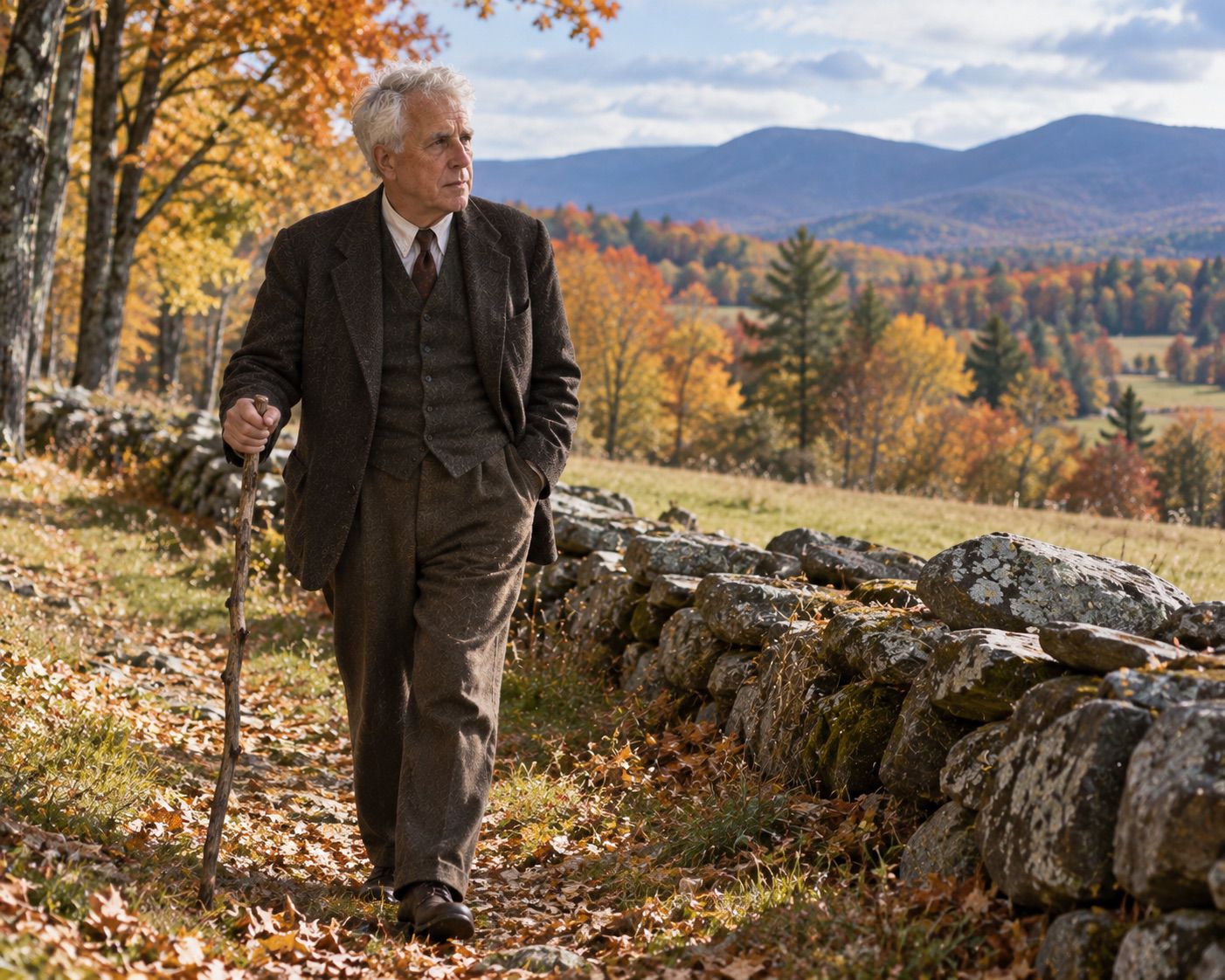
I’ve always been fascinated by Robert Frost’s poetry, but it wasn’t until I read his biography that I started to feel a strange kinship with him. Not because we share similar experiences or interests, but because of the way he navigates complexity and ambiguity in his work.
As a writer, I’m drawn to Frost’s ability to convey multiple perspectives without ever fully resolving them. His poems often seem to hover between two opposing ideas, like the woods in “The Road Not Taken” – dark and foreboding on one side, but also full of possibility and promise on the other. It’s as if he’s acknowledging that sometimes we have to choose between two undesirable options, or that the choice itself is what creates the complexity.
I find myself doing something similar when I write. I’ll start with a clear idea in mind, only to discover that it’s not so clear-cut after all. The more I explore the topic, the more nuances and contradictions emerge. It’s like Frost said: “The truth must dazzle gradually / Or every man be blind.” (From “A Servant to Servants”) I feel a sense of responsibility to capture these complexities in my own writing, but it can also leave me feeling uncertain and unsure.
Frost’s personal life is another area where I find myself drawn into the gray areas. His relationship with his wife, Elinor, seems almost suffocating at times – they were married for 46 years, but there are hints of tension and frustration in their interactions. It’s hard not to wonder if their marriage was a product of its time, or if it was genuinely fulfilling for both parties.
As someone who values independence and autonomy, I find myself questioning Frost’s choices. Did he truly value his individuality, or did he see marriage as a way to settle down and establish himself? It’s not that I think I would have made different decisions – I’m still figuring out my own life! – but rather that I want to understand why Frost made the choices he did.
Frost’s poetry also has a tendency to be quite lyrical, which can sometimes feel at odds with its dark and introspective themes. Take “Stopping by Woods on a Snowy Evening,” for example: it’s one of his most famous poems, but it’s also incredibly enigmatic. On the surface, it seems like a peaceful and serene description of a winter landscape – but scratch beneath the surface, and you’ll find all sorts of ambiguities and paradoxes.
I think what I love about Frost is that he’s not afraid to be ambiguous, to leave things unsaid or unresolved. In an age where clarity and precision are often prized above all else, his willingness to grapple with complexity feels almost radical. As a writer, it’s inspiring to see someone who values the messy, imperfect nature of human experience.
It’s funny – when I first started reading Frost, I thought he was going to be this safe, comforting presence in my life as a writer. But instead, he’s turned out to be a source of discomfort and uncertainty, pushing me to confront the ambiguities that lie at the heart of all creative work. Maybe that’s what draws me to him – not just his poetry, but his willingness to inhabit those gray areas, to let the complexity shine through.
As I delve deeper into Frost’s work and life, I find myself drawn to the tension between his desire for simplicity and his need to grapple with complexity. His poetry often seems to long for a sense of clarity, but is ultimately thwarted by the messiness of human experience. This ambivalence resonates deeply with me, as I navigate my own struggles to find meaning in the world.
I think about how Frost’s love of nature – particularly the woods and mountains of New England – can be seen as a metaphor for his desire for simplicity and connection to something greater than himself. Yet, even in these idyllic settings, he often finds ways to complicate and subvert our expectations. The woods are not just peaceful and serene; they’re also dark and foreboding, full of secrets and unseen dangers.
This paradox is reflected in my own writing, where I often struggle to balance the need for clarity with the demands of complexity. When I’m working on a piece, I might start out with a clear idea or message – but as I dig deeper, I begin to realize that there are multiple perspectives at play, and that the truth is not so easily distilled. It’s a frustration I’ve come to expect from my writing, and one that Frost seems to understand all too well.
One of the most striking things about Frost’s poetry is its ability to capture the nuances of human experience – the moments when we’re caught between two opposing emotions or desires. His poem “Mending Wall” comes to mind, where he explores the tension between individuality and conformity, as embodied in the image of a man repairing a stone wall that separates his property from his neighbor’s.
What strikes me about this poem is not just its exploration of these complex themes, but also the way Frost presents them through the voices of two characters. The speaker and his neighbor are engaged in a conversation about the wall, but they’re also representing different perspectives on the nature of reality – the speaker sees the world as a place of individuality and freedom, while the neighbor views it as a realm of fixed boundaries and obligations.
I find myself returning to this poem again and again, not just because of its technical skill or its exploration of complex themes, but because of the way it captures the ambiguity of human experience. We’re all caught between multiple perspectives, pulled in different directions by our desires and fears. And yet, as Frost shows us, it’s precisely these contradictions that make life worth living – that give it depth, complexity, and meaning.
As I continue to explore Frost’s work, I’m struck by the sense of unease that often accompanies his poetry. It’s not a feeling of discomfort or anxiety, exactly, but rather a sense of being on the cusp of something new and uncertain. Like Frost himself, I find myself drawn to the unknown, to the spaces between what we think we know and what lies beyond our understanding.
And yet, even as I’m drawn into these gray areas, I’m also aware that there’s a risk involved – the risk of getting lost in ambiguity, of losing my footing on solid ground. It’s a tension that Frost seems to understand all too well, one that he captures with uncanny precision in his poetry.
For me, Frost’s work is not just about capturing complex themes or exploring nuanced emotions; it’s also about finding a way forward, even when the path ahead is uncertain. He shows us that complexity is not something to be feared or avoided, but rather something to be embraced – that it’s precisely in these gray areas that we find true meaning and connection with the world around us.
As I delve deeper into Frost’s poetry, I’m struck by the way he seems to inhabit multiple worlds at once. His poems often feel like snapshots of different moments in time, each one a window into a unique perspective or experience. And yet, despite these fragmented narratives, there’s a sense of cohesion and continuity that underlies his work – a thread that weaves together disparate threads and perspectives.
I think about how this echoes my own experiences as a writer. When I’m working on a piece, I often feel like I’m trying to capture multiple versions of myself at once. I’ll start out with one clear idea or perspective, only to discover that it’s not so simple after all. The more I write, the more nuances and contradictions emerge, and I find myself drawn into the gray areas between opposing ideas.
It’s almost as if Frost is showing me that this is what writing itself is – a negotiation between multiple perspectives and desires. And yet, despite the ambiguity and uncertainty of it all, there’s a sense of clarity and purpose that underlies his work. It’s a paradox that I’m still trying to wrap my head around, but one that feels both exhilarating and terrifying.
One of the things that draws me to Frost is his ability to convey the complexity of human emotion without ever resorting to sentimentality or melodrama. His poems are never straightforward or didactic; instead, they’re richly nuanced and open-ended, inviting the reader to fill in the gaps with their own experiences and perspectives.
I think about how this approach resonates with me as a writer. When I’m working on a piece, I often feel like I’m trying to capture the essence of a particular emotion or experience – but it’s never quite that simple. Emotions are messy and multifaceted, existing at the intersection of multiple desires and fears.
Frost seems to understand this complexity intuitively, capturing emotions in all their messy, contradictory glory. His poems are like snapshots of moments in time, each one a window into a unique perspective or experience. And yet, despite these fragmented narratives, there’s a sense of cohesion and continuity that underlies his work – a thread that weaves together disparate threads and perspectives.
As I continue to explore Frost’s poetry, I’m struck by the way he seems to inhabit multiple worlds at once. His poems often feel like snapshots of different moments in time, each one a window into a unique perspective or experience. And yet, despite these fragmented narratives, there’s a sense of cohesion and continuity that underlies his work – a thread that weaves together disparate threads and perspectives.
I’m not sure where this will lead me, but I’m excited to find out.
One of the things that continues to fascinate me about Frost is the way he uses nature as a metaphor for human experience. In his poems, trees are not just trees – they’re symbols of wisdom and strength, or perhaps even vulnerability and fragility. The natural world becomes a kind of mirror, reflecting back at us our own complexities and contradictions.
As I read through his poetry, I find myself thinking about my own relationship with nature. Growing up in the city, I’ve always felt a bit disconnected from the natural world – but as I’ve gotten older, I’ve begun to appreciate its beauty and power. There’s something about being in the woods or by the water that feels like a balm to my soul.
Frost seems to understand this instinctively, capturing the way nature can be both calming and unsettling at the same time. In “The Witch of Coös,” he writes about an old woman who lives on the edge of a forest, surrounded by strange and sinister creatures. On one level, the poem is a spooky tale – but on another, it’s a reflection of our own fears and anxieties.
I think about how this resonates with me as a writer. When I’m working on a piece, I often feel like I’m trying to capture the essence of a particular emotion or experience – but it’s never quite that simple. Emotions are messy and multifaceted, existing at the intersection of multiple desires and fears.
Frost seems to understand this complexity intuitively, capturing emotions in all their messy, contradictory glory. His poems are like snapshots of moments in time, each one a window into a unique perspective or experience. And yet, despite these fragmented narratives, there’s a sense of cohesion and continuity that underlies his work – a thread that weaves together disparate threads and perspectives.
As I continue to explore Frost’s poetry, I’m struck by the way he uses language itself as a kind of metaphor for human experience. In “The Oven Bird,” he writes about a bird that sings its song over and over again, never changing its tune. On one level, the poem is a commentary on the cyclical nature of life – but on another, it’s a reflection of our own tendency to repeat ourselves, to get stuck in patterns of thought and behavior.
I think about how this resonates with me as a writer. When I’m working on a piece, I often feel like I’m trying to break free from the constraints of language itself. I want my words to be fresh and original, to capture the unique essence of an experience or emotion – but at the same time, I know that language is always limited, always imperfect.
Frost seems to understand this tension intuitively, using language in ways that are both precise and evocative. His poems are like puzzles, each one a complex web of images and symbols that invite the reader to fill in the gaps with their own experiences and perspectives.
As I continue to explore Frost’s poetry, I’m struck by the way he seems to inhabit multiple worlds at once. His poems often feel like snapshots of different moments in time, each one a window into a unique perspective or experience. And yet, despite these fragmented narratives, there’s a sense of cohesion and continuity that underlies his work – a thread that weaves together disparate threads and perspectives.
I’m not sure where this will lead me, but I’m excited to find out.