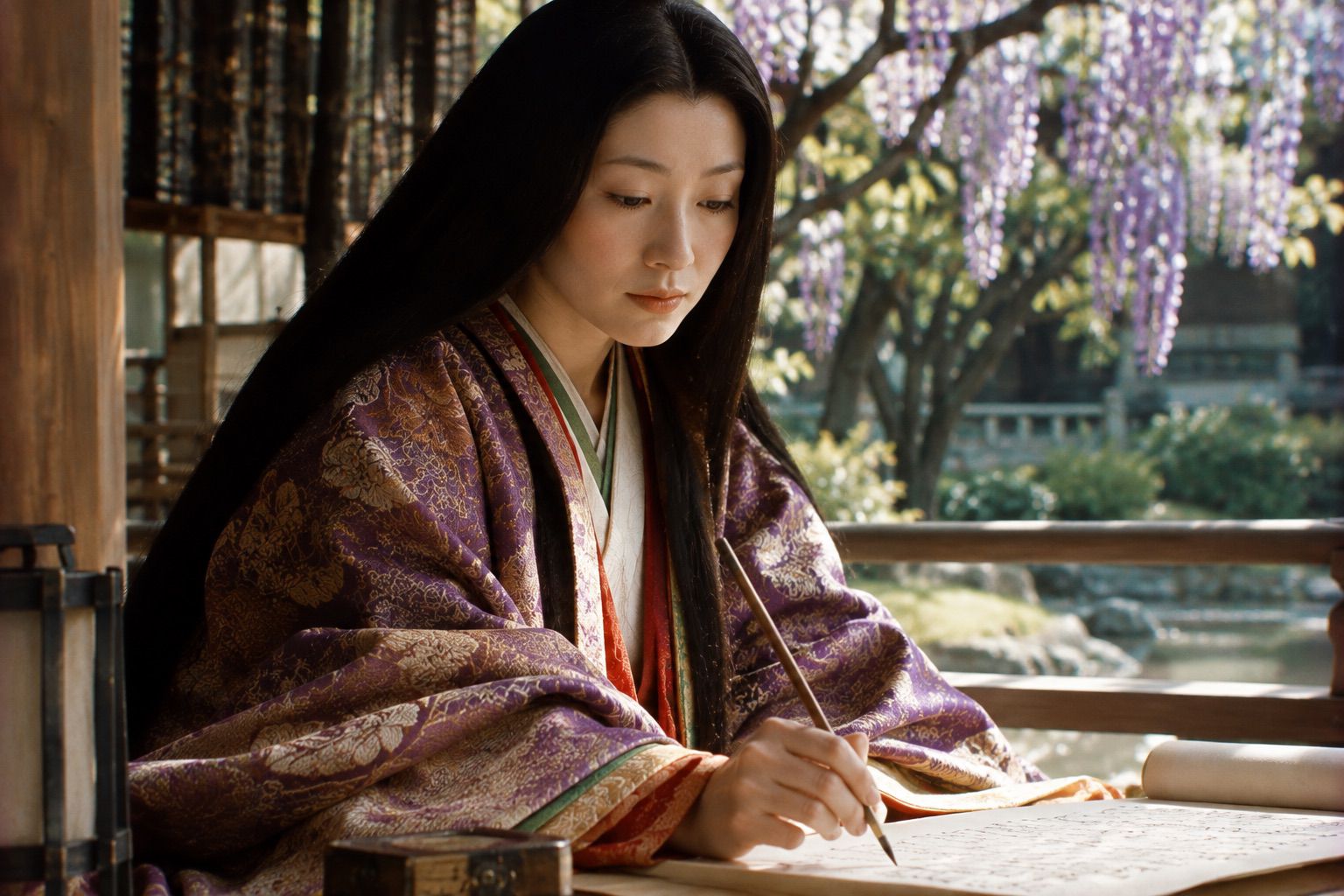
Murasaki Shikibu’s story has been on my mind a lot lately, probably because I’ve been struggling to find my own place within the confines of tradition and expectation. As I read about her life, I’m struck by how familiar her struggles feel – the weight of responsibility, the pressure to conform, the desire for autonomy.
It’s hard not to see myself in her, at least on some level. We’re both women who grew up in a time when our choices were limited, and our futures largely predetermined. She was born into a noble family in 10th-century Japan; I’m the daughter of a middle-class American family living in suburban New Jersey. But despite these differences, there’s something about her story that resonates with me.
One thing that keeps drawing me back to Murasaki is her writing itself – or rather, her relationship with it. She was a court lady, a member of the imperial household, and yet she poured all her thoughts and feelings into a novel called The Tale of Genji. It’s this paradox that fascinates me: how could someone so deeply entrenched in tradition find the courage to create something so innovative, so bold?
For Murasaki, writing was a way of exploring the world around her – but also of escaping it. She wrote about the intricate hierarchies and social norms of court life, but she also used those conventions as a starting point for her own experimentation and subversion. And in doing so, she created this rich, complex world that feels both timeless and deeply rooted in its time.
As I read about Murasaki’s experiences, I find myself questioning my own relationship with writing – and the expectations that come with it. Am I using writing as a way to cope with the pressures of modern life, just like she did? Or am I trying to break free from those constraints, to create something new and original? The truth is, I’m not entirely sure.
Murasaki’s story also makes me think about the tension between tradition and innovation. She was writing during a time when literature was heavily influenced by classical Chinese models – but she was determined to carve out her own path, even if it meant pushing against those conventions. It’s this spirit of creative dissent that I admire most about her.
But there are also moments where I feel disconnected from Murasaki’s experiences. She was born into a life of privilege; I’ve had to fight for every opportunity I’ve ever gotten. And yet, when I read about her struggles with anxiety and depression, I feel a sense of solidarity – as if we’re both navigating the same kinds of emotional landscapes.
As I continue to explore Murasaki’s story, I’m struck by how much there is still to learn – about her life, about her writing, about the world she lived in. There are gaps in our knowledge that will never be filled; secrets that will remain forever hidden. And yet it’s precisely those unknowns that make me keep coming back to her, drawn by the mystery of her story and the mystery of my own place within it.
In many ways, Murasaki’s writing is a reminder that even the most seemingly rigid structures can be subverted – that even in the midst of tradition and expectation, there’s always room for innovation, for experimentation, for self-expression. And as I navigate my own journey as a writer and a woman, her story serves as a powerful reminder of the power of creativity to disrupt, to disturb, and to transform.
As I delve deeper into Murasaki’s world, I find myself fascinated by her use of language – the way she weaves together subtle nuances of tone and meaning to create a rich tapestry of emotions and experiences. Her writing is like a puzzle, with each piece carefully crafted to reflect the complexities of human relationships and the inner lives of her characters.
I’m particularly drawn to the way Murasaki explores the boundaries between reality and fantasy in The Tale of Genji. She takes historical events and figures, but then manipulates them to create this dreamlike world that’s both rooted in tradition and yet utterly unique. It’s as if she’s saying: “This is what could have been, or maybe even should be.” And I’m struck by how similar it feels to my own writing process – the way I try to capture the essence of a moment, but then twist it just enough to make it feel new and original.
But there are also moments where I feel like I’m getting lost in Murasaki’s world. The courtly language, the complex social hierarchies – it can be overwhelming at times. And yet, even as I struggle to keep up with the historical context, I find myself drawn back to the emotional resonance of her writing. It’s like she’s speaking directly to me, across centuries and cultures.
I wonder if that’s what happens when we read about people from different times and places – we connect on a deeper level because of our shared humanity, despite the surface-level differences between us. Murasaki’s story makes me realize how much I’ve been taking my own privileges for granted – the fact that I can read, write, and share my thoughts with others without fear of reprisal or persecution.
As I continue to explore her life and writing, I’m struck by the ways in which she navigates these complexities. She’s a product of her time, but also a rebel within it – using her art to subvert expectations and challenge the status quo. And I’m left wondering: what would happen if I did the same? If I used my writing as a way to disrupt the norms that bind me, rather than just conforming to them?
It’s a daunting prospect, but also exhilarating. The more I learn about Murasaki Shikibu, the more I feel like I’m uncovering a part of myself – a part that’s been waiting to be expressed, to be set free. And so I’ll keep writing, keep exploring her story and my own, because in the end, it’s not just about creating art or fiction – it’s about discovering who we are, and what we’re capable of becoming.
As I reflect on Murasaki’s use of language, I’m struck by how she employs a range of literary devices to convey the complexities of human emotions. She uses metaphor, simile, and personification to create vivid descriptions that not only paint a picture but also invite the reader into her inner world.
I find myself marveling at her ability to capture the subtleties of courtly love, with its intricate hierarchies and etiquette-laden relationships. It’s as if she’s revealing a hidden language, one that speaks directly to the heart of what it means to be human. And yet, even as I’m drawn into this world, I’m also aware of the ways in which her writing is embedded within the context of its time.
For example, her portrayal of Genji’s many loves and mistresses raises questions about consent, agency, and power dynamics. On one hand, her writing suggests a deep understanding of the complexities of human relationships; on the other, it also reinforces some problematic attitudes towards women and their bodies. It’s this tension that makes me feel uncomfortable – as if I’m being asked to navigate a minefield of cultural sensitivities.
I wonder: how would Murasaki have written about these issues in her own time? Would she have been able to challenge the social norms that governed her world, or was she bound by the very same expectations that she critiques through her writing?
As I grapple with these questions, I’m reminded of my own struggles as a writer. How do I balance my desire to create art that speaks to the human experience with the need to acknowledge and address the problematic aspects of history? Can I, like Murasaki, use my writing to subvert expectations and challenge the status quo?
It’s a daunting prospect, but also an exhilarating one. The more I learn about Murasaki Shikibu, the more I feel like I’m uncovering a part of myself – a part that’s been waiting to be expressed, to be set free.
And so I’ll keep writing, keep exploring her story and my own, because in the end, it’s not just about creating art or fiction – it’s about discovering who we are, and what we’re capable of becoming.
As I delve deeper into Murasaki’s world, I find myself fascinated by her exploration of the human condition. Her writing is a masterclass in subtlety, nuance, and complexity. She takes the mundane and elevates it to an art form, revealing the intricate web of emotions that underlies even the most seemingly ordinary experiences.
One aspect of Murasaki’s writing that I find particularly compelling is her use of character development. Her protagonist, Genji, is a masterfully crafted creation – flawed, multifaceted, and relatable. He’s a product of his time, yet somehow transcends it, speaking to universal human desires and frailties.
As I read about Genji’s many loves and relationships, I’m struck by the ways in which Murasaki portrays women as agents of their own destiny. They’re not simply passive objects of desire; they’re active participants in the narrative, with their own motivations, desires, and agency. It’s a refreshingly modern take on courtly love, one that challenges traditional notions of female subservience.
But it’s also this portrayal of women that makes me uncomfortable. Some of Murasaki’s depictions of female characters feel problematic, even misogynistic. Take the character of Narayama, for example – a woman who’s both pitied and reviled by society due to her perceived shortcomings. Her fate is a tragic one, and yet it feels like a commentary on the societal norms that governed women’s lives during Murasaki’s time.
I find myself wondering: how can I reconcile my admiration for Murasaki’s writing with my discomfort at its more problematic aspects? Is it possible to separate the art from the artist, or do we risk perpetuating the very same attitudes and biases that we’re trying to critique?
As I grapple with these questions, I’m reminded of my own experiences as a woman writer. I’ve faced my share of sexism, misogyny, and marginalization – all of which have left their mark on my writing and my psyche. And yet, I’ve also been privileged in ways that many women writers haven’t – having access to education, resources, and opportunities that others can only dream of.
It’s this tension between privilege and marginalization that makes me feel like I’m walking a tightrope as a writer. How do I use my voice to amplify the experiences of those who’ve been silenced or marginalized, without perpetuating the very same systems of oppression that have held them back?
Murasaki Shikibu’s story has given me a lot to think about – not just in terms of her writing, but also in terms of my own relationship with tradition and expectation. As I navigate my own journey as a writer and a woman, I’m drawn back to her paradoxical world again and again – a world that’s both deeply rooted in its time and yet utterly timeless.
And it’s this sense of connection that keeps me coming back to Murasaki’s story – the feeling that, despite our differences, we’re all part of some larger narrative, one that spans centuries, cultures, and experiences. It’s a powerful reminder that our stories are never just about ourselves; they’re about the world around us, the people who came before us, and the ones who will come after.
As I continue to delve into Murasaki Shikibu’s story, I’m struck by the ways in which she uses language to create a sense of intimacy and connection with her readers. Her writing is like a warm ember that draws you in, making you feel like you’re part of some secret world that only exists between the lines.
One aspect of Murasaki’s writing that fascinates me is her use of descriptive language. She has this incredible ability to paint vivid pictures with words, transporting you to another time and place. Her descriptions of nature are particularly striking – the way she captures the scent of cherry blossoms or the sound of autumn leaves rustling in the wind.
But what I think I admire most about Murasaki’s writing is its emotional depth. She has this remarkable ability to convey complex emotions through subtle hints and suggestions, rather than outright statements. It’s like she’s tapping into a deeper wellspring of human experience, one that transcends cultural and historical boundaries.
As I read her words, I find myself thinking about my own struggles with anxiety and depression. There are moments when the darkness feels overwhelming, and I wonder how Murasaki navigated similar challenges in her life. Did she, like me, feel like she was struggling to keep up with the expectations of others? Or did she, as a member of the imperial household, have access to resources that helped her cope?
I’m not sure if I’ll ever find out, but it’s clear that Murasaki’s experiences inform her writing in profound ways. Her portrayal of Genji’s struggles with mental health is both heartbreaking and hopeful – a testament to the human capacity for resilience and growth.
As I reflect on Murasaki’s story, I’m struck by the ways in which she challenges traditional notions of femininity and womanhood. She takes these rigid expectations and turns them inside out, revealing the complexity and nuance that lies beneath. Her female characters are multidimensional and flawed, with their own desires, motivations, and agency.
It’s a powerful reminder that women have always been more than just objects of desire or passive recipients of patriarchal oppression. We’ve been active participants in shaping our own destinies, even when the world around us has tried to constrain us.
Murasaki’s writing is like a mirror held up to my own experiences as a woman writer. I see myself reflected in her struggles with societal expectations and creative freedom. But I also see myself in her triumphs – the moments when she dares to challenge the status quo, to subvert conventions and push against the boundaries of what’s considered acceptable.
As I continue to explore Murasaki’s story, I’m left wondering: how can I use my own writing as a tool for social change? How can I take the lessons I’ve learned from her experiences and apply them to my own life, to create something new and original?
It’s a daunting question, but also an exhilarating one. The more I learn about Murasaki Shikibu, the more I feel like I’m uncovering a part of myself – a part that’s been waiting to be expressed, to be set free.
And so I’ll keep writing, keep exploring her story and my own, because in the end, it’s not just about creating art or fiction – it’s about discovering who we are, and what we’re capable of becoming.