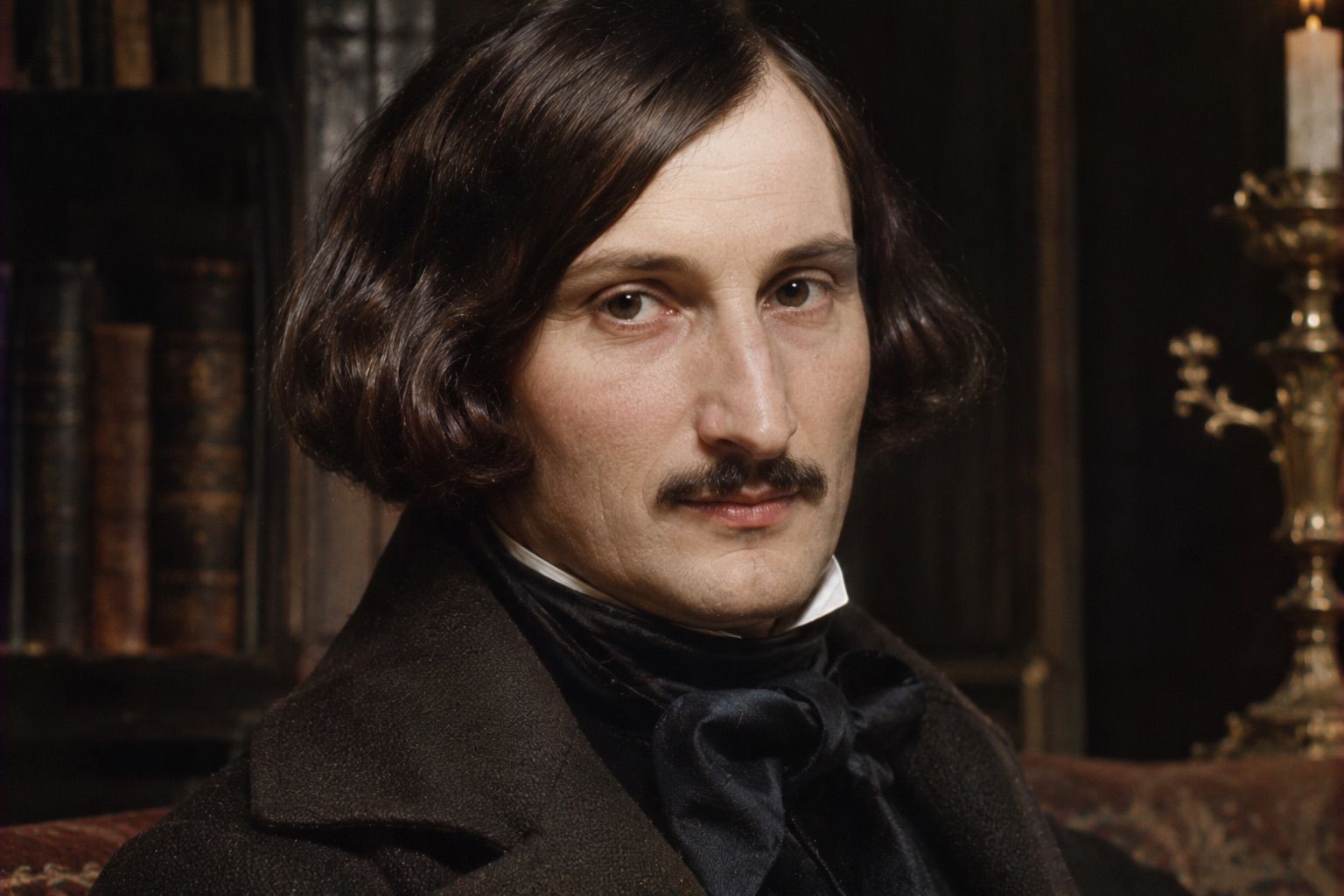
Nikolai Gogol’s existence is like a mirage on the horizon of my mind – I’ve always known he was there, but the closer I look, the more elusive he becomes. As I try to grasp his essence, I find myself lost in the labyrinthine streets of St. Petersburg, where he spent most of his life.
I’m drawn to Gogol’s struggles with identity, with being a Ukrainian-born writer living in a predominantly Russian culture. His work is riddled with contradictions – he writes about the absurdities and hypocrisies of Russian society, yet he also seems to revel in its grandeur and mystique. I wonder if this was a reflection of his own inner turmoil, caught between two worlds that didn’t quite fit.
I’ve always been fascinated by Gogol’s novel “Dead Souls,” which reads like a fever dream of Russia’s rural underbelly. The characters are a motley crew of peasants, nobles, and con artists, each with their own brand of madness. But what strikes me most is the way Gogol portrays the bureaucratic machinery that governs their lives – the endless forms, the tedious paperwork, the soulless efficiency of it all.
It’s a feeling I know all too well. As a recent college graduate, I’ve been navigating my own share of bureaucratic systems, from student loan applications to job interviews. There’s something stifling about being funneled through these narrow channels, where creativity and individuality are constantly at odds with the demands of efficiency and productivity.
Gogol’s work often feels like a rebellion against this kind of soul-sucking drudgery – a desperate attempt to break free from the constraints of society and tap into something more primal and authentic. But what does it mean to be “authentic” in a world that values conformity above all else? Is it even possible to escape the expectations that have been imposed upon us?
As I read Gogol’s letters, I’m struck by his own sense of disconnection – from his family, from his culture, from himself. He writes about feeling like an outsider, a stranger in his own land. It’s a feeling I’ve experienced myself, particularly during my college years when I struggled to find my place among the diverse crowd.
But Gogol’s struggles are on a different scale altogether – he’s grappling with the weight of Russian history, with the legacy of Orthodox Christianity and Imperial power. His writing is like a howl in the wilderness, a cry for recognition and understanding in a world that seems determined to silence him.
I’m not sure what I’m trying to uncover here – perhaps it’s just a sense of solidarity, a feeling that I’m not alone in my own struggles with identity and purpose. Or maybe it’s something more fundamental, a desire to understand the human condition in all its messy, contradictory glory. Whatever it is, Gogol’s presence in my life feels like a reminder that we’re all searching for something – sometimes desperately, sometimes futilely – even when we don’t know what we’re looking for.
As I close this essay, I’m left with more questions than answers. But maybe that’s the point – to acknowledge the uncertainty, the ambiguity, and the sheer complexity of human experience. Gogol may be a writer from another era, but his struggles feel hauntingly familiar, like a ghostly presence lurking just beyond the edge of my perception.
As I delve deeper into Gogol’s world, I’m struck by the way he weaves together themes of identity, morality, and the human condition. His writing is like a rich tapestry, intricate and complex, with threads that seem to pull in multiple directions at once.
I find myself drawn to his portrayal of the “dead souls” – those peasants who have been exploited and manipulated by the system, reduced to mere statistics and paperwork. It’s a commentary on the dehumanizing effects of bureaucracy, where people are treated as nothing more than commodities or numbers.
This resonates with me on a personal level, as I navigate my own post-grad life. I feel like I’m being funneled through a system that values productivity and efficiency above all else – a system that’s designed to churn out conformist drones rather than creative thinkers. It’s suffocating, to be honest.
But Gogol’s work also speaks to something deeper within me – a sense of disconnection from the world around me. As I read about his struggles with identity and belonging, I feel like I’m seeing a reflection of my own experiences. The feeling of being an outsider, of not quite fitting in, is one that I know all too well.
It’s funny, because when I was in college, I used to think that Gogol’s work was just about critiquing Russian society – but now I see it as something more universal. It’s a commentary on the human condition, on our deep-seated fears and insecurities. We’re all struggling to find our place in the world, to make sense of this crazy, beautiful mess we call life.
As I continue to explore Gogol’s writing, I’m struck by his use of satire – his willingness to mock and subvert the expectations of society. It’s a bold move, one that requires a certain level of courage and conviction. And yet, as I read through his letters, I see that he was driven by a desire for authenticity, for truth.
What does it mean to be authentic in a world that values conformity? Is it even possible to escape the expectations that have been imposed upon us? These are questions that haunt me still, long after I’ve closed Gogol’s book.
But maybe that’s the point – to acknowledge the uncertainty, the ambiguity, and the sheer complexity of human experience. Maybe Gogol’s work is less about providing answers and more about asking the right questions.
As I continue to grapple with these questions, I find myself thinking about the tension between authenticity and conformity. Gogol’s writing often blurs the lines between satire and social commentary, making it difficult to discern what’s real and what’s not. This ambivalence is both captivating and unsettling – it’s like trying to navigate a hall of mirrors where reflections keep shifting and distorting.
I think about my own life, too, and how I’ve struggled with this same tension. In college, I was part of a creative writing community that valued experimentation and taking risks. But as I entered the “real world,” I found myself facing expectations from family, friends, and even myself to conform to certain standards – get a good job, pay off student loans, settle down. The pressure to be practical and responsible has been suffocating at times.
Gogol’s work suggests that this tension between authenticity and conformity is not unique to me or my generation. It’s a fundamental aspect of the human condition, a constant struggle to find our true selves amidst the demands of society. And yet, as I read his letters, I’m struck by the sense of despair and hopelessness that permeates them.
What does it mean to be an outsider in a world that values conformity above all else? Is it possible to maintain your individuality in the face of overwhelming pressure to conform? These are questions that Gogol’s writing raises, but doesn’t necessarily answer. And it’s this uncertainty that keeps me coming back to his work – the sense that there’s still so much to explore, to question, and to understand.
As I delve deeper into Gogol’s world, I’m struck by the way he portrays the absurdities of Russian society. His characters are like caricatures come to life – the pompous nobles, the cunning merchants, the hapless peasants. And yet, beneath these surface-level absurdities lies a profound commentary on the human condition.
Gogol’s work is often described as “absurdist,” but I’m not sure that word captures its full complexity. It’s more like a dark comedy, a satire that wears its heart on its sleeve while still managing to skewer societal norms with precision and accuracy. And it’s this blend of humor and critique that makes his writing so compelling – it’s like nothing else I’ve ever read.
As I close my thoughts on Gogol for now (though I know I’ll return to him again and again), I’m left with a sense of wonder and awe at the human experience. His writing is like a mirror held up to society, reflecting all our fears, insecurities, and contradictions back at us. And yet, even in its darkness, there’s a glimmer of hope – a hope that we can break free from the constraints of societal expectations and find our own unique path in life.
Or maybe I’m just projecting my own desires onto Gogol’s work. Maybe I’m reading too much into his writing, imposing my own anxieties and hopes onto his pages. But what if that’s exactly what his writing is for – to challenge us, to provoke us, to make us question everything we thought we knew about the world?
As I continue to grapple with Gogol’s work, I find myself thinking about the concept of “home” and how it relates to identity. For Gogol, home is a complicated notion – he was born in Ukraine but spent most of his life in Russia, struggling to reconcile his cultural heritage with the society that surrounded him. His writing often reflects this sense of disconnection, as if he’s searching for a place where he truly belongs.
I identify with this feeling of displacement, particularly after leaving college and entering the “real world.” It’s like I’ve been dropped into an unfamiliar landscape, where every step feels uncertain and every decision fraught with anxiety. The pressure to find a stable career, make friends, and establish a routine is overwhelming, and sometimes it feels like I’m just going through the motions without any real sense of purpose.
Gogol’s work suggests that this feeling of disconnection is not unique to me or my generation. It’s a fundamental aspect of the human experience, one that we all struggle with at some point in our lives. And yet, as I read his letters and essays, I’m struck by the sense of desperation and disillusionment that permeates them.
What does it mean to be “at home” in a world that seems determined to disrupt and destabilize us? Is it possible to find a sense of belonging when everything around us is constantly changing? These are questions that Gogol’s writing raises, but doesn’t necessarily answer. And it’s this uncertainty that keeps me coming back to his work – the sense that there’s still so much to explore, to question, and to understand.
As I delve deeper into Gogol’s world, I’m struck by the way he uses satire and absurdity to critique societal norms. His writing is like a subversive whisper in my ear, urging me to question everything I thought I knew about the world. And yet, even as I laugh at his witty observations and clever plot twists, I’m aware of the underlying sadness that drives his work.
Gogol’s struggles with identity and belonging are deeply personal, but they’re also reflective of a larger cultural context. His writing is like a mirror held up to Russian society, revealing all its hypocrisies and contradictions. And as I read through his letters and essays, I’m struck by the sense that this struggle is not unique to Russia or even Eastern Europe – it’s a universal human experience.
We’re all searching for a sense of belonging, for a place where we can call home. But what does it mean to be “at home” when everything around us is constantly changing? Is it possible to find stability and security in a world that seems determined to disrupt and destabilize us?
As I close my thoughts on Gogol for now, I’m left with more questions than answers. But maybe that’s the point – to acknowledge the uncertainty, the ambiguity, and the sheer complexity of human experience. Maybe Gogol’s work is less about providing answers and more about asking the right questions.
And it’s this questioning, this seeking, that I think I identify with most in Gogol’s writing. He’s like a fellow traveler on this journey through life, someone who’s also searching for meaning and purpose in a world that often seems cruel and capricious. His work is like a beacon of hope, shining a light into the darkness and illuminating all our fears, insecurities, and contradictions.
Or maybe I’m just reading too much into his writing, imposing my own desires and anxieties onto his pages. But what if that’s exactly what his writing is for – to challenge us, to provoke us, to make us question everything we thought we knew about the world?