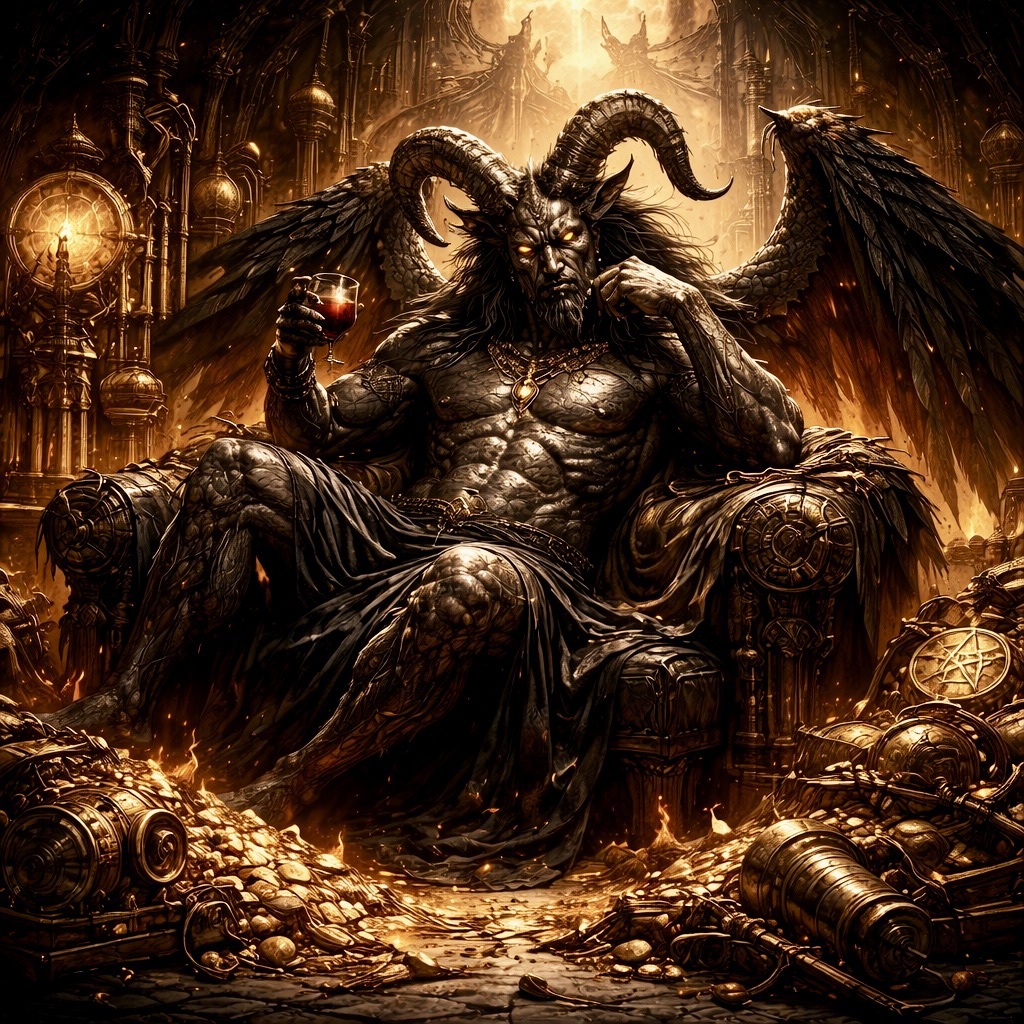
Belphegor is one of those figures in demonology that seems deceptively simple at first glance. He is often labeled as the demon of sloth, associated with laziness, idleness, and the avoidance of effort. But like many figures in this domain, the surface description only hints at something much deeper. Belphegor is not merely about doing nothing. He is about why we want to do nothing, how we avoid effort, and the strange, almost paradoxical ways in which avoidance can lead to innovation.
His origins trace back to ancient Moabite worship, where he was associated with the deity Baal-Peor. Over time, as cultural and religious narratives shifted, this figure was reinterpreted within demonological frameworks, eventually becoming Belphegor—a prince or powerful demon associated with one of the seven deadly sins: sloth.
But even within that classification, Belphegor stands apart.
Sloth is often misunderstood. It is not simply laziness in the sense of resting or taking a break. True sloth is a deeper resistance to effort, a reluctance to engage with what requires energy, focus, or discipline. It is the tendency to choose the easiest path, even when that path leads to stagnation.
Belphegor embodies this tendency.
But he also does something unexpected.
According to many traditions, Belphegor does not simply encourage idleness. He offers solutions—shortcuts, inventions, and ideas that promise to make life easier. He inspires people to create tools that reduce effort, to find ways around obstacles rather than through them.
At first, this seems beneficial.
Who wouldn’t want an easier way to accomplish tasks?
Who wouldn’t prefer efficiency over struggle?
But this is where Belphegor’s deeper symbolism emerges.
He represents the fine line between efficiency and avoidance.
Between innovation and dependency.
Between making life easier and losing the ability to engage with difficulty.
To understand this, consider how innovation often begins. Many inventions are born out of a desire to reduce effort. The wheel, the plow, the computer—these are tools designed to make tasks more efficient, to save time and energy.
In this sense, the desire to avoid effort can be a powerful motivator.
Belphegor taps into that motivation.
He encourages the question: “Is there an easier way?”
And sometimes, that question leads to progress.
But it can also lead to something else.
If the focus shifts entirely to ease, if the goal becomes eliminating effort altogether, the result can be stagnation. Skills are lost. Engagement decreases. The individual becomes dependent on systems rather than capable within them.
Belphegor exists within this tension.
He does not oppose work entirely.
He redefines it.
He shifts the focus from effort to outcome, from process to result.
And in doing so, he changes the relationship between the individual and their actions.
This dynamic is particularly relevant in modern contexts. Technology has advanced to the point where many tasks that once required significant effort can now be completed with minimal input. Communication, information retrieval, and even creative processes have been streamlined.
This has undeniable benefits.
But it also raises questions.
What happens when effort is no longer required?
What is lost when struggle is removed?
Belphegor’s mythology anticipates these questions.
He represents the allure of ease—the comfort of solutions that require little from us. But he also reflects the consequences of relying too heavily on those solutions.
His depiction often includes imagery of wealth, comfort, and relaxation. He is not portrayed as a frantic or aggressive figure. He is calm, almost indulgent, surrounded by the results of his influence.
This calmness is significant.
Belphegor does not rush.
He does not force.
He invites.
He suggests.
He offers.
And in doing so, he creates a situation where the individual willingly chooses the easier path.
This choice is key.
Belphegor does not impose sloth.
He makes it appealing.
From a psychological perspective, this aligns with the concept of cognitive ease—the tendency to prefer options that require less mental effort. Humans naturally gravitate toward simplicity, toward solutions that are easy to understand and implement.
This is not inherently negative. It allows for efficiency and reduces unnecessary strain.
But it can also lead to oversimplification.
Complex problems may be reduced to simple answers that do not fully address them. Effortful thinking may be avoided in favor of quick conclusions.
Belphegor embodies this tendency.
He is the voice that says, “There’s an easier way,” without always considering whether that way is complete.
His association with invention further complicates this narrative. In some traditions, he is credited with inspiring new technologies and ideas, particularly those that generate wealth.
This introduces another layer.
Belphegor is not just about avoiding effort.
He is about gaining reward with minimal effort.
This combination—ease and reward—is particularly powerful. It creates a feedback loop where the individual is encouraged to continue seeking shortcuts, to prioritize efficiency over engagement.
In economic terms, this can be seen in systems that prioritize profit over process, outcomes over experience. Efficiency becomes the primary goal, sometimes at the expense of sustainability or depth.
Belphegor represents this shift.
He is not opposed to success.
He redefines how it is achieved.
This redefinition can be beneficial in moderation. Finding efficient solutions, reducing unnecessary effort, and optimizing processes are all valuable.
But when taken to extremes, it can lead to imbalance.
Skills may deteriorate.
Understanding may become shallow.
Dependency may increase.
Belphegor does not create these outcomes directly.
He facilitates the conditions under which they occur.
His presence in demonology serves as a reminder of the complexity of human motivation. The desire for ease is not inherently wrong. It is part of how people navigate the world.
But it must be balanced with engagement, effort, and awareness.
Without that balance, ease becomes avoidance.
And avoidance leads to stagnation.
In literature, characters associated with sloth or ease often undergo transformations that reveal the limitations of their approach. They may achieve short-term success, but eventually face challenges that require deeper engagement.
Belphegor fits this narrative.
He is not the final state.
He is a phase.
A temptation.
A possibility.
The question is whether the individual remains within that state or moves beyond it.
In the end, Belphegor stands as a symbol of the seductive nature of ease. He reminds us that the path of least resistance is not always the most meaningful, that effort has value beyond its immediate outcome, and that innovation, while powerful, must be balanced with understanding.
He does not demand idleness.
He offers comfort.
And somewhere between comfort and complacency, between innovation and avoidance, between effort and ease—that is where Belphegor resides.
Not as a force that stops movement, but as one that redirects it.
The one who asks, “Why work harder… when you could work less?”