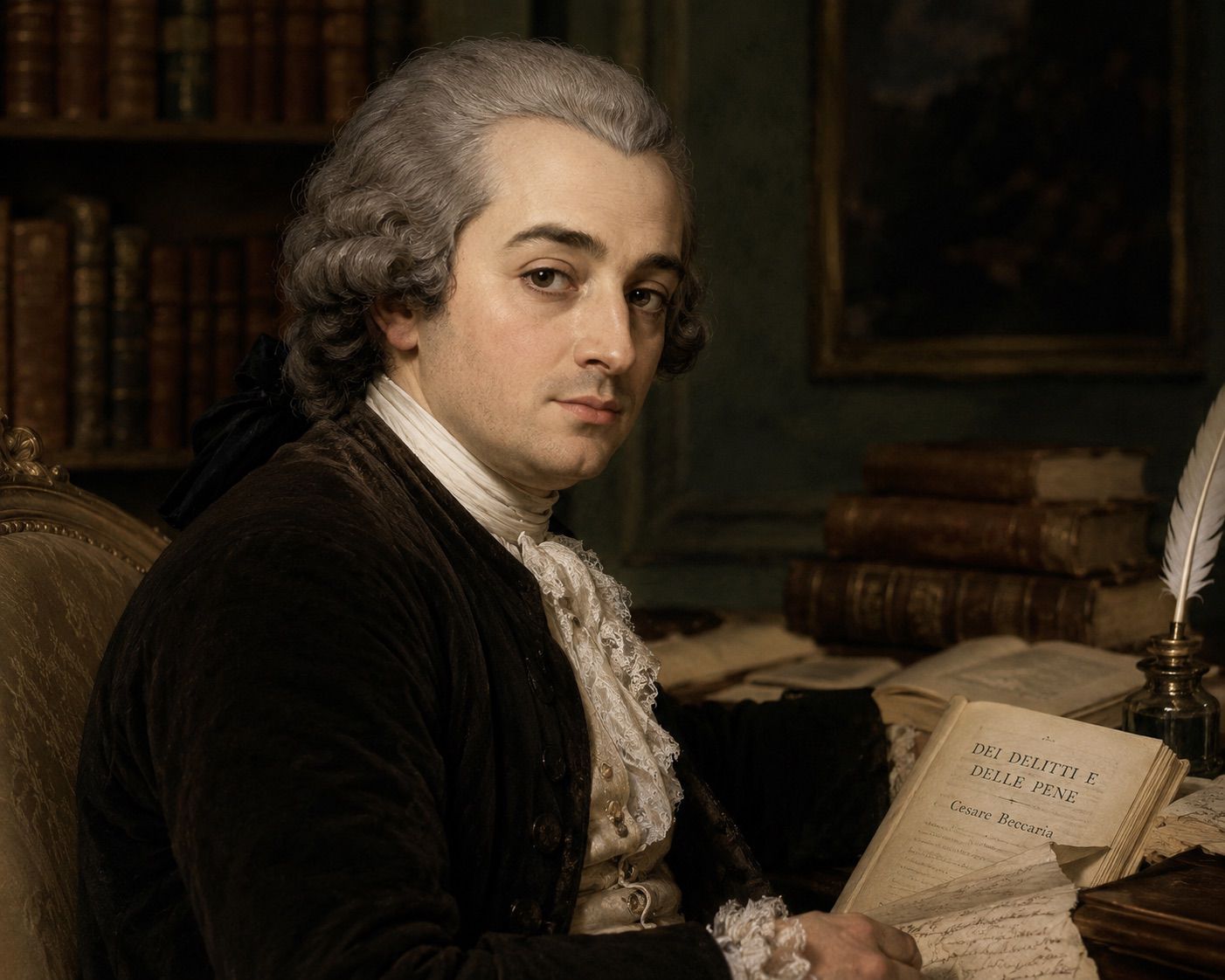
I’ve been reading Cesare Beccaria’s “On Crimes and Punishments” for what feels like an eternity, but I’m not even halfway through it. Yet, somehow, his ideas have become a constant hum in the background of my mind. His thoughts on crime, punishment, and human nature have me questioning everything.
I think one of the things that really draws me to Beccaria is his optimism about human beings. He genuinely believes that we’re capable of reason and morality, that our actions are guided by a desire for pleasure and avoidance of pain. It’s an idea that resonates with me, because I’ve always tried to see people as more than just their flaws or mistakes.
But the more I read, the more I’m struck by how radical Beccaria’s ideas were in his time. He argued that punishments should be based on the principle of deterrence, not retribution – a notion that was considered absurd and even heretical. It makes me wonder: what would happen if we actually took that approach today? Would our justice system become more just, or would it just be a facade?
I also find myself drawn to Beccaria’s writing style. He’s concise, yet elegant; his sentences are like short, sharp jabs that cut straight to the point. It’s almost as if he’s speaking directly to me, rather than writing for an audience. I’ve found myself copying out passages in my notebook, scribbling notes in the margins.
But there’s something else, too – a sense of unease that creeps up on me when I read about Beccaria’s views on human nature. He sees us as flawed, yes, but also as fundamentally rational beings who can be improved through education and exposure to reason. It’s an appealing idea, but it feels… simplistic? I don’t know – it makes me uncomfortable, like there’s something lurking just beneath the surface that I’m not seeing.
I think part of what bothers me is the way Beccaria’s ideas have been co-opted by certain ideologies over time. He’s often cited as a precursor to utilitarianism, which has its own set of problems and complications. It makes me wonder: can we take his ideas on their own terms, without getting tangled up in the baggage that comes with them?
I’m not even sure what I think about Beccaria’s views on punishment anymore – whether they’re too lenient or too harsh. Part of me wants to believe that people can change, that given the right circumstances and education, we can become better versions of ourselves. But another part of me is skeptical, wondering if it’s all just a myth.
I guess what I’m getting at is this: Beccaria’s ideas are like a puzzle that I keep coming back to, trying to make sense of them in my own way. It’s not always easy – there are pieces that don’t fit, or that seem to fit differently depending on the angle you’re looking at it from. But I suppose that’s what makes his work so compelling: it challenges me to think, to question, and to wonder about the human condition in all its complexity.
I’m still reading “On Crimes and Punishments”, but now I feel like I’m just scratching the surface of what Beccaria has to say. It’s a feeling that’s both exhilarating and unsettling – like I’ve opened a door to a whole new world, one that’s full of contradictions and uncertainties.
As I continue to read and think about Beccaria’s ideas, I find myself becoming increasingly aware of the complexities of human nature. His optimism about our capacity for reason and morality feels both empowering and limiting – it’s a double-edged sword that cuts both ways. On one hand, it’s reassuring to believe that we have the potential to improve ourselves through education and exposure to reason. But on the other hand, it can feel dismissive of the darker aspects of human experience, the parts that refuse to be rationalized or explained away.
I think about my own experiences with people who’ve made mistakes, who’ve hurt others or themselves in ways that seem unfathomable. Beccaria’s ideas would have us believe that these individuals are capable of change, that they can learn from their errors and become better versions of themselves. But what about the times when it feels like there’s no changing them? When their actions are driven by a deep-seated selfishness or cruelty that seems to defy explanation?
It’s in these moments that I feel Beccaria’s optimism begin to unravel, like a thread pulled loose from a sweater. His ideas start to seem too simplistic, too reliant on the notion that we’re all fundamentally rational beings who can be improved through education and exposure to reason. But what about the parts of us that refuse to be changed? The parts that are driven by passion or emotion rather than reason?
I’m not sure if I’m trying to critique Beccaria’s ideas or simply grapple with my own doubts and uncertainties. Maybe it’s both – maybe his work has sparked a conversation within me, one that I’m still in the process of having. As I continue to read and think about “On Crimes and Punishments”, I feel like I’m being pulled into a world where black and white are constantly blurring into gray.
It’s a disorienting feeling, but also kind of exhilarating. Beccaria’s ideas have become a mirror held up to my own thinking, forcing me to confront the complexities and uncertainties that lie at the heart of human nature. I’m not sure what conclusions I’ll come to – or if any conclusions are even possible – but for now, it feels like I’m just beginning to scratch the surface of this puzzle, trying to make sense of the pieces as they fit together in unexpected ways.
I find myself getting lost in the pages of Beccaria’s book, searching for answers that seem to slip through my fingers like sand. The more I read, the more I realize how little I actually understand about human nature. It’s a humbling experience, but also a liberating one – because it means I’m not stuck with a fixed idea of what people are or should be.
As I continue to grapple with Beccaria’s ideas, I start to think about my own experiences as a college student. I’ve seen friends struggle with addiction, others with mental health issues, and some who have made questionable choices that have hurt themselves and those around them. And yet, in each of these cases, there’s a part of me that wants to believe that people can change, that they can learn from their mistakes and become better versions of themselves.
But what if that’s just wishful thinking? What if some people are beyond redemption, their actions driven by deep-seated flaws or circumstances that are beyond their control? It’s a scary thought, but one that I think is worth exploring. Because if we’re being honest with ourselves, most of us have done things in the past that we’re not proud of – and yet, somehow, we’ve managed to move forward.
I’m not sure what Beccaria would say about this – whether he’d see it as evidence of human fallibility or proof of our capacity for growth. But I do know that his ideas have made me realize how little I actually understand about the complexities of human experience. And in a way, that’s both terrifying and exhilarating.
Because if we’re all just a bunch of flawed, messy humans trying to make sense of ourselves and the world around us – well, then maybe that’s what makes life so worth living. Maybe it’s not about finding some tidy, rational explanation for everything; maybe it’s about embracing the uncertainty, the chaos, and the beauty of being human.
I’m not sure where I am with Beccaria’s ideas anymore – whether they’ve convinced me or left me more confused than ever. But what I do know is that his book has sparked a conversation within me, one that I’m still trying to have. And as I continue to read and think about “On Crimes and Punishments”, I feel like I’m being pulled into a world where the only certainties are uncertainty and doubt – and somehow, that feels kind of okay.
As I delve deeper into Beccaria’s ideas, I find myself wandering through the streets of 18th-century Europe, trying to imagine what life must have been like for him as a young man. I picture him walking along the canals of Venice, discussing politics and philosophy with his friends, and scribbling down notes in his journal. It’s easy to get caught up in the romanticism of it all – the idea that great thinkers are born from some sort of divine spark, that their ideas are destined to change the world.
But as I read on, I start to notice the ways in which Beccaria’s optimism about human nature is tempered by his own experiences. He writes about the harsh realities of poverty and crime in Italy, about the ways in which a lack of education and opportunity can lead people down a path of desperation and despair. It’s a nuanced view of humanity – one that acknowledges our capacity for good, but also recognizes the darker aspects of our nature.
I find myself drawn to this complexity, this willingness to grapple with the messy realities of human experience. Because let’s be real – most of us are not saints, nor are we purely rational beings driven by a desire for pleasure and avoidance of pain. We’re messy, contradictory creatures, capable of both great kindness and terrible cruelty.
As I continue to read, I start to wonder about the role that education plays in shaping our humanity. Beccaria argues that education is key to improving human behavior, that it can help us become more rational and moral beings. But what about those who lack access to education? What about the poor, the marginalized, or those who are simply born into difficult circumstances?
I think about my own experiences as a college student – the privilege of having access to resources, to mentors and professors who guided me through my studies. I think about friends who came from more challenging backgrounds, who struggled to make ends meet while pursuing their degrees. And I start to wonder: is education truly a panacea for human suffering, or is it just another form of privilege that perpetuates inequality?
It’s a question that Beccaria doesn’t fully address in his book – and one that I’m still grappling with as I continue to read. But what I do know is that his ideas have sparked a conversation within me about the complexities of human experience, about the ways in which education and opportunity can shape our humanity.
As I close this chapter on Beccaria’s “On Crimes and Punishments”, I feel like I’m being left with more questions than answers. But maybe that’s the point – to recognize that we’re all just a bunch of flawed, messy humans trying to make sense of ourselves and the world around us. Maybe it’s not about finding some tidy, rational explanation for everything; maybe it’s about embracing the uncertainty, the chaos, and the beauty of being human.
I’m not sure where this conversation will take me next – or what conclusions I’ll come to as I continue to grapple with Beccaria’s ideas. But for now, I’m content to sit in the midst of this uncertainty, to let the complexities of human nature wash over me like a tide.
As I sit here, surrounded by notes and scribbled marginalia, I feel like I’m still trying to catch my breath after being pulled under the waves of Beccaria’s ideas. His book has left me with more questions than answers, but in a way, that’s exactly what I was hoping for.
I think about how easily we can get caught up in simple solutions, in tidy explanations for complex problems. We see it all around us – in politics, in social media, even in our own conversations with friends and family. We want to believe that everything is black and white, good or bad, right or wrong. But Beccaria’s work reminds me that life is rarely so simple.
As I continue to think about his ideas on education and opportunity, I start to wonder about the role of privilege in shaping our humanity. I’ve been fortunate enough to have had access to resources and opportunities that many people can only dream of – a good education, supportive family and friends, a stable job. But what about those who haven’t been so lucky? What does it mean for their humanity when they’re denied the same chances?
I think about my own experiences as a college student, and how I sometimes felt like I was playing catch-up with students from more affluent backgrounds. They had the luxury of pursuing internships or study abroad programs, while I was struggling to make ends meet and juggling multiple part-time jobs. And yet, despite those challenges, I still managed to succeed – in a way that feels both empowering and disconcerting.
It’s this sense of unease that keeps me coming back to Beccaria’s ideas. His optimism about human nature is tempered by his own recognition of the darker aspects of our experience. He knows that we’re flawed, messy creatures, capable of both great kindness and terrible cruelty. And yet, he still believes in us – in our capacity for growth, for change, for improvement.
As I delve deeper into Beccaria’s work, I start to see parallels between his ideas on human nature and my own experiences as a writer. When I write, I’m trying to capture the complexities of human experience – the contradictions, the ambiguities, the messy, contradictory ways in which we think and feel. It’s a daunting task, but one that I find exhilarating.
Because when I write, I’m not just trying to convey my own thoughts and feelings – I’m also trying to understand the people around me, to make sense of their experiences and perspectives. And it’s here, in this space between writer and reader, that Beccaria’s ideas come alive for me.
His optimism about human nature is a reminder that we’re all capable of growth, of change, of improvement – even when it feels like the odds are stacked against us. It’s a message that resonates deeply with me as a writer, because I know how much power words can hold in shaping our perceptions and understanding of one another.
As I close this chapter on Beccaria’s “On Crimes and Punishments”, I feel like I’m being left with more questions than answers – but also a sense of hope. His ideas have sparked a conversation within me about the complexities of human experience, about the ways in which education and opportunity can shape our humanity.
And as I look out at the world around me, I see that conversation reflected in the people I meet every day – friends, family, strangers on the street. We’re all just trying to make sense of ourselves and the world around us, to navigate the complexities and uncertainties of human experience.
It’s a daunting task, but also an exhilarating one. Because when we approach life with humility and curiosity, when we recognize our own flaws and limitations – that’s when the real magic happens.