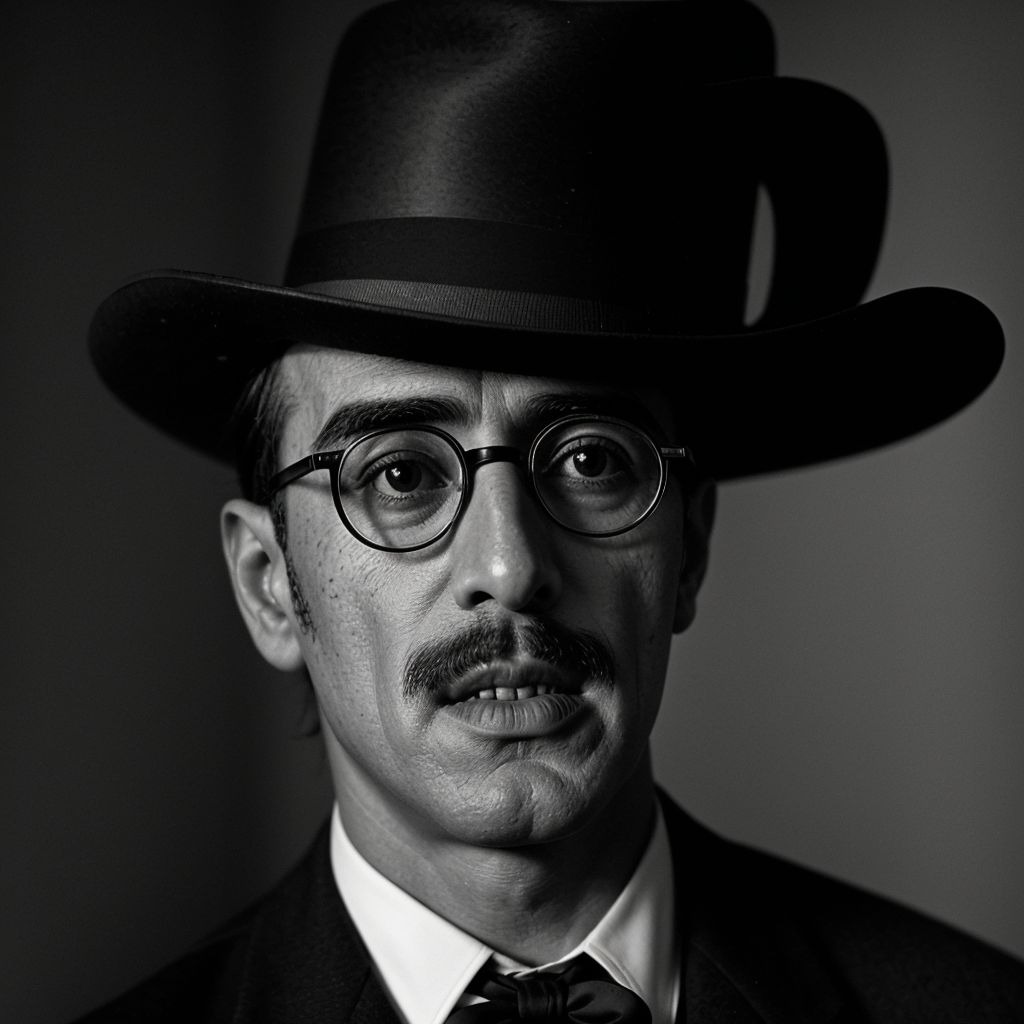
Fernando Pessoa has been a constant presence in my life, lurking in the margins of my thoughts like a whispered secret. I first encountered him in a literature class during my senior year of college, where we devoured his poetry and prose alongside other modernist giants. But it wasn’t until I started reading his letters, scattered throughout the internet like breadcrumbs, that I felt an inexplicable connection to this Portuguese writer.
What draws me to Pessoa is his multiplicity – or rather, his multiplicities. He’s a man of many personas, each with its own distinct voice and perspective. There’s Bernardo Soares, the accountant-turned-poet, who writes with a detached precision that unsettles me; Ricardo Reis, the physician with a penchant for classical allusions; and Álvaro de Campos, the engineer turned poet, whose verses are infused with a sense of longing and disillusionment.
As I delve deeper into Pessoa’s work, I find myself oscillating between fascination and discomfort. It’s as if he’s holding up a mirror to my own fragmented self – the various roles I’ve assumed and discarded over the years: daughter, student, writer, friend. I identify with the sense of dislocation that pervades his writing, the feeling of being a stranger in one’s own life.
One of Pessoa’s most famous declarations is that he has “many faces” but no individual self. This concept both intrigues and terrifies me. On one hand, it speaks to the fluidity of identity – how we’re constantly reinventing ourselves, shedding old skins like snakes. But on the other hand, it implies a kind of dissolution, a dispersal of self that feels both exhilarating and terrifying.
Reading Pessoa’s letters, I’m struck by his inner turmoil, his struggles with depression, anxiety, and writer’s block. He’s a man who has grappled with the void, the abyss that lies at the heart of human existence. His writing is often an attempt to bridge this chasm, to create meaning from the fragments of his own life.
As I reflect on my own experiences with mental health, I’m reminded of Pessoa’s words: “I am a multitude, but a multitude without unity.” It’s as if he’s describing my own internal landscape – the constant tug-of-war between competing voices, desires, and fears. His writing becomes a lifeline, a testament to the fact that I’m not alone in this struggle.
But Pessoa’s work is also a reminder of the dangers of fragmentation. When we fragment ourselves, when we become multiple personas or identities, don’t we risk losing our sense of coherence, our grip on reality? It’s a question I return to again and again as I read his poetry and letters – what happens when we’re no longer sure who we are, or where we belong?
Perhaps this is the greatest mystery that Pessoa’s work holds for me: the tension between multiplicity and unity. Is it possible to hold these opposing forces in balance, to find a sense of self amidst the disparate voices and personas? Or am I forever doomed to navigate the labyrinthine corridors of my own mind, searching for a door that leads out into the light?
As I close Pessoa’s letters and step away from his writing, I’m left with more questions than answers. But it’s precisely this uncertainty that draws me back in – the promise that even in the midst of confusion, there lies a deeper truth waiting to be uncovered.
The more I immerse myself in Pessoa’s work, the more I feel like I’m wandering through a maze with no clear exit. His writing is a perpetual questioning, a probing into the depths of human experience that leaves me both unsettled and intrigued. It’s as if he’s holding up a mirror to the fragility of the self, revealing all the cracks and fissures that lie beneath the surface.
I find myself wondering about Pessoa’s own experiences with identity and fragmentation. Was it always this way for him – a constant juggling act between personas and voices? Or was there a moment, a turning point, when he realized that his multiplicity was both a gift and a curse? And what of his famous phrase, “I am a multitude, but a multitude without unity”? Is it a statement of defeat or declaration of liberation?
As I ponder these questions, I’m struck by the realization that Pessoa’s work is not just about him – it’s about all of us who have ever felt lost in our own skins. His writing becomes a kind of communal confessional, where we can confront our own fears and doubts without shame or apology. And yet, even as we find solace in his words, there’s also a sense of disorientation, a feeling that the ground beneath our feet is shifting.
Pessoa’s notion of “heteronyms” – his various personas and identities – has me thinking about my own relationships with language and identity. I’ve always been drawn to writing as a way of exploring myself, but Pessoa’s work raises questions about the limits of self-expression. Can we truly capture our essence through words, or are we forever trapped in the ambiguities of language?
Sometimes, when I’m sitting at my desk, staring blankly at my computer screen, I feel like I’m channeling Álvaro de Campos – Pessoa’s engineer-turned-poet persona. The lines between reality and fiction blur, and I become lost in a sea of possibilities. It’s both exhilarating and terrifying, this sensation of being multiple selves at once.
I wonder if Pessoa ever felt the same way – caught between his various personas like a shipwreck on a stormy sea. Or did he find some kind of resolution, a way to integrate his disparate voices into a cohesive whole? I’m not sure I’ll ever find the answers to these questions, but the search itself is what draws me back to Pessoa’s work again and again – a journey into the labyrinthine corridors of my own mind.
As I continue to grapple with Pessoa’s concept of heteronyms, I start to wonder about the relationship between language and identity. Is it possible to capture our true selves through words, or are we forever bound by the limitations of language? Pessoa’s use of multiple personas seems to suggest that language can never fully contain us, that there will always be a gap between what we say and what we mean.
I think about my own experiences with writing as a way of exploring myself. I’ve always felt that words have the power to shape me, to help me make sense of the world around me. But Pessoa’s work raises questions about the nature of self-expression. Can we truly capture our essence through language, or are we forever trapped in the ambiguities of words?
I remember a conversation I had with a friend during college, where she said that writing was like trying to catch a fish with your bare hands – it’s always slipping away from you, just out of reach. I think about this now as I read Pessoa’s letters, and I realize that she was onto something. Our words are never quite enough to capture the complexity of our experiences; they’re always provisional, always subject to revision.
And yet, despite these limitations, we keep writing, keep trying to pin down the elusive self. It’s a Sisyphean task, but one that feels essential to who I am as a person. Pessoa’s work reminds me that this struggle is not unique to me – it’s a fundamental aspect of the human experience.
I start to wonder about the relationship between Pessoa’s use of heteronyms and his experiences with mental health. Did he see his multiple personas as a way of coping with depression, anxiety, or writer’s block? Or were they simply a natural outgrowth of his creative process? I’m not sure, but it seems clear that his work was deeply influenced by his inner life.
As I read through Pessoa’s letters, I start to notice the ways in which he uses language to navigate his own emotions. He writes about feeling lost and disconnected from himself, about struggling to find a sense of purpose or meaning. And yet, even in the midst of this turmoil, there is a sense of wonder, of curiosity about the world around him.
This is something that resonates deeply with me – the idea that our inner lives are always in flux, always shifting and evolving. Pessoa’s work reminds me that it’s okay to be uncertain, to not have all the answers. In fact, it’s precisely this uncertainty that makes life worth living.
I find myself thinking about my own experiences with mental health, and how they’ve influenced my writing. I’ve always felt like I’m struggling to keep up with my own thoughts, like I’m constantly trying to catch my breath. Pessoa’s work feels like a kind of validation – proof that I’m not alone in this struggle.
But at the same time, there’s a sense of disorientation, a feeling that the ground beneath me is shifting. It’s as if I’m standing on the edge of a precipice, staring out into an abyss. And yet, even in the midst of this uncertainty, there is a sense of possibility – the promise that anything can happen, that the future is full of unknowns.
This is what Pessoa’s work does for me – it holds up a mirror to my own fragility and uncertainty, reminding me that I’m not alone in this struggle. And yet, even as it acknowledges our shared humanity, his writing also offers a kind of liberation – the freedom to explore, to experiment, to see where the journey takes us.
As I continue to immerse myself in Pessoa’s work, I find myself drawn to the idea that our identities are not fixed or static, but rather fluid and ever-changing. This concept is both exhilarating and terrifying, as it suggests that we are constantly reinventing ourselves, shedding old skins like snakes.
I think about my own experiences with self-discovery, how I’ve struggled to pin down a sense of identity throughout my life. It’s as if I’m perpetually chasing after something just out of reach, always trying to catch up with myself. Pessoa’s notion of heteronyms seems to speak to this experience, the idea that we are multiple selves at once, each with its own distinct voice and perspective.
But what does it mean to be a multitude without unity? Is it a statement of defeat or declaration of liberation? I’m not sure, but I do know that Pessoa’s work has given me permission to explore these questions, to delve deeper into the complexities of my own identity.
I start to wonder about the relationship between Pessoa’s use of heteronyms and his experiences with creativity. Did he see his multiple personas as a way of accessing different aspects of himself, of tapping into new sources of inspiration? Or were they simply a natural outgrowth of his creative process?
As I read through his letters, I start to notice the ways in which he uses language to navigate his own emotions. He writes about feeling lost and disconnected from himself, about struggling to find a sense of purpose or meaning. And yet, even in the midst of this turmoil, there is a sense of wonder, of curiosity about the world around him.
This is something that resonates deeply with me – the idea that our inner lives are always in flux, always shifting and evolving. Pessoa’s work reminds me that it’s okay to be uncertain, to not have all the answers. In fact, it’s precisely this uncertainty that makes life worth living.
I find myself thinking about my own creative process, how I’ve often struggled to find a sense of purpose or direction in my writing. But Pessoa’s work has given me permission to explore these questions, to delve deeper into the complexities of my own creativity.
As I continue to grapple with Pessoa’s concept of heteronyms, I start to wonder about the relationship between language and identity. Is it possible to capture our true selves through words, or are we forever bound by the limitations of language? Pessoa’s use of multiple personas seems to suggest that language can never fully contain us, that there will always be a gap between what we say and what we mean.
I think about my own experiences with writing as a way of exploring myself. I’ve always felt that words have the power to shape me, to help me make sense of the world around me. But Pessoa’s work raises questions about the nature of self-expression. Can we truly capture our essence through language, or are we forever trapped in the ambiguities of words?
As I ponder these questions, I’m struck by the realization that Pessoa’s work is not just about him – it’s about all of us who have ever felt lost in our own skins. His writing becomes a kind of communal confessional, where we can confront our own fears and doubts without shame or apology.
And yet, even as we find solace in his words, there’s also a sense of disorientation, a feeling that the ground beneath our feet is shifting. It’s as if Pessoa’s work is holding up a mirror to our shared humanity, revealing all the cracks and fissures that lie beneath the surface.
I’m left with more questions than answers, but it’s precisely this uncertainty that draws me back in – the promise that even in the midst of confusion, there lies a deeper truth waiting to be uncovered.