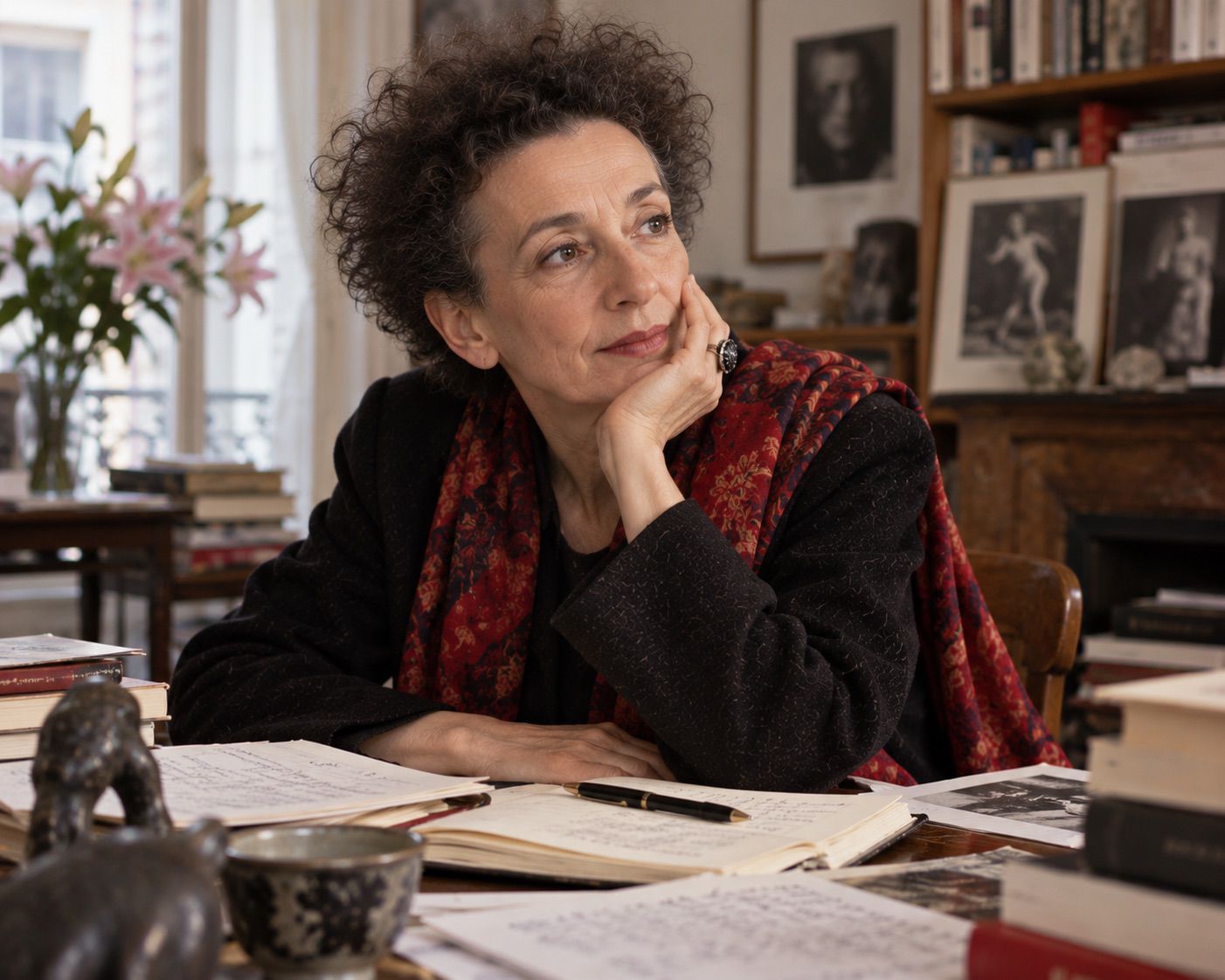
I’ve been reading Helene Cixous for weeks now, and I’m still trying to wrap my head around her ideas about women’s writing and the body. As a writer myself, I’m drawn to her emphasis on the importance of personal experience and embodiment in creative work. But the more I read, the more I feel like I’m getting lost in a sea of theory.
Cixous’s notion that women have been silenced by patriarchal society and must find their own voices through writing resonates deeply with me. As a woman who’s only recently finished college, I know what it’s like to be socialized to speak less, to listen more, and to take up less space in the world. But when Cixous talks about “écriture féminine” – this idea of a unique, feminine way of writing that’s characterized by fluidity, multiplicity, and a rejection of traditional notions of linearity – I feel like she’s speaking directly to me.
Or at least, I think she is. The more I read her work, the more I start to wonder if I’m just projecting my own desires onto her ideas. Am I really seeing what she means by “écriture féminine,” or am I just using it as a way to justify my own writing practice? It’s hard for me to separate out Cixous’s theory from my own experiences and biases, which is probably exactly the point – after all, Cixous herself writes about how women’s writing must be rooted in their own bodies and experiences.
I’ve been reading her work alongside some of my own writing, trying to see if I can spot any echoes or resonances between our styles. It’s funny – sometimes I feel like I’m writing right along with her, like we’re having a conversation about the same things from different sides of the room. Other times, I read something she’s written and feel like it’s completely alien to me, like I’m trying to decipher some code that only makes sense to her.
I think part of what draws me to Cixous is the way she talks about writing as a way of reclaiming one’s body – not just as a physical space, but as a source of creative power. For women, in particular, this means finding ways to express ourselves that aren’t controlled by patriarchal norms or expectations. It’s a radical idea, and it makes me think about all the ways I’ve been socialized to see my own body as something that needs to be tamed or contained.
But here’s the thing: Cixous’s ideas are also pretty complicated, especially when it comes to issues of identity and power. She talks about how women must find their own voices through writing, but she also acknowledges that this can be a privilege – not everyone has access to education, language, or the freedom to write in the first place. I don’t have all the answers on this one, and it’s frustrating because it feels like Cixous is pulling me in two different directions at once.
Maybe that’s what makes her work so compelling: she’s forcing me to confront my own ambivalence and uncertainty about these issues. As a writer, I’m used to trying to pin down ideas and make them coherent – but Cixous’s work keeps slipping through my fingers like sand. It’s uncomfortable, but in a way that feels necessary.
I don’t know if I’ll ever fully understand what Helene Cixous is saying, or if I’ll ever be able to write in the same way she does. But I do know that her ideas are making me think about my own writing and identity in ways that feel both exhilarating and terrifying. And for now, that’s enough to keep me reading – and writing.
As I continue to read Cixous’s work, I’m struck by the way she blurs the lines between writer and reader, self and other. Her writing is often described as “auto-biographical,” but it’s not just about her own experiences – it’s also about how those experiences intersect with others, how they’re shaped by history, culture, and power dynamics. This makes me think about my own writing, and the ways in which I try to position myself as a writer.
I’ve always felt like I’m trying to write from a place of authenticity, but at the same time, I’m aware that my experiences are filtered through my privilege – my education, my language skills, my access to resources. Cixous’s work makes me wonder: can I ever truly write “as myself,” or am I always already writing from a position of difference? And what does it mean to write from a place of difference, anyway?
These questions have been swirling around in my head for weeks now, and I’m not sure I’ve made any progress towards answering them. But the more I read Cixous, the more I feel like I’m being pulled into a conversation that’s both deeply personal and profoundly theoretical. It’s a conversation about writing, identity, power – but it’s also a conversation about how to live, how to be in the world.
I think part of what I love about Cixous is the way she refuses to give easy answers or provide clear solutions. She doesn’t offer any tidy formulas for writing as a woman, or for finding one’s own voice. Instead, she shows us how the process of writing can itself be a journey of discovery – a journey through language, culture, and the self.
This makes me think about my own writing practice, and the ways in which I’ve been trying to force myself into certain molds or categories. As a young writer, I’ve often felt pressure to conform to certain standards or expectations – to write in a certain style, to explore certain themes. But Cixous’s work is showing me that these constraints are just that: constraints. They’re not inherent to writing itself, but rather the result of external pressures and biases.
I’m starting to see my own writing as an act of resistance, then – not just a way of expressing myself, but also a way of pushing back against the norms and expectations that try to contain me. This is both exhilarating and terrifying, because it means I have to confront the possibility that my writing might fail, or that it might be misinterpreted in ways that hurt or exclude others.
But Cixous’s work suggests that this risk is worth taking – that the act of writing itself can be a radical act of self-discovery, even if we’re not sure what we’ll find along the way. And as I continue to read and write alongside her, I’m starting to feel like I’m finding my own voice, slowly but surely – a voice that’s messy, imperfect, and utterly unique.
As I delve deeper into Cixous’s work, I find myself becoming increasingly fascinated by the concept of “écriture féminine” as a form of resistance against patriarchal norms. But I’m also aware that this idea can be problematic, especially when it comes to issues of identity and power.
Cixous herself acknowledges that women’s writing is not a monolithic entity, and that different women have experienced oppression in different ways. She writes about how French women, for example, have been socialized to value domesticity and femininity above all else, while African women may have faced entirely different forms of oppression under colonialism.
This makes me wonder: can I ever truly speak as a woman, or do I need to acknowledge my own privilege and positionality? And what does it mean to write about the body when you’re not from the same cultural or social background?
These questions are making me feel like I’m stuck in a loop of self-doubt, unable to make any progress towards understanding Cixous’s ideas. But at the same time, I feel like I’m being pushed to confront my own biases and assumptions about women’s writing.
As I continue to read and write alongside Cixous, I’m starting to see how her work is not just about theory or abstract concepts – it’s also about the messy, embodied experience of living as a woman in the world. It’s about the way our bodies are policed, judged, and controlled by societal norms.
And it’s this that makes me realize: Cixous’s ideas aren’t just about writing as a form of resistance; they’re also about resisting the very notion of a fixed or essential self. Her work suggests that identity is fluid, multiple, and constantly in flux – and that this is especially true for women, who have been socialized to conform to certain expectations.
This idea is both liberating and terrifying, because it means I can never truly pin down who I am as a writer or as a person. But at the same time, it’s also exhilarating, because it means I’m free to explore and experiment with my writing in ways that feel authentic and true to myself.
As I finish reading Cixous’s work for now, I’m left with more questions than answers – but I’m also feeling more connected to my own writing practice, and to the idea of writing as a form of resistance against societal norms. It’s a conversation that feels both deeply personal and profoundly theoretical, one that I know will continue to unfold in ways both expected and unexpected.
As I close Cixous’s book for now, I’m struck by how her ideas have unsettled me, but also how they’ve made me feel seen and heard as a woman writer. It’s funny – I think part of what I love about her work is that it makes me feel like I’m not alone in my doubts and uncertainties about writing and identity.
I’m starting to realize that Cixous’s emphasis on “écriture féminine” isn’t just about women finding their own voices; it’s also about recognizing the ways in which our bodies and experiences are always already filtered through patriarchal norms. It’s like she’s saying, “Hey, your writing is never going to be neutral – but that doesn’t mean you can’t use that as a starting point for something new.”
This makes me think about my own writing practice, and the ways in which I’ve been trying to navigate the tension between authenticity and representation. As a young writer from a privileged background, I know I have a responsibility to acknowledge my positionality – but at the same time, I don’t want to get stuck in a cycle of self-doubt or feel like I’m never good enough.
Cixous’s work is showing me that this tension is inherent to writing as a woman, and that it’s not something we can resolve once and for all. Instead, it’s an ongoing process – one that requires us to be constantly aware of our own biases and assumptions, while also pushing against the norms that try to contain us.
I’m starting to see my writing as a form of dialogue with others – not just with Cixous, but with women from different backgrounds and experiences who have been silenced or marginalized by patriarchal society. It’s like she’s saying, “Your writing is never going to be a solo act – it’s always already part of a larger conversation.”
This idea feels both exhilarating and terrifying, because it means I’m not in control of how my words will be received or interpreted. But at the same time, it also feels like a radical act of freedom – one that allows me to take risks, experiment with new forms and styles, and push against the boundaries of what’s considered “acceptable” writing.
As I look back on our conversation (if you can even call it that), I’m struck by how Cixous’s ideas have unsettled me, but also how they’ve made me feel more connected to my own writing practice. It’s like she’s shown me a map of the terrain – not a clear path or destination, but a sense of the contours and obstacles we’ll face as women writers.
I don’t know what comes next for me, or where my writing will take me from here. But I do know that Cixous’s work has given me permission to keep exploring, to keep taking risks, and to keep pushing against the norms that try to contain me. And that feels like a radical act of freedom – one that I’m grateful for every day.