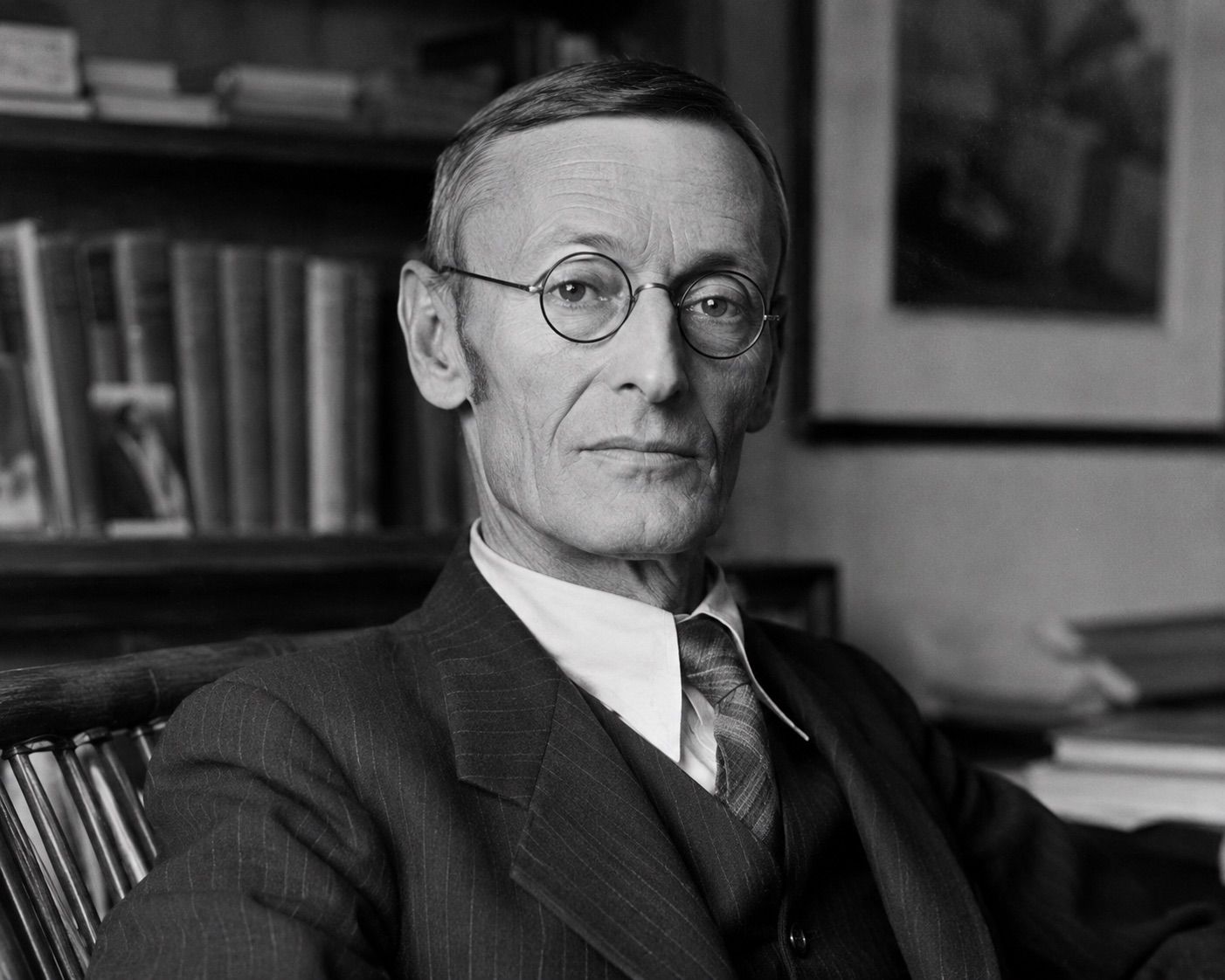
I’ve always been fascinated by Herman Hesse’s inner turmoil. It’s like he took the complexities of human existence and poured them onto the page, leaving me to wrestle with his thoughts and emotions alongside him. As I read through his works, I find myself drawn to the way he grapples with identity, spirituality, and societal expectations.
I think part of what resonates with me is Hesse’s own journey from being a young man caught between tradition and individuality. His early years were spent in a strict Catholic boarding school, where he struggled to reconcile his desire for freedom with the constraints placed upon him. I can relate to that feeling – during my college years, I often felt trapped by the expectations of others, whether it was from family members, professors, or even myself.
Hesse’s writing captures this sense of dissonance beautifully. In “Steppenwolf,” he embodies the character of Harry Haller, a man torn between his intellectual pursuits and his desire for connection with the world around him. I see a bit of myself in Harry’s struggles – the feeling of being an outsider, observing life through the lens of art and literature, yet longing to break free from the confines of my own mind.
What strikes me most about Hesse is how he explores the tension between individuality and conformity. He pokes fun at societal norms and expectations, often using satire to highlight the absurdities of modern life. At the same time, he also acknowledges the importance of community and connection – his characters are always seeking a sense of belonging, even as they rebel against the status quo.
I’ve found myself wondering, though, if Hesse’s critiques of modern society were simply a reflection of his own disaffection with the world around him. Was he critiquing the system because it was fundamentally flawed, or was he merely trying to justify his own disillusionment? As I read through his works, I’m struck by the ambiguity of his views – he seems to be both a critic and a romantic, simultaneously railing against the constraints of society while yearning for connection with something greater.
This ambivalence speaks to me on a deep level. I’ve always struggled with my own sense of purpose and identity, often feeling like I’m caught between different worlds or perspectives. Hesse’s writing reminds me that this is a normal part of being human – we’re all searching for meaning and connection in our own ways.
As I continue to explore Hesse’s works, I find myself drawn into the labyrinthine corridors of his mind. His writing is like a puzzle, full of hidden meanings and symbolism that require close attention. But it’s precisely this complexity that makes him so compelling – he refuses to simplify or reduce the human experience to easy answers.
In many ways, Hesse’s struggles with identity and belonging have helped me come to terms with my own place in the world. His writing has given me permission to explore my own doubts and uncertainties, to question the expectations placed upon me by others (and myself). As I navigate the complexities of adulthood, Hesse’s works remain a constant companion – a reminder that I’m not alone in my search for meaning, connection, and purpose.
One thing that continues to fascinate me about Hesse is his use of mysticism as a means of exploring the human condition. In “Siddhartha,” he delves into the world of Eastern spirituality, drawing parallels between the Buddha’s journey and the search for meaning in modern life. I’ve always been intrigued by the way Hesse weaves together elements of philosophy, psychology, and spirituality to create a rich tapestry of ideas.
As someone who’s struggled with feelings of disconnection and alienation, I find myself drawn to the idea that there’s something more profound at work beneath the surface of human experience. Hesse’s writing suggests that our everyday lives are but a small part of a larger web of meaning – one that can be accessed through intuition, meditation, or simply paying attention to the world around us.
But what does it mean to truly “wake up” to this deeper reality? Is it possible for me, a young adult still trying to figure out my place in the world, to access this kind of spiritual awareness? Or is it something that only comes with years of practice and dedication?
Hesse’s own journey was marked by periods of intense spiritual seeking – he was deeply influenced by Eastern mysticism and spent time studying under various gurus. But his writing also suggests a sense of disillusionment with the very idea of spirituality as a fixed or attainable state. In “Demian,” for example, he portrays a young protagonist who becomes increasingly disillusioned with the guru-like figure of Max Demian, realizing that true wisdom can’t be reduced to simple formulas or dogma.
This ambivalence speaks to me on a deep level – I’ve always struggled with my own relationship to spirituality and faith. As someone who grew up in a relatively secular household, I never had a traditional religious upbringing, but I’ve always felt drawn to the idea of something greater than myself. Hesse’s writing has helped me navigate these feelings, encouraging me to approach spirituality with a sense of curiosity rather than dogma.
As I continue to read and reflect on Hesse’s works, I find myself returning to the question of what it means to be fully alive – to experience life in all its complexity and beauty. Is it possible for us to truly “awaken” to this reality, or are we forever trapped in our own mental constructs?
As I delve deeper into Hesse’s works, I’m struck by the way he often uses nature as a symbol of the human experience. In “Siddhartha,” the river is a powerful force that represents both transformation and decay. It’s a reminder that our lives are constantly in flux, and that we’re all subject to the whims of fate.
I find myself drawn to this idea, particularly in relation to my own experiences during college. There were times when I felt like I was stuck in a rut, unable to move forward or make sense of my life’s trajectory. But Hesse’s writing suggests that even in the midst of uncertainty and chaos, there is beauty to be found.
Take, for example, his description of the river in “Siddhartha.” He writes about how it flows effortlessly, yet is constantly changing shape and form. This paradox speaks to me on a deep level – I’ve always struggled with my own need for control and predictability, but Hesse’s writing reminds me that life is inherently messy and unpredictable.
In many ways, this understanding has been liberating for me. It’s allowed me to approach challenges and uncertainties with a sense of curiosity rather than fear or anxiety. And yet, I still find myself grappling with the question of how to truly live in the present moment.
Hesse’s writing suggests that it’s not about achieving some kind of enlightenment or spiritual awakening – it’s about embracing the impermanence and uncertainty of life itself. He writes about how Siddhartha comes to realize that true freedom lies not in escaping the world, but in fully engaging with it.
This idea resonates deeply with me, particularly as I navigate the challenges of young adulthood. It’s easy to get caught up in planning for the future or dwelling on past regrets – but Hesse’s writing reminds me that there is beauty and meaning to be found in the present moment.
I’m not sure what this means for my own life, exactly – perhaps it means embracing uncertainty and chaos as a natural part of the human experience. Or maybe it means learning to appreciate the small moments of beauty and connection that make life worth living.
As I continue to read and reflect on Hesse’s works, I find myself returning to these questions again and again. What does it mean to be fully alive? How can we cultivate a sense of wonder and curiosity in our daily lives? And what role does spirituality or faith play in this search for meaning?
These are questions that I’m still struggling to answer – but Hesse’s writing has given me the courage to continue exploring, to keep seeking out new perspectives and insights. And in doing so, I’ve come to realize that perhaps the most profound lesson of his works is not some grand or universal truth, but simply the importance of being open to the mystery and complexity of human existence.
As I delve deeper into Hesse’s works, I’m struck by the way he often uses paradoxes to explore the human condition. In “Steppenwolf,” Harry Haller is a character torn between his love of nature and his disdain for the artificial world around him. This tension speaks to me on a deep level – I’ve always struggled with my own relationship to technology and modern society, feeling like I’m caught between two opposing forces.
Hesse’s writing suggests that this kind of paradox is at the heart of the human experience. We’re constantly pulled between our desire for freedom and our need for connection, between our love of nature and our reliance on technology. And it’s in these moments of tension that we’re forced to confront the complexities of our own identities.
I’m reminded of my own experiences during college, when I felt like I was caught between two worlds – the world of academia and the world of creative expression. I loved writing and literature, but I also felt pressure to pursue a “practical” career path. Hesse’s writing helped me see that this kind of tension is not unique to me, but rather a fundamental aspect of being human.
One of the things that continues to fascinate me about Hesse is his use of symbolism in his works. In “Demian,” he uses the figure of Max Demian as a symbol of spiritual guidance and wisdom. But at the same time, Demian is also portrayed as a complex and flawed character – someone who is not immune to the temptations and pitfalls of human nature.
This ambivalence speaks to me on a deep level – I’ve always struggled with my own desire for certainty and control in life. Hesse’s writing suggests that true wisdom lies not in having all the answers, but in embracing the uncertainty and ambiguity of human experience.
As I continue to read and reflect on Hesse’s works, I find myself drawn into the world of his characters – a world that is both familiar and strange. His writing has given me permission to explore my own doubts and uncertainties, to question the expectations placed upon me by others (and myself). And in doing so, I’ve come to realize that perhaps the most profound lesson of his works is not some grand or universal truth, but simply the importance of being open to the mystery and complexity of human existence.
I’m not sure what this means for my own life, exactly – perhaps it means embracing the impermanence and uncertainty of life itself. Or maybe it means learning to appreciate the small moments of beauty and connection that make life worth living. Whatever it is, I know that Hesse’s writing has given me a new perspective on the world – one that is both unsettling and liberating.
As I close this essay, I’m left with more questions than answers. What does it mean to be fully alive? How can we cultivate a sense of wonder and curiosity in our daily lives? And what role does spirituality or faith play in this search for meaning?
These are questions that I’m still struggling to answer – but Hesse’s writing has given me the courage to continue exploring, to keep seeking out new perspectives and insights. And in doing so, I’ve come to realize that perhaps the most profound lesson of his works is not some grand or universal truth, but simply the importance of being open to the mystery and complexity of human existence.