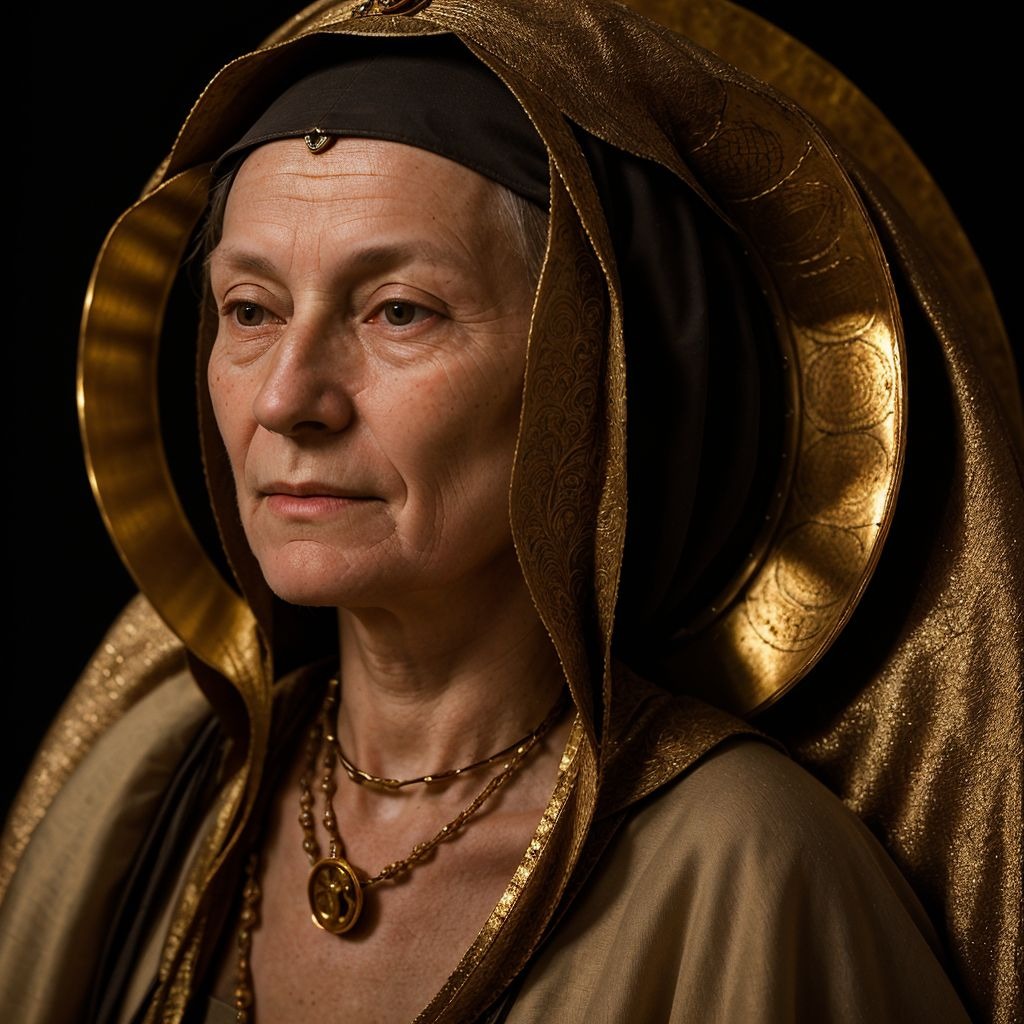
I’ll be honest, I stumbled upon Hildegard of Bingen by chance, while browsing through a used bookstore. Her name jumped off the page, and I had to look her up. At first, I was drawn to her as a trailblazer – a woman who defied conventions in a time when women’s voices were largely silenced. But as I delved deeper into her life, I found myself fascinated by something more complex: her inner world.
What struck me about Hildegard is the intensity of her emotions. She wrote extensively on the nature of sin and redemption, but also poured out her own feelings of despair, anxiety, and frustration in her letters and treatises. It’s like she wore her heart on her sleeve, unapologetically and without pretense. I felt a deep connection to that raw vulnerability.
As someone who’s struggled with anxiety and self-doubt myself, I couldn’t help but see parallels between Hildegard’s experiences and my own. Her descriptions of feeling overwhelmed by the weight of sin and responsibility resonated deeply. I remember times when I felt like I was drowning in my own emotions, unable to articulate what was wrong or how to make it right.
Hildegard’s solution, though, was vastly different from mine. She turned to God, pouring out her heart in prayers and hymns that were both beautiful and unflinching. Her writing is peppered with imagery and metaphor – she compares sin to a serpent coiled around the human heart, or a weight that presses down on her shoulders. It’s as if she’s trying to grasp the intangible, to pin down the elusive nature of evil.
I’ve always struggled with organized spirituality myself. Growing up in a secular household, I never really connected with institutionalized faith. But there’s something about Hildegard’s emotional honesty that feels more authentic than most of what I’ve encountered in my own life. Maybe it’s because she wasn’t trying to present a perfect facade; instead, she was grappling with the messy, contradictory nature of human experience.
As I read through her writings, I found myself questioning my own relationship with doubt and uncertainty. What does it mean to be unsure about one’s faith or values? Is it somehow less valid than certainty? Hildegard’s life is a testament to the fact that even in times of great turmoil, we can still find a way to express ourselves truthfully.
But what really fascinates me is how she reconciled her inner struggles with her external role as a leader. As abbess and doctor of the church, she wielded significant power and influence, yet she never seemed to lose sight of her own fragility. It’s like she was constantly negotiating between these two aspects of herself – the public persona and the private self.
I’m not sure I fully understand how Hildegard managed this; it’s something I still grapple with in my own life. Do we have to choose between authenticity and expectation, or is there a way to hold both together? Maybe that’s what draws me back to her – she offers no easy answers, only the messy, imperfect exploration of the human experience.
The more I learn about Hildegard, the more I realize how much I still don’t know. But it’s okay; I’m not trying to summarize her life or prescribe a moral lesson. What I’m searching for is a deeper understanding of myself, and perhaps, through her example, a way to reconcile my own contradictions.
As I continue to explore Hildegard’s world, I find myself caught up in the complexity of her relationships with others. Her letters are peppered with emotional outbursts, accusations, and defensiveness – it’s like she’s wearing her heart on her sleeve, just as she does in her writings. But what’s striking is how she navigates these interactions, often with a sense of vulnerability and openness that feels both courageous and raw.
I think about my own relationships, particularly those with people who don’t quite understand me. I’ve always struggled to articulate my emotions, to convey the depth of my feelings without sounding whiny or dramatic. Hildegard’s letters show me that it’s okay to be messy, to express the full range of human experience – even if it means risking rejection or misunderstanding.
One particular letter stands out to me: a scathing rebuke she sends to her nemesis, a fellow nun named Disibod. The language is fiery and unflinching, but what’s striking is how Hildegard pours out her own emotions in the process – her hurt, her anger, her sense of betrayal. It’s like she’s not just writing about Disibod; she’s confronting her own darkness, her own capacity for cruelty.
I can relate to that feeling of being torn between self-expression and social expectation. As a young adult, I’ve often felt like I’m stuck between two worlds – the desire to speak my truth, and the fear of being rejected or ostracized by those around me. Hildegard’s letter shows me that it’s okay to be fierce, to defend myself even when it means taking risks.
But what about forgiveness? How does Hildegard reconcile her anger with her own capacity for compassion? In one of her treatises, she writes about the importance of mercy and understanding – but it feels like a more polished, theoretical idea, rather than something rooted in personal experience. I’m left wondering: can we truly forgive ourselves and others when we’ve been hurt so deeply?
I think back to my own struggles with forgiveness, particularly towards those who have wronged me in the past. It’s not always easy; sometimes it feels like a heavy burden to carry, one that threatens to overwhelm me at every turn. But Hildegard’s example shows me that even in the midst of conflict and pain, there’s still room for growth, for transformation.
As I continue to explore her life, I’m struck by how little we know about the inner workings of her mind – her motivations, her fears, her desires. It’s like she’s a mystery waiting to be unraveled, one that both fascinates and daunts me. What secrets lies hidden beneath her words? How did she manage to hold together so many disparate threads – her faith, her emotions, her relationships?
I’m not sure I’ll ever fully understand Hildegard of Bingen, but that’s okay. The mystery is part of what draws me in, what keeps me coming back to her life again and again. Maybe it’s because she reminds me that even the most imperfect, messy lives can be a source of inspiration – a reminder that we’re all struggling, stumbling towards some kind of truth, no matter how elusive or fragmented it may seem.
As I delve deeper into Hildegard’s life, I find myself captivated by her sense of wonder and awe. Despite living in a time when the natural world was often viewed as mysterious and even frightening, she saw it as a source of beauty and majesty. Her writings are filled with descriptions of flowers, birds, and trees – not just as physical entities, but as symbols of spiritual truth.
I’m struck by how her sense of wonder is tied to her faith. She writes about the intricate web of creation, where every living thing is connected and interdependent. It’s a perspective that feels both poetic and profound, one that reminds me of my own experiences in nature – the way a sunset can fill me with a sense of awe, or the sound of birdsong can bring me peace.
But what really resonates with me is how Hildegard saw the natural world as a reflection of her own inner life. She wrote about the seasons as metaphors for human experience – spring representing hope and renewal, summer signifying abundance and growth, autumn symbolizing decline and harvest, and winter embodying darkness and dormancy.
It’s like she’s trying to make sense of the ebbs and flows of her own emotions, using the rhythms of nature as a way to articulate the complexities of human experience. I think about my own struggles with anxiety and self-doubt – how sometimes it feels like the darkness is closing in around me, or that I’m stuck in a cycle of growth and decline.
Hildegard’s writings offer no easy answers, but they do suggest that even in the midst of uncertainty, there’s always the possibility for transformation. Her image of the tree, which she writes about at length in her treatises, is particularly striking to me – a symbol of resilience and adaptability, one that can weather storms and still produce fruit.
I’m left wondering: how do we cultivate our own sense of wonder and awe, especially when it feels like the world around us is increasingly complex and overwhelming? Do we need to adopt Hildegard’s approach – seeing the natural world as a reflection of our own inner lives? Or can we find ways to tap into that sense of wonder through other means?
As I continue to explore her life, I’m struck by how much I still don’t know about the historical context in which she lived. What were the social and cultural forces at play during her time – the influences that shaped her thoughts and experiences? How did she navigate the complexities of medieval society as a woman, a member of a powerful family?
I feel like I’m just scratching the surface of Hildegard’s world, and yet it feels like there’s so much more to explore. Maybe that’s what draws me back to her – not just her words, but the mystery itself, the sense that there’s always more to discover, more to learn.
As I close this essay for now, I’m left with a sense of gratitude towards Hildegard, who reminds me that even in the midst of uncertainty and doubt, there’s always room for growth, transformation, and wonder.
I find myself drawn back to her letters again and again, not just because they offer insights into her life but also because they speak to a fundamental human experience – the struggle to express oneself truthfully in a world that often demands conformity.
As I read through her correspondence, I’m struck by how many of her letters are addressed to people who disagree with her, challenge her, or even threaten her. And yet she responds with a depth and nuance that is both impressive and humbling. She doesn’t shy away from conflict; instead, she engages it head-on, using her words to cut through the noise and get to the heart of the matter.
I’m reminded of my own experiences in online forums and social media, where disagreements can quickly escalate into shouting matches. Hildegard’s approach is a stark contrast to the kind of toxic discourse that often passes for “conversation” today. She writes with passion, yes, but also with empathy and understanding – qualities that are all too rare in our digital age.
As I delve deeper into her letters, I begin to see patterns emerge. Hildegard has a way of framing disagreements as opportunities for growth and learning, rather than threats to her ego or authority. She seeks to understand the perspectives of those who disagree with her, even when they’re at odds with her own views. And she’s not afraid to admit when she’s wrong – in fact, she often takes pains to acknowledge the mistakes she’s made.
I’m struck by how these qualities are not just admirable but also surprisingly relevant today. In a world where polarization and division seem to be on the rise, Hildegard’s approach offers a powerful alternative. She reminds us that even in the midst of conflict and disagreement, there’s always room for empathy, understanding, and growth.
But what I find most compelling about Hildegard is not just her approach to conflict but also her willingness to confront her own limitations and biases. In one particularly striking letter, she writes about how she’s struggled with feelings of inadequacy and self-doubt – not just as a woman in a patriarchal society but also as a leader who feels the weight of responsibility on her shoulders.
It’s a moment of raw vulnerability that feels both deeply personal and profoundly universal. I think back to my own experiences of self-doubt, particularly when I was struggling to find my place in the world after college. Hildegard’s words offer a reminder that even the most accomplished and powerful people can struggle with feelings of inadequacy – and that it’s okay to acknowledge those struggles rather than pretending they don’t exist.
As I continue to explore Hildegard’s life, I’m struck by how much she reminds me of my own grandmother. Like Hildegard, my grandmother was a woman of strong faith who wore her heart on her sleeve. She had a way of navigating the complexities of family relationships and community conflicts that felt both intuitive and wise.
But what I think I love most about Hildegard is not just her similarities to my grandmother but also her differences. While my grandmother was a product of her time, with all its attendant social and cultural expectations, Hildegard was something more radical – a woman who refused to be bound by the conventions of her era.
In many ways, she’s an inspiration to me as I navigate my own life, particularly as a young adult trying to find my place in the world. She reminds me that even when we feel lost or uncertain, there’s always room for growth and transformation – and that it’s okay to be messy, imperfect, and true to ourselves.
As I close this essay for now, I’m left with a sense of wonder at the mystery of Hildegard’s life. Who was she, really? What drove her to write so extensively about sin and redemption, only to pour out her own emotions in letters that are both raw and beautiful?
I don’t know if I’ll ever fully understand Hildegard of Bingen – but I do know that I’m grateful for the glimpse into her world that her writings offer. She’s a reminder that even in the midst of uncertainty and doubt, there’s always room for growth, transformation, and wonder.