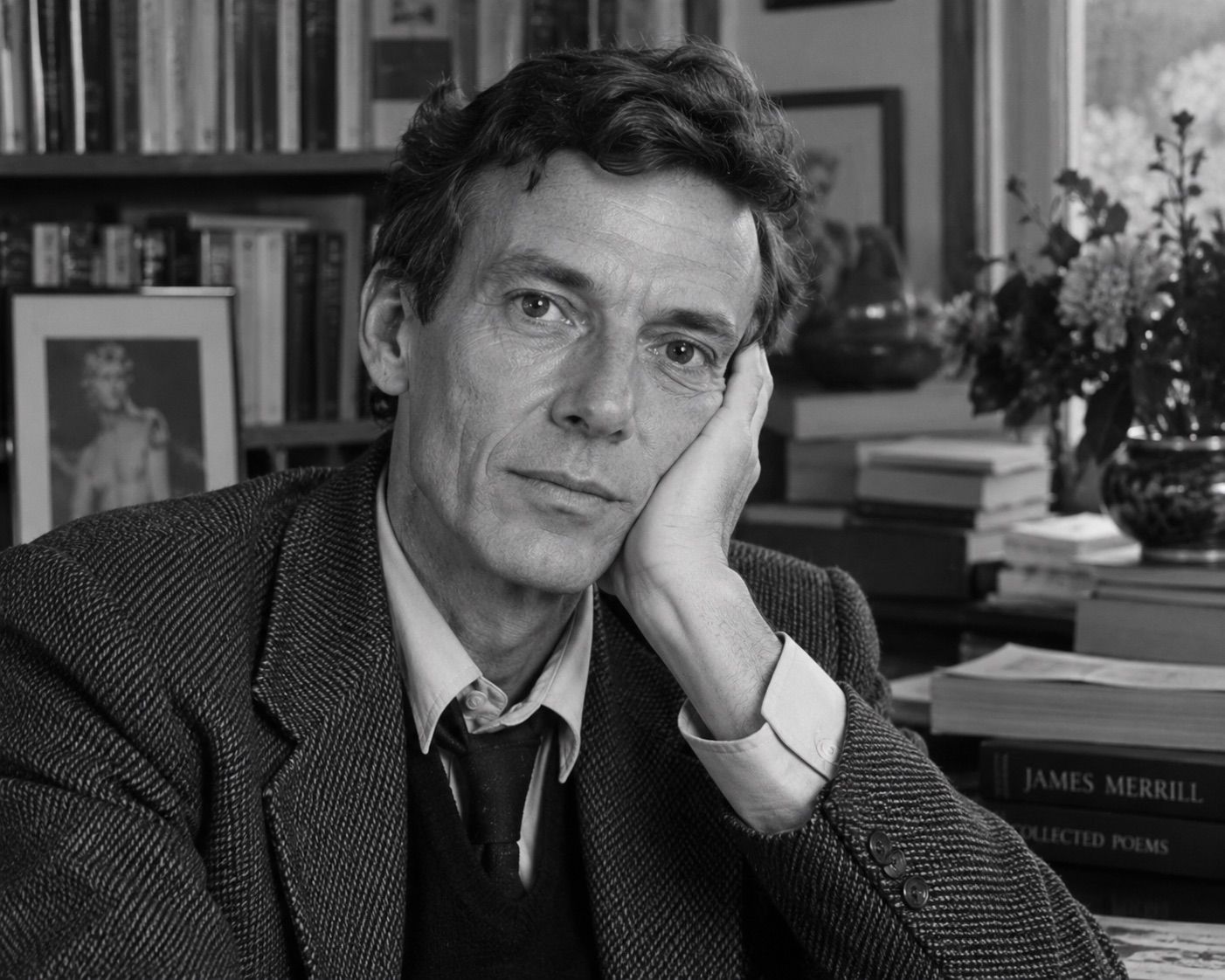
James Merrill’s poetry has been a constant presence in my life, even though I’ve only recently started reading him seriously. There’s something about his work that makes me feel like I’m getting lost in a world I’m not quite sure I want to find my way out of.
I think what draws me in is the sense of tension between elegance and despair that runs through much of his poetry. It’s like he’s always poised on the edge of some precipice, but never quite takes the leap. This makes him feel both deeply relatable and impossibly distant at the same time. I’ve spent hours poring over poems like “The Book of Ephraim” or “Divine Comedies”, trying to untangle the threads of his emotions and ideas.
One thing that’s always struck me about Merrill is how he writes about himself as a kind of unreliable narrator. He’ll weave these intricate stories and mythologies, only to undercut them with some wry aside or self-deprecating joke. It’s like he’s constantly questioning his own account of reality, and I find myself doing the same thing while reading him.
I think part of what makes this so compelling is that it speaks to my own experiences as a writer. For me, writing is often a way of making sense of the world – or at least, of trying to make sense of myself within it. But with Merrill, I get the feeling that he’s not always sure which way is up, either. This makes him feel more human, somehow, and less like some kind of literary icon.
Another aspect of Merrill’s work that I find fascinating is his exploration of spirituality and the supernatural. He writes about ghosts and demons and angels, but it never feels like he’s taking any of this stuff at face value. Instead, he’s always probing beneath the surface, trying to get at some deeper truth or insight. This resonates with me because I’ve always been someone who’s a little uncomfortable with the idea of faith – not that I don’t believe in anything, exactly, but more like…I’m just not sure what I do believe.
When I read Merrill’s poetry about spirit communication and channeling, I feel like he’s speaking directly to this part of me. It’s as if he’s saying, “Look, I know it sounds crazy, but sometimes the only way to make sense of things is to listen for voices that aren’t your own.” This feels both unsettling and liberating at the same time – like maybe, just maybe, there are ways of knowing that don’t rely on reason or logic.
I’m not sure what this says about me as a person, but it’s certainly made me more aware of my own ambivalence around faith and spirituality. Merrill’s work doesn’t provide any easy answers, which is probably why I find it so compelling in the first place. He’s always pushing at the boundaries of what we think we know, and this feels both exhilarating and terrifying all at once.
As I continue to read and reread Merrill’s poetry, I’m struck by how little I really understand about him – or his work, for that matter. But maybe that’s the point: maybe it’s okay not to have everything figured out, even when you’re writing about the mysteries of life and death.
Lately, I’ve been thinking a lot about Merrill’s use of language as a way to conjure up other worlds. He has this incredible ability to create entire atmospheres with just a few words, like a painter would mix colors on a palette. When I read his poetry, I feel like I’m stepping into these dreamlike landscapes that are both familiar and strange at the same time.
I think what draws me in is the way Merrill uses language as a kind of magical tool. He’s not just describing things; he’s creating them. And this makes me wonder about my own use of language, too. As a writer, I’ve always tried to be honest with myself and with my readers – but at the same time, I know that language is never entirely neutral. We all bring our own biases and assumptions to the page, even when we’re trying to be objective.
Merrill’s work shows me that this is okay, even necessary. In fact, it’s what makes writing so powerful: the way we can use words to shape reality, or at least our perception of it. When I read his poetry about myth and legend, I feel like I’m being invited into a world where anything is possible – and yet, at the same time, it’s also uncomfortably close to home.
This has me thinking about my own writing habits, too. I’ve always been drawn to stories that are weird or unsettling in some way, but I’ve never felt brave enough to push myself into truly uncharted territory. Reading Merrill has made me realize how much I’m missing out on – and also how hard it is to be willing to take risks with your own writing.
It’s funny: when I was reading through “Divine Comedies” the first time, I found myself getting frustrated with Merrill for being too obscure, too difficult. But now that I’ve read him more, I realize that this obscurity is actually a kind of generosity – he’s willing to leave room for me to fill in the blanks, to make my own connections between the lines.
I’m not sure what this says about my own writing style or preferences, but it feels like Merrill has given me permission to be more expansive, more experimental. He’s shown me that language is a kind of tool, one that can be used to build entire worlds – and also to break them down into their component parts.
I’m not sure what happens next, but I feel like this is where the real journey begins.
As I sit here with Merrill’s poetry still swirling in my head, I find myself thinking about the concept of “otherness” – how it can be both a source of fascination and discomfort. Merrill’s work often blurs the lines between reality and fantasy, inviting the reader to inhabit spaces that are simultaneously familiar and strange. This makes me wonder: what does it mean for someone like me, who’s always trying to make sense of the world through language?
Growing up, I was always a bit of an outsider – not in a dramatic way, but more like…I just didn’t quite fit into the usual categories or expectations. And I think this is why I’m drawn to Merrill’s poetry: it acknowledges that there are multiple ways of being in the world, and that none of them might be entirely accurate.
When I read about his experiences with spirit communication, for instance, I feel like he’s tapping into a part of me that’s always been wary of taking things at face value. It’s as if he’s saying: “Yes, there are mysteries beyond our comprehension – but what if we were to approach them not with certitude, but with curiosity?” This feels incredibly liberating, and also terrifying.
I’ve always thought of myself as a writer who’s interested in exploring the human condition, but I realize now that this is a pretty narrow focus. Merrill’s work shows me that there are so many other ways to experience reality – through myth, legend, spirit communication…and maybe even just plain old imagination.
This has me thinking about my own writing goals and aspirations. For a long time, I’ve been trying to write in a way that feels authentic and true to myself, but what if authenticity is not the only goal? What if I’m allowed to explore different modes of expression – to conjure up worlds that are entirely fictional, or to tap into experiences that aren’t my own?
Merrill’s poetry doesn’t provide any easy answers, of course. But it does show me that language can be a kind of portal to other realities – and that maybe this is what writing is all about: creating new ways of seeing, feeling, and understanding the world around us.
As I continue to read and reread Merrill’s work, I’m struck by how much I still don’t understand. But maybe that’s okay – maybe it’s even necessary. Because when we’re faced with mysteries that are beyond our comprehension, what choice do we have but to keep exploring? To keep writing?
I find myself lost in the labyrinthine corridors of Merrill’s mind, trying to untangle the threads of his thoughts and emotions. It’s like he’s given me a map with no clear destination, and I’m left to navigate the twists and turns on my own.
One thing that’s always struck me about Merrill is how he blurs the lines between personal and public experience. His poetry often feels like a kind of confessional, but it’s not just about revealing secrets or exposing his innermost thoughts – it’s also about creating a sense of connection with the reader. He’s constantly pushing against the boundaries of what we think we know about him as a person, and this makes me wonder: what does it mean to be a public figure, anyway?
I think about how Merrill was often criticized for being too private or too opaque in his work – people would say that he was hiding behind his poetry, using it as a way to veil his true self. But I see it differently. To me, Merrill’s privacy is actually a kind of generosity – he’s sharing pieces of himself with us, but only on his own terms.
This makes me think about my own relationship with readers and the public sphere. As a writer, I’ve always felt a sense of responsibility to be honest and authentic in my work. But what if that’s not enough? What if Merrill is showing me that being private or ambiguous can actually be a strength – that it allows us to connect with others on a deeper level?
I’m not sure where this line of thinking will lead, but I feel like it’s getting at something fundamental about the nature of writing and self-expression. It’s like Merrill is saying: “Look, I know you think you want me to reveal myself to you, but what if I told you that I’m still holding back? That there are pieces of me that I’ll never share with anyone?”
This feels both exhilarating and terrifying – it’s like Merrill is inviting me into a world where the boundaries between self and other are constantly shifting. And when I think about my own writing, I realize that this is exactly what I’m trying to do: create spaces where readers can inhabit multiple selves at once.
But how do I pull this off? How do I capture the complexity of human experience without resorting to simplicity or abstraction? Merrill’s poetry often feels like a kind of alchemy – he takes fragments and disparate elements, and somehow coaxes them into a new form that’s both familiar and strange. This is what I’m aiming for in my own writing: not to create perfect replicas of reality, but to conjure up new possibilities for understanding and connection.
And so I keep reading Merrill’s poetry, trying to absorb its lessons and insights. I feel like he’s giving me a key to unlock the doors of perception – or maybe even just a map to navigate the labyrinthine corridors of my own mind. The journey is far from over, but I’m excited to see where it takes me next.
As I continue to delve into Merrill’s poetry, I find myself becoming increasingly fascinated with his use of mythology and symbolism. He weaves these narratives throughout his work, often blurring the lines between personal experience and mythological archetype. It’s as if he’s saying that our individual stories are not unique, but rather part of a larger tapestry that’s been woven from threads of collective human experience.
This resonates deeply with me because I’ve always been drawn to mythology and folklore in my own writing. I find that these ancient stories tap into something primal within us, speaking to universal desires and fears that transcend time and culture. Merrill’s use of mythological symbolism feels like a kind of portal to this collective unconscious, inviting the reader to step into a world that’s both familiar and strange.
But what strikes me most about Merrill’s approach is his willingness to subvert and complicate these mythologies. He doesn’t shy away from ambiguity or uncertainty, instead embracing the complexities and contradictions that lie at the heart of human experience. This makes him feel more honest, somehow – like he’s acknowledging the messiness of life without trying to tidy it up into neat packages.
As I reflect on my own writing, I realize that I’ve often fallen into the trap of trying to tie things up with a bow. I’ll spend hours crafting a narrative that feels complete and satisfying, only to have some inner voice whispering “no, no, this isn’t enough.” Merrill’s poetry shows me that sometimes it’s okay to leave things undone, to let the ambiguities and uncertainties of life speak for themselves.
I’m starting to wonder if this is what I mean by “truth” in my writing – not some fixed or objective reality, but rather a kind of dynamic tension between competing narratives and perspectives. This feels both liberating and terrifying all at once: what if I let go of the need for control and resolution, embracing instead the messy complexity of human experience?
Merrill’s poetry doesn’t provide any easy answers to these questions, of course. But it does show me that language can be a kind of mirror held up to the soul – reflecting back our deepest fears and desires, our highest aspirations and lowest impulses. This is what I’m trying to tap into in my own writing: not some external truth or objective reality, but rather the inner workings of the human heart.
As I continue to explore Merrill’s work, I find myself becoming increasingly fascinated with his use of language as a kind of performative act. He’ll take words and phrases that are seemingly ordinary – even banal – and infuse them with a kind of magical power. It’s like he’s conjuring up entire worlds with just a few carefully chosen words.
This makes me think about my own relationship with language, too. As a writer, I’ve always tried to use clear, concise language that gets the point across without resorting to unnecessary complexity or jargon. But Merrill’s poetry shows me that this is only half the story – that language can also be a kind of alchemy, transforming base metal into gold.
I’m starting to wonder if this is what I mean by “style” in my writing – not some fixed or identifiable trait, but rather a kind of fluid, adaptive quality that emerges from the unique intersection of language and experience. Merrill’s poetry feels like it’s always pushing against the boundaries of style, refusing to be contained within neat categories or expectations.
This has me thinking about the relationship between language and identity, too. As I read through Merrill’s work, I’m struck by how much he blurs the lines between self and other – making it impossible for me (or anyone else) to pin him down into some fixed or essential category. This feels both exhilarating and terrifying all at once: what if my own writing is not about revealing some hidden truth or authentic self, but rather about creating a kind of linguistic alchemy that transforms the reader’s perceptions?