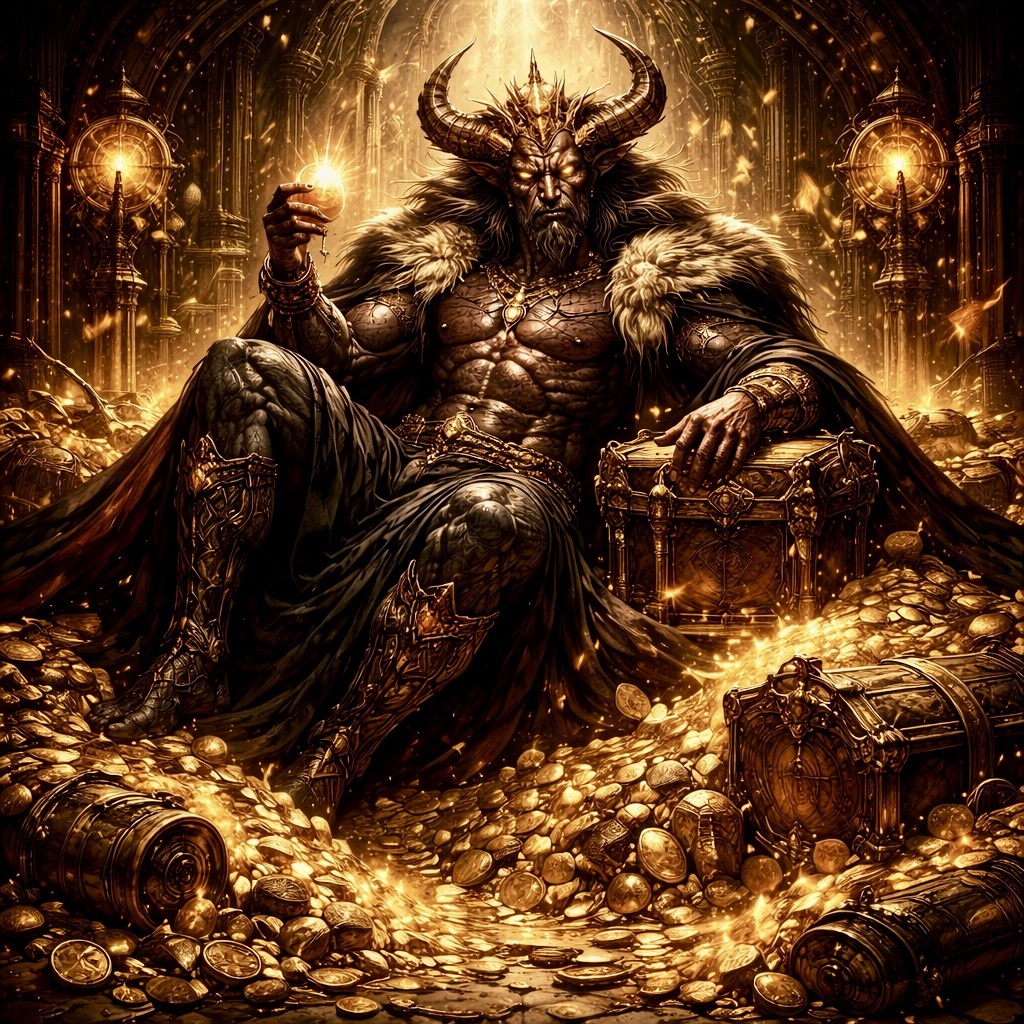
Mammon is one of those names that transcends demonology and slips into everyday language, often without people even realizing its origin. When someone speaks about “serving Mammon,” they are not just referencing wealth—they are invoking an idea that has existed for centuries, one that ties money, power, desire, and identity into a single, complicated concept. Mammon is not merely a demon of riches. He is the embodiment of what happens when wealth stops being a tool and becomes the purpose.
Unlike many figures found in grimoires such as the Ars Goetia, Mammon’s roots are deeply embedded in religious and linguistic history. The word itself comes from Aramaic, where it originally referred simply to wealth or material possessions. Over time, particularly in biblical texts, the term evolved. It stopped being neutral. It became a warning.
In the New Testament, Mammon is not described as a being in the same way as other demonic figures. Instead, it is personified—treated as something that can be served, something that competes with devotion, something that demands allegiance. “You cannot serve both God and Mammon,” the text states, drawing a direct line between spiritual commitment and material obsession.
This is where Mammon’s identity begins to take shape.
He is not just wealth.
He is devotion to wealth.
This distinction is critical. Wealth itself is not inherently problematic. It can provide stability, opportunity, and security. It can be used to build, to create, to support. But when wealth becomes the primary focus—when it defines decisions, values, and priorities—it transforms.
It becomes Mammon.
This transformation is not immediate. It is gradual, almost imperceptible. A desire for comfort becomes a pursuit of accumulation. Accumulation becomes a measure of success. Success becomes tied to identity. And identity, once anchored in wealth, begins to shift.
Mammon represents that shift.
He is the moment when value becomes numerical, when worth is measured in quantity rather than quality, when the question is no longer “What is enough?” but “How much more?”
The imagery often associated with Mammon reflects this excess. He is depicted surrounded by gold, jewels, and riches, often seated upon a throne or buried within his own wealth. This visual is not just about abundance. It is about immersion.
He is not using the wealth.
He is within it.
This immersion is symbolic of how wealth, when pursued without balance, can become all-encompassing. It shapes perception, influences decisions, and alters priorities. The individual becomes defined by what they possess rather than what they are.
From a psychological perspective, Mammon can be understood as an archetype of material attachment—the tendency to derive identity and meaning from external possessions. This attachment is not limited to money. It extends to status, power, and recognition.
Humans are naturally inclined to seek security and validation. Material wealth provides a tangible way to achieve both. It offers control, predictability, and a sense of accomplishment.
But it also introduces risk.
When identity becomes tied to external factors, it becomes unstable. Wealth can fluctuate. Status can change. Recognition can fade. If these are the foundations of identity, then the individual is constantly at risk of losing themselves.
Mammon embodies this instability.
He represents the illusion of permanence within something inherently transient.
This illusion is powerful because it feels real. Wealth can create a sense of control, of mastery over circumstances. It can make the future seem predictable.
But this control is never absolute.
Markets shift. Systems change. External factors intervene.
Mammon does not eliminate uncertainty.
He masks it.
This masking is part of his influence. By focusing attention on accumulation, he diverts it from deeper questions—questions about purpose, meaning, and balance. The pursuit of wealth becomes a distraction from introspection.
This does not mean that wealth is inherently negative. The key lies in its role.
Is it a tool or a goal?
When wealth is a tool, it serves a function. It enables action, supports goals, and provides resources. When it becomes a goal, it begins to define behavior.
Mammon represents the latter.
He is the point at which the tool becomes the purpose.
This shift can be subtle. It often begins with reasonable intentions—providing for family, achieving stability, improving quality of life. These goals are not problematic.
But as accumulation increases, the focus can change. The original purpose fades, replaced by the process itself. The act of gaining becomes more important than what is gained.
This is where Mammon takes hold.
He does not force this change.
He facilitates it.
He makes accumulation appealing, rewarding, and seemingly necessary.
In modern society, this dynamic is amplified. Economic systems often prioritize growth, efficiency, and output. Success is frequently measured in financial terms. Wealth becomes a primary indicator of achievement.
Within this context, Mammon is not an external force.
He is embedded within the system.
He exists in the metrics, the incentives, the structures that guide behavior.
This makes him particularly relevant.
He is not a distant figure from ancient texts.
He is a reflection of contemporary experience.
The tension between material success and personal fulfillment is a recurring theme in modern life. People pursue careers, build businesses, and strive for financial stability. These efforts can lead to significant achievements.
But they can also lead to imbalance.
Time may be sacrificed. Relationships may be strained. Personal well-being may be compromised.
The pursuit of more can overshadow the appreciation of what already exists.
Mammon represents this imbalance.
He is not opposed to success.
He redefines it.
He shifts the focus from sufficiency to excess, from purpose to accumulation.
This shift is not inherently obvious. It often feels justified. Each step seems reasonable, each decision logical. The problem arises when the cumulative effect leads to a loss of perspective.
When “enough” is never reached.
When satisfaction becomes temporary.
When the pursuit continues without end.
Mammon thrives in this environment.
He does not require dramatic actions.
He operates through gradual change.
From a philosophical standpoint, Mammon can be seen as a challenge—a test of priorities. He raises questions about value, about what truly matters, about how resources should be used.
These questions do not have universal answers.
They depend on context, perspective, and individual goals.
But they are essential.
Without them, behavior becomes automatic, driven by external incentives rather than internal understanding.
Mammon disrupts this understanding.
He simplifies value into quantity.
He reduces complexity into numbers.
And in doing so, he makes the pursuit of wealth both straightforward and endless.
In literature and art, figures associated with greed often serve as cautionary examples. They illustrate the consequences of imbalance, the risks of overcommitment to a single aspect of life.
Mammon fits this role, but with a modern twist.
He is not always depicted as monstrous or grotesque. Sometimes, he appears refined, composed, even admirable. This reflects how wealth is often perceived—desirable, aspirational, and respectable.
This duality is important.
Mammon is not inherently repulsive.
He is attractive.
That is what makes him effective.
In the end, Mammon stands as one of the most enduring symbols in demonology because he represents a universal human challenge—the balance between material and immaterial value.
He does not demand worship.
He invites it.
He offers security, power, and recognition.
And in return, he asks for focus, attention, and priority.
The question is not whether wealth should be pursued.
It is how.
Somewhere between necessity and excess, between tool and identity, between having and becoming—that is where Mammon resides.
Not as a force that creates wealth, but as one that defines what it means.
And the definition matters more than the amount.