There is a fascinating phenomenon that occurs the moment people arrive somewhere warm enough to contain palm trees, turquoise water, and the vague possibility of snorkeling. Entire personalities begin to shift. People who spent the previous eleven months behaving as perfectly ordinary adults suddenly develop the confidence and mannerisms of seasoned ocean explorers despite having, in many cases, limited experience with anything more aquatic than hotel swimming pools. I say this not critically, but with genuine affection, because once you notice it, it becomes impossible not to. Summer seems to possess a strange ability to convince people that proximity to water alone unlocks entirely new versions of themselves. Perhaps it’s the heat, the sunlight, or the temporary suspension of normal life. Whatever the cause, vacation has a remarkable way of encouraging reinvention.
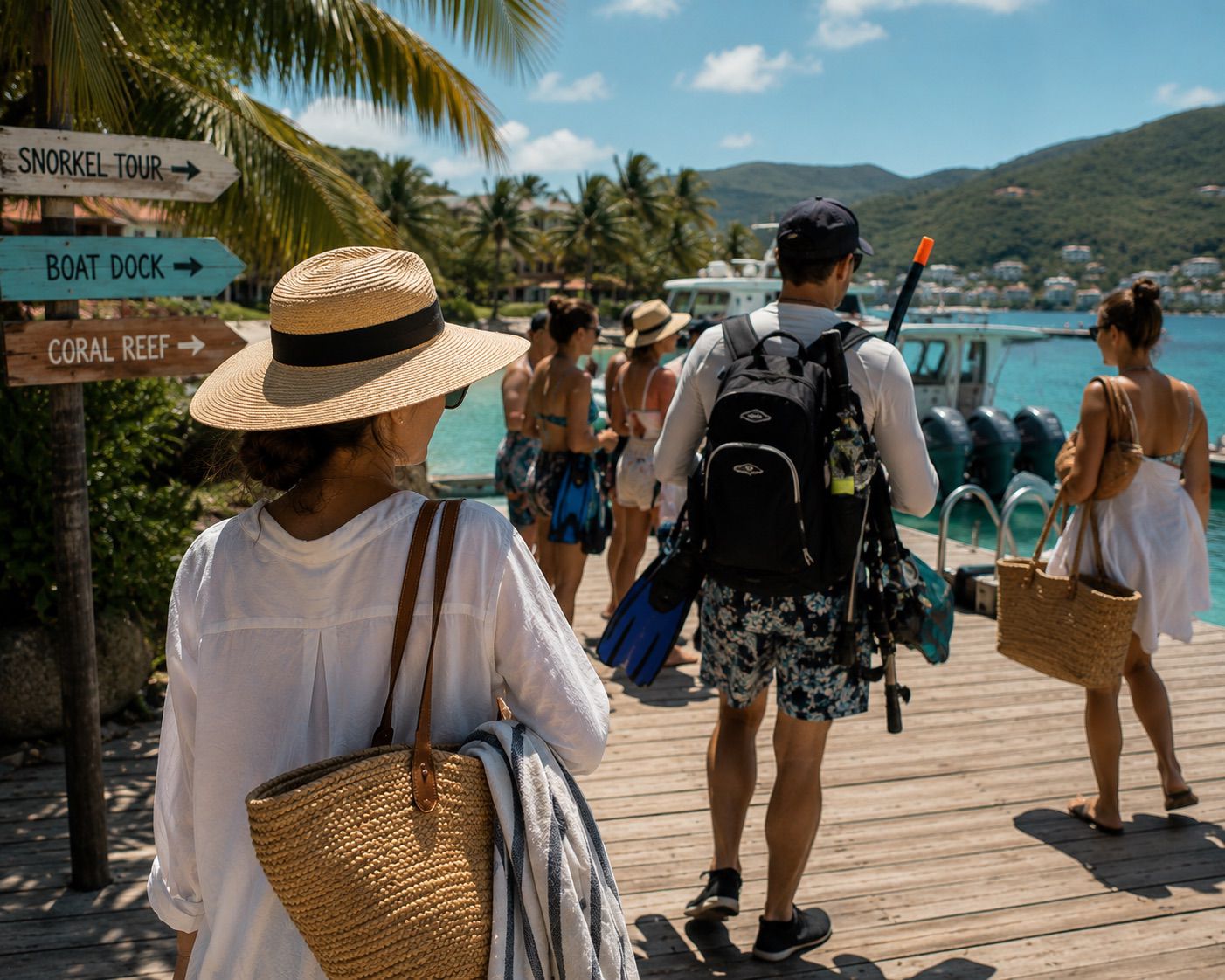
I began thinking about this during a recent morning near a resort marina where groups of visitors had gathered for snorkeling excursions. The dock itself looked like a temporary holding area for several competing versions of vacation identity. Some people approached the experience with casual practicality — a swimsuit, sandals, perhaps a towel tossed over one shoulder. Others arrived as though preparing for a deep-sea expedition requiring rescue helicopters and international coordination. The contrast was extraordinary. One gentleman stood nearby wearing water shoes, compression sleeves, polarized sunglasses, fingerless gloves, a waterproof watch large enough to guide aircraft, and enough attached equipment to suggest he might also be capable of locating submarines. He was preparing to snorkel in water shallow enough to reveal fish directly from the dock.
Standing beside him was a woman carrying nothing but a woven beach bag and a straw hat. She looked entirely unconcerned with logistics and fully committed to the visual fantasy of vacation itself. Both approaches felt strangely understandable because vacations create unusual versions of ourselves. Or perhaps more accurately, they reveal versions that spend most of the year waiting quietly beneath routines and responsibilities. People become ocean people very quickly. This transformation seems to happen somewhere between unpacking luggage and applying sunscreen. Suddenly, individuals who normally spend their days answering emails and attending meetings begin discussing reef visibility, currents, tide conditions, and underwater life with startling authority.
By breakfast on the second day, complete novices somehow acquire the confidence of lifelong marine researchers. I recently overheard a man explaining snorkeling conditions with such conviction that one might reasonably assume he had spent decades studying ocean ecosystems. Twenty minutes later, I watched him struggling with a rental snorkel mask while standing in waist-deep water. I say this with love because there is something deeply charming about watching people embrace temporary identities. Summer encourages it and vacation practically demands it. For one week, people become sailors, divers, adventurers, naturalists, beach philosophers, and experts on subjects they had not considered three days earlier. And somehow everyone collectively agrees to participate in the performance.
The visual transformation is equally fascinating. Board shorts suddenly appear. Oversized hats migrate across beach towns with remarkable consistency. Sunglasses become larger, woven bags emerge from storage, and waterproof accessories begin appearing everywhere. Entire populations start dressing as though they are moments away from boarding private yachts despite spending the afternoon waiting in line for boat tours and frozen drinks. Everyone begins looking slightly more adventurous, slightly more coordinated, and considerably more optimistic than they did back home. Vacation fashion, I’ve realized, has very little to do with realism and almost everything to do with aspiration.
Yet beneath the humor, I suspect something more meaningful may be happening. People rarely pack solely for practicality. They pack for possibility. They pack for versions of themselves they hope might emerge once routines and responsibilities temporarily disappear. The organized version. The adventurous version. The relaxed version. The version that wakes up early for snorkeling excursions and effortlessly swims alongside tropical fish while appearing calm and impossibly photogenic in every picture. Reality, of course, eventually intervenes. Sunburns happen. Snorkel masks leak. Someone inevitably swallows ocean water and spends several minutes pretending not to panic.
But increasingly, I suspect those details miss the point entirely. Vacations have never really been about accuracy. They’ve always been about imagination. They allow us to briefly step outside routines and experiment with alternate versions of ourselves. And perhaps that is why I’ve become unexpectedly fond of these tiny transformations. Not because I necessarily believe them, but because they reveal something surprisingly hopeful about people. Even after years of routines and obligations, we still enjoy imagining ourselves becoming someone slightly different for a while. Honestly, I think there’s something rather lovely about that.