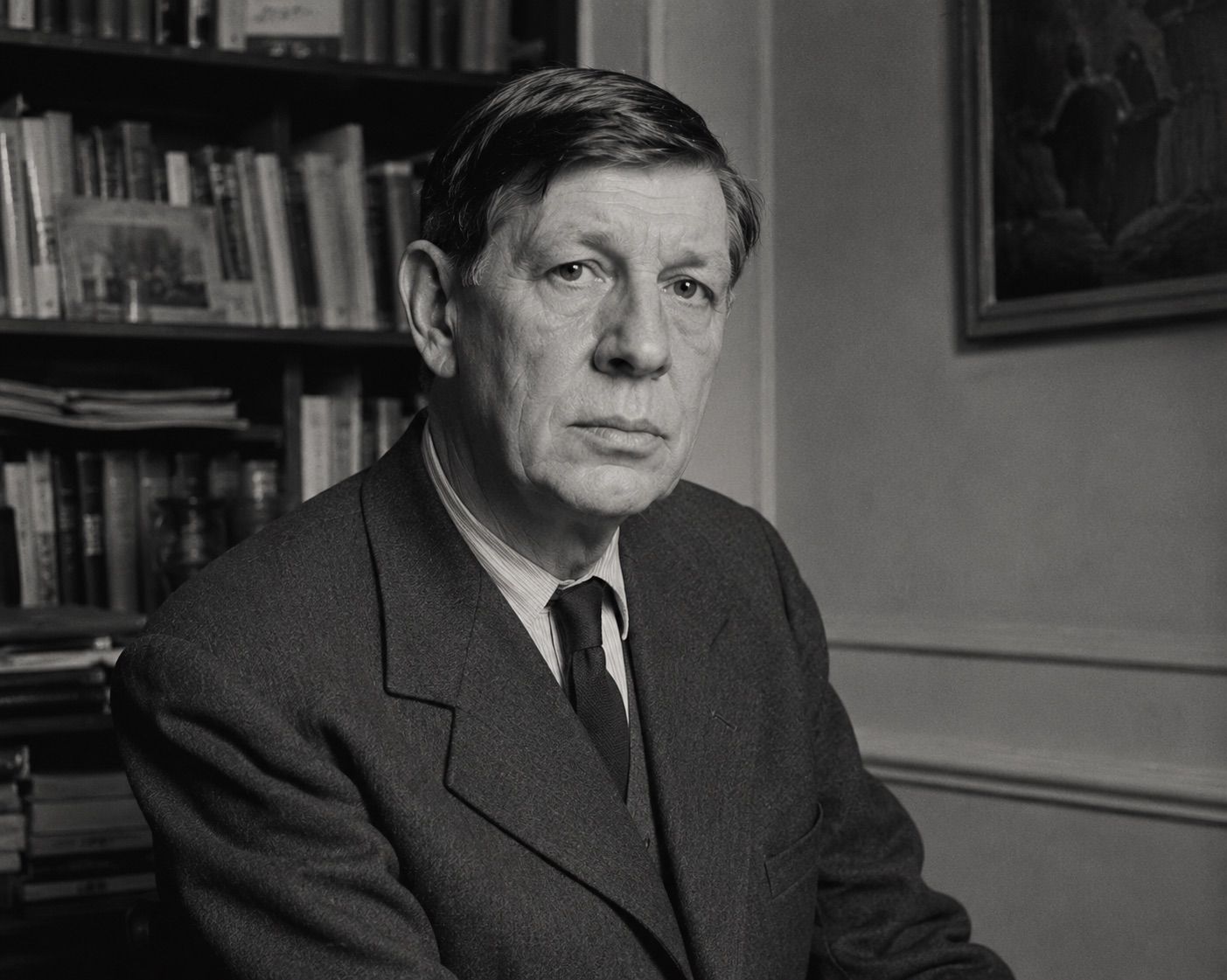
W.H. Auden’s poetry has been a constant presence in my life, even though I only discovered him during my senior year of college. It’s funny how sometimes it takes stumbling upon something to truly appreciate its value. For me, Auden’s words are like a gentle reminder that even the most seemingly straightforward thoughts can be messy and complex.
I remember reading “The Shield of Achilles” for the first time and feeling both captivated and unsettled by his exploration of heroism and vulnerability. The way he weaves together mythological references with personal anecdotes creates a sense of unease, like he’s probing at the edges of our collective understanding. It’s as if he’s saying that even the most iconic stories can’t shield us from the ambiguities of human experience.
One of the things I find most intriguing about Auden is his ability to balance intellectualism with emotional authenticity. His poetry often feels both erudite and intimate, like he’s sharing a secret with you while also making sure you understand the historical context. This blend of high-mindedness and vulnerability resonates deeply with me – maybe because it’s something I’ve struggled with in my own writing.
When I’m stuck on an idea or struggling to put words together, I often find myself drawn to Auden’s work. His poetry is like a balm for my writer’s block, reminding me that even the most abstract concepts can be approached through storytelling and imagery. But at the same time, his complexities also make me question my own approaches – am I being too didactic? Too vague?
I’ve been reading about Auden’s relationships and how they influenced his writing, particularly his friendships with Christopher Isherwood and Stephen Spender. It’s clear that these men played a significant role in shaping his perspective, but what really fascinates me is the way their personal dynamics mirror some of the themes in his poetry. For example, his exploration of loneliness and connection feels eerily familiar when considering the tumultuous nature of male friendships during the mid-20th century.
Auden’s struggles with identity and belonging are also something that I can relate to on a deeper level. As someone who’s navigated the often-fractured world of higher education, I know what it means to feel like you’re trying to fit into multiple roles at once – student, writer, friend, family member. Auden’s words seem to capture this feeling of dislocation, of being suspended between different worlds and identities.
One of his most famous lines keeps popping up in my head whenever I think about his work: “We would see with equal eye / If we could see the air.” This phrase has become a kind of refrain for me, a reminder that sometimes it’s not what we can see or measure that’s most important, but rather the spaces in between – the silences, the ambiguities, and the complexities.
I’m still grappling with how to fully integrate Auden’s poetry into my own writing. Part of me wants to emulate his mastery of language and form, while another part is drawn to the more unstructured, confessional elements of his work. It’s as if I’m caught between two opposing forces – the desire for control and precision versus the need for honesty and vulnerability.
Perhaps that’s what ultimately draws me to Auden’s poetry: its willingness to confront uncertainty head-on. In an era where we’re constantly being told what we should be, think, or feel, his words are a refreshing reminder that complexity is not something to be solved but rather something to be explored – and celebrated.
As I delve deeper into Auden’s poetry, I’m struck by the way he navigates the tension between order and chaos. His work often feels like a delicate balance of structure and spontaneity, as if he’s deliberately pushing against the boundaries of language to reveal something more authentic. This resonance echoes my own experiences with writing, where I struggle to reconcile the desire for control with the need for creative freedom.
I find myself wondering how Auden would approach the notion of “authenticity” in today’s social media landscape. Would he see the curated selves we present online as a form of performance, or would he view them as a genuine expression of self? His poetry often touches on the performative nature of identity, but I’m not sure if he’d be as skeptical of social media as I am.
One poem that keeps coming back to me is “The Unknown Citizen.” It’s a powerful critique of bureaucratic dehumanization, where Auden describes a life reduced to statistics and data. The poem’s title character is a faceless figure, stripped of individuality and reduced to a mere abstraction. This image haunts me because it feels so familiar in our digital age – we’re constantly being asked to present ourselves as data points, likes, and shares.
Auden’s poetry often explores the tension between the individual and society, but I’m not sure if he’d be surprised by how quickly that conversation has evolved since his time. In many ways, social media has amplified the performative aspects of identity, making it easier to curate a public persona while hiding behind a mask. And yet, Auden’s work reminds me that this performance is precisely what makes us human – our contradictions, flaws, and uncertainties are what make life worth living.
I’m drawn to the idea that Auden’s poetry can be seen as a form of resistance against the forces of conformity. By embracing complexity and ambiguity, he creates space for the unknown, the uncertain, and the unseen. This is something I aspire to in my own writing – to capture the messiness of human experience, with all its contradictions and paradoxes.
As I continue to explore Auden’s work, I’m left wondering if his poetry can be a catalyst for change. Can it inspire us to question our assumptions about identity, community, and belonging? Or is it simply a reflection of the world we live in – a mirror held up to reveal the complexities and contradictions that surround us?
I’m not sure what the answer is, but I do know that Auden’s poetry has changed me in some fundamental way. It’s as if his words have given me permission to explore the unknown, to confront my own uncertainties, and to find beauty in the spaces between.
As I sit here with Auden’s poetry scattered around me, I’m struck by the realization that his work is not just a reflection of his own experiences, but also a mirror held up to our collective psyche. His ability to capture the complexities and contradictions of human nature feels both universally relatable and deeply personal.
I find myself thinking about my own relationships with others – how we present ourselves to the world versus the hidden aspects of our personalities that only reveal themselves in intimate moments. Auden’s poetry often touches on this tension between performance and authenticity, making me wonder if I’m being honest enough with those around me.
One of his lines keeps echoing in my mind: “No man is an island.” It’s a phrase that resonates deeply with me, especially as someone who’s struggled to balance individuality with the need for connection. In today’s world, where social media often encourages us to curate our own islands of solitude, Auden’s words feel like a reminder that true community and belonging can only be found by embracing our shared humanity.
I’m also drawn to his exploration of language as a tool for both creation and destruction. His poetry often blurs the lines between art and politics, revealing the power dynamics at play in how we communicate with each other. This makes me think about my own writing – am I using language to build bridges or create walls?
As I delve deeper into Auden’s work, I’m struck by the way he navigates the relationship between creativity and responsibility. His poetry often feels like a delicate balance of freedom and constraint, as if he’s pushing against the boundaries of language while also acknowledging its limitations.
This echoes my own struggles with creative freedom – how much can I control the narrative versus how much must I surrender to the unknown? Auden’s poetry reminds me that true art lies in embracing both the constraints and the possibilities of language, rather than trying to impose a predetermined vision on the world.
I’m left wondering if this is what Auden meant by his famous line: “We are all waiting for something.” Is it possible that we’re not just waiting for external events or circumstances to unfold, but also for our own inner transformations – for the moments when our perceptions shift and our understanding of ourselves and the world expands?
As I close my laptop and step away from Auden’s poetry, I’m left with a sense of gratitude and awe. His work has given me permission to explore the complexities and contradictions of human nature, and to find beauty in the spaces between. In this era of curated selves and performative identities, his poetry feels like a reminder that true authenticity lies not in presenting a polished image, but in embracing our messy, imperfect humanity.
As I reflect on my own relationship with Auden’s poetry, I’m struck by the way it has become a kind of companion for me during uncertain times. His words have a way of anchoring me to the present moment, reminding me that even in the midst of chaos and complexity, there is always beauty to be found.
One thing that resonates deeply with me is Auden’s concept of “in-betweenness.” In his poem “The Sea and the Mirror,” he writes about the liminal spaces between life and death, reality and fantasy. It’s as if he’s saying that it’s in these threshold moments, where we’re suspended between different states of being, that we find true creativity and understanding.
I think about my own experiences with transition – moving from college to adulthood, navigating uncertain relationships, trying to figure out what I want to do with my life. These periods of limbo can be disorienting and overwhelming, but Auden’s poetry reminds me that it’s in these moments of flux that we’re forced to confront our own assumptions and limitations.
His exploration of ambiguity is also something that speaks deeply to me. In an era where social media often encourages us to present a curated image of ourselves, Auden’s poetry is a refreshing reminder that complexity is not something to be avoided or hidden, but rather something to be celebrated.
One of his most famous lines, “We are all waiting for something,” keeps echoing in my mind as I think about the role of uncertainty in creative work. It’s as if he’s saying that true art and understanding arise from the space between what we know and don’t know, between what we can see and can’t see.
I’m drawn to the idea that Auden’s poetry is not just a reflection of his own experiences, but also a mirror held up to our collective psyche. His exploration of human nature, with all its complexities and contradictions, feels both universally relatable and deeply personal.
As I delve deeper into his work, I’m struck by the way he navigates the relationship between art and politics. His poetry often blurs the lines between creativity and responsibility, revealing the power dynamics at play in how we communicate with each other.
This makes me think about my own writing – am I using language to build bridges or create walls? Auden’s poetry reminds me that true art lies in embracing both the constraints and the possibilities of language, rather than trying to impose a predetermined vision on the world.
I’m left wondering if this is what Auden meant by his concept of “the necessary angel.” In one of his poems, he writes about an inner voice that guides us towards truth and understanding. It’s as if he’s saying that true creativity arises from the intersection of our own inner worlds with the external realities we navigate.
As I close my thoughts on Auden for now, I’m left with a sense of awe and gratitude for his poetry. His work has given me permission to explore the complexities and contradictions of human nature, and to find beauty in the spaces between. In an era where we’re constantly being told what to think and feel, his words are a refreshing reminder that true authenticity lies not in presenting a polished image, but in embracing our messy, imperfect humanity.
I’m left wondering if Auden’s poetry will continue to be a source of inspiration for me as I navigate the complexities of adulthood. Will it guide me towards new insights and perspectives? Will it remind me to stay true to myself amidst the pressures of conformity?
As I put down my pen and step away from these thoughts, I’m left with a sense of uncertainty – but also a sense of possibility.