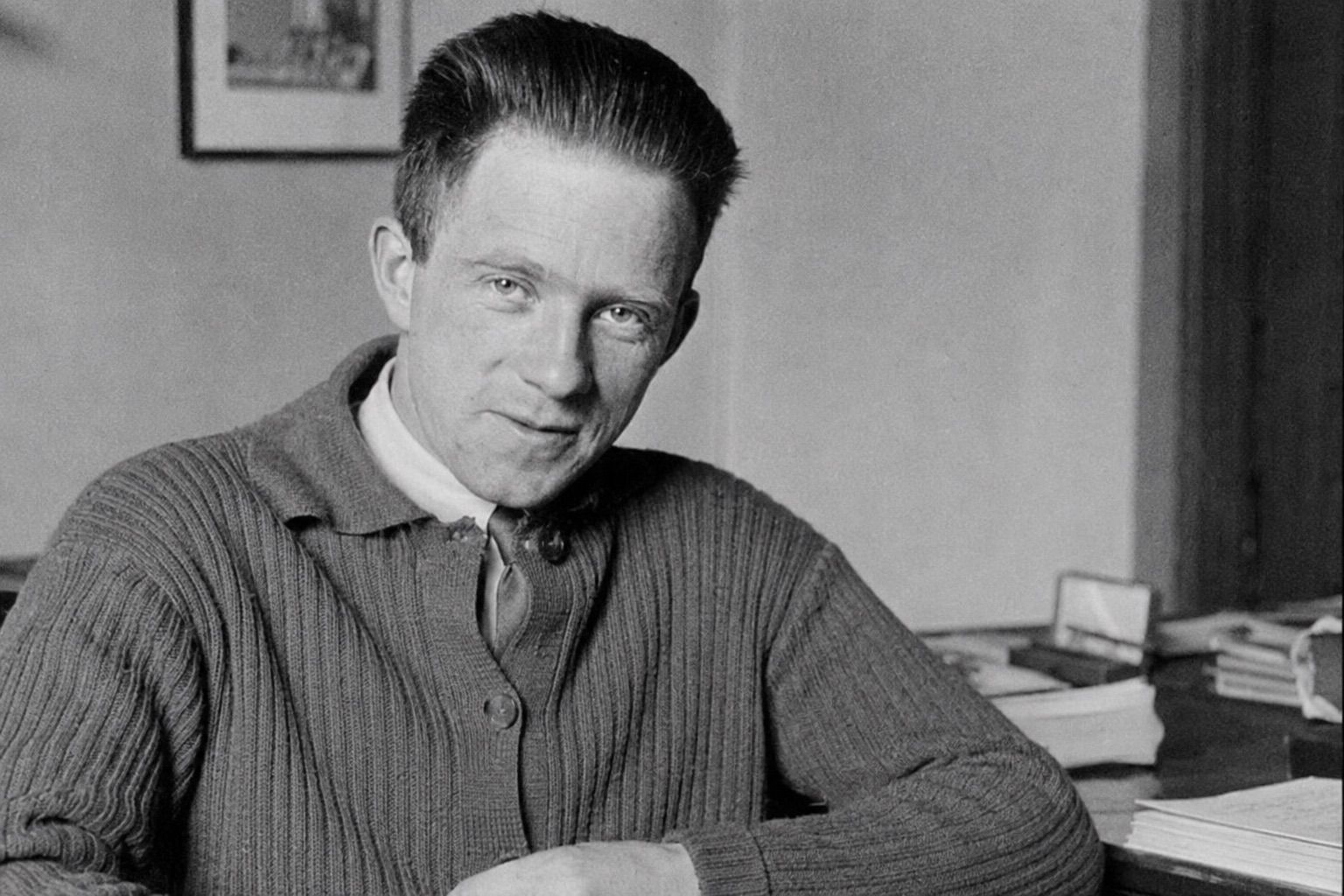
I still remember stumbling upon Werner Heisenberg’s name while reading about the development of quantum mechanics. At first, I was drawn to the abstract concepts – wave-particle duality, uncertainty principle, and Schrödinger’s cat. But as I delved deeper into his work, I found myself captivated by the man behind the theories.
As a student, I struggled with the idea that Heisenberg’s principles challenged our understanding of reality. It was disorienting to think that we could never truly know the position and momentum of a particle at the same time. But what really caught my attention was the tension between his scientific discoveries and his involvement in Nazi Germany.
I’ve always been fascinated by the complexity of people who seem to embody both brilliance and darkness. Heisenberg’s work during World War II, particularly his involvement with the Uranverein project (the German nuclear energy project), makes me uncomfortable. It’s hard for me to reconcile the man who pioneered quantum mechanics with the one who collaborated with the Nazi regime.
I wonder if it’s possible to separate a person’s scientific contributions from their personal views and actions. Can we isolate Heisenberg’s groundbreaking work on the uncertainty principle from his decisions during wartime? I’m not sure, but exploring this dichotomy keeps me up at night. It’s as if I’m caught in a vortex of conflicting emotions – admiration for his intellectual pursuits versus revulsion towards his involvement with a regime responsible for unimaginable atrocities.
As I read about Heisenberg’s interactions with Niels Bohr and other physicists, I sense a level of complexity that feels eerily familiar. It reminds me of the internal conflicts I’ve struggled with in my own life – wanting to do good but being drawn into environments that compromise my values. Maybe it’s because we’re all multifaceted beings, capable of both creativity and cruelty, and Heisenberg’s story serves as a haunting reminder of this duality.
Sometimes, when I’m writing about these themes, I feel like I’m grasping at fragments – trying to make sense of the connections between abstract ideas, personal experiences, and historical events. It’s as if I’m searching for a thread that weaves everything together. Heisenberg’s story keeps me searching, making me question my own reactions and biases.
I’ve come across claims that Heisenberg was not a fervent Nazi but rather an opportunist who sought to secure funding for his research. Others argue that he was indeed a devoted supporter of the regime. I’m left wondering which narrative is more accurate or if it’s even possible to discern the truth behind these accounts.
Heisenberg’s legacy continues to intrigue me, and I find myself circling back to the same questions: Can we separate art from artist? Can we distinguish between scientific discoveries and personal moralities? As I ponder these questions, I’m reminded that life is a messy tapestry of contradictions – where brilliant minds can coexist with dark impulses.
My fascination with Heisenberg’s story might stem from my own struggles to reconcile the complexities within myself. Perhaps it’s a reflection of our collective human experience: trying to make sense of the world while acknowledging our own flaws and biases. Whatever the reason, I’m drawn back to his enigmatic figure, seeking insight into the intricate dance between creativity, morality, and the human condition.
As I continue to grapple with Heisenberg’s legacy, I find myself drawn to the concept of “opportunism” – a term often used to describe his alleged relationship with the Nazi regime. On one hand, it seems like a convenient excuse, a way to avoid taking responsibility for the choices we make when we’re faced with difficult circumstances. But on the other hand, it’s possible that Heisenberg genuinely believed he was doing what was best for Germany, even if that meant collaborating with a brutal government.
This ambivalence makes me think about my own experiences navigating complex social situations. There have been times when I’ve felt pressure to conform to certain expectations or ideals, even if they go against my personal values. It’s as if I’m caught in a web of conflicting loyalties – loyalty to myself, to others, and to the world around me.
I remember a conversation with a friend who was struggling to decide whether to join a social justice organization that had a reputation for being radical. My friend felt torn between wanting to make a difference and not wanting to compromise their own values by associating with a group that might be seen as extreme. I listened and offered suggestions, but ultimately, the decision was theirs.
In hindsight, I realize that my friend’s dilemma is similar to Heisenberg’s conundrum – caught between doing what feels right versus doing what seems necessary or expedient. It’s a difficult balance to strike, especially when we’re surrounded by people who expect us to conform to certain norms or expectations.
I’m not sure if it’s possible to reconcile these competing demands, but I do know that it requires a level of self-awareness and critical thinking. We need to be able to question our own biases and assumptions, as well as the motivations of those around us. It’s a delicate dance between standing up for what we believe in and being pragmatic about the world we live in.
As I continue to explore Heisenberg’s legacy, I’m struck by the ways in which his story speaks to universal human experiences – the struggle to make sense of our place in the world, the tension between individual values and collective expectations, and the search for authenticity in a complex and often contradictory reality.
As I delve deeper into Heisenberg’s life and work, I’m reminded of the importance of nuance in understanding human behavior. It’s easy to reduce complex individuals like him to simplistic labels or moral judgments, but that does a disservice to the messy realities of their experiences.
I think about my own struggles with self-acceptance, where I’ve often found myself torn between conforming to societal expectations and staying true to my values. Heisenberg’s story makes me realize that even someone as brilliant and influential as he was still grappled with these same internal conflicts.
It’s a humbling thought – that the people we admire or revere are just as flawed and uncertain as the rest of us. I wonder if this is what makes his legacy so haunting, not just because of his involvement in Nazi Germany but also because it humanizes him in a way that’s both beautiful and painful.
I’ve started to see parallels between Heisenberg’s work on uncertainty principle and my own experiences with uncertainty in life. The more I learn about the intricate dance between observation and reality, the more I realize how it applies to our everyday lives. When we’re faced with choices or situations that are outside our control, do we try to pin down answers or acknowledge the inherent ambiguity?
Sometimes I feel like Heisenberg’s story is urging me to lean into the uncertainty, to trust that even in the midst of chaos and complexity, there can be beauty and meaning. It’s a hard lesson to learn, especially when it feels like the stakes are high and the consequences of making a wrong choice are dire.
I’m struck by how Heisenberg’s legacy has become intertwined with my own struggles to find my place in the world. I wonder if this is what happens when we grapple with universal questions – they start to seep into our personal experiences, becoming part of who we are and how we navigate the complexities of life.
As I continue to explore Heisenberg’s story, I’m left with more questions than answers. But that’s okay. It’s in these moments of uncertainty that I feel most alive, most connected to the messy tapestry of human experience that we’re all trying to make sense of together.
I find myself returning to Heisenberg’s concept of “Gedankenexperiment,” or thought experiment, which he used to explore the limits of our understanding in quantum mechanics. It’s a method of imagining hypothetical scenarios to gain insight into complex phenomena. As I reflect on his approach, I realize that it’s not so different from my own writing process – trying to imagine alternative perspectives, to consider multiple viewpoints, and to grapple with the ambiguities of human experience.
Heisenberg’s Gedankenexperiment feels like a reminder that even in the face of uncertainty, we can still try to make sense of things. We can ask questions, propose theories, and explore new ideas – all while acknowledging that our understanding is provisional, subject to revision or even rejection. It’s a humble approach, one that recognizes the limitations of human knowledge and the complexity of the world around us.
As I delve deeper into Heisenberg’s work, I’m struck by his emphasis on the importance of imagination in scientific inquiry. He saw the thought experiment as a way to “create” new possibilities, to explore the boundaries of what we think is possible. It’s a mindset that feels both liberating and terrifying – because it acknowledges that our understanding can be reshaped or even upended at any moment.
I wonder if this is why I’m drawn to writing about Heisenberg’s story in the first place. Maybe it’s because his work and legacy challenge me to think more creatively, to imagine alternative perspectives on the world. Or perhaps it’s because his experiences serve as a reminder that even in the most uncertain times, we can still try to make sense of things – through science, through art, or through simply trying to be honest with ourselves.
As I continue to reflect on Heisenberg’s story, I’m left with more questions about the nature of truth and knowledge. Can we ever truly know anything for certain? Or are we always operating within a realm of uncertainty, where our understanding is subject to revision or even rejection? These are questions that Heisenberg’s work raises, but they’re also questions that resonate deeply with my own experiences as a writer and a thinker.
In the end, I suppose it’s not about finding answers – at least, not definitive ones. It’s about embracing the complexity of human experience, acknowledging the uncertainty that lies at its heart, and trying to make sense of things in our own imperfect way.
As I sit here, pondering Heisenberg’s legacy, I’m struck by the ways in which his story has become intertwined with my own struggles to find meaning in the world. It’s as if his life and work have become a kind of mirror, reflecting back at me the complexities and contradictions that I see in myself.
I think about how Heisenberg’s involvement with the Nazi regime still haunts him, even after all these years. The uncertainty principle that he pioneered seems almost laughably simple compared to the moral ambiguities that he faced during World War II. And yet, as I grapple with my own sense of purpose and direction, I find myself wondering if there’s a similar tension between my ideals and the reality of the world around me.
It’s disorienting to think about how easily our values can become compromised when we’re forced to navigate complex social situations. We might start out with good intentions, but as we get caught up in the currents of expectation and pressure, it’s easy to lose sight of what truly matters. Heisenberg’s story serves as a reminder that even the most well-intentioned among us can become mired in the same kind of moral ambiguity.
As I continue to explore Heisenberg’s legacy, I’m drawn back to his concept of “Wirklichkeit,” or reality. It’s a term that he used to describe the world around us, but it also feels like a metaphor for the complexities of human experience. How can we ever truly know what’s real when our perceptions are shaped by so many different factors – culture, upbringing, personal biases? Heisenberg’s work on quantum mechanics suggests that reality is inherently uncertain, that even at the most fundamental level, there’s always an element of ambiguity.
I find myself wondering if this is why I’m drawn to writing about Heisenberg’s story in the first place. Maybe it’s because his work and legacy challenge me to think more creatively, to imagine alternative perspectives on the world. Or perhaps it’s because his experiences serve as a reminder that even in the most uncertain times, we can still try to make sense of things – through science, through art, or through simply trying to be honest with ourselves.
As I sit here, surrounded by the echoes of Heisenberg’s story, I feel like I’m caught in a vortex of conflicting emotions. There’s a part of me that wants to reject his legacy altogether, to condemn him for his involvement with the Nazi regime and his failure to take a stand against injustice. And yet, another part of me sees him as a complex, multifaceted human being – someone who was capable of both brilliance and darkness.
I’m not sure which way I’ll ultimately lean. All I know is that Heisenberg’s story has become a kind of touchstone for me, a reminder of the complexities and contradictions that we all face in our own lives. As I continue to explore his legacy, I’m left with more questions than answers – about the nature of truth and knowledge, about the human condition, and about my own place in the world.
Perhaps it’s not about finding answers at all. Perhaps it’s just about embracing the uncertainty that lies at the heart of human experience, and trying to make sense of things in our own imperfect way.