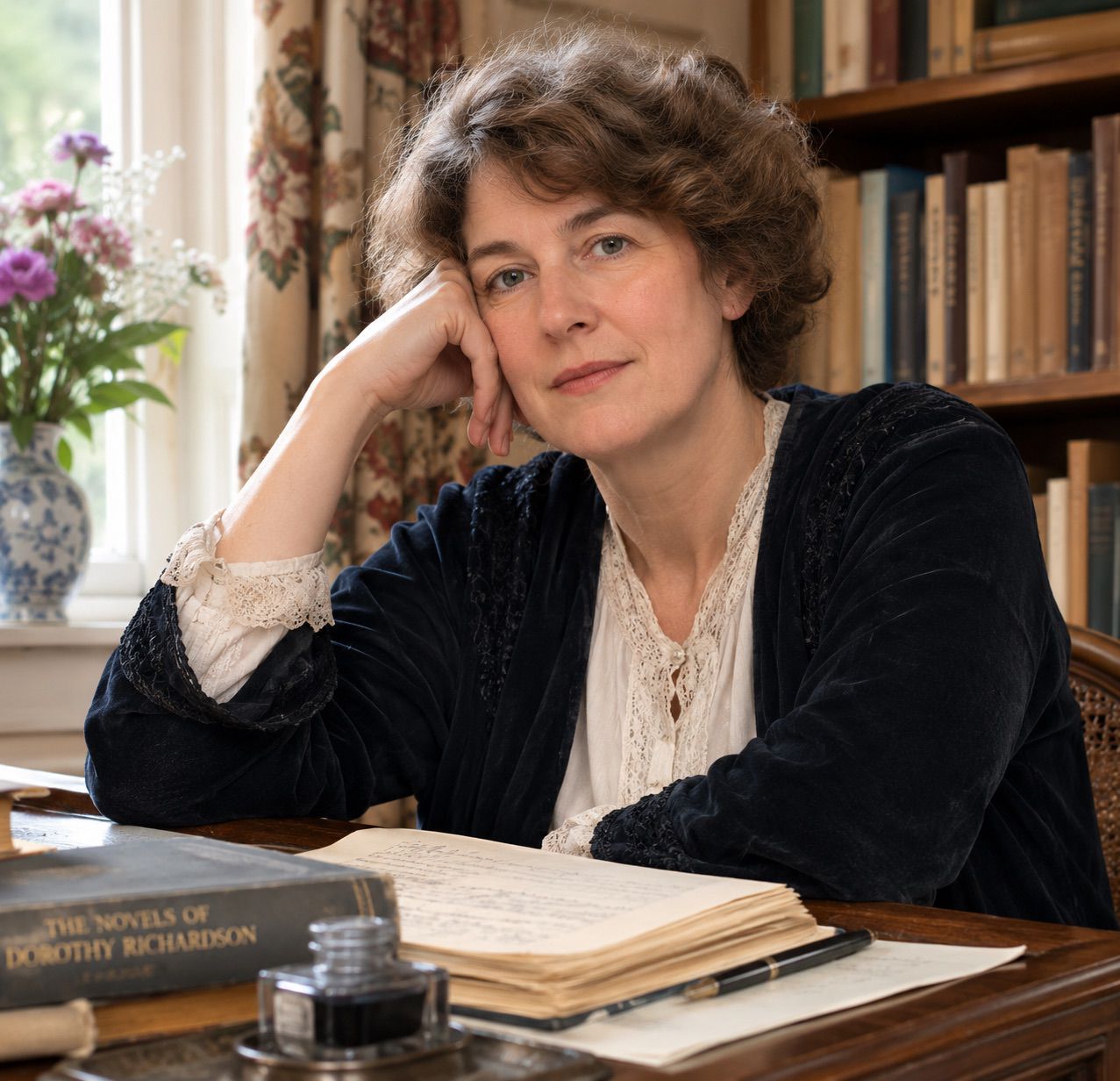
Dorothy Richardson has been a constant companion of mine for what feels like an eternity, yet I’m still not entirely sure why she fascinates me so deeply. Maybe it’s the way her words dance across the page, weaving intricate narratives that defy easy categorization as fiction or nonfiction. Or perhaps it’s the sheer audacity of her style, which veers wildly between poetic introspection and unflinching realism.
As I read through her work, particularly her novels, I find myself drawn to the way she navigates the complexities of female experience in early 20th-century England. Her protagonist, Miriam Henderson, is a cipher for Richardson herself, and their shared struggles with identity, relationships, and societal expectations are both deeply relatable and profoundly alienating.
I’ve always been struck by Richardson’s willingness to push against the conventions of her time, even when it meant sacrificing commercial success or mainstream recognition. Her novels are often meandering, unpunctuated, and narratively loose – qualities that I initially found off-putting but eventually grew to admire for their raw honesty.
One aspect that continues to puzzle me is Richardson’s decision to abandon the conventional narrative structure in favor of a more fluid, impressionistic approach. It’s as if she’s trying to capture the unscripted nature of life itself, with all its twists and turns, contradictions and paradoxes. In doing so, she creates this sense of disorientation, where the reader is forced to navigate alongside Miriam through the thorny thickets of her psyche.
I find myself mirroring Richardson’s process in my own writing. When I’m stuck or uncertain, I’ll often try to recapture the unstructured flow of my thoughts by scribbling down fragments, half-formed sentences, and observations that seem too minor to be considered “real” writing. It’s as if I’m trying to tap into a similar creative dynamic with Richardson – one where the boundaries between self and narrative blur, and the reader is invited to participate in the act of discovery.
At times, however, this fluid approach can leave me feeling lost or disconnected from the narrative. I’ll find myself wandering through paragraphs without a clear sense of purpose or direction, only to stumble upon some revelatory insight that feels both illuminating and unsettling. It’s as if Richardson has opened up a door in my mind, revealing hidden corners and secret passageways that I’d never previously noticed.
One specific instance where this happened was when I read through Richardson’s novel Pilgrimage (1938). The section on Miriam’s relationship with her friend, Sara, struck me as both tender and disturbing. Their bond is portrayed as a mix of deep emotional connection and awkward silences, their interactions veiled in ambiguity and misunderstanding. As I reflected on this portrayal, I realized that Richardson was grappling with the very same questions about intimacy and friendship that I had been pondering in my own life.
This is perhaps where the true power of Richardson’s work lies – not in its historical significance or literary influence (although both are undeniable), but in its ability to illuminate our shared human experiences. When we read her novels, we’re not just engaging with a static text; we’re participating in a dynamic, iterative process that’s as much about self-discovery as it is about understanding the world around us.
For now, I’ll continue to return to Richardson’s work, hoping to unravel some of its mysteries and contradictions. Her writing may be challenging, but it’s also strangely comforting – a reminder that even in our most turbulent moments, there lies a hidden order waiting to be unearthed.
As I delve deeper into Richardson’s oeuvre, I find myself preoccupied with the concept of time itself. Miriam Henderson’s experiences unfold at a glacial pace, meandering through decades of her life with an almost geological slowness. It’s as if Richardson is attempting to excavate the very fabric of memory, unearthing moments and emotions that were previously buried beneath the surface.
I’m reminded of my own struggles with time management during college. With so much on my plate – coursework, internships, social obligations – I often felt like I was rushing through life without truly experiencing it. Richardson’s writing shows me a different path: one where time is fluid, subjective, and open to interpretation. Her prose is less concerned with chronology than with the fluid dynamics of human experience.
This approach resonates deeply with me, especially given my own tendency to get caught up in the present moment. I often find myself lost in thought, replaying conversations or rehashing arguments in my head for hours on end. Richardson’s writing suggests that this isn’t a weakness, but rather an opportunity – one where we can excavate our inner lives and unravel the threads of memory that shape us.
One passage from Pilgrimage stands out to me: Miriam’s reflection on her relationship with her mother. The two are at odds over their differing views on marriage and social status, but amidst the tension lies a deep wellspring of love and longing. Richardson captures this complexity with breathtaking subtlety, weaving together phrases that feel both familiar and utterly alien.
As I read these words, I’m struck by the way they seem to inhabit my own memories – memories that are tinged with a similar bittersweetness. My relationship with my mother has always been complicated, marked by moments of fierce argument and quiet understanding. Richardson’s portrayal of Miriam’s dynamic with her mother feels like a mirror held up to my own experiences: messy, imperfect, and somehow, inexplicably, beautiful.
This is perhaps the greatest gift that Richardson’s writing offers – not just a window into her own life or times, but a reflection of our shared humanity. In her words, I see echoes of my own struggles, doubts, and triumphs. It’s as if she’s reminding me that even in the most mundane moments, there lies a depth and complexity waiting to be unearthed – and that this process of discovery is both exhilarating and terrifying all at once.
As I continue to grapple with Richardson’s concept of time, I find myself thinking about my own relationship with memory. Like Miriam Henderson, I’ve often felt like I’m trying to excavate fragments of the past, piecing together a narrative that makes sense of my experiences. But Richardson’s writing suggests that this process is never quite linear, that our memories are always tangled up with emotions, associations, and biases.
I think about how Richardson’s use of unpunctuated paragraphs can create a sense of timelessness, where the reader is free to navigate the text at their own pace. It’s as if she’s given me permission to slow down, to let my mind wander through the labyrinthine corridors of memory. And yet, this approach also demands a level of engagement from the reader – we’re forced to participate in the process of discovery, to fill in the gaps and make sense of the fragmented narrative.
I wonder if Richardson’s use of free indirect discourse – where she seamlessly shifts between Miriam’s inner monologue and external observations – is another way of capturing the fluidity of time. It’s as if she’s created a kind of temporal osmosis, where the boundaries between past, present, and future begin to blur.
As I read through Pilgrimage again, I notice how Richardson’s descriptions of London’s streets and buildings seem to mirror my own experiences of navigating unfamiliar cities. There’s a sense of disorientation, as if I’m stumbling through a foreign landscape without a map or compass. And yet, amidst the uncertainty lies a strange comfort – a feeling that I’m not alone in this process of discovery.
This is perhaps where Richardson’s writing speaks most directly to me: in its recognition that even in our most mundane moments, there lies a depth and complexity waiting to be unearthed. Her novels are like a series of excavations, where she’s carefully unearthing the hidden layers of human experience – and inviting us to join her on this journey of discovery.
As I delve deeper into Richardson’s oeuvre, I find myself drawn to her concept of “personality” – that complex web of traits, habits, and emotions that make up our individual selves. Miriam Henderson is a masterclass in personality development, as Richardson deftly captures the ebbs and flows of her protagonist’s inner life.
I think about how this approach resonates with my own experiences of identity formation during college. It’s as if I’ve been trying to construct a narrative around myself – one that balances competing desires, fears, and ambitions. Richardson’s writing suggests that this process is never fixed or static, that our personalities are constantly evolving like the shifting sands of a desert.
One passage from Pilgrimage stands out to me: Miriam’s reflection on her own identity as a woman. Richardson captures the tension between societal expectations and personal desire with breathtaking nuance, revealing a character who is both fragile and resilient. As I read these words, I’m struck by the way they seem to inhabit my own experiences of navigating femininity in a society that often seems determined to constrain it.
This is perhaps where the true power of Richardson’s writing lies – not just in its literary innovation or historical significance (although both are undeniable), but in its ability to illuminate our shared human experiences. When we read her novels, we’re not just engaging with a static text; we’re participating in a dynamic, iterative process that’s as much about self-discovery as it is about understanding the world around us.
As I close this piece, I’m left wondering what other secrets Richardson’s writing might hold – secrets that lie hidden beneath the surface of her narratives, waiting to be unearthed by a curious reader. Her work continues to fascinate me, inspiring me to push against my own boundaries and limitations as a writer. And for that, I’ll be eternally grateful.
As I close this piece, I’m left with more questions than answers about Richardson’s writing and its impact on me. But perhaps that’s the point – to leave room for interpretation, for the reader to fill in the gaps and make their own connections. It’s a quality that I admire in Richardson’s work, and one that I strive for in my own writing.
One aspect that I’ve been exploring in this piece is the relationship between Richardson’s use of unpunctuated paragraphs and her concept of time. She often employs long, flowing passages that seem to meander through decades of Miriam Henderson’s life without a clear narrative thread. It’s as if she’s trying to capture the fluidity of human experience – the way our memories are tangled up with emotions, associations, and biases.
I’ve been experimenting with this approach in my own writing, using unpunctuated paragraphs to create a sense of timelessness, where the reader is free to navigate the text at their own pace. It’s a challenging style to master, but one that I find liberating. By letting go of traditional narrative structures, I’m able to tap into a more fluid, impressionistic approach – one that feels more true to my own experiences and emotions.
But Richardson’s use of unpunctuated paragraphs also raises questions about the role of the reader in shaping meaning. When we’re given so much freedom to interpret the text, do we become complicit in creating our own narrative? Or are we simply mirroring the author’s intentions, even if they’re not explicitly stated?
As I grapple with these questions, I’m reminded of Richardson’s own experiences as a writer – her struggles to find an audience, her willingness to experiment with form and style. She was a true pioneer in her field, and one who paved the way for future generations of writers.
One aspect that I’ve been fascinated by is Richardson’s use of free indirect discourse – where she seamlessly shifts between Miriam’s inner monologue and external observations. It’s a technique that creates a sense of intimacy with the reader, drawing us into Miriam’s world and making us feel like we’re experiencing her thoughts and emotions firsthand.
But this approach also raises questions about the blurring of boundaries between self and narrative. When we’re given access to Miriam’s inner life, do we start to lose track of where she ends and the narrator begins? And what implications does this have for our understanding of identity and subjectivity?
These are just a few of the questions that I’ve been exploring in my piece on Richardson. As I continue to write about her work, I’m finding myself drawn into a world of complex ideas and emotions – one that’s both deeply personal and universally relatable.
For now, I’ll leave you with this sense of curiosity and wonder – a feeling that there’s still so much to explore in Richardson’s writing, and in our shared human experiences.