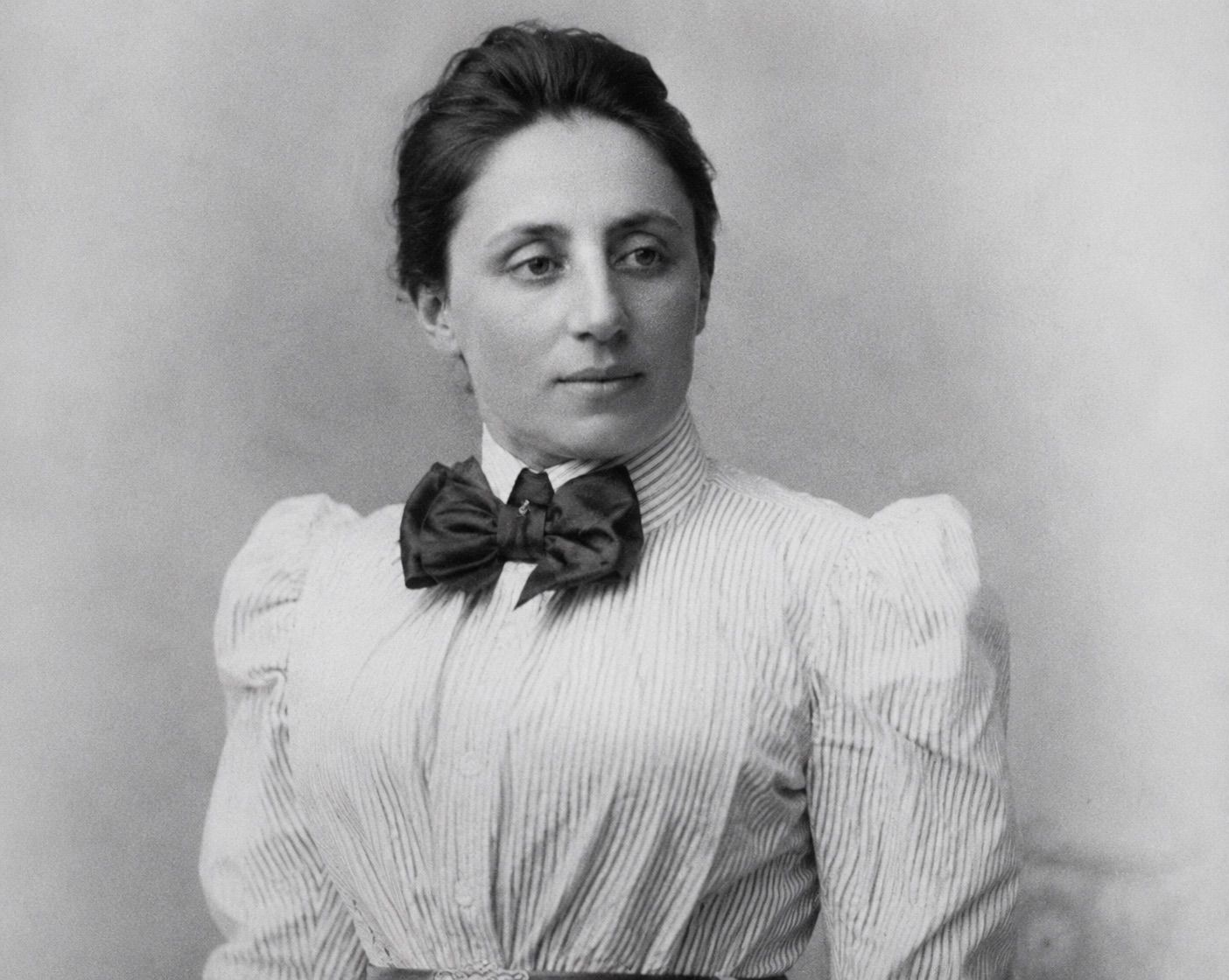
Emmy Noether’s name keeps popping up in my math textbooks, but she was more than just a formula or a theorem to me – at least, not until I started digging into her life. There’s something about the way she worked, the way she thought, that resonates with me.
I think it’s because we both found our own paths, in our own ways. Emmy dropped out of school as a teenager and went off to live with her mother, who was also a mathematician. My parents always wanted me to follow a traditional path – college, then grad school, maybe a teaching job or something stable – but I’ve never been one for plans. I changed majors three times in four years, and when I graduated, I still wasn’t sure what I wanted to do with my life.
It’s funny how we’re told that uncertainty is something to be overcome, like it’s this obstacle that needs to be vanquished before we can truly succeed. But Emmy Noether didn’t seem to worry about that. She just kept working, kept thinking, and somehow that led her to some of the most groundbreaking math of the 20th century.
I’ve read that she was a bit of a loner, that she had trouble connecting with people outside of academia. I get that. I’m not always great at making friends either – especially when you’re trying to figure out who you are and what you want to do with your life. It’s like, everyone else seems so sure of themselves, while you’re just trying to keep up.
But Emmy Noether didn’t let that stop her. She kept pushing forward, even when it felt like the whole world was against her. And in a way, I think that’s what draws me to her story – not just because she’s some kind of math genius (although that’s pretty cool too), but because she shows us that it’s okay to be uncertain, to be uncomfortable.
I’m not sure if that makes sense, though. Maybe it’s just something I want to believe. When I look at Emmy Noether’s work – her equations, her theorems – it feels like a whole different language. Like, I get the words on the page, but the meaning behind them is still lost on me.
It’s almost as if she’s speaking directly to me, telling me that it’s okay to not know everything right now. That sometimes, the best thing you can do is just keep going, even when it feels like you’re walking into a wall.
But what does that really mean? Is it something about perseverance, or is it more than that? I’m not sure. All I know is that Emmy Noether’s story keeps coming back to me – like she’s saying something specific, but in a language only I can hear.
I guess that’s what draws me to her, though – the way she challenges my assumptions about success and failure, about who we are and how we find our place in the world. It’s like, when I look at Emmy Noether, I see myself – or at least, the parts of myself that I’m still trying to figure out.
And maybe that’s enough for now.
I’ve been thinking a lot about what it means to be uncertain, and how Emmy Noether embodies that sense of ambiguity in her own life and work. It’s funny, because when I think about my own uncertainty, it often feels like a deficit – something that’s holding me back from achieving some kind of idealized version of myself.
But Emmy Noether seems to have flipped that on its head. Her uncertainty was what drove her to create some of the most important work in modern mathematics. And yet, at the same time, she’s not just some abstract figure – she’s a person with her own fears and doubts, who struggled to connect with others and find her place in the world.
I think that’s part of why I relate to her so strongly. It’s easy to get caught up in this idea that we need to be perfect, that we need to have it all figured out before we can start making a difference. But Emmy Noether shows us that that’s just not true – that uncertainty is what makes us human, and that it’s precisely our imperfections and doubts that can lead to some of the most groundbreaking discoveries.
I’ve been rereading her biography lately, and I’m struck by how much she struggled with feeling like an outsider. She was a woman in a male-dominated field, a Jew in Nazi Germany – there were so many things working against her. And yet, despite all those obstacles, she managed to produce some of the most important work in modern mathematics.
It’s hard not to feel a little envious when I read about her life. Like, how did she do it? How was she able to push through all that uncertainty and doubt and come out on top? But at the same time, I’m aware that envy can be a kind of trap – it can make us forget our own unique struggles and experiences.
So instead of comparing myself to Emmy Noether, I’ve been trying to listen to my own doubts and fears. What am I afraid of, really? What’s holding me back from pursuing my own dreams and passions? And how can I use that uncertainty as a catalyst for growth, rather than something that’s paralyzing me?
It’s funny – I never thought I’d be the kind of person to get so caught up in someone else’s story. But Emmy Noether has been a constant presence in my life lately, and I think it’s because she speaks directly to this sense of uncertainty that I’m still trying to navigate. She shows me that it’s okay to not know everything, that it’s okay to be imperfect – and that sometimes, those imperfections are exactly what we need to make us grow.
As I delve deeper into Emmy Noether’s story, I find myself wondering about the role of community in her life. She was known to have been a bit of a loner, but at the same time, she was part of a close-knit group of mathematicians who supported and encouraged each other’s work. There’s something about that dynamic that resonates with me – the idea that we don’t have to be alone in our uncertainty, that there are others out there who understand what it’s like to struggle with doubt and fear.
But what does it mean to find a community of people who “get” us? Is it just about sharing similar interests or experiences, or is it something more profound? For Emmy Noether, her community was made up of fellow mathematicians who shared her passion for abstract algebra and theoretical physics. They challenged each other’s ideas, pushed the boundaries of what was possible, and together, they created some of the most groundbreaking work in their field.
I’ve been thinking about my own community – or lack thereof – and how it affects my ability to navigate uncertainty. I’ve always struggled with feeling like an outsider, even within my own academic department. It’s like, everyone else seems to know what they’re doing, while I’m just trying to figure things out as I go along. But maybe that’s not the right way to think about it. Maybe community isn’t just about finding people who share your interests or experiences – but about finding people who understand and support you in a deeper way.
Emmy Noether’s story has been making me realize that uncertainty is not just something we experience individually, but also collectively. We’re all struggling with doubts and fears, even the most successful and accomplished people among us. And maybe it’s precisely this shared uncertainty that can bring us together, create a sense of community and belonging.
But what would that look like? How do we build communities around our uncertainties, rather than trying to hide them or overcome them on our own? For Emmy Noether, her community was made up of fellow mathematicians who challenged and supported each other’s ideas. But for me, I’m not sure what that looks like yet – maybe it’s a writing group, or an online forum where people share their struggles and triumphs. Whatever it is, I know that I need to find it, because the uncertainty can be overwhelming on my own.
As I continue to explore Emmy Noether’s story, I’m struck by her unwavering commitment to her work – even in the face of extreme adversity. She was a woman living in Nazi Germany, where Jewish people were being systematically persecuted and excluded from society. But she refused to give up, refusing to let her circumstances dictate her path. Instead, she continued to push forward, using her mathematics as a way to create meaning and purpose in a world that seemed determined to crush her.
It’s hard not to feel inspired by her courage – even when faced with seemingly insurmountable obstacles. But at the same time, I’m also aware of my own limitations, my own fears and doubts. Can I really be like Emmy Noether? Can I find a way to channel my uncertainty into something productive and meaningful?
I don’t know yet. All I know is that her story continues to resonate with me, speaking directly to the parts of myself that are still trying to figure things out. And maybe that’s enough – for now, at least.
As I sit here, thinking about Emmy Noether and her unwavering commitment to her work, I’m struck by a sense of dissonance within myself. On the one hand, I feel inspired by her courage and determination in the face of adversity. But on the other hand, I’m also aware of my own limitations and fears – and how they often hold me back from pursuing my own passions and goals.
It’s funny, because when I think about Emmy Noether, I often imagine her as this towering figure – someone who is confident, self-assured, and unapologetically herself. And yet, the more I learn about her life, the more I realize that she was just as complex and multifaceted as anyone else. She struggled with feelings of inadequacy, with doubts about her abilities and her place in the world.
I think this is where our stories intersect – not just in terms of our shared uncertainty, but also in terms of our own self-doubt and fears. Emmy Noether was a woman who broke through barriers and achieved incredible things, despite facing intense opposition and adversity. But she wasn’t immune to doubt and fear herself – and it’s precisely that vulnerability that makes her story so compelling.
As I reflect on my own experiences with uncertainty, I’m reminded of the ways in which it can be both paralyzing and empowering. On the one hand, uncertainty can make me feel like I’m stuck in limbo – unable to move forward or make decisions because I’m afraid of making a wrong choice. But on the other hand, uncertainty can also give me permission to explore new possibilities, to take risks and push beyond my comfort zone.
Emmy Noether’s story shows us that it’s possible to find a way through even the most daunting obstacles – not by overcoming them, but by embracing our own vulnerabilities and uncertainties. She teaches us that we don’t have to be perfect, that we can be imperfect and still achieve greatness.
But what does this mean for me? How can I apply Emmy Noether’s lessons to my own life, where uncertainty seems to reign supreme? For now, I’m not sure – all I know is that I need to continue exploring her story, and finding ways to connect with the parts of myself that are still trying to figure things out.
I’ve been thinking a lot about the idea of embracing vulnerability in the face of uncertainty. It’s something that Emmy Noether seemed to do effortlessly, but for me, it’s a constant struggle. I feel like I’m always trying to present this perfect image, even when I’m feeling completely lost and unsure.
But what if that was okay? What if being vulnerable wasn’t something to be ashamed of, but rather something to be celebrated? Emmy Noether’s story shows us that vulnerability can be a strength, not a weakness. She didn’t let her doubts and fears hold her back from achieving greatness – instead, she used them as fuel to drive her forward.
I’m starting to realize that this is something I need to learn for myself. I’ve been so focused on trying to prove myself, on showing the world that I’m capable and competent, that I’ve forgotten how to be vulnerable. But what if that’s exactly where the magic happens? What if embracing my uncertainty, rather than trying to overcome it, is the key to unlocking my true potential?
It’s a scary thought, but also kind of exhilarating. I think about all the times when I’ve felt like giving up, like I just can’t do this anymore. But what if those moments were actually opportunities for growth? What if they were chances for me to tap into my own vulnerabilities and use them as fuel to drive forward?
I’m not sure how to do that yet – it’s still a work in progress for me. But I do know that Emmy Noether’s story has given me permission to be more open, more honest with myself about my fears and doubts. And maybe that’s the most important lesson of all.
As I continue to explore her life and work, I’m struck by the way she saw the world – as a vast, complex web of interconnected relationships and patterns. She was a mathematician who saw the beauty in abstract concepts, but also understood the importance of human connection. And that’s something that resonates deeply with me.
I’ve always been fascinated by the idea of patterns and connections – how everything is linked together in ways both visible and invisible. Emmy Noether showed us that even in the most seemingly disparate fields, there are threads that weave them all together. And I think that’s what draws me to her story – not just because she was a brilliant mathematician, but because she saw the world as a vast, interconnected tapestry.
It’s funny, because when I think about my own life and work, I often feel like I’m trying to navigate a series of isolated islands. Each project, each task, feels like a separate entity – something that exists in its own little bubble. But Emmy Noether’s story shows us that that’s not the way it has to be. We can see the world as a seamless web of relationships and patterns, rather than a collection of discrete objects.
I’m starting to realize that this is a fundamental shift in perspective for me – one that requires me to let go of my own sense of isolation and fragmentation. It’s scary, but also kind of liberating. Because when I see the world as a vast, interconnected web, I start to feel like anything is possible.
As I wrap up my thoughts on Emmy Noether, I’m left with a sense of awe and wonder at her life and work. She was a woman who broke through barriers, pushed beyond the boundaries of what was thought possible, and created something truly beautiful in the process. And as I reflect on our shared experiences of uncertainty and vulnerability, I’m reminded that we’re not so different after all.
We’re both still trying to figure things out – Emmy Noether in her own way, and me in mine. We both know what it’s like to feel lost and unsure, to wonder if we’ll ever find our place in the world. But we also both know that it’s okay to not have all the answers, that sometimes the best thing you can do is just keep going – even when it feels like you’re walking into a wall.
And maybe that’s the greatest lesson of all – one that I’m still trying to learn for myself.