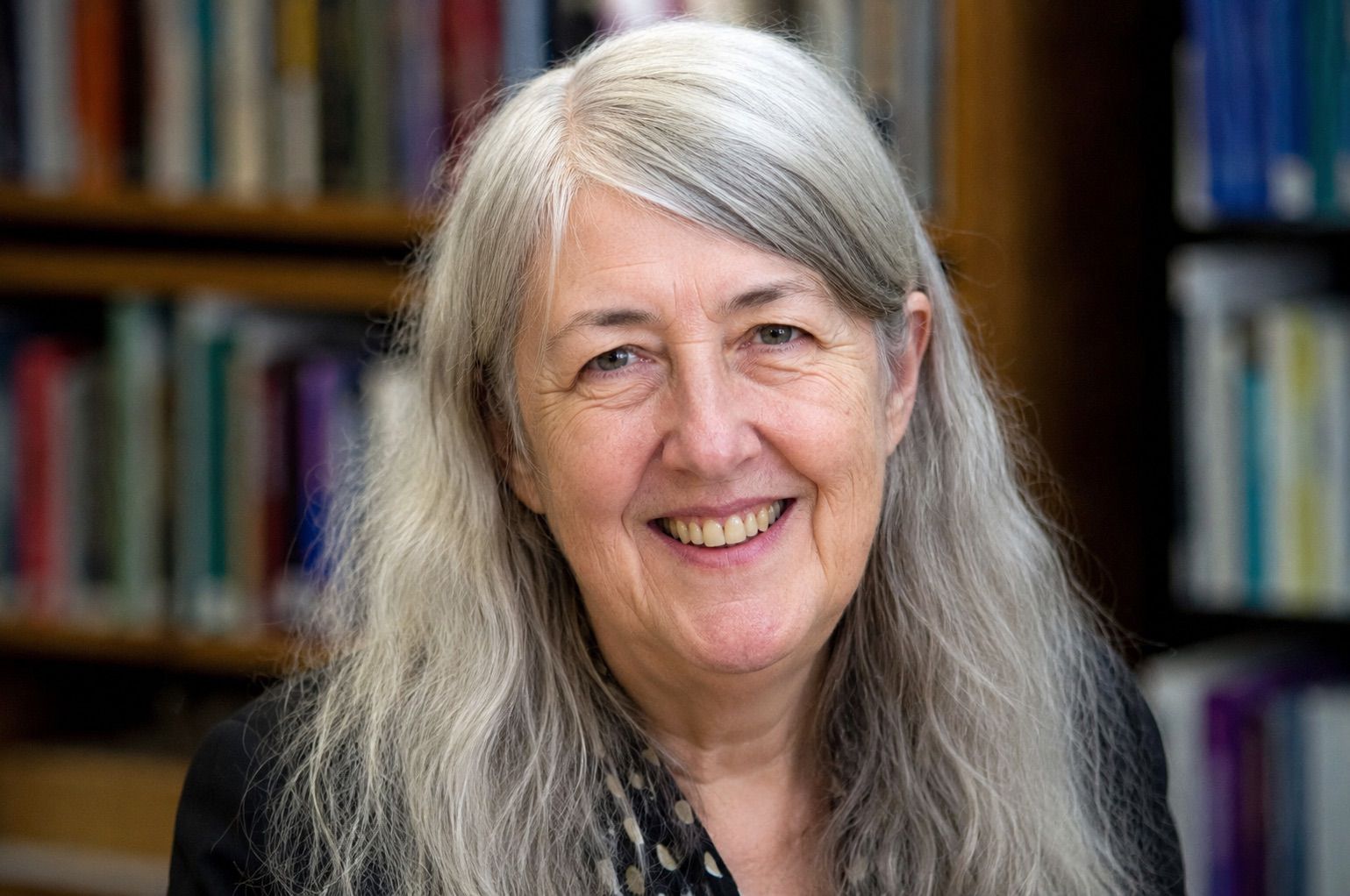
Mary Beard. I’ve been thinking about her a lot lately, especially after finishing college. It’s funny how certain people seem to pop up at exactly the right (or wrong) moment in our lives. Maybe it’s because we’re all searching for different answers at different times, and sometimes those answers come in unexpected packages.
I first heard of Mary Beard through an anthropology course I took during my senior year. Our professor was obsessed with her work on Roman history, and how she challenged traditional notions of classical civilization. But what really caught my attention was her willingness to speak truth to power – not just in the context of ancient Rome, but also in our own time.
As someone who’s always struggled with self-expression, I find myself drawn to Mary’s boldness. She’s not afraid to ruffle feathers or take on the establishment, whether it’s debating the relevance of classical studies in modern education or pushing back against online trolls and abuse. It’s a quality that makes me uncomfortable, but also admires – like watching someone perform a tightrope act without a net.
But what really fascinates me is how Mary navigates the tension between her intellectual pursuits and her personal life. As an academic, she’s built a reputation for being fiercely intelligent and widely respected within her field. Yet, outside of her work, she seems to be unapologetically herself – not always polished or camera-ready, but genuinely human.
I think this is what draws me in: the idea that we can be whole, complex people with our own contradictions and flaws. As someone who’s often felt like they’re living between worlds (the academic bubble vs. real life), I find it both reassuring and unsettling to see Mary Beard embodying this kind of authenticity.
Of course, there are times when her outspokenness makes me squirm – like when she gets into online feuds or takes on sensitive topics without fully considering the nuances. In those moments, I wonder if she’s being too brash, too willing to sacrifice her own reputation for a point being made. It’s a question that’s haunted me since college, especially as I navigate my own relationships with social media and public engagement.
Still, there’s something about Mary Beard that keeps me coming back – maybe it’s the way she insists on telling stories that are messy, multifaceted, and often uncomfortable to confront. Her willingness to complicate the narrative, to challenge easy answers and simplistic assumptions, is a quality I admire deeply.
As I reflect on why Mary holds my attention, I’m left with more questions than answers. Is it her intellectual rigor? Her commitment to social justice? Or something deeper – like the way she embodies a kind of fearless, unapologetic selfhood that feels both inspiring and terrifying?
Whatever it is, I know I’ll keep coming back to Mary Beard’s work and words, searching for a glimmer of understanding in my own life.
As I delve deeper into Mary’s writing and public persona, I’m struck by the way she weaves together personal anecdotes with historical insights. It’s as if she’s saying, “You know what? We’re not just talking about ancient Rome here; we’re talking about us.” Her ability to make the past feel relevant, messy, and human is a gift.
I find myself thinking about my own relationships with history and identity. As someone who grew up in a family of immigrants, I’ve always felt like I’m caught between worlds – between the cultural traditions that shaped me and the modern world that’s often at odds with those values. Mary’s work on Roman culture and its intersections with modern society resonates deeply with me.
But what really gets me thinking is how Mary navigates her own positionality as a white, middle-class academic in a field dominated by men. I’ve seen her speak out against the lack of diversity in academia and the ways in which classical studies can be used to justify elitism and exclusivity. It’s not just about challenging the establishment; it’s about using her privilege to amplify marginalized voices.
As someone who’s often felt like they’re on the outside looking in, I’m fascinated by Mary’s willingness to take risks and challenge her own assumptions. She’s not afraid to say, “I don’t know,” or “I was wrong,” even when it means confronting her own biases or privilege. It’s a quality that makes me feel less alone in my own struggles with identity and belonging.
But what I’m also grappling with is the tension between Mary’s public persona and her private self. We see glimpses of her on Twitter, responding to trolls and debating with scholars; we read about her personal experiences as a woman in academia in her writing. Yet, I wonder: how does she reconcile these two selves – the bold, outspoken critic and the vulnerable, imperfect human being?
It’s a question that haunts me because I’ve always struggled to reconcile my own public and private selves. As someone who writes about complex topics like identity and culture, I often feel like I’m performing for an audience rather than speaking truthfully from within. Mary’s willingness to be messy, to take risks, and to be herself – even when it’s uncomfortable or unpopular – is a quality that I both admire and aspire to.
And yet… there are times when I worry that I’m romanticizing her approach, that I’m ignoring the very real costs of being outspoken in a world that’s quick to criticize. Mary has faced online abuse, personal attacks, and professional backlash for her views; she’s also been forced to confront her own privilege and biases. It’s a delicate balance to strike, one that requires both courage and humility.
As I continue to grapple with these questions, I’m reminded of the messiness of human experience – the way our identities, values, and relationships are constantly shifting and evolving. Mary Beard’s work is a reflection of this complexity, a reminder that there are no easy answers or simple solutions. And it’s precisely this kind of nuance, this willingness to complicate the narrative, that draws me back to her words again and again.
As I delve deeper into Mary Beard’s work, I’m struck by the way she navigates the tension between her intellectual pursuits and her personal life. It’s as if she’s constantly negotiating a delicate balance between being true to herself and being mindful of how others perceive her. This resonates deeply with me, especially as someone who’s often felt like they’re living in two separate worlds – the world of academia, where I’m expected to be polished and professional, and the real world, where I’m just trying to figure things out.
I find myself wondering what it must be like for Mary to walk this tightrope, to be both a public figure and a private individual. Does she ever feel like she’s losing herself in the process of being “Mary Beard”? Or is she able to maintain some sense of separation between her public and private selves? I think about my own struggles with social media, where it feels like every move I make is scrutinized by an invisible audience. Do I present a curated version of myself online, or do I take risks and be vulnerable?
Mary’s willingness to be imperfect, to admit when she doesn’t know something or makes a mistake, is something that I deeply admire. It’s a quality that feels both authentic and refreshing in a world where everyone seems to have it all together. But at the same time, I worry about the costs of being so open and honest – the way it can make you vulnerable to criticism and attack.
I’m struck by the way Mary Beard has been treated online, particularly by men who feel threatened by her opinions or challenged by her presence in a field dominated by men. It’s a reminder that even the most well-intentioned and intelligent people are not immune to abuse and harassment. And yet, despite all of this, Mary continues to speak truth to power, to challenge the status quo and push boundaries.
This is what I find so fascinating about her – the way she embodies both vulnerability and strength, both imperfection and resilience. It’s a quality that feels deeply human, deeply relatable. As someone who’s often felt like they’re struggling to find their place in the world, Mary Beard’s example is a powerful reminder that it’s okay to be messy, to make mistakes, and to be true to oneself.
But what I’m also left wondering is: how does she do it? How does she maintain this level of authenticity and vulnerability in a world that often rewards pretension and performance? Is it a skill that she’s developed over time, one that requires constant practice and self-reflection? Or is it something more innate, a natural part of who she is?
I’m not sure I have the answers to these questions, but as I continue to grapple with them, I’m reminded of the importance of being honest with myself. As someone who writes about complex topics like identity and culture, I need to be willing to take risks and be vulnerable – not just online, but in real life. It’s a scary prospect, one that requires both courage and humility.
And yet, as I think back on Mary Beard’s work and words, I’m reminded of the power of being true to oneself. Even when it’s uncomfortable or unpopular, even when it feels like you’re walking on thin ice – there’s something about being authentic, about being vulnerable, that feels deeply human.
As I continue to reflect on Mary Beard’s work and persona, I’m struck by the way she embodies a sense of agency in her writing and public engagement. She doesn’t shy away from controversy or difficult topics; instead, she leans into them with a willingness to listen, learn, and adapt. This is a quality that I deeply admire, especially as someone who’s often felt like they’re stuck between different identities and perspectives.
One of the things that resonates most with me about Mary Beard is her ability to make connections between seemingly disparate ideas and experiences. She weaves together threads from ancient history, personal anecdotes, and social commentary in a way that feels both nuanced and accessible. It’s as if she’s saying, “Look, these are all connected – the past, our present, and our future.” This kind of interdisciplinary thinking is something that I’ve always struggled with, but Mary’s work shows me that it’s possible to navigate multiple perspectives and disciplines in a way that feels authentic and meaningful.
But what also strikes me about Mary Beard is her commitment to listening and learning. She doesn’t pretend to have all the answers; instead, she acknowledges her own limitations and biases, and seeks out diverse perspectives and voices. This is something that I feel like I’ve been struggling with in my own life – the desire to be seen as an expert or authority, rather than someone who’s still learning and growing.
As I think about Mary Beard’s approach to listening and learning, I’m reminded of a conversation I had with a friend during college. We were talking about the importance of empathy and understanding in our relationships and communities, and my friend said something that stuck with me: “Empathy is not about being perfect; it’s about being willing to be imperfect.” Mary Beard embodies this kind of empathy in her writing and public engagement – she’s willing to listen to difficult perspectives, to acknowledge her own biases and limitations, and to learn from others.
I think this is a quality that I’m still trying to develop in myself. As someone who writes about complex topics like identity and culture, I often feel like I’m expected to have all the answers or be an expert on every topic. But Mary Beard shows me that it’s okay to not know everything – that it’s okay to be vulnerable, to ask questions, and to seek out diverse perspectives. This is a kind of freedom that feels both liberating and terrifying at the same time.
As I continue to reflect on Mary Beard’s work and persona, I’m left with more questions than answers. What does it mean to be an authentic and vulnerable public figure in a world that often rewards pretension and performance? How do we balance the need for self-expression and truth-telling with the risks of vulnerability and criticism? And what can I learn from Mary Beard’s example about being true to myself, even when it feels like the hardest thing in the world?
These are questions that I’m still grappling with, but as I continue to explore them, I’m reminded of the importance of being honest with myself. As someone who writes about complex topics and identities, I need to be willing to take risks and be vulnerable – not just online, but in real life. It’s a scary prospect, one that requires both courage and humility.
But as I think back on Mary Beard’s work and words, I’m reminded of the power of being true to oneself. Even when it’s uncomfortable or unpopular, even when it feels like you’re walking on thin ice – there’s something about being authentic, about being vulnerable, that feels deeply human. And it’s this kind of humanity that draws me back to Mary Beard’s writing and public engagement time and again.