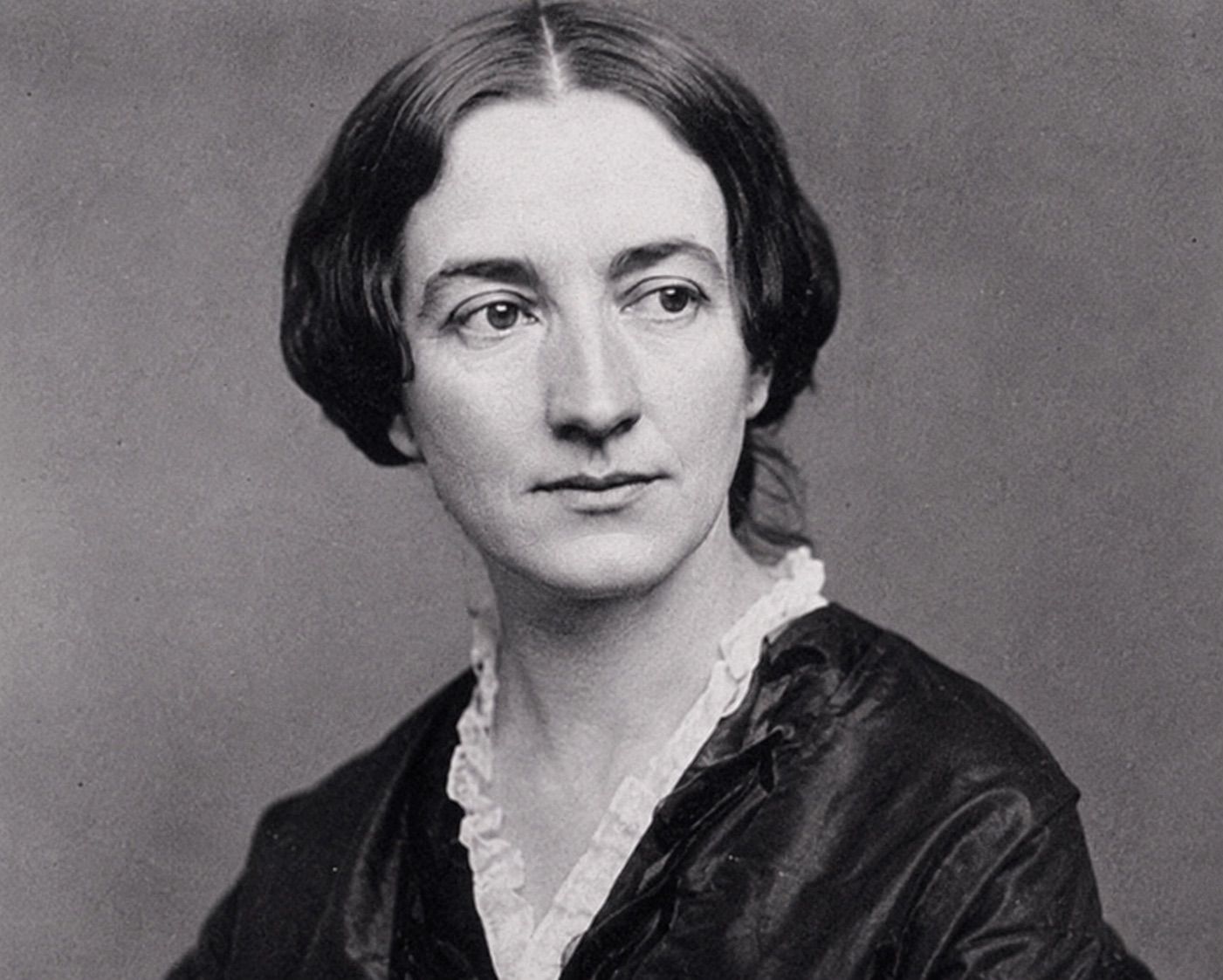
Margaret Fuller’s name keeps appearing in my writing, as if I’m trying to summon her spirit by mentioning it enough times. I’ve been reading her essays and letters, getting lost in the pages of “Woman in the Nineteenth Century” and feeling a strange sense of kinship with this woman who lived over 150 years ago.
What draws me to Fuller is her unapologetic desire for intellectual freedom. She was a true original, blazing her own trail through the patriarchal society of 19th-century America. I admire her fearlessness in speaking her mind and challenging the status quo, even when it meant facing ridicule and criticism. Her words still resonate today, reminding me that my own thoughts and opinions are valid, no matter how unpopular they might be.
But what really gets under my skin is Fuller’s complicated relationship with her own identity. She was a transatlantic thinker, moving between Europe and America, navigating the complexities of belonging to multiple cultures and intellectual circles. Her essays often grapple with the tension between her American roots and her European influences, leaving me wondering how she reconciled these different parts of herself.
I find myself reflecting on my own identity in relation to Fuller’s experiences. As a young woman from a relatively stable background, I’ve never had to navigate the same level of cultural or social upheaval that Fuller faced. Yet, I’ve always felt like an outsider within my own community – a white girl raised by parents who were hippies and activists, but also firmly rooted in middle-class America. Fuller’s struggles with her own sense of belonging make me realize just how much I take for granted the privileges I have as a member of this particular society.
Reading Fuller’s letters to Ralph Waldo Emerson, I’m struck by the depth of their intellectual friendship and the way they pushed each other to think critically about art, literature, and politics. Their relationship is both exhilarating and suffocating – a reminder that even the most passionate connections can be complicated by power dynamics and unspoken expectations.
One passage in particular keeps circling back to me: Fuller’s account of a dinner party where she felt like an outsider among the men, struggling to contribute to conversations dominated by their voices. I’ve had my own share of awkward moments in similar situations – times when I feel like I’m trying too hard to fit in or be heard, only to realize that my presence is either being ignored or condescended to.
Fuller’s writing on this topic feels both empowering and disorienting. On the one hand, she’s showing me that it’s okay to feel uncomfortable, to acknowledge when I’m not being seen or heard. But on the other hand, her words also make me realize just how much I’ve internalized these same dynamics – the pressure to conform, the fear of speaking out, and the expectation to prioritize others’ needs over my own.
I’m not sure where I’m going with this reflection, only that it feels necessary to explore these complexities alongside Fuller’s. Her life and work offer a mirror to my own experiences, forcing me to confront the ways in which I’ve both benefited from and been marginalized by societal norms.
As I delve deeper into Fuller’s writing, I find myself becoming increasingly aware of the weight of her words on my own shoulders. It’s as if she’s holding up a mirror to my own desires for intellectual freedom, my struggles with identity, and my relationships with others. Her experiences are both familiar and foreign, making me realize just how much we’re connected across time and space.
One passage in particular has been haunting me: Fuller’s description of her own “double consciousness,” as she put it – the feeling of being torn between two worlds, two cultures, and two identities. I can relate to this sense of dislocation, of not quite belonging anywhere. But whereas Fuller was navigating a specific historical context, my own feelings of disorientation are more diffuse, more tied to the messy complexities of modern life.
Reading about Fuller’s struggles with her own identity makes me wonder: what does it mean to be an outsider within your own culture? Is it even possible to reconcile the different parts of ourselves, or do we forever exist in a state of tension between our multiple identities? I think back to my own experiences as a young woman from a relatively stable background, feeling like an outsider among my peers because of my hippie parents. Was that sense of dislocation a privilege, or a burden?
Fuller’s writing on this topic is both liberating and unsettling. On the one hand, she shows me that it’s okay to be uncertain, to feel like I’m caught between two worlds. But on the other hand, her words also make me realize just how much I’ve internalized these same dynamics – the pressure to conform, the fear of speaking out, and the expectation to prioritize others’ needs over my own.
I start to wonder: what if I were to write a letter to Margaret Fuller, asking for her advice on navigating this complex web of identities? What would she say to me, with all my privilege and confusion? Would she tell me to find my own voice, to speak out against the injustices of society, or to cultivate a deeper sense of empathy for those around me?
As I ponder these questions, I realize that Fuller’s legacy is not just about her individual experiences, but also about the ways in which we can learn from her struggles and triumphs. Her writing offers a powerful reminder that our identities are complex, multifaceted, and ever-changing – and that it’s okay to be uncertain, to question, and to seek out new perspectives.
In the end, I’m not sure what I’ve gained from reflecting on Margaret Fuller’s life and work. But I do know that her writing has forced me to confront my own complexities, to see myself in a new light, and to acknowledge the ways in which we’re all connected across time and space.
As I sit with these questions, I find myself returning to Fuller’s words on intellectual freedom. Her fearlessness in speaking her mind, even when it meant facing ridicule and criticism, is a quality that I both admire and aspire to. But what I’m starting to realize is that my own desire for intellectual freedom is also tied up in my privilege as a white woman from a relatively stable background.
I think about the ways in which my parents’ activism and hippie values have given me a sense of entitlement to speak out on social justice issues, even when I don’t fully understand them. And yet, I’m also aware of how this same privilege has insulated me from the very real struggles that marginalized communities face every day.
Fuller’s writing challenges me to think critically about my own positionality and the ways in which it influences my perspectives and actions. She shows me that true intellectual freedom requires not just a willingness to speak out, but also a deep understanding of one’s own biases and limitations.
As I reflect on this, I’m reminded of a conversation I had with a friend who is a person of color. We were discussing the Black Lives Matter movement, and she shared her frustration with white allies who claim to be supportive, but ultimately don’t do enough to dismantle systemic racism. I remember feeling defensive and unsure of how to respond, but also deeply grateful for my friend’s willingness to educate me.
Fuller’s writing on intellectual freedom is making me wonder: what does it mean to truly listen to marginalized voices? How can I use my privilege to amplify their perspectives, rather than speaking over them or ignoring their experiences?
I’m not sure if I’ll ever find the answers to these questions, but I do know that Margaret Fuller’s legacy is a powerful reminder of the importance of intellectual freedom and critical self-reflection. Her writing offers me a mirror to my own complexities, forcing me to confront the ways in which I’ve both benefited from and been marginalized by societal norms.
As I close this reflection, I’m left with more questions than answers. But I’m also left with a sense of gratitude for Margaret Fuller’s courage, her intellectual curiosity, and her unwavering commitment to speaking truth to power. Her legacy is a gift that continues to inspire me, even as it challenges me to grow and learn in ways I never thought possible.
I’ve been sitting with these questions for days, trying to untangle the complexities of intellectual freedom and my own privilege. Fuller’s writing has left me feeling both empowered and humbled, forced to confront the ways in which my own biases and limitations shape my understanding of the world.
One thing that keeps coming back to me is the idea of “double consciousness,” a concept that Fuller described as the experience of being torn between two worlds, two cultures, and two identities. As I reflect on this, I realize that I’ve often felt like an outsider within my own community – a white girl raised by parents who were hippies and activists, but also firmly rooted in middle-class America.
Growing up, I struggled to reconcile these different parts of myself, feeling like I didn’t quite fit in anywhere. But as I look back on those experiences, I realize that they’ve given me a unique perspective – one that’s shaped by my privilege as a white woman from a relatively stable background. This realization makes me wonder: what does it mean to use this privilege to amplify marginalized voices, rather than speaking over them or ignoring their experiences?
I think about the conversations I’ve had with friends of color, listening to their stories and struggles while trying to stay silent and not interrupt. It’s a strange feeling – one that’s both empowering and suffocating. On the one hand, I feel grateful for these friendships and the opportunities they’ve given me to learn and grow. But on the other hand, I’m aware of how my privilege can insulate me from the very real struggles that marginalized communities face every day.
Fuller’s writing challenges me to think critically about my own positionality and the ways in which it influences my perspectives and actions. She shows me that true intellectual freedom requires not just a willingness to speak out, but also a deep understanding of one’s own biases and limitations. This is a hard lesson to learn – one that I’m still grappling with.
As I continue to reflect on Fuller’s legacy, I’m struck by the ways in which her writing continues to resonate today. Her fearlessness in speaking her mind, even when it meant facing ridicule and criticism, is a quality that I both admire and aspire to. But what I’m starting to realize is that my own desire for intellectual freedom is also tied up in my privilege as a white woman from a relatively stable background.
This realization makes me wonder: how can I use this privilege to create space for others, rather than speaking over them or ignoring their experiences? How can I listen more deeply and amplify marginalized voices, rather than perpetuating the same systems of oppression that have held people back for centuries?
I don’t have any answers yet – only a sense of determination to keep learning, growing, and pushing myself to be a better ally. Margaret Fuller’s legacy is a powerful reminder of the importance of intellectual freedom and critical self-reflection. Her writing offers me a mirror to my own complexities, forcing me to confront the ways in which I’ve both benefited from and been marginalized by societal norms.
As I close this reflection, I’m left with more questions than answers – but also with a sense of gratitude for Margaret Fuller’s courage, her intellectual curiosity, and her unwavering commitment to speaking truth to power.
I find myself returning to the concept of “double consciousness,” feeling like I’m still trying to wrap my head around it. As I reflect on my own experiences as a young woman from a relatively stable background, I realize that I’ve often felt like an outsider within my own community. But what does it mean to be an outsider in this way? Is it a privilege, or is it a burden?
I think about the ways in which my parents’ activism and hippie values have given me a sense of entitlement to speak out on social justice issues, even when I don’t fully understand them. And yet, I’m also aware of how this same privilege has insulated me from the very real struggles that marginalized communities face every day.
Fuller’s writing challenges me to think critically about my own positionality and the ways in which it influences my perspectives and actions. She shows me that true intellectual freedom requires not just a willingness to speak out, but also a deep understanding of one’s own biases and limitations. This is a hard lesson to learn – one that I’m still grappling with.
As I continue to reflect on Fuller’s legacy, I’m struck by the ways in which her writing continues to resonate today. Her fearlessness in speaking her mind, even when it meant facing ridicule and criticism, is a quality that I both admire and aspire to. But what I’m starting to realize is that my own desire for intellectual freedom is also tied up in my privilege as a white woman from a relatively stable background.
This realization makes me wonder: how can I use this privilege to create space for others, rather than speaking over them or ignoring their experiences? How can I listen more deeply and amplify marginalized voices, rather than perpetuating the same systems of oppression that have held people back for centuries?
I think about the conversations I’ve had with friends of color, listening to their stories and struggles while trying to stay silent and not interrupt. It’s a strange feeling – one that’s both empowering and suffocating. On the one hand, I feel grateful for these friendships and the opportunities they’ve given me to learn and grow. But on the other hand, I’m aware of how my privilege can insulate me from the very real struggles that marginalized communities face every day.
As I ponder these questions, I realize that Fuller’s writing is not just about her own experiences, but also about the ways in which we can learn from her struggles and triumphs. Her legacy is a powerful reminder of the importance of intellectual freedom and critical self-reflection.
I’m left with more questions than answers – but also with a sense of determination to keep learning, growing, and pushing myself to be a better ally. Margaret Fuller’s courage, intellectual curiosity, and unwavering commitment to speaking truth to power inspire me to continue exploring these complexities, even when it feels uncertain or uncomfortable.
I wonder: what if I were to take a step back from my own privilege and biases, and instead focus on listening to the voices of others? What would I learn from their experiences, and how could I use that knowledge to create space for them in the conversations we have about social justice?
As I close this reflection, I’m left with a sense of gratitude for Margaret Fuller’s legacy – but also with a deep awareness of my own limitations and biases. Her writing challenges me to think critically about myself, and to continue learning and growing as an ally.
The more I reflect on Fuller’s life and work, the more I realize that her true legacy is not just about intellectual freedom or critical self-reflection – but about creating space for others to speak, listen, and be heard. Her writing offers me a mirror to my own complexities, forcing me to confront the ways in which I’ve both benefited from and been marginalized by societal norms.
As I continue on this journey of exploration and growth, I’m left with more questions than answers – but also with a sense of determination to keep learning, growing, and pushing myself to be a better ally.