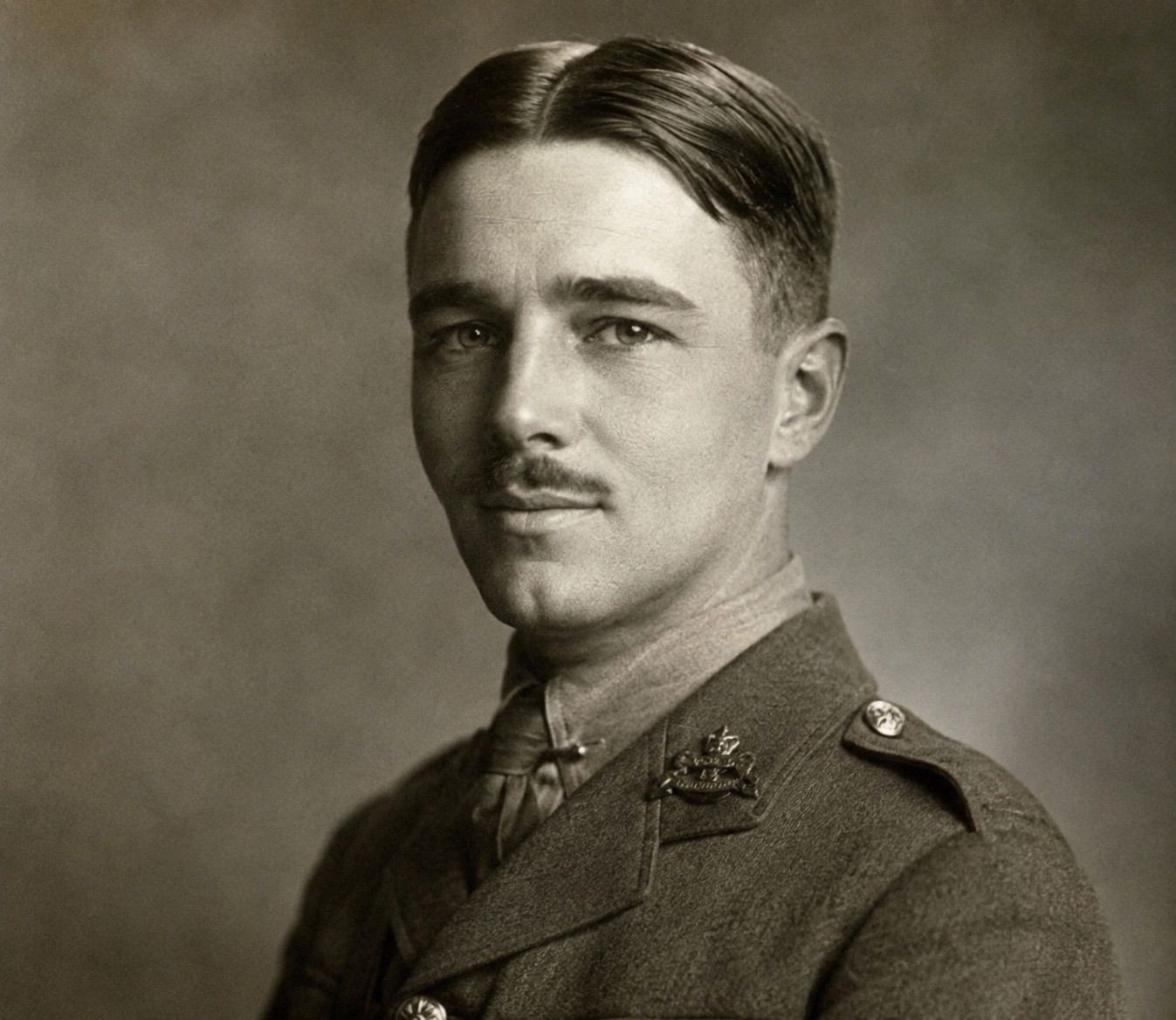
I’ve always been fascinated by Wilfred Owen’s words, but it wasn’t until I stumbled upon his poem “Dulce et Decorum Est” that I truly began to grasp the depth of his emotion. The way he describes the horrors of war – the “mud” and “blood” that cling to the soldiers’ bodies like a second skin – made me feel like I was experiencing it alongside him.
As someone who’s only known the quiet, comfortable rhythms of college life, Owen’s words are a jarring reminder of the realities that others have faced. His poetry is like a punch to the gut, leaving me breathless and questioning my own naivety. It’s uncomfortable, but in a way that feels necessary.
I’ve been trying to understand why Owen’s writing resonates with me on such a deep level. Is it because I’m drawn to his sense of empathy? He writes about the soldiers’ exhaustion, their fear, and their desperation – not as abstract concepts, but as tangible, human experiences that we can all relate to.
Or is it something more specific? Maybe it’s the way Owen tackles the idea of beauty in war. In “Dulce et Decorum Est,” he describes the gas attack as a “pity” that “moves” him – not in a sentimental or romantic sense, but in a way that feels both heartbreaking and infuriating. It’s like he’s holding up a mirror to our collective hypocrisy: we talk about the glory of war, the nobility of sacrifice, but what does that even mean when faced with the actual reality?
I find myself wondering if Owen was driven by a desire to expose this contradiction, to force us into a confrontation with the true nature of war. His poetry is like a scream in the face of societal complacency – a cry to wake up and acknowledge the ugliness we’ve been ignoring.
And yet… there’s something that still eludes me about Owen’s work. Maybe it’s the sense of melancholy that pervades even his most scathing critiques. He writes with a precision, a control that belies the turmoil he’s describing – like he’s channeling his emotions into these beautifully crafted poems, but still somehow managing to contain them.
I’m not sure if I’ll ever fully grasp the intricacies of Owen’s mind or experience. All I know is that his words have stayed with me long after I finished reading them – a lingering presence in my thoughts, a reminder of the complexities and cruelties of human nature.
As I continue to explore his work, I find myself returning to this idea: that the most powerful writing is often the kind that leaves us uncomfortable, questioning our assumptions. Owen’s poetry doesn’t offer easy answers or solace; instead, it plunges us into the depths of war and suffering, forcing us to confront the darkness within ourselves.
It’s a daunting prospect, but one that feels necessary – like Owen’s words are pushing me toward some deeper understanding, even if I’m not entirely sure what that means yet.
I’ve been thinking about Owen’s use of imagery in “Dulce et Decorum Est.” The way he describes the gas attack is so vivid, it’s almost like I can smell the chlorine and feel the burning in my lungs. It’s a visceral experience, one that makes me realize how disconnected I am from the realities of war.
As I read through his poetry, I’ve started to notice this tendency towards vividness – not just in describing the horrors of war, but also in depicting the mundane details of soldier life. He writes about the discomfort of trench foot, the stench of mud and blood, and the monotony of waiting for orders. These moments feel like a reminder that even in the midst of chaos, there’s still a sense of normalcy – a sense of routine that we often overlook.
It’s this juxtaposition between the surreal horror of war and the banal realities of soldier life that I find so striking. Owen’s poetry doesn’t shy away from the brutal facts of war, but it also acknowledges the humanity that exists within those facts. He writes about soldiers as individuals, with their own fears, doubts, and desires – rather than just viewing them as abstract pawns in a larger conflict.
This makes me wonder: what does it mean to write honestly about such traumatic experiences? Is it possible to convey the complexity of war without resorting to sentimentality or clichés? Owen’s poetry suggests that it is, but I’m still not entirely sure how he achieves this balance.
I’ve been reading some of his letters to friends and family, too – trying to get a sense of his inner world. There’s something about his writing that feels both confessional and calculated, like he’s deliberately crafting these words to convey a message. But what is that message, exactly? Is it simply to expose the horrors of war, or is there something more nuanced at play?
Owen’s poetry has become a kind of obsession for me – one that I’m not entirely sure how to shake off. His words keep circling back in my mind, refusing to let go. It’s like he’s challenging me to confront my own assumptions about the world, to see things from a different perspective. And while it’s uncomfortable at times, I feel like it’s also necessary – like Owen’s poetry is pushing me toward some kind of growth or understanding that I’m not entirely sure I want to admit to yet.
As I delve deeper into Owen’s work, I find myself becoming increasingly fascinated by his use of metaphor. In “Dulce et Decorum Est,” he compares the gas attack to a dance, with the soldiers stumbling and falling like dancers out of rhythm. It’s a powerful image that conveys the chaos and disorientation of war. But what struck me recently is how Owen also uses metaphor to describe his own emotions – comparing his feelings of outrage and sorrow to a “cold wind” that blows through him.
It’s this blending of personal and universal experiences that I think makes Owen’s poetry so compelling. He doesn’t just write about the horrors of war; he writes about the way it makes him feel, the way it challenges his own sense of identity and purpose. And in doing so, he creates a space for me to connect with his emotions, to see myself reflected in his words.
I’ve been thinking a lot about the idea that poetry can be a form of emotional contagion – that when we read someone else’s words, we’re not just absorbing their ideas or experiences, but also their feelings. And Owen’s poetry is like a masterclass in emotional contagion. He writes with such intensity and vulnerability that it’s impossible not to feel swept up in his emotions.
But what I find most intriguing about Owen’s use of metaphor is how it highlights the complexity of human experience. War is often reduced to simple binaries – good vs. evil, heroism vs. cowardice – but Owen’s poetry shows us that reality is far more nuanced. He describes soldiers who are both frightened and fearless, capable of incredible acts of bravery and yet also crippled by their own fears.
It’s this nuance that I think makes Owen’s poetry so necessary – a reminder that human experience is always multifaceted, always contradictory. And as someone who’s only known the comforts of college life, I find myself drawn to his words like a moth to flame. They’re uncomfortable, yes, but they’re also exhilarating – forcing me to confront my own assumptions and biases in ways that feel both painful and liberating.
I’ve been wondering lately if Owen’s poetry is somehow a form of resistance – a way of pushing back against the simplistic narratives that often surround war. By describing the horrors of war in such vivid detail, he’s forcing us to see beyond the propaganda and rhetoric, to confront the messy reality of human conflict.
But what does it mean to resist the dominant narrative? Is it simply to expose its flaws and contradictions, or is there something more active at play – a desire to create an alternative narrative, one that values humanity over patriotism, empathy over ideology?
Owen’s poetry doesn’t offer easy answers, but it does raise important questions. And as I continue to grapple with his words, I find myself feeling both unsettled and invigorated – like I’m being pushed toward some kind of growth or understanding that I’m not entirely sure I want to admit to yet.
As I delve deeper into Owen’s poetry, I’m struck by the way he uses language to subvert our expectations. He takes words like “dulce” and “decorum” – which typically evoke feelings of sweetness and propriety – and turns them on their head. The phrase “dulce et decorum est pro patria mori” becomes a cruel joke, a stark reminder that the idea of dying for one’s country is often nothing more than a hollow ideal.
It’s this kind of linguistic trickery that I think makes Owen’s poetry so effective in challenging our assumptions. He’s not just writing about war; he’s writing against it – using language to undermine the very notion of patriotism and duty that underpins so much of Western culture.
But what strikes me as particularly remarkable is how Owen achieves this subversion without resorting to simplistic or didactic language. His poetry is never heavy-handed, never preachy. Instead, it feels like a nuanced exploration of the human condition – one that’s both deeply personal and universally relatable.
As I read through his poems, I find myself drawn to the way he uses imagery to convey the complexity of war. He writes about the “trenches” as a kind of liminal space – a place where the boundaries between life and death, sanity and madness, are constantly blurred. And it’s this blurring that I think makes Owen’s poetry so powerful: he shows us that even in the midst of chaos, there’s still a sense of ambiguity, a sense that nothing is ever as clear-cut as we’d like to believe.
I’ve been thinking about the idea that Owen’s poetry is somehow a form of confession – not just a personal expression of his emotions, but also a kind of public admission of guilt. By writing so honestly about the horrors of war, he’s exposing himself to criticism and ridicule, but also, I think, to a deeper sense of understanding.
It’s this willingness to confront our own complicity in the violence of war that I find most compelling about Owen’s poetry. He doesn’t just write about the soldiers who fought; he writes about the civilians who suffered, the families who lost loved ones, and the politicians who perpetuated the conflict. And by doing so, he raises important questions about our collective responsibility – about how we enable or condemn the actions of those in power.
As I continue to explore Owen’s work, I’m struck by the way his poetry feels both timeless and timely. His words are like a warning – a reminder that the horrors of war are never truly distant, but always lurking just beneath the surface. And yet, they’re also a kind of testament to the human spirit: even in the face of unimaginable suffering, we can find moments of beauty, of kindness, and of resilience.
I’m not sure what lies ahead as I continue to grapple with Owen’s poetry – whether it will lead me down some new path of understanding or simply leave me more questions than answers. But for now, at least, I feel like I’m being pushed toward a deeper appreciation of the complexities that underlie human experience – and a recognition that even in the darkest moments, there’s always a glimmer of hope to be found.
As I sit here with Owen’s words still resonating within me, I find myself thinking about the idea of “hope” in the midst of war. Is it possible for someone like Owen, who witnessed such unimaginable atrocities, to hold onto hope? Or is that just a luxury reserved for those of us who haven’t experienced the raw brutality of conflict?
I’m struck by how Owen’s poetry often oscillates between despair and defiance – as if he’s simultaneously acknowledging the futility of war while also refusing to give in to its crushing weight. It’s this tension between hope and despair that I think makes his work so compelling, and also so difficult to understand.
For me, it’s like trying to grasp a handful of sand: the more I try to hold onto it, the more it slips through my fingers. I’m not sure if Owen ever found a way to reconcile his own feelings about war, or if he simply learned to live with the contradictions that seemed to simmer just beneath the surface.
What I do know is that his poetry has given me a new perspective on the complexities of human experience – one that acknowledges both the darkness and the light. It’s like Owen is shining a flashlight into the recesses of our collective psyche, illuminating the shadows and forcing us to confront the parts of ourselves we’d rather keep hidden.
I’m not sure if I’ll ever fully understand the intricacies of Owen’s mind or experience, but I do know that his poetry has stayed with me in ways that feel both exhilarating and terrifying. It’s like he’s left me a trail of breadcrumbs to follow, leading me deeper into the labyrinthine corridors of human emotion.
As I continue to explore Owen’s work, I’m drawn to the way he uses language to create a sense of intimacy – as if we’re sharing a secret that only we understand. It’s this feeling of being let in on a private truth that makes his poetry feel so powerful, and also so vulnerable.
I’m not sure what lies ahead for me as I continue to grapple with Owen’s words, but I do know that I’ll be carrying them with me – like a weight or a talisman – reminding me of the complexities and cruelties of human nature. And maybe, just maybe, it will lead me down some new path of understanding, one that acknowledges both the darkness and the light that exists within us all.
The more I read Owen’s poetry, the more I realize how little I know about war – about its causes, its consequences, and its impact on individuals and society. It’s like he’s holding up a mirror to our collective ignorance, forcing us to confront the gaps in our knowledge and understanding.
I’m struck by how Owen’s work is both deeply personal and universally relatable – as if his experiences are somehow connected to my own, despite the vastly different circumstances of our lives. It’s this sense of connection that makes his poetry feel so powerful, and also so humbling.
For me, reading Owen’s words is like trying to untangle a knot – one that only seems to get more complicated with each passing moment. And yet, it’s in the midst of this complexity that I find myself feeling most alive – as if the very act of grappling with his poetry is somehow keeping me connected to the world around me.
I’m not sure what lies ahead for me as I continue to explore Owen’s work, but I do know that I’ll be carrying his words with me – like a reminder of the complexities and cruelties of human nature. And maybe, just maybe, it will lead me down some new path of understanding, one that acknowledges both the darkness and the light that exists within us all.