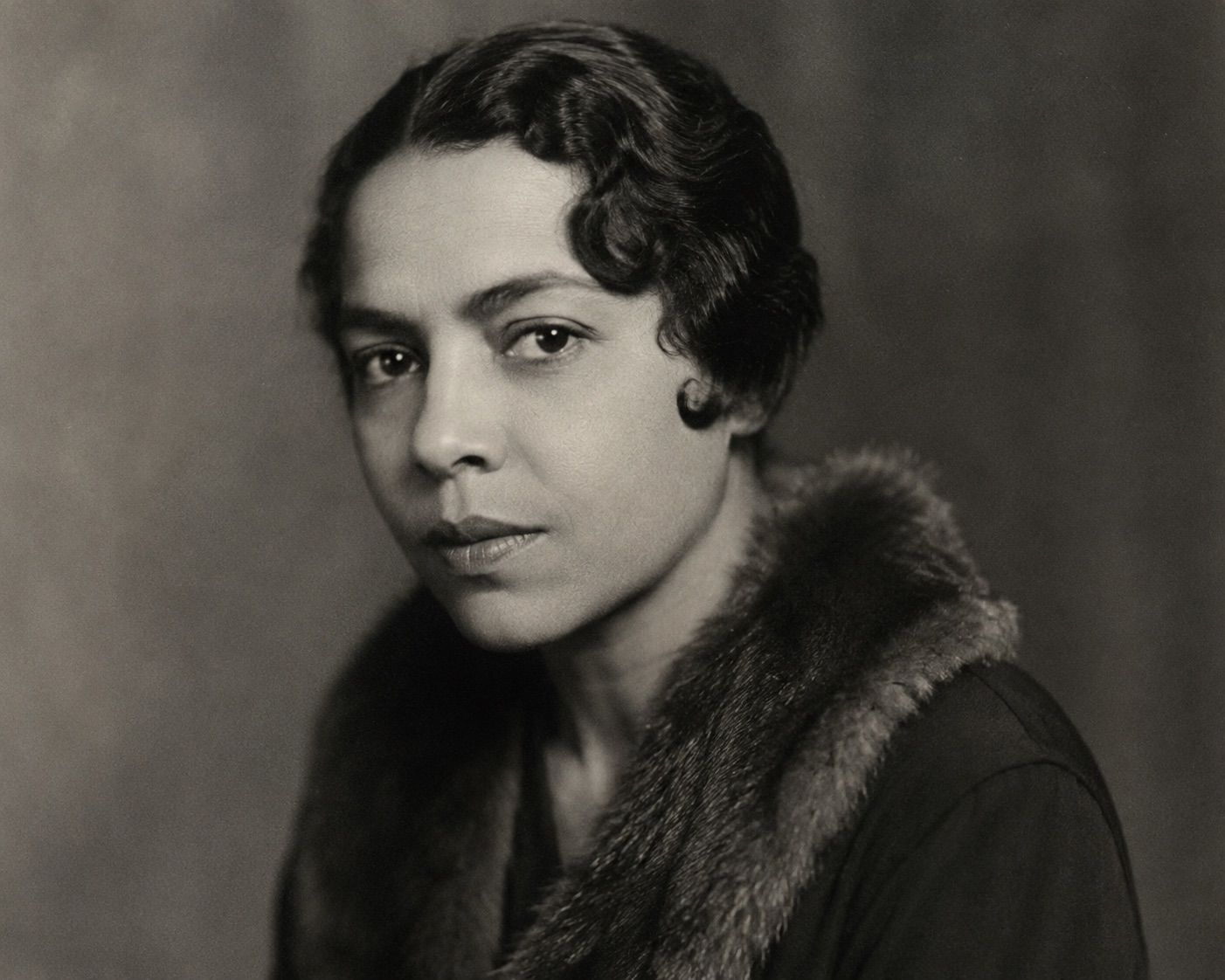
Nella Larsen. Her name has been stuck in my head for months now, like a line from a poem I’ve yet to decipher. What draws me to her, really? Is it the way she defied convention, embracing her mixed heritage and rejecting societal expectations of what it means to be black or white? Or is it something more intangible – the sense that she was always looking at the world with a critical eye, never quite satisfied with the answers she found?
I remember reading about Larsen’s struggles with identity in passing, particularly in her novel “Quicksand”. I felt a shiver run down my spine as I read about Helga Crane’s desperate attempts to find her place within the narrow confines of early 20th-century American society. But it was more than just Helga’s story that resonated with me – it was Larsen’s own biography, marked by a life of secrecy and self-doubt.
As someone who has struggled to define themselves outside of academia (I majored in English lit, after all), I find myself drawn to Larsen’s experiences as a writer. She wrote about the complexities of racial identity, but also about the constraints placed on women – particularly those from marginalized communities – by societal expectations and personal desires. Her work is both a reflection of her own life and a critique of the systems that sought to silence her.
I’ve been reading through some of Larsen’s essays and letters, trying to get a better sense of who she was beyond her writing. There’s something haunting about the way she describes her feelings of disconnection from both black and white communities – like she’s stuck between two worlds, unable to fully belong in either one. It’s a feeling I recognize all too well, having grown up with parents from different cultural backgrounds myself.
But what really gets me is Larsen’s decision to erase herself from public life in the 1930s. She stopped writing novels and essays, effectively disappearing from the literary scene. Some say it was due to personal struggles or financial pressures, but I’m left wondering if there wasn’t something more to it – a sense of disillusionment with the world she’d been trying to navigate all along.
I find myself oscillating between admiration for Larsen’s courage in speaking truth to power and frustration at her seeming retreat from the very public discourse she helped shape. It’s like I’m torn between two parts of myself: the part that wants to shout from the rooftops about social justice, and the part that wants to quietly observe and write – to keep my head down, even if it means risking being forgotten.
Larsen’s story has left me with more questions than answers. Is it possible to be both authentic and invisible? Can we truly live outside the expectations of others, or are we forever bound by the societal norms that shape us? I’m not sure what Larsen would say in response – but as I sit here, scribbling away in my journal, I know she’s given me permission to explore these questions for myself.
As I delve deeper into Larsen’s life and work, I find myself becoming increasingly fascinated by her enigmatic presence. She’s a woman who defies categorization – a black woman, a mixed-race woman, a writer, an artist, a rebel. And yet, in her most famous works, she often seems to be pulling back from the very identity that defines her.
I think about Helga Crane, the protagonist of “Quicksand”, and how she embodies this tension between identity and erasure. Helga is a woman torn apart by her own desires and societal expectations – she’s a product of both black and white cultures, and yet she feels like an outsider in both. It’s as if Larsen is using Helga to explore the impossibility of true belonging, the way that even our most authentic selves can be reduced to mere caricatures or tokens.
But what strikes me most about Larsen’s work is its sense of melancholy – a feeling that pervades every sentence, every paragraph. It’s as if she’s perpetually haunted by the knowledge that we’re all just pretending to be something we’re not, that our identities are always in flux. And yet, despite this uncertainty, she continues to write, to probe at the edges of her own existence and those around her.
I’m reminded of my own experiences with identity – how I’ve often felt like I’m caught between two worlds, struggling to reconcile the expectations of my parents with my own desires. It’s a feeling that can be both exhilarating and suffocating, like being suspended in mid-air without any clear direction or purpose.
Larsen’s decision to erase herself from public life in the 1930s only adds to this sense of mystery – as if she’s disappeared into thin air, leaving behind only fragments of her work and a trail of questions. What was it about the world that made her feel like she had to retreat? Was it the pressure to conform to societal norms, or the weight of her own expectations?
I find myself wondering what Larsen would say if I were to meet her today – if she’d be willing to share the secrets of her silence, the reasons behind her disappearance from the literary scene. Would she talk about the toll that writing took on her mental health, or the way that societal pressures forced her to prioritize her private life over her public persona?
Or would she simply shrug and say that sometimes, it’s okay to disappear – to let go of the personas we’ve created for ourselves, and to step into the void?
The more I read about Larsen, the more I’m struck by the fragility of identity. It’s as if she’s constantly negotiating between different versions of herself, never quite finding a sense of stability or belonging. And yet, it’s precisely this tension that makes her work so compelling – a testament to the messy, complicated nature of human experience.
I think about how Larsen’s decision to erase herself from public life might be seen as a form of self-protection, a way of shielding herself from the expectations and pressures of others. But is it really possible to protect oneself in this way? Or are we forever bound by the societal norms that shape us?
As I grapple with these questions, I’m reminded of my own experiences with identity politics – how sometimes, it feels like being a part of multiple communities means constantly performing for different audiences, always trying to meet their expectations. But what about when those expectations conflict? What happens when you’re caught between two worlds, struggling to reconcile your own desires with the demands of others?
Larsen’s work seems to suggest that this is a universal human experience – one that transcends racial or cultural boundaries. Her characters are always navigating these tensions, always trying to find their place in a world that often seems hostile or indifferent.
And yet, despite the uncertainty and self-doubt that pervades her writing, there’s something quietly defiant about Larsen’s presence. She’s a writer who refused to be silenced, who continued to speak truth to power even when it meant risking everything. That takes courage – a quality that I admire deeply, but also find intimidating.
I’m not sure if I’ll ever write with the same level of passion and conviction as Larsen did. But reading her work has given me permission to explore my own identity in new ways – to question the expectations placed upon me, and to seek out my own voice within the chaos of conflicting demands.
As I close this journal entry, I’m left wondering what secrets Larsen took with her into that silence – what stories she might have told if she’d continued writing. But even without answers, I feel a sense of gratitude for the questions themselves – for the way they’ve allowed me to see my own life in a new light.
I find myself drawn back to Larsen’s novel “Passing”, where she explores the complexities of racial identity through the story of Irene Redfield, a black woman who passes as white in order to maintain her privileged lifestyle. On the surface, it seems like a familiar theme – the struggle for social mobility and acceptance. But what resonates with me is the way Larsen highlights the performative nature of identity, how we all play roles and pretend to be something we’re not.
I think about my own experiences growing up with parents from different cultural backgrounds. My mom is Korean-American, while my dad is white. As a child, I felt like I was constantly navigating between two worlds – trying to speak Korean at home, but also speaking English in school. It was like I had multiple identities vying for attention, each one pulling me in different directions.
Larsen’s work makes me realize that this sense of fragmentation is not unique to me or my experiences as a mixed-race person. She shows how identity is always in flux, shaped by the societal expectations and pressures we face every day. And yet, despite this fluidity, she also highlights the importance of self-definition – the need to find one’s own voice and authenticity within the chaos.
I’m struck by Larsen’s use of language in “Passing”, how it seems to capture the fragility and complexity of human experience. Her writing is like a dance between different selves, each one emerging and receding into the background as she navigates the complexities of identity. It’s as if she’s constantly questioning her own assumptions and biases, always seeking to deepen her understanding of herself and others.
As I read through Larsen’s letters and essays, I’m reminded that she was a product of her time – a writer who emerged during the Harlem Renaissance, an era marked by great social change and cultural upheaval. Her work reflects this tumultuous period, capturing the anxieties and aspirations of African Americans as they sought to assert their place in American society.
But what strikes me most is how Larsen’s writing transcends historical context – how her exploration of identity continues to resonate today. I think about my own experiences with social justice movements, how we often find ourselves caught between competing demands for authenticity and representation. It’s a tension that Larsen captures beautifully in her work, highlighting the messy, complicated nature of human experience.
I’m left wondering what it would be like to sit down with Larsen, to talk to her about her experiences as a writer and an artist. Would she share her own struggles with identity, or reveal the secrets behind her decision to erase herself from public life? Or would she simply smile and say that sometimes, it’s okay to let go of our personas – to step into the void and emerge anew?
The more I read about Larsen, the more I realize how little we really know about her as a person. There are gaps in her biography, silences that seem to haunt her every move. And yet, it’s precisely these silences that make her work so compelling – a testament to the mysterious, enigmatic nature of human experience.
As I close this journal entry, I’m left with more questions than answers – about Larsen, about identity, and about the complex web of expectations and pressures we face every day. But in some ways, it’s precisely these questions that give me permission to explore my own life in new ways – to question the assumptions and biases that shape me, and to seek out my own voice within the chaos.
The more I read about Larsen, the more I’m struck by the tension between her desire for authenticity and her need for self-protection. It’s as if she’s constantly negotiating between these two poles, always seeking a balance that feels true to herself while also acknowledging the societal expectations that surround her.
I think about how this dynamic plays out in her writing, particularly in “Quicksand”. Helga Crane is a character who embodies this tension perfectly – she’s a black woman who’s been educated in Europe and returns to America, only to find herself caught between two worlds. It’s as if Larsen is using Helga to explore the impossibility of true belonging, the way that even our most authentic selves can be reduced to mere caricatures or tokens.
But what strikes me most about Helga’s story is its sense of desperation – a feeling that pervades every sentence, every paragraph. It’s as if Larsen is capturing the raw emotion of identity crisis, the sense of being lost and alone in a world that doesn’t seem to understand us.
As I read through Larsen’s essays and letters, I’m reminded that she was a product of her time – a writer who emerged during the Harlem Renaissance, an era marked by great social change and cultural upheaval. Her work reflects this tumultuous period, capturing the anxieties and aspirations of African Americans as they sought to assert their place in American society.
But what strikes me most is how Larsen’s writing transcends historical context – how her exploration of identity continues to resonate today. I think about my own experiences with social justice movements, how we often find ourselves caught between competing demands for authenticity and representation. It’s a tension that Larsen captures beautifully in her work, highlighting the messy, complicated nature of human experience.
I’m left wondering what it would be like to sit down with Larsen, to talk to her about her experiences as a writer and an artist. Would she share her own struggles with identity, or reveal the secrets behind her decision to erase herself from public life? Or would she simply smile and say that sometimes, it’s okay to let go of our personas – to step into the void and emerge anew?
The more I read about Larsen, the more I realize how little we really know about her as a person. There are gaps in her biography, silences that seem to haunt her every move. And yet, it’s precisely these silences that make her work so compelling – a testament to the mysterious, enigmatic nature of human experience.
As I close this journal entry, I’m left with more questions than answers – about Larsen, about identity, and about the complex web of expectations and pressures we face every day. But in some ways, it’s precisely these questions that give me permission to explore my own life in new ways – to question the assumptions and biases that shape me, and to seek out my own voice within the chaos.
I think about how Larsen’s work has allowed me to see my own identity in a new light – as a complex tapestry of different selves, each one vying for attention. It’s a feeling that can be both exhilarating and suffocating, like being suspended in mid-air without any clear direction or purpose.
But it’s precisely this sense of uncertainty that makes Larsen’s work so compelling – a reminder that identity is always in flux, shaped by the societal expectations and pressures we face every day. And yet, despite this fluidity, she also highlights the importance of self-definition – the need to find one’s own voice and authenticity within the chaos.
As I close this journal entry, I’m left with more questions than answers – about Larsen, about identity, and about the complex web of expectations and pressures we face every day. But in some ways, it’s precisely these questions that give me permission to explore my own life in new ways – to question the assumptions and biases that shape me, and to seek out my own voice within the chaos.
I’m not sure what Larsen would say if I were to meet her today – if she’d be willing to share the secrets of her silence, the reasons behind her disappearance from the literary scene. But as I sit here, scribbling away in my journal, I know that she’s given me permission to explore these questions for myself.
And so, I’ll continue to read and write about Larsen – to delve deeper into her life and work, and to seek out the secrets that lie beneath the surface. For it’s in the silences and gaps of her biography that I find the most compelling aspects of her story – a testament to the mysterious, enigmatic nature of human experience.