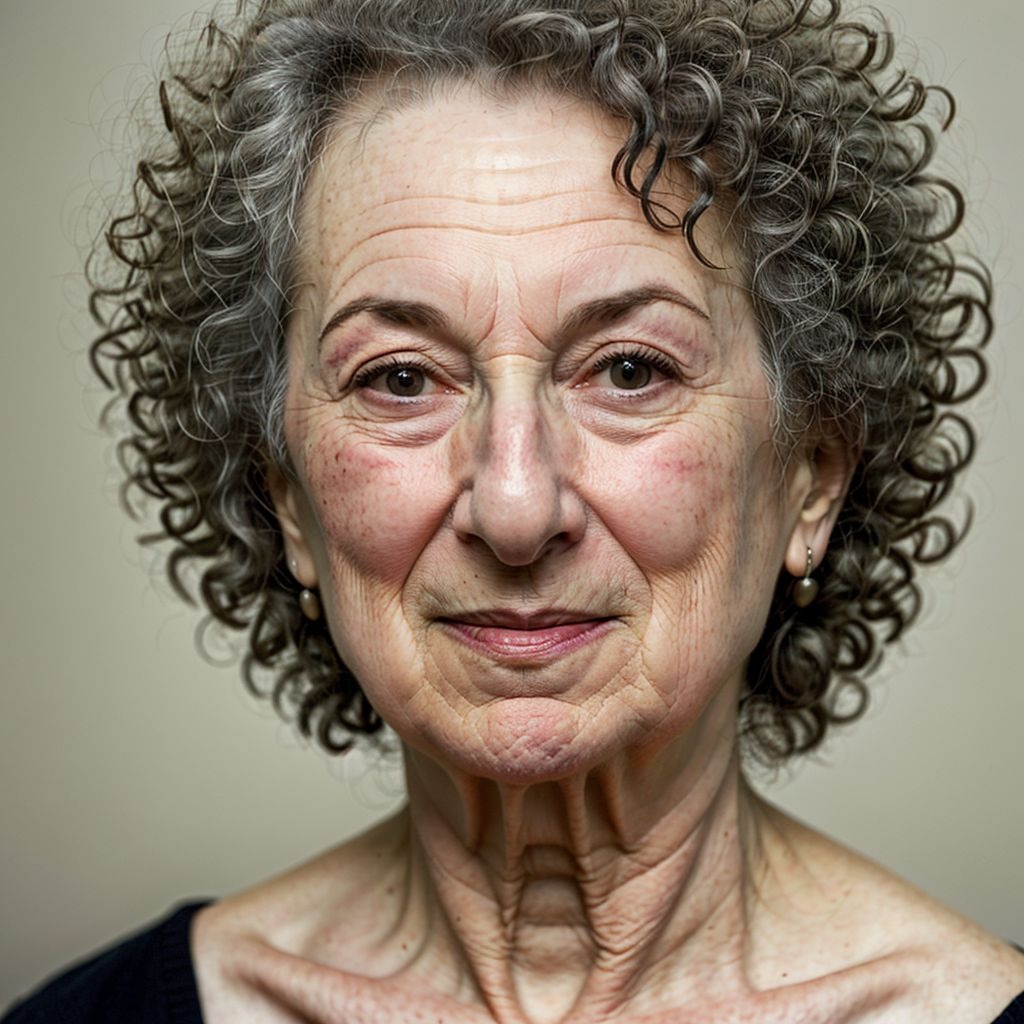
Margaret Atwood. I’ve been thinking about her a lot lately, not just because of the recent buzz around The Testaments – although that certainly didn’t hurt. But it’s more than that. It’s like she’s tapped into some deep part of me, this desire to understand the world through stories and symbols.
I think what draws me in is the way Atwood navigates the complexities of being a woman, especially in patriarchal societies. Her writing is never didactic or heavy-handed; instead, it’s infused with a sly wit and intelligence that makes you feel like you’re piecing together clues alongside her. Take The Handmaid’s Tale, for instance – on the surface, it’s a dystopian novel about oppression and resistance, but scratch beneath and you find all these rich layers of commentary on power, morality, and even science.
As I read Atwood’s work, I find myself getting stuck in this liminal space between fiction and reality. The Handmaid’s Tale is so eerily prophetic that it’s hard not to wonder if some of its themes are more than just hypothetical. Have we really become the kind of society where women’s bodies are owned by the state? Where dissent is quashed, and free thought is a luxury only the privileged can afford?
Atwood’s exploration of this gray area resonates deeply with me because I’ve been there myself – in my own way, at least. Growing up, I was always the one questioning authority, pushing against boundaries (much to my parents’ chagrin). And now, as an adult, I’m still grappling with what it means to be a woman in a world that often seems hell-bent on silencing us.
But Atwood’s writing isn’t just about me; it’s also about the world we live in. Her depiction of a society where environmental degradation has become a moral and economic imperative makes me feel like I’m staring into some sort of funhouse mirror – everything is distorted, but at the same time, eerily familiar.
As I delve deeper into Atwood’s work, I start to notice these threads of feminism and ecology running throughout her writing. It’s almost as if she’s trying to say that our personal choices have consequences on a much larger scale – consequences that can either perpetuate or challenge the status quo.
And yet…and yet…I’m not entirely convinced by Atwood’s vision of resistance. The Handmaid’s Tale, in particular, often feels like it’s advocating for a binary choice between oppression and revolution, as if there aren’t any other options on the table. It’s this rigid dichotomy that makes me uneasy – what about all the gray areas in between? What about the times when we’re neither fully complicit nor actively resisting?
Atwood’s writing isn’t meant to provide easy answers; it’s more like a series of provocations, nudging us toward uncomfortable truths and difficult questions. And that’s precisely why I keep coming back to her work – because she refuses to give me (or anyone) an easy way out.
As I write this, I’m aware that I’m still grappling with the complexities of Atwood’s vision – and my own place within it. It’s a messy, unresolved business, but one that feels essential to navigating our current world.
One thing that’s struck me about Atwood’s writing is her use of myth and folklore as a way to explore these big questions about power, morality, and the human condition. In The Penelopiad, for example, she retells Homer’s Odyssey from Penelope’s perspective – a woman who’s often reduced to a mere prop in her husband’s story. By giving her voice back, Atwood subverts this centuries-old narrative and reveals all these hidden dynamics at play.
It’s this kind of subtle manipulation that I find so captivating – the way she can take something familiar and turn it on its head. And yet, as much as I appreciate the intellectual gymnastics involved in deconstructing myth and folklore, I’m also aware that there’s a risk of losing sight of what matters most: the human experience.
Sometimes, when reading Atwood’s work, I feel like I’m so caught up in the cleverness and nuance that I forget to connect it back to my own life. It’s as if I’ve become too enamored with the intellectual exercises she sets up – the clever allusions, the philosophical debates – that I’ve neglected the messy, emotional aspects of her stories.
Take The Blind Assassin, for instance. On one level, it’s this intricate puzzle of a novel, full of codes and ciphers that require close attention to unravel. But beneath all the surface-level complexity, there’s a powerful exploration of family dynamics, trauma, and the ways in which our pasts shape us. It’s this human core that resonates with me on a deeper level – it reminds me that even the most cerebral writing is ultimately about people.
As I continue to read Atwood’s work, I’m aware that I’m still trying to reconcile these different parts of her oeuvre – the intellectual playfulness, the feminist critique, the exploration of human emotions. It’s a balancing act, and one that requires me to stay attuned to my own responses, rather than just getting lost in the cleverness or complexity.
Atwood’s writing is like this constant reminder that even as we try to understand the world through stories and symbols, there are always more questions waiting to be asked – more perspectives to consider. And it’s this sense of uncertainty, this willingness to stay open-minded and adaptable, that I think is ultimately what draws me back to her work again and again.
As I reflect on Atwood’s use of myth and folklore, I’m struck by how she blurs the lines between fact and fiction. It’s almost as if she’s saying that our understanding of the world is always filtered through some kind of narrative lens – whether it’s personal, cultural, or historical. And yet, this realization also makes me wonder: what happens when we try to separate the two? When do we take things at face value, and when do we question their underlying stories?
I think about my own experiences with mythology and folklore. Growing up, I was fascinated by Greek myths – particularly the stories of Penelope, Medusa, and Persephone. As a young woman, I saw these characters as symbols of power, agency, and transformation. But now that I’m older, I realize how much those interpretations were influenced by my own cultural and personal biases.
Atwood’s re-tellings of myths like The Penelopiad challenge me to rethink my assumptions about what it means to be a woman, especially in patriarchal societies. She forces me to confront the ways in which our stories have been distorted or manipulated over time – often to serve the interests of those in power.
It’s this kind of critical thinking that I value most in Atwood’s work. She doesn’t offer easy answers or solutions; instead, she poses questions and encourages us to explore the complexities of human experience. And yet, as much as I appreciate her intellectual rigor, I’m also aware that there are times when I need something more straightforward – a story that speaks directly to my emotions, rather than just my intellect.
Take The Year of the Flood, for example. On one level, it’s this dense, philosophical novel about environmental collapse and human resilience. But beneath all the surface-level complexity, there’s a powerful exploration of grief, loss, and redemption. It’s this emotional core that resonates with me on a deeper level – it reminds me that even the most cerebral writing can be deeply personal.
As I continue to read Atwood’s work, I’m aware that I’m still trying to reconcile these different parts of her oeuvre – the intellectual playfulness, the feminist critique, the exploration of human emotions. It’s a balancing act, and one that requires me to stay attuned to my own responses, rather than just getting lost in the cleverness or complexity.
Atwood’s writing is like this constant reminder that even as we try to understand the world through stories and symbols, there are always more questions waiting to be asked – more perspectives to consider. And it’s this sense of uncertainty, this willingness to stay open-minded and adaptable, that I think is ultimately what draws me back to her work again and again.
But what if I’m wrong? What if Atwood’s vision is too narrow, too focused on the intellectual or feminist aspects of human experience? What if there are other stories waiting to be told – stories that don’t fit neatly into our existing narratives?
As I ponder these questions, I realize that they’re not just about Atwood’s writing; they’re also about my own role as a reader. Do I have the capacity to see beyond her intellectual exercises and emotional explorations? Can I recognize when she’s pushing me toward uncomfortable truths or difficult questions – even if it means challenging my own assumptions and biases?
These are the kinds of uncertainties that keep me coming back to Atwood’s work. She doesn’t offer easy answers, but instead invites me into a world of complex questions and messy, unresolved business. And it’s this kind of intellectual humility, this willingness to stay open-minded and adaptable, that I think is ultimately what makes her writing so powerful – and so necessary in our current world.
As I sit here with my thoughts on Atwood’s writing, I’m struck by the realization that her work has become a kind of mirror for me – reflecting back my own experiences, biases, and assumptions about the world. It’s as if she’s taken all these fragments of myself and woven them into a tapestry of complex questions and messy, unresolved business.
I think about how Atwood’s writing often blurs the lines between fact and fiction, leaving me to wonder what’s real and what’s constructed. And I realize that this is precisely the kind of uncertainty that makes her work so compelling – it forces me to question my own understanding of the world and to consider multiple perspectives.
But what if this uncertainty is also a limitation? What if Atwood’s refusal to offer easy answers or clear solutions is actually a reflection of our own inability to confront the complexities of human experience? What if, as readers, we’re more interested in intellectual exercises than emotional resonance?
As I ponder these questions, I’m reminded of my own experiences with writing. When I write, it’s often because I’m trying to make sense of something – a difficult emotion, a complex idea, or a messy situation. And yet, the more I write, the more I realize that there are no easy answers, only more questions and complexities waiting to be explored.
Atwood’s writing has taught me to approach my own writing with a similar sense of humility and uncertainty. Rather than trying to impose order on the world, I’m learning to embrace the messiness of human experience – to see it as a rich tapestry of contradictions and paradoxes rather than a neat, tidy narrative.
And yet, even as I’m drawn to this kind of intellectual curiosity, I’m also aware that there are times when I need something more straightforward – a story that speaks directly to my emotions rather than just my intellect. Atwood’s writing often leaves me feeling stimulated and challenged, but sometimes it also leaves me feeling lonely or disconnected from the world around me.
This is why I think I’ll continue to read Atwood’s work, even as I struggle with its complexities and uncertainties. Because in her writing, I see a reflection of my own struggles – not just as a reader, but as a writer, too. And it’s this sense of solidarity, this feeling that I’m part of a larger conversation about the human experience, that keeps me coming back to her work again and again.
But what lies ahead? As I continue to read Atwood’s writing, I wonder if I’ll find more answers or just more questions. Will I discover new perspectives on the world, or will I become even more lost in the complexities of human experience? Only time will tell, but for now, I’m content to keep exploring – with Atwood as my guide, and myself as the uncertain, questioning reader that I am.