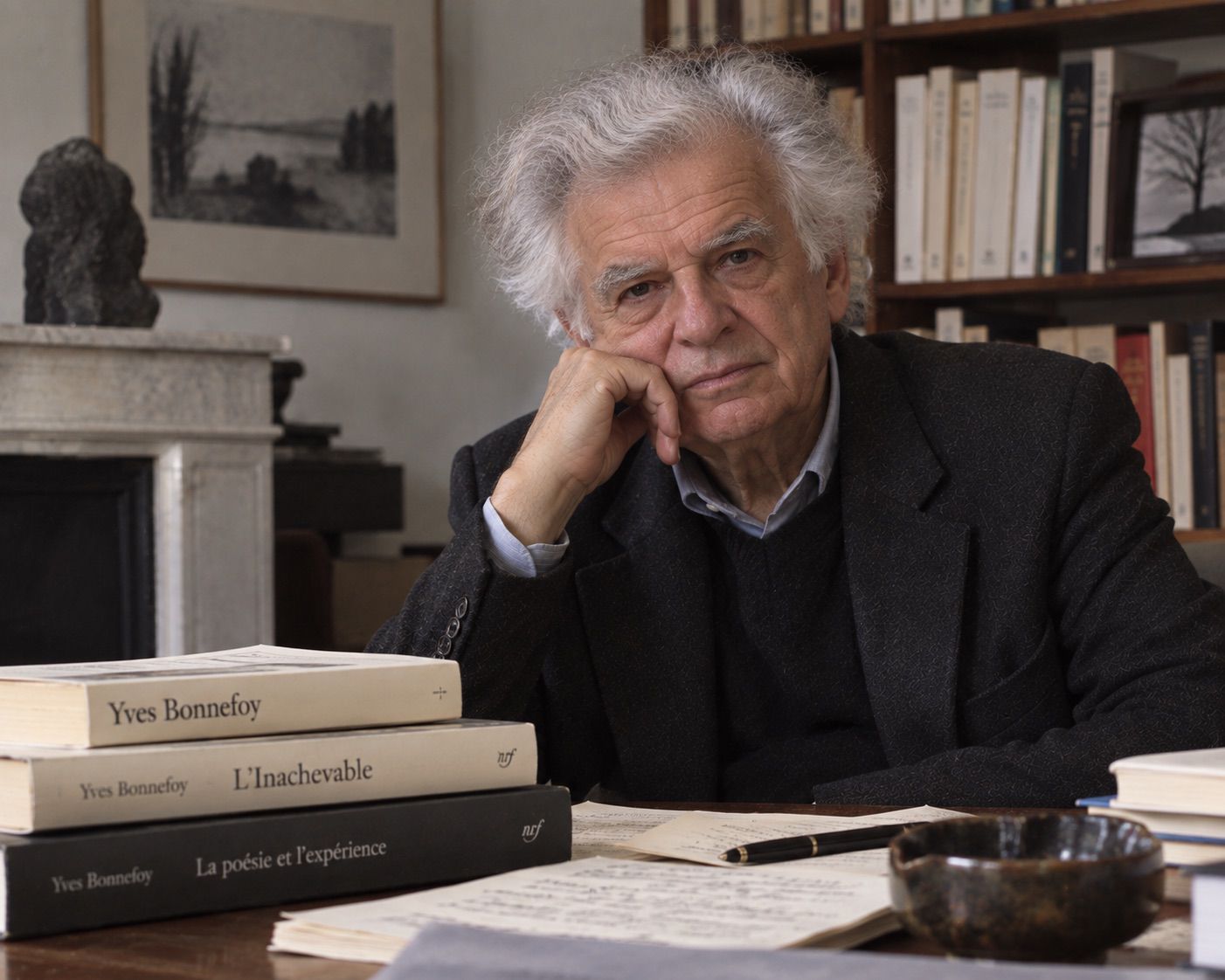
I’ll be honest, I only recently stumbled upon Yves Bonnefoy’s work, and yet his poetry has left an indelible mark on me. There’s something about the way he weaves together myth, history, and personal experience that resonates deeply with my own writing process.
As someone who writes as a way to think, I’m drawn to Bonnefoy’s introspective and often fragmented style. His poems are like mirrors reflecting multiple perspectives, inviting the reader to piece together their own narrative. It’s a quality that feels both comforting and unsettling – like being lost in a familiar woods, where every step reveals a new path.
One of the aspects that fascinates me is Bonnefoy’s exploration of the self through art and myth. His work often blurs the lines between creator and created, echoing my own struggles with identity and expression. In his poem “The Painter,” he writes about a painter who sees the world as a canvas, only to realize that the brushstrokes are not just marks on paper but also the gestures of his own soul. It’s as if Bonnefoy is asking: what lies beneath our creative endeavors? Is it the self, or something more?
This question has haunted me since college, when I wrote my senior thesis on the intersection of identity and art in contemporary women’s literature. My research took me down a rabbit hole of feminist theory, where I encountered thinkers like Simone de Beauvoir and bell hooks, who argued that creativity is often tied to our own experiences of marginalization and self-discovery. Bonnefoy’s work resonates with this idea – his poetry is an exercise in excavating the self through artistic expression.
Yet, there’s also a sense of disorientation in Bonnefoy’s writing that makes me uncomfortable. His use of mythological references, for instance, can feel like a double-edged sword: on one hand, it adds depth and richness to his poems; on the other hand, it risks romanticizing or essentializing entire cultures. I’m not sure how to navigate this tension – do we risk being complicit in cultural appropriation by borrowing from mythological narratives? Or is that inevitable when trying to tap into the collective unconscious?
Bonnefoy’s exploration of history and politics also makes me squirm. His poem “The Island” grapples with the legacies of colonialism and the search for identity within post-imperial France. I’m struck by his ability to convey the complexity of historical trauma, without resorting to platitudes or simplistic answers. At the same time, I find myself wondering: can we ever truly account for the past? Do our attempts at reckoning with history only serve to obscure more than they reveal?
These are the questions that linger after reading Bonnefoy’s work – the messy, unresolved ones that refuse to be tied up in neat bows. They’re the same questions I’m still grappling with as a writer, and it’s precisely this sense of shared uncertainty that draws me back to his poetry again and again.
Perhaps, for me, the true value of Bonnefoy’s writing lies not in its answers but in its capacity to pose new questions – to nudge me toward the edges of my own understanding. In an era where identity politics often reduces complexity to soundbites or hashtags, Bonnefoy’s work reminds me that true thought requires patience, vulnerability, and a willingness to confront the ambiguities within ourselves.
As I sit here, reflecting on his poetry, I feel like I’m still unraveling threads – threads of identity, culture, history, and self-expression. It’s a process that feels both exhilarating and disorienting, like being lost in a labyrinth with no clear exit. And yet, it’s precisely this sense of uncertainty that keeps me coming back to Bonnefoy’s work, searching for clues, patterns, or maybe just a glimpse of the self reflected back at me from his poems.
I find myself returning to Bonnefoy’s concept of the “double,” where he explores the idea of multiple selves existing within each individual. His poem “The Double” describes this phenomenon as a kind of doubling, where one’s own identity is reflected back at them through art, history, or mythology. It’s an intriguing notion that speaks to my own experiences with creative expression.
As I write, I often feel like I’m trying on different personas – the introverted poet, the extroverted writer, the introspective observer. Each persona feels authentic, yet they also seem to be hiding aspects of myself from view. Bonnefoy’s concept of the double resonates deeply with this sense of fragmentation, where my various selves are in constant dialogue.
But what lies at the heart of this doubling? Is it a reflection of our inner multiplicity, or is it an attempt to escape into other personas? I’m reminded of my own struggles with self-expression, where I often feel like I’m caught between the desire for authenticity and the need to perform for others. Bonnefoy’s work suggests that this tension is inherent in the creative process – that we’re always negotiating multiple selves, trying to find a way to integrate them into our art.
This idea has me thinking about the role of vulnerability in creativity. When I’m writing from a place of vulnerability, I feel like I’m exposing myself to the world, and yet, paradoxically, it’s also where I feel most connected to my true self. Bonnefoy’s poetry seems to operate on this same wavelength – he’s unafraid to explore his own doubts, fears, and contradictions, making him all the more relatable.
But vulnerability can be a double-edged sword too. When we’re exposed, we risk being hurt or rejected. I’ve seen it happen in my own writing community – where writers feel pressured to conform to certain standards of identity or style, lest they be ostracized or dismissed. Bonnefoy’s work suggests that this is precisely the opposite of what creativity should be about – embracing our complexities, rather than trying to fit into predetermined molds.
As I reflect on these ideas, I’m struck by how much Bonnefoy’s poetry has forced me to confront my own biases and assumptions. His exploration of history, politics, and identity has made me realize just how narrow my perspective often is – how quickly I default to simplistic answers or dismissive attitudes when faced with complexity. It’s a sobering reminder that writing, for me, will always be an act of self-discovery, where I’m constantly navigating the uncertain terrain between my own thoughts and feelings.
In this sense, Bonnefoy’s work becomes a kind of mirror – reflecting back at me not just his own ideas, but also my own limitations, biases, and fears. It’s a disorienting yet exhilarating experience, one that leaves me feeling both lost and found in the same breath. And it’s precisely this sense of self-discovery that keeps me coming back to his poetry – searching for answers, questions, or maybe just a glimpse of myself reflected back at me from the pages of his work.
As I delve deeper into Bonnefoy’s concept of the double, I’m struck by its resonance with my own experiences as a writer and an individual. The idea that we’re comprised of multiple selves, each with their own unique perspectives and voices, feels both empowering and daunting. It’s as if I’m staring into a kaleidoscope, where every turn reveals a new pattern, a new self.
I think back to my college days, when I spent hours poring over Simone de Beauvoir’s “The Ethics of Ambiguity.” Her concept of the “ambiguated subject” – an individual who exists in a state of perpetual uncertainty, constantly negotiating multiple identities and perspectives – feels eerily familiar. It’s as if Bonnefoy’s double is a more poetic manifestation of this same idea.
But what happens when these doubles collide? When do they merge into a cohesive self, and when do they diverge into conflicting voices? I’m reminded of my own struggles with anxiety and self-doubt – moments when my inner critic seems to take over, whispering doubts and fears that threaten to drown out the more confident, creative aspects of myself.
Bonnefoy’s poetry suggests that this collision is a natural part of the creative process. His use of fragmentation and multiple narrative voices creates a sense of tension, as if different selves are competing for dominance on the page. It’s a dynamic I’ve witnessed in my own writing – where opposing forces, whether internal or external, can either stifle creativity or propel it forward.
I think about my senior thesis, where I argued that women writers often employ fragmentation as a way to subvert dominant narratives and reclaim their voices. Bonnefoy’s use of the double feels like a more nuanced iteration of this idea – one that acknowledges the complexity of identity and experience, rather than reducing them to simplistic categories or binary oppositions.
As I explore this theme further, I’m struck by the ways in which Bonnefoy’s poetry has forced me to confront my own relationships with power and privilege. His exploration of history and politics raises uncomfortable questions about cultural appropriation, imperialism, and the legacy of colonialism. It’s a topic that’s become increasingly relevant in my own writing community – where writers are grappling with issues of representation, diversity, and inclusion.
Bonnefoy’s work suggests that these conversations will never be easy or straightforward. His poetry is an exercise in nuance, one that acknowledges the complexity of power dynamics and the multiple perspectives involved. It’s a messy, unresolved conversation that I’m still trying to navigate – both as a writer and as a member of society.
In many ways, Bonnefoy’s concept of the double feels like a reflection of this same messiness. His poetry is an exploration of the multiple selves that exist within each individual, each with their own unique experiences and perspectives. It’s a dynamic that I’m still trying to understand – one that speaks to my own struggles with identity, creativity, and power.
As I continue to reflect on Bonnefoy’s work, I’m struck by its ability to pose new questions, rather than providing answers. His poetry is an invitation to explore the complexities of human experience – a journey that’s both exhilarating and disorienting, like being lost in a labyrinth with no clear exit. It’s a journey that I’m still on, one that I hope will continue to unfold as I delve deeper into his work.
One of the things that I find particularly fascinating about Bonnefoy’s concept of the double is its relationship to the idea of the “fragmented self.” In my own writing, I often feel like I’m piecing together disparate parts of myself, trying to create a cohesive narrative out of fragments. It’s as if I’m constantly negotiating between different personas, each with their own unique voice and perspective.
Bonnefoy’s poetry suggests that this fragmentation is not only a natural part of the creative process but also a necessary one. His use of multiple narrative voices and fragmented forms creates a sense of tension and uncertainty, mirroring the inner turmoil that I often experience as a writer.
I think about my own struggles with anxiety and self-doubt – moments when my inner critic seems to take over, whispering doubts and fears that threaten to drown out the more confident, creative aspects of myself. Bonnefoy’s poetry is like a mirror reflecting back at me, showing me that this fragmentation is not unique to my own experiences but rather a universal aspect of human consciousness.
But what does it mean to fragment oneself in the creative process? Is it a form of self-protection, a way to shield ourselves from the uncertainty and risk of vulnerability? Or is it an attempt to escape into other personas, to hide behind a mask of identity?
Bonnefoy’s concept of the double suggests that this fragmentation is not just a defensive mechanism but also a necessary step towards creativity. By embracing our multiple selves, we can tap into the complexities of human experience and create works that are more nuanced and multifaceted.
I’m reminded of my own struggles with self-expression – moments when I feel like I’m caught between the desire for authenticity and the need to perform for others. Bonnefoy’s poetry suggests that this tension is inherent in the creative process, but it’s also an opportunity for growth and exploration.
As I continue to reflect on Bonnefoy’s work, I’m struck by its ability to push me outside of my comfort zone. His poetry is like a labyrinth, full of twists and turns that challenge me to navigate the complexities of human experience. It’s a journey that I’m still on, one that I hope will continue to unfold as I delve deeper into his work.
One of the things that I find particularly intriguing about Bonnefoy’s concept of the double is its relationship to the idea of “double consciousness.” W.E.B. Du Bois’ concept of double consciousness describes the experience of being both black and American, caught between two conflicting identities.
Bonnefoy’s poetry suggests that this double consciousness is not unique to marginalized communities but rather a universal aspect of human experience. His use of multiple narrative voices and fragmented forms creates a sense of tension and uncertainty, mirroring the inner turmoil that many people experience as they navigate different cultures and identities.
I think about my own experiences growing up as a woman, navigating the expectations of society and trying to find my own voice in the world. Bonnefoy’s poetry is like a mirror reflecting back at me, showing me that this double consciousness is not just a product of external forces but also an internal struggle – a tension between different parts of myself.
But what does it mean to navigate these multiple identities? Is it a form of self-deception, where we try to hide behind masks of identity? Or is it an attempt to tap into the complexities of human experience and create works that are more nuanced and multifaceted?
Bonnefoy’s poetry suggests that this double consciousness is not just a necessary step towards creativity but also a source of growth and exploration. By embracing our multiple selves, we can tap into the richness of human experience and create works that are more authentic and meaningful.
As I continue to reflect on Bonnefoy’s work, I’m struck by its ability to push me outside of my comfort zone. His poetry is like a maze, full of twists and turns that challenge me to navigate the complexities of human identity. It’s a journey that I’m still on, one that I hope will continue to unfold as I delve deeper into his work.