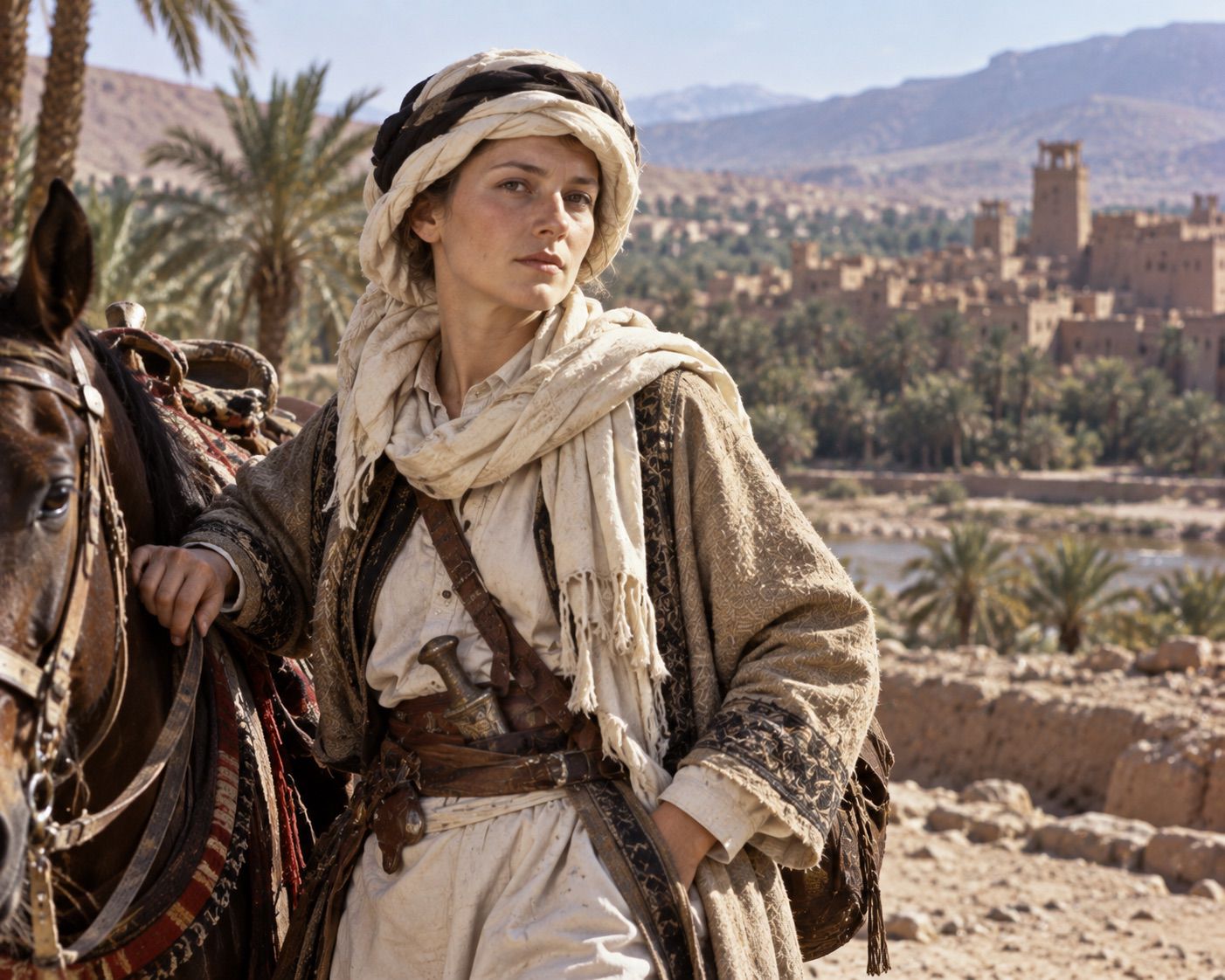
Isabelle Eberhardt’s life has been a persistent presence in my thoughts lately, like a gentle hum that refuses to fade into the background. I’ve found myself drawn to her story, again and again, as if searching for some hidden thread that ties me to her experiences.
What fascinates me most about Isabelle is the way she navigated multiple identities – French, German, Swiss, and Muslim – in a way that feels both authentic and calculated. She was born with a complicated legacy: her mother was a Swiss convert to Islam, and her father was a French diplomat. This cultural liminality must have made her feel like a puzzle piece that didn’t quite fit anywhere.
I identify with this sense of disorientation. As a 22-year-old who’s spent the last four years navigating college campuses, social media, and family expectations, I’ve struggled to define myself within the narrow confines of “who I’m supposed to be.” Isabelle’s story makes me wonder: can we ever truly choose our identities, or do they choose us? And what happens when those choices conflict with societal norms?
Isabelle’s conversion to Islam in her early 20s seems like a particularly striking example of this tension. She left behind the comforts and conventions of her European upbringing to immerse herself in Muslim culture, adopting Arabic as her primary language and dressing in traditional attire. It’s a choice that must have been both liberating and isolating.
I find myself questioning my own relationship with spirituality. Growing up, I was raised Catholic but never felt particularly connected to the faith. As an adult, I’ve experimented with different practices – meditation, yoga, mindfulness – but always seem to come back to the same doubts: is this just a way to calm my anxiety, or can it be something more?
Isabelle’s experiences in North Africa during World War I also resonate deeply with me. She traveled to Algeria as a correspondent for the Swiss newspaper Le Journal de Genève, where she witnessed firsthand the brutality of colonialism and the struggles of indigenous peoples. Her writing from this period is hauntingly beautiful, capturing the dissonance between European ideals and the harsh realities on the ground.
As I read her accounts of village life, desert landscapes, and Berber tribespeople, I’m struck by the way she saw the world – with a mix of wonder, curiosity, and skepticism. It’s as if she was constantly asking herself: what lies beneath the surface of this seemingly tranquil landscape? And what stories am I not hearing?
I think about my own experiences working in community development projects, where I’ve often felt like an outsider looking in. Isabelle’s writing has made me realize that even in those moments of discomfort or disorientation, there may be a deeper truth waiting to be uncovered.
But perhaps the most unsettling aspect of Isabelle’s story is her tragic fate – she died at 28 from a malaria-related illness, leaving behind a husband and child in Algeria. Her life was marked by both beauty and fragility, like so many of the people I’ve met who seem to be living on the periphery of society.
As I sit here, reflecting on Isabelle’s journey, I’m left with more questions than answers. What does it mean to truly belong? Can we ever fully reconcile our multiple identities? And what happens when the stories we tell ourselves about who we are collide with the harsh realities of the world around us?
For now, these questions remain suspended in the air, like a series of unresolved chords waiting for resolution. But I’m grateful to have Isabelle’s story as a reminder that even in uncertainty and disorientation, there is always the possibility of growth – and perhaps, just perhaps, a deeper understanding of ourselves and our place within the world.
As I delve deeper into Isabelle’s life, I find myself thinking about the tension between identity and expectation. She was born into a family of diplomats and travelers, but her choice to convert to Islam and immerse herself in North African culture seems like a deliberate rejection of that legacy. It’s as if she’s saying, “I know who my parents are, but I’m choosing to be someone else.”
This resonates with me because I’ve always felt like I’m caught between two worlds – the expectations of my family and the desires of my own heart. My parents want me to pursue a “stable” career, something that will provide a sense of security and continuity. But what does that even mean? Is it possible to be stable in a world that’s constantly changing?
Isabelle’s decision to leave behind her European upbringing and adopt a new identity feels like a bold statement against the conventional norms of her time. And yet, I’m not sure if she ever truly escaped those expectations. She was still a Westerner in Muslim dress, always an outsider looking in.
I wonder if this is why I’ve been drawn to Isabelle’s story – because it speaks to my own feelings of disconnection and disorientation. As someone who’s struggled to define herself within the narrow confines of college life and social media, I feel like I’m constantly searching for a sense of authenticity.
Isabelle’s writing from North Africa is hauntingly beautiful, but it’s also marked by a sense of melancholy and loss. She writes about the beauty of the desert landscapes, but also about the struggles of the people she meets – the poverty, the inequality, the crushing weight of colonialism.
This makes me think about my own experiences working in community development projects. I’ve seen firsthand the ways in which systemic inequalities can perpetuate poverty and marginalization. And yet, even in those moments of discomfort or disorientation, there’s always a glimmer of hope – a sense that we might be able to create something new, something different.
Isabelle’s story has made me realize that this is what drives me – the desire to create change, to challenge the status quo, and to find my place in a world that often feels overwhelming. But it’s also left me with more questions than answers – about identity, expectation, and the fragility of human life.
As I sit here, reflecting on Isabelle’s journey, I’m reminded that there are still so many mysteries waiting to be uncovered. What lies beneath the surface of our identities? Can we ever truly reconcile our multiple selves? And what happens when the stories we tell ourselves about who we are collide with the harsh realities of the world around us?
For now, these questions remain suspended in the air, like a series of unresolved chords waiting for resolution. But I’m grateful to have Isabelle’s story as a reminder that even in uncertainty and disorientation, there is always the possibility of growth – and perhaps, just perhaps, a deeper understanding of ourselves and our place within the world.
As I continue to explore Isabelle’s life, I find myself drawn to her relationships with women. She was known for her close friendships with other female travelers and writers, many of whom shared her passion for social justice and spiritual exploration. Their letters and diaries provide a glimpse into a world where women were free to roam, to experiment, and to challenge the conventions of their time.
I’m struck by how Isabelle’s relationships with women seem to be a source of both comfort and tension in her life. On one hand, she was drawn to women who shared her values and passions, and these friendships provided her with a sense of belonging and validation. On the other hand, I wonder if she ever felt constrained by societal expectations around female relationships – if she ever had to hide or downplay her feelings for women in order to avoid judgment or ridicule.
This makes me think about my own experiences as a woman navigating complex relationships and social norms. As someone who’s struggled with identity and self-expression, I often find myself wondering: what does it mean to be a woman in the 21st century? What are the limits of our freedom, and how can we push against those boundaries?
Isabelle’s story has given me permission to explore these questions more deeply. She was a woman who refused to be defined by the conventions of her time – who instead chose to follow her heart and pursue her passions with courage and conviction. And while I know that I’ll never be able to replicate her experiences or choices, I’m grateful for the example she sets: a reminder that women can be fierce, bold, and unapologetic in their pursuit of self-discovery and social justice.
As I reflect on Isabelle’s relationships with women, I’m also struck by how little we know about her personal life. We have accounts of her friendships and correspondence, but there are few details about her romantic relationships or intimate experiences. This lack of information creates a sense of mystery around her life – a reminder that even the most well-documented stories can be incomplete or ambiguous.
I find myself wondering: what secrets might Isabelle’s journals or letters hold? What untold stories might emerge if we were to uncover more about her personal relationships and desires? The mystery surrounding her life is both tantalizing and unsettling, leaving me with a sense of longing for more information – but also a deeper appreciation for the complexity and nuance of human experience.
The more I delve into Isabelle’s story, the more I’m struck by the contradictions that seem to define her life. She was a woman who craved connection and intimacy, yet often found herself isolated and alone. She was a convert to Islam, but also struggled with feelings of disorientation and cultural liminality. And she was a writer who poured her heart and soul onto the page, yet seemed to be haunted by the fragility of human life.
I think about my own experiences as a writer, and how often I find myself struggling to put words on paper. Isabelle’s writing is like a siren call to me – it’s beautiful, evocative, and hauntingly honest. And yet, when I try to write about my own experiences, I feel like I’m stumbling in the dark. What can I possibly say that will be worthy of her legacy?
As I continue to read about Isabelle’s life, I start to notice something else – a sense of impermanence and transience that seems to permeate every aspect of her story. She was always on the move, never staying in one place for too long. Her relationships were intense but fleeting, her passions burning brightly before they flickered out. And even her writing – those beautiful, evocative words – seem to be imbued with a sense of mortality and impermanence.
This resonates deeply with me because I’ve always felt like my own life is in flux. As someone who’s struggled to define herself within the narrow confines of college life and social media, I often feel like I’m drifting through life without a clear sense of purpose or direction. Isabelle’s story makes me realize that this feeling of impermanence may be a blessing in disguise – an opportunity to let go of expectations and attachments, and to see the world with fresh eyes.
As I sit here, reflecting on Isabelle’s journey, I’m struck by the realization that our lives are all just temporary, fleeting moments. We come into this world with nothing, and we leave it with nothing. The only thing that truly matters is how we live in between – how we choose to use our time, our talents, and our relationships.
Isabelle’s story has given me permission to see my own life as a work of art in progress – a constantly evolving, ever-changing tapestry of experiences and emotions. And while I still have no idea what the future holds, I’m grateful for the example she sets: a reminder that even in uncertainty and impermanence, there is always the possibility of growth, learning, and transformation.
As I close my eyes and let Isabelle’s story settle into my mind, I feel a sense of peace wash over me. It’s as if her life has become a part of mine – a thread that weaves together our shared experiences of identity, expectation, and uncertainty. And while I still have so many questions about who I am and where I belong, I’m grateful to have Isabelle’s story as a reminder that the journey itself is what truly matters – not some final destination or definition of self.