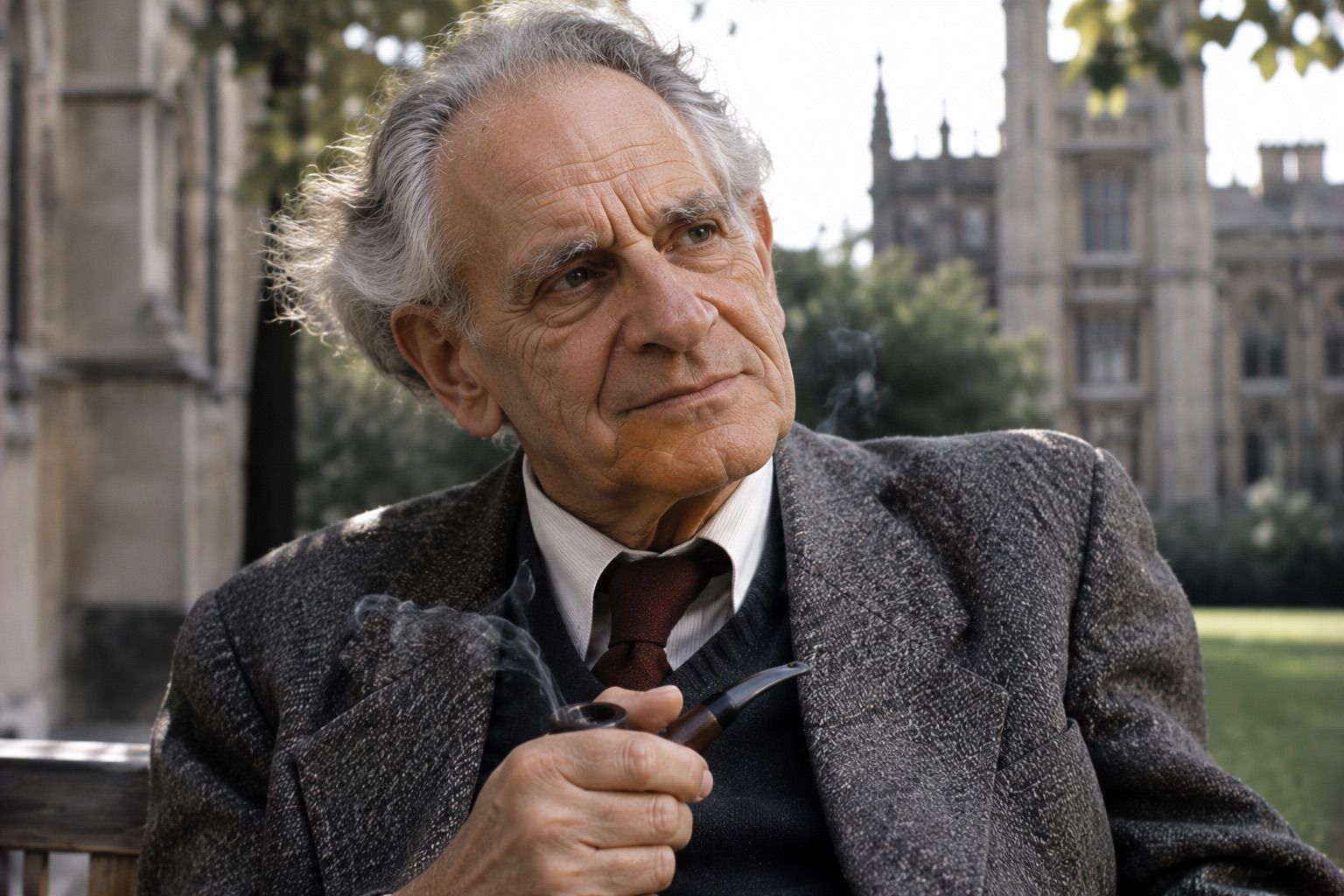
I’ve been thinking about Karl Popper lately, which is unfortunate because I was beginning to feel reasonably confident about a few things. Not important things, necessarily. Just the ordinary collection of opinions, assumptions, and carefully maintained convictions that allow a person to get through the day without questioning absolutely everything. Then along comes a philosopher who suggests that the most valuable thing about an idea might be our willingness to discover that it’s wrong. Naturally, I took this personally. I’ve spent a considerable portion of my life trying not to be wrong, and now I’m supposed to regard the possibility as something approaching an intellectual opportunity. It’s a rather irritating proposition, especially coming from a man who seems to have made an entire career out of questioning the foundations of certainty.
I encountered Popper during my philosophy studies, when his name appeared on reading lists with enough regularity that I began to suspect the professors were trying to tell us something. His work on scientific knowledge, particularly *The Logic of Scientific Discovery*, seemed straightforward enough at first. Science progresses by testing ideas, examining evidence, and correcting mistakes. That sounded perfectly sensible, almost reassuringly ordinary. Then I began reading more carefully and realized that Popper was challenging something I’d taken for granted: the assumption that accumulating enough supporting evidence could eventually establish a scientific theory as unquestionably true. Apparently, even a mountain of confirmation doesn’t provide the kind of certainty I’d been hoping for. There I was, expecting philosophy to help me understand the world, and instead it was politely dismantling my confidence in how understanding works.
Popper’s argument about falsifiability is both simple and maddeningly difficult to live with. A scientific theory, in his account, must expose itself to the possibility of being shown false by observation or experiment. If an explanation can accommodate absolutely every conceivable outcome, then it becomes difficult to test in any meaningful way. The familiar example involves swans. You might observe thousands of white swans and conclude that all swans are white, but discovering a single black swan would be enough to overturn that universal claim. I understand the logic perfectly well, although I can’t help feeling a little sorry for the person who spent years counting white swans before the inconvenient black one appeared. There’s something almost comically cruel about the arrangement. All that careful observation, all that confidence, and then one bird wanders into view and ruins everything.
What fascinated me wasn’t simply Popper’s argument about science, but the attitude toward knowledge that seemed to emerge from it. We don’t have to pretend that our explanations are infallible to take them seriously. We can construct theories, test them rigorously, and regard those that survive demanding tests as valuable without imagining that they’ve become immune to future criticism. That distinction matters because uncertainty is so often treated as a weakness, as though admitting the possibility of error somehow invalidates everything we’ve learned. Popper offers a different picture. Knowledge can grow precisely because we’re willing to expose our ideas to challenges rather than protect them from uncomfortable evidence. I find that wonderfully liberating in theory. In practice, I still become mildly offended when someone points out a mistake in something I’ve written, so clearly I have some work to do.
I’ve been noticing how frequently I search for confirmation in my own life. If I develop an opinion about something, I become remarkably skilled at finding examples that support it. A favorable review confirms that I have excellent taste. An unfavorable review suggests that the reviewer has misunderstood the subject entirely. If someone agrees with my interpretation of a book, I consider the conversation intellectually rewarding. If they disagree, my first instinct is sometimes to wonder whether they’ve actually read it properly. I don’t particularly enjoy admitting this, but intellectual honesty becomes rather less comfortable when it requires examining one’s own habits. Popper’s philosophy makes me wonder how often I approach a disagreement as an opportunity to learn and how often I approach it as a problem to be defeated.
The difficulty is that being wrong rarely feels like a purely intellectual event. We attach ourselves to our beliefs in ways that have very little to do with logic. An opinion can become part of how we understand our intelligence, our values, or our place in the world. When someone challenges it, we may hear something much more personal than a disagreement about evidence. We hear that our judgment is questionable, that our understanding is incomplete, or that the confidence we’ve carefully cultivated might be misplaced. I’ve caught myself defending an argument long after I’ve begun to suspect that the other person has a point, simply because admitting it would require an embarrassing retreat. Popper’s emphasis on criticism seems almost designed to expose this tendency. He asks us to separate the value of an idea from our emotional investment in being the person who proposed it, which is an excellent principle and an extraordinarily inconvenient one.
I find myself thinking about this whenever I write. There’s a particular moment in the writing process when a sentence begins to feel so elegant that I become reluctant to examine whether it actually says anything useful. It has rhythm, a pleasing arrangement of words, perhaps even a slightly impressive vocabulary. Surely something that sounds so convincing must be worth keeping. Unfortunately, a second reading often reveals that I’ve constructed a beautiful sentence around an argument that doesn’t quite exist. This is where Popper’s critical rationalism begins to feel unexpectedly relevant. Writing isn’t scientific experimentation, and a paragraph can’t be falsified in precisely the same way as a scientific hypothesis, but the willingness to challenge one’s own assumptions is useful in both activities. Sometimes the most productive thing I can do is ask whether the sentence I’m proudest of is also the one that’s preventing the rest of the piece from making sense.
There’s an odd relationship between creativity and criticism that I hadn’t appreciated before reading Popper. We often imagine creativity as something spontaneous and almost mysterious, a sudden burst of inspiration that arrives when the mind is sufficiently relaxed or the lighting is appropriately dramatic. I confess that I’ve occasionally encouraged this romantic image of writing, particularly when it provides a convenient explanation for why I’ve spent an entire afternoon staring at an unfinished paragraph. Popper’s account of knowledge gives imagination a more active role. New theories don’t emerge simply by collecting observations until an explanation assembles itself. Someone has to propose a possibility, make an imaginative leap, and offer an idea that can then be examined critically. The creative act and the critical examination aren’t enemies. They’re different parts of a process that allows understanding to develop.
This realization has changed the way I think about getting stuck. When a piece of writing refuses to cooperate, my usual response is to become increasingly determined to force it into the shape I originally imagined. I rearrange sentences, change a few adjectives, and convince myself that another cup of coffee will somehow resolve the underlying problem. Occasionally it does, although I suspect the coffee deserves less credit than I give it. More often, the difficulty is that I’ve become attached to an interpretation that no longer fits what I’m trying to say. The opening paragraph promises one thing, the argument has wandered somewhere else, and the conclusion is desperately attempting to pretend that everyone arrived at the same destination. Instead of asking how to preserve my original idea, I might be better served by asking what the writing has revealed about its limitations. That’s a less flattering question, but frequently a more useful one.
What I appreciate about Popper is that he doesn’t treat criticism as the opposite of intellectual commitment. He isn’t suggesting that we abandon every belief the moment someone raises an objection, or that all ideas deserve equal confidence simply because certainty is difficult. His approach demands that we take arguments seriously enough to test them, examine their consequences, and acknowledge when they fail. There’s a discipline involved that goes well beyond casually announcing that everyone is entitled to an opinion. Opinions are easy. I’ve accumulated quite a collection myself, some of which are supported by evidence and others by nothing more substantial than an instinctive dislike of being inconvenienced. The challenge is learning to distinguish between the two and being willing to revise the second category when the world refuses to cooperate.
I remember discussions in philosophy classes where we became so entangled in defining words like *truth*, *knowledge*, and *reality* that I occasionally forgot what question we’d been trying to answer. Someone would introduce a distinction, another person would challenge it, and before long we’d be debating the meaning of a term that had seemed perfectly ordinary twenty minutes earlier. At the time, I sometimes found the process exhausting. Surely there had to be a point at which we could agree on something and move forward. Looking back, I wonder whether my frustration came partly from expecting philosophy to provide the sort of closure that it was never designed to guarantee. Popper’s work suggests that intellectual progress doesn’t require us to eliminate every uncertainty before proceeding. It requires us to develop explanations that can withstand criticism while remaining open to correction. That sounds much more manageable, although I still reserve the right to become impatient when a discussion about one question somehow produces twelve more.
Of course, Popper’s philosophy isn’t beyond criticism, and I think that matters. His account of falsification has generated substantial debate, particularly because scientific theories aren’t always abandoned the moment an observation appears to contradict them. Experiments can be flawed, measurements can be mistaken, and theories often depend on additional assumptions that complicate the relationship between prediction and evidence. Scientists sometimes have good reasons to investigate an apparent contradiction rather than immediately discard an otherwise successful explanation. I find these objections interesting because they prevent Popper from becoming the very thing his philosophy warns against: an authority whose ideas are accepted without question. It would be a rather spectacular irony to defend critical rationalism by refusing to consider criticism of the man who developed it.
The more I think about this, the more I realize that intellectual humility isn’t the same thing as perpetual indecision. I’ve sometimes confused the two, as though being open-minded required me to hesitate indefinitely before forming a judgment. But uncertainty doesn’t mean refusing to choose. We make decisions with incomplete information all the time, and waiting for absolute certainty would leave most of us incapable of doing anything more ambitious than deciding what to have for breakfast. Even that can become complicated if I start questioning the nutritional assumptions behind my preferences. The point isn’t to eliminate conviction but to hold it in a way that leaves room for evidence, disagreement, and the possibility of change. I can believe something strongly while recognizing that I may eventually discover a reason to believe otherwise.
This distinction becomes especially important when I think about the world beyond books and classrooms. Public discussions often seem designed to reward confidence rather than careful reasoning. People are expected to have immediate opinions about complicated subjects, and changing one’s mind can be treated as evidence of weakness or inconsistency. There’s very little patience for someone who says they need more information, or who admits that an argument has caused them to reconsider a position. I find that atmosphere exhausting, partly because I recognize the temptation to participate in it. Certainty is attractive. It makes us sound decisive, protects us from awkward questions, and saves us the trouble of explaining the qualifications that accompany most thoughtful judgments. Popper’s philosophy reminds me that an unwillingness to reconsider an opinion isn’t necessarily evidence of intellectual strength. Sometimes it’s simply stubbornness dressed in respectable clothing.
His political philosophy adds another dimension to this problem. In *The Open Society and Its Enemies*, Popper argues against forms of political thinking that claim to possess privileged knowledge of history’s inevitable direction. He is deeply suspicious of systems that place themselves beyond criticism or demand that individuals submit to supposedly unquestionable historical truths. His defense of an open society rests partly on the importance of institutions that allow people to challenge authority, correct mistakes, and replace harmful policies without resorting to violence. I find that connection between intellectual humility and political freedom compelling. A society that acknowledges the possibility of error has a reason to protect criticism, while one that insists its leaders or doctrines cannot be wrong has a powerful incentive to silence disagreement. The implications are considerably more serious than my occasional reluctance to revise a paragraph.
What interests me most is that Popper’s approach doesn’t require us to believe human beings are naturally wise or consistently reasonable. Quite the opposite. We make mistakes, misunderstand evidence, become attached to bad explanations, and sometimes defend our assumptions with astonishing determination. The important question is whether we’ve created ways to recognize and correct those errors. In science, that means exposing theories to demanding tests and criticism. In public life, it means preserving opportunities for disagreement and institutional correction. In ordinary relationships, I suspect it begins with something much less grand: listening carefully when someone tells us we’ve misunderstood them. None of these activities guarantees that we’ll reach the right conclusion, but they make it less likely that we’ll remain comfortably trapped in the wrong one.
I’ve been trying to apply some of this to the way I respond to criticism, with mixed results. My first reaction to an unfavorable comment is still occasionally defensive, particularly when I’ve invested considerable effort in the thing being criticized. There’s a brief, undignified period during which I mentally assemble evidence that the other person has failed to appreciate my brilliance. Fortunately, this usually passes. Once I’ve recovered from the shock of discovering that my work isn’t universally admired, I can sometimes recognize that the criticism contains something useful. Not always, of course. Some criticism is careless, unfair, or simply mistaken, and being open-minded doesn’t require pretending otherwise. But the possibility that someone might see a weakness I’ve overlooked is worth taking seriously, even when acknowledging it bruises my pride.
I think this is where Popper has become unexpectedly personal for me. I began reading him as a philosopher concerned with scientific method, and somehow ended up examining my relationship with embarrassment, uncertainty, and the uncomfortable business of changing my mind. I hadn’t expected a discussion of falsifiability to make me reconsider the way I handle disagreement or revise my writing. Yet the connection feels increasingly difficult to ignore. Both activities require a willingness to distinguish between an idea and the person who holds it. If an argument fails, that doesn’t necessarily make its author foolish. If a piece of writing needs revision, that doesn’t mean the effort involved in producing it was wasted. Sometimes discovering what doesn’t work is precisely what allows us to find something better.
There’s a peculiar comfort in that thought. I’ve spent years treating mistakes as things to avoid, conceal, or explain away, as though they were embarrassing interruptions in an otherwise respectable intellectual life. Popper offers a more useful possibility: error is something we can learn to investigate. That doesn’t make being wrong pleasant, and I doubt I’ll ever reach the point where I greet every correction with genuine delight. I’m not applying for sainthood. But perhaps I can become less frightened of discovering that an assumption I’ve relied upon is mistaken. Perhaps I can approach disagreement with curiosity before defensiveness, or look at a failed argument as an opportunity to understand why it failed rather than as evidence that I should never have attempted it.
I’m also beginning to see that uncertainty can create room for imagination. When I stop insisting that my first interpretation must be correct, other possibilities become available. A character in a story might behave differently than I originally intended. An argument might develop in an unexpected direction. A question I thought I’d answered might turn out to be more interesting than the answer itself. None of this means abandoning structure or discipline. It means allowing ideas to be challenged before deciding they’ve reached their final form. I find that a surprisingly hopeful way of thinking about creativity, particularly on days when the blank page seems determined to demonstrate the limits of my intelligence.
There are still parts of Popper’s philosophy that leave me uncertain. I don’t know whether his account of scientific progress captures everything important about how scientists actually work, and I remain interested in the criticisms that later philosophers and historians of science have raised. But perhaps that uncertainty is a more appropriate response than the enthusiastic agreement I initially wanted to offer. I can admire his insistence on critical inquiry without accepting every aspect of his framework. I can find his arguments useful while recognizing their limitations. And I can allow those limitations to become part of the conversation rather than treating them as reasons to abandon it. For someone who has occasionally approached philosophy as though the objective were to discover which thinker was finally correct about everything, this feels like a modest but significant improvement.
What stays with me most is the possibility that intellectual confidence and intellectual humility don’t have to be enemies. We can pursue knowledge seriously, defend arguments we believe are sound, and make decisions based on the best evidence available while remaining willing to reconsider them. We don’t have to choose between absolute certainty and complete confusion. There is a difficult, imperfect middle ground where understanding develops through imagination, criticism, and revision. I suspect that’s where most meaningful thinking actually happens, even if it lacks the reassuring elegance of a final answer. It also happens to be where I spend a great deal of my time, although until recently I’d considered that more of a personal failing than a philosophical position.
I suppose that’s why Karl Popper has stayed with me. He hasn’t given me a reliable method for avoiding mistakes, and he’s certainly done nothing to improve my ability to accept criticism gracefully. What he has offered is a different way of thinking about the possibility of being wrong. Instead of treating uncertainty as something shameful that must be overcome before I can begin, I can recognize it as part of the reason inquiry matters in the first place. I can test my assumptions, listen to objections, and change my mind when the evidence demands it without imagining that every revision represents a defeat. I may never become entirely comfortable with that process, but perhaps comfort isn’t the point. The world is complicated, my understanding of it is incomplete, and I have a remarkable talent for becoming attached to explanations that later prove inadequate. At least now I have a philosopher reminding me that this needn’t be the end of the story.
And if I eventually discover that I’ve misunderstood Popper himself, I suppose the appropriate response would be to reconsider my interpretation, revise this essay, and carry on. I can’t promise I’ll do so without complaining. But I’m beginning to think that being willing to change my mind is considerably more valuable than being able to insist I was right all along.