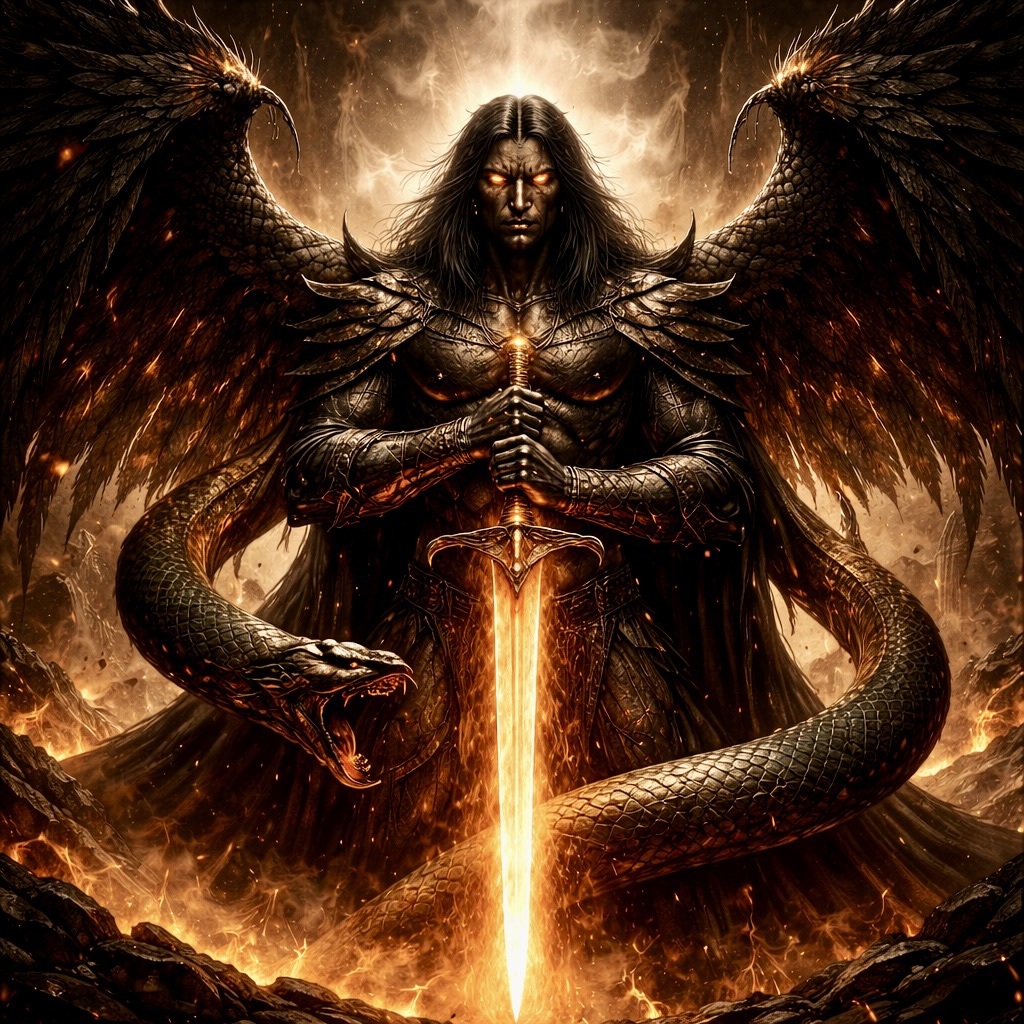
There are figures in demonology and mysticism who are easily categorized—beings of chaos, deception, or temptation whose roles fit neatly into the framework of good versus evil. And then there are figures like Samael, who resist such simple definitions. Samael is not merely a demon, nor is he purely an angel in the conventional sense. He exists in a space that is far more complex, a liminal zone where judgment, destruction, divine will, and necessary endings converge into a single, paradoxical identity.
His name is often translated as “Venom of God” or “Poison of God,” a title that immediately introduces tension. Poison, in most contexts, is something harmful, something to be avoided. Yet when paired with the divine, it suggests a force that is not random or malicious, but purposeful. It implies that even what is destructive may serve a role within a larger order.
Samael appears in various strands of Jewish mysticism, particularly within Kabbalistic tradition, where he is sometimes described as an angel of severity, a force associated with judgment and restriction. In other interpretations, he is linked to the Angel of Death, the being responsible for carrying out the end of life. In yet other traditions, he is associated with darker aspects of existence, sometimes even equated with adversarial or demonic roles.
This multiplicity of identities is not a contradiction. It is a reflection of his nature.
Samael is not one thing.
He is a function.
To understand him, we must move beyond the idea of fixed categories and instead look at processes—particularly the process of judgment and consequence.
Judgment, in its most basic form, is the act of evaluation. It determines outcomes based on actions, weighing cause and effect. In human terms, judgment can be moral, legal, or personal. It establishes boundaries, defines consequences, and maintains structure.
Without judgment, systems collapse.
Without consequence, actions lose meaning.
Samael represents this principle in its most uncompromising form.
He is not concerned with comfort or fairness in the human sense. He operates according to a framework that is absolute—one where actions lead to outcomes, where balance must be maintained, and where excess or imbalance is corrected.
This is where the concept of poison becomes significant.
Poison is often seen as destructive, but in controlled forms, it can also be medicinal. Many treatments in medicine involve substances that, in large quantities, would be harmful. The difference lies in application.
Samael embodies this duality.
He is the force that can harm, but also the force that corrects.
He is the element that introduces consequence into systems that might otherwise become unbalanced.
The serpent imagery frequently associated with him reinforces this idea. The serpent has long been a symbol of knowledge, transformation, and duality. It sheds its skin, renewing itself while remaining fundamentally the same. It is both feared and revered, representing danger and wisdom simultaneously.
In some traditions, Samael is linked to the serpent in the Garden of Eden, the figure that introduces knowledge to humanity. This connection is not universally accepted, but it highlights an important theme: the relationship between knowledge and consequence.
Knowledge changes behavior.
Behavior creates outcomes.
Outcomes require judgment.
Samael exists within this chain.
He is not the origin of action, nor is he the final result. He is the process that ensures the link between them remains intact.
From a philosophical perspective, Samael can be understood as the embodiment of necessary limitation. In any system, there must be boundaries. Without them, growth becomes uncontrolled, leading to instability.
Consider natural systems. Predators regulate populations, preventing overgrowth that could collapse ecosystems. Gravity limits movement, ensuring structure. Biological processes maintain balance through cycles of growth and decay.
Samael represents this limiting force.
He is not opposed to creation.
He ensures it does not exceed its bounds.
This role can be unsettling because it often manifests as loss, restriction, or endings. In human experience, these are rarely welcomed. People seek growth, expansion, and freedom. Limitations feel like obstacles.
Yet without them, systems fail.
Samael introduces those limitations.
He is the moment when expansion stops.
The point at which growth is evaluated.
The force that says, “This far, and no further.”
This makes him one of the most psychologically resonant figures in demonology and mysticism. His presence can be felt in moments of consequence—when actions lead to outcomes that cannot be avoided, when decisions result in change that cannot be undone.
These moments are often difficult, but they are also clarifying.
They reveal structure.
They show how systems operate.
Samael does not create these moments.
He enforces them.
His association with the Angel of Death further emphasizes this role. Death is the ultimate limitation—the boundary that defines life. It is not arbitrary. It is part of the structure of existence.
Without death, life would not have the same meaning. Time would lose its significance. Change would stagnate.
Samael, as a figure linked to death, represents this boundary.
He is not the cause of life ending in a random sense. He is the function that ensures the cycle continues.
This perspective aligns with many philosophical and spiritual traditions that view death not as an end, but as a transition.
Samael governs that transition.
He is the threshold.
The point where one state ends and another begins.
In Kabbalistic thought, Samael is sometimes associated with the concept of Gevurah—severity or judgment—one of the attributes of the divine structure. Gevurah represents discipline, strength, and the power to enforce boundaries.
Without Gevurah, there would be only expansion, only mercy, only growth without limitation.
Samael embodies this attribute.
He is the balancing force.
The counterpart to unchecked expansion.
This duality is essential. Systems require both growth and restriction, creation and destruction, mercy and judgment.
Samael ensures that balance is maintained.
From a modern perspective, his archetype can be seen in systems of accountability. Laws, regulations, and consequences exist to maintain order. They are not inherently negative. They provide structure.
Yet they can also feel restrictive.
This tension is central to human experience.
People seek freedom, but they also rely on structure.
Samael represents the structure.
He is the reminder that actions have consequences, that systems operate according to rules, and that balance must be preserved.
In literature, figures like Samael often appear as judges, enforcers, or guardians of thresholds. They are not antagonists in the traditional sense, but they are not allies either. They serve a function that transcends individual perspective.
They are impartial.
Samael fits this role perfectly.
He does not act out of emotion.
He acts out of necessity.
This makes him both formidable and essential.
In the end, Samael stands as one of the most complex and profound figures in demonology and mysticism. He is not easily understood because he does not fit into simple categories.
He is not purely destructive, nor purely constructive.
He is the force that ensures both exist in balance.
He is the boundary that defines possibility.
The judgment that clarifies action.
The poison that corrects imbalance.
And somewhere between life and death, between action and consequence, between growth and limitation—that is where Samael resides.
Not as a force to be feared alone, but as one to be recognized.
The one who ensures that everything has its weight—and its cost.