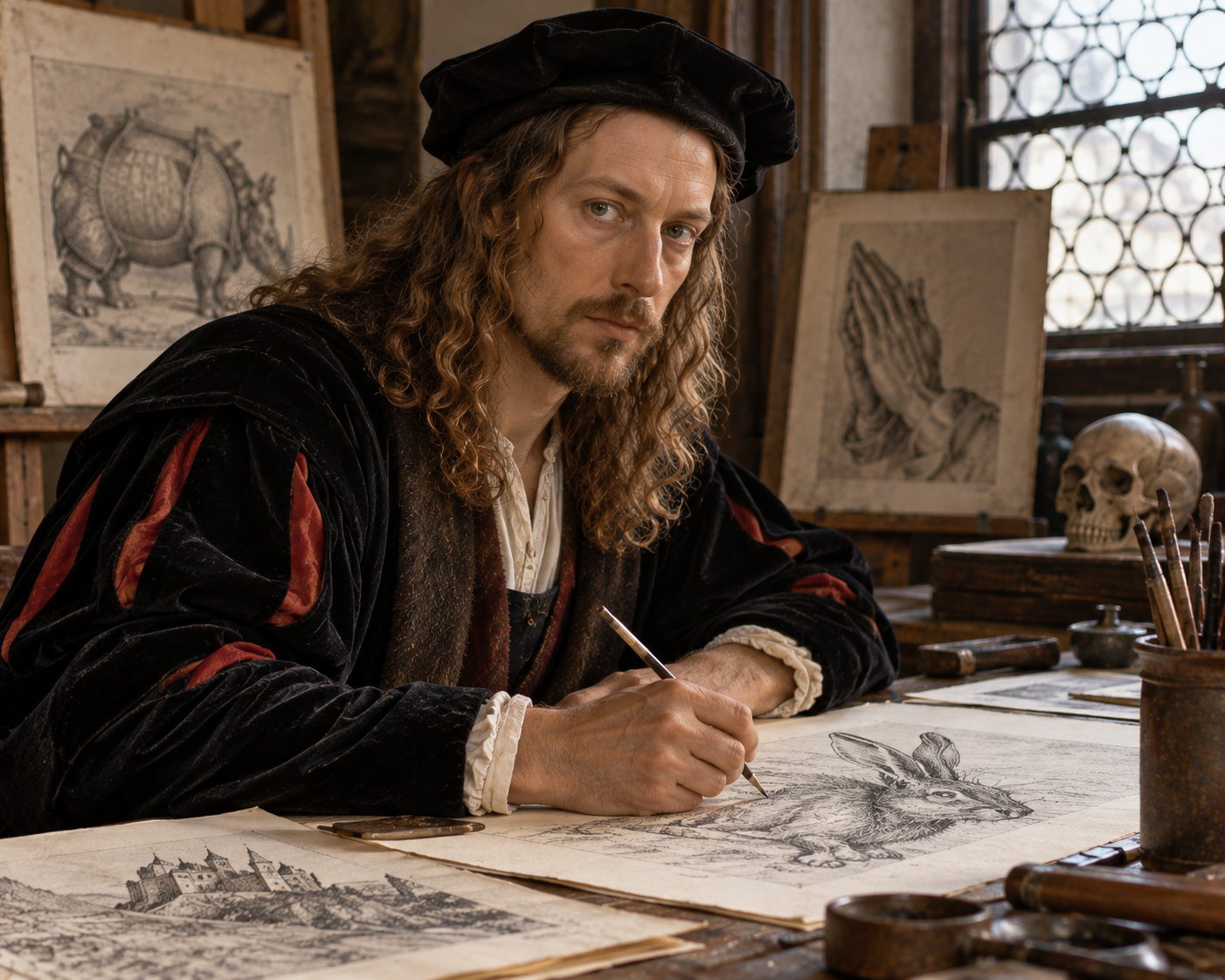
I’ve been thinking a lot about Albrecht Durer lately, ever since I stumbled upon his self-portraits in an art history textbook. There’s something about the intensity of his gaze that unsettles me – it’s as if he’s daring me to look away. At first, I felt like I was staring into a mirror, seeing myself reflected back at me with all my own insecurities and doubts.
As I delved deeper into Durer’s work, I started to notice the way he obsessively drew his hands, often rendering them in excruciating detail. It’s almost as if he’s trying to capture their inner workings, to understand the mechanics of creativity itself. His hands are a symbol of his craft, but also of his own fragility and mortality. He was an artist who suffered from anxiety and depression, and it shows in his work.
I’ve always been fascinated by artists who bare their souls on canvas (or, in Durer’s case, woodcuts and etchings). There’s a sense of vulnerability that comes with creating something so intensely personal, yet also leaving it open to interpretation. I think about my own writing, how it helps me process my thoughts and emotions, but also leaves me exposed and raw. Do I have the courage to be as honest as Durer was in his art?
One thing that strikes me is Durer’s fascination with geometry and proportion. He spent years studying the mathematical principles behind art, trying to understand the underlying order of the universe. It’s a quest for meaning that resonates deeply with me – I’ve always struggled with feeling like there’s something missing, some hidden pattern or code that I’m not seeing.
As I look at Durer’s work, I see fragments of my own search for purpose. His art is a reflection of his spiritual and intellectual pursuits, and it makes me wonder about the role of faith in creativity. Was he trying to capture the divine through his art, or was it simply a means to explore the human condition? For me, writing is often a way to connect with something greater than myself, but I’m not sure if that’s what Durer was after.
Sometimes, when I’m staring at one of Durer’s self-portraits, I feel like he’s judging me. Not in a harsh or critical way, but rather as an equal, someone who understands the struggles and complexities of being human. His art is a reminder that even the most brilliant minds are haunted by their own doubts and fears.
I find myself lost in Durer’s world, surrounded by his meticulous drawings and intricate woodcuts. It’s a place where logic and emotion coexist, where the rational and the irrational intersect. I’m drawn to this paradox because it speaks to my own experience as an artist – the tension between creating something beautiful and confronting the darkness within.
The more I look at Durer’s work, the more I see myself reflected back. It’s a strange feeling, like I’ve stumbled upon a part of myself that I never knew existed. And yet, in this mirrored gaze, I see the beauty of imperfection – the messiness of life, the uncertainty of art.
As I continue to immerse myself in Durer’s world, I find myself pondering the concept of perfection. His art is renowned for its precision and attention to detail, yet at the same time, it’s infused with an air of humanity – a sense that he’s not trying to create something flawless, but rather something authentic. This paradox speaks directly to my own creative struggles.
I’ve always felt like I’m striving for perfection in my writing, as if every word and sentence needs to be meticulously crafted to convey the depth of my emotions. But Durer’s work shows me that it’s okay to be imperfect, to leave a little room for error and uncertainty. His hands, with all their imperfections and flaws, are a testament to this idea.
This notion of embracing imperfection makes me think about my own self-perception. Growing up, I was always the type who felt like she needed to be perfect – grades, appearance, relationships. But Durer’s art tells me that it’s okay to be human, with all our quirks and flaws. It’s a liberating thought, one that makes me feel more at ease with myself.
I wonder if this is why I’m drawn to writing in the first place – because it allows me to express my imperfections in a way that feels authentic? When I write, I can let go of the need for perfection and simply be. It’s a feeling of freedom that I don’t always experience in other areas of my life.
As I delve deeper into Durer’s work, I’m struck by his use of symbolism. His art is full of hidden meanings and allusions, often referencing mythology and alchemy. This speaks to my own fascination with the symbolic language of dreams – how our subconscious mind uses symbols to convey complex emotions and ideas.
Durer’s use of symbolism makes me think about my own writing as a form of self-discovery. When I write, I’m not just putting words on paper; I’m also tapping into my own subconscious, allowing it to guide me towards new insights and understandings. It’s a process that feels almost meditative, like I’m unraveling a thread that’s been hidden beneath the surface.
In many ways, Durer’s art is a reflection of his own spiritual journey – a quest for meaning and understanding in a world that can often feel chaotic and overwhelming. As I look at his work, I see echoes of my own search for purpose, my own desire to connect with something greater than myself. And it makes me wonder – what lies beyond the surface level of our creations?
As I ponder Durer’s symbolism, I’m reminded of my own experiences with dreams and their ability to tap into the subconscious mind. I’ve always been fascinated by the way a single image or symbol can hold so much weight and meaning, often revealing hidden fears, desires, and motivations. It’s as if our minds are trying to communicate something fundamental about ourselves, but in a language that’s both personal and universal.
I think back to my own writing process, how I often find myself drawn to symbols and metaphors that seem to emerge from nowhere. A particular image or phrase will appear in my mind, and before I know it, I’m following its thread through the story, uncovering secrets and emotions that were hidden beneath the surface. It’s a process that feels both intuitive and instinctual, like my subconscious is guiding me towards something deeper and more meaningful.
Durer’s use of symbolism also makes me think about the role of intuition in art. He didn’t just draw what he saw; he drew what he felt, what he sensed, and what he intuited to be true. His art is a testament to the power of intuition, how it can guide us towards new insights and understandings that might not have been accessible through reason alone.
As I continue to explore Durer’s work, I’m struck by his attention to detail. Every line, every shape, every texture seems carefully considered, as if he’s trying to capture the essence of reality itself. And yet, beneath this precision lies a sense of freedom, a willingness to take risks and push boundaries in pursuit of something new and innovative.
This dichotomy between control and creativity resonates with me on a deep level. As a writer, I often find myself torn between the need for structure and the desire for spontaneity. Do I plan out every detail, or do I let the words flow freely? Durer’s art shows me that it’s possible to balance these opposing forces, to find a middle ground that allows for both precision and play.
As I look at his self-portraits, I’m struck by their sense of vulnerability. He’s not just drawing himself; he’s exposing his innermost thoughts and feelings, laying bare the very fabric of his being. It’s a level of honesty that I can only aspire to in my own writing, where I often feel like I’m hiding behind masks of words and narrative.
Durer’s art is a reminder that true creativity requires vulnerability, that we must be willing to take risks and expose ourselves in order to truly connect with others. And it’s this connection – between the artist and their audience, between the self and the external world – that speaks most deeply to me.
As I ponder Durer’s legacy, I’m left with more questions than answers. What lies beyond the surface level of our creations? How do we capture the essence of reality itself, without becoming mired in its complexities? And what is the true role of intuition in art, and how can we tap into it to create something truly original?
These questions haunt me still, as I continue to explore Durer’s world and mine own creative journey. But they’re also a reminder that art is never about finding answers; it’s about embracing the uncertainty, the messiness, and the beauty of the unknown.
As I delve deeper into Durer’s work, I find myself returning to the concept of imperfection. It’s as if his art has awakened a part of me that was previously dormant, a part that recognizes the beauty in the imperfect, the flawed, and the uncertain. I think about how my own writing often struggles with this same tension – between striving for perfection and embracing the imperfections that make life worth living.
Durer’s hands, with their intricate details and subtle flaws, have become a symbol of this paradox for me. His art is a testament to the idea that imperfection is not something to be hidden or ashamed of, but rather something to be celebrated. It’s as if he’s saying, “This is what it means to be human – to be messy, to be imperfect, and to be beautiful in spite of our flaws.”
As I look at his self-portraits, I see a man who is unafraid to show his vulnerabilities, his fears, and his doubts. He’s not trying to present a perfect image; he’s presenting himself as he truly is – complex, multifaceted, and full of contradictions. And it’s this honesty that resonates so deeply with me.
I wonder if Durer’s art would have been different if he had never experienced anxiety and depression. Would his hands still have been imperfect, or would they have been rendered with a precision that hid their true nature? I think about how my own writing is often shaped by my experiences, and how those experiences – both the joys and the struggles – inform my perspective and my creativity.
Durer’s art reminds me that imperfection is not just a personal trait; it’s also a universal one. Every human being has flaws, every relationship has its imperfections, and every work of art has its own unique set of limitations. And yet, it’s precisely these imperfections that make life worth living – the messiness, the complexity, and the beauty that arises from them.
As I ponder this idea further, I find myself thinking about the concept of “good enough.” It’s a phrase that my parents often used when I was growing up, as a way to encourage me to strive for excellence without becoming overly perfectionistic. But Durer’s art shows me that “good enough” is not just a practical solution; it’s also an artistic one.
When we create something with the intention of making it perfect, we often lose sight of its true purpose – which is to connect with others, to convey emotions and ideas, and to leave a mark on the world. But when we aim for “good enough,” we’re forced to confront our own limitations and imperfections, and to find beauty in their midst.
Durer’s art is a testament to this idea – that it’s not about creating something flawless, but rather something authentic, something honest, and something imperfect. And it’s this willingness to be vulnerable, to take risks, and to expose ourselves that makes his work so powerful, so relatable, and so human.