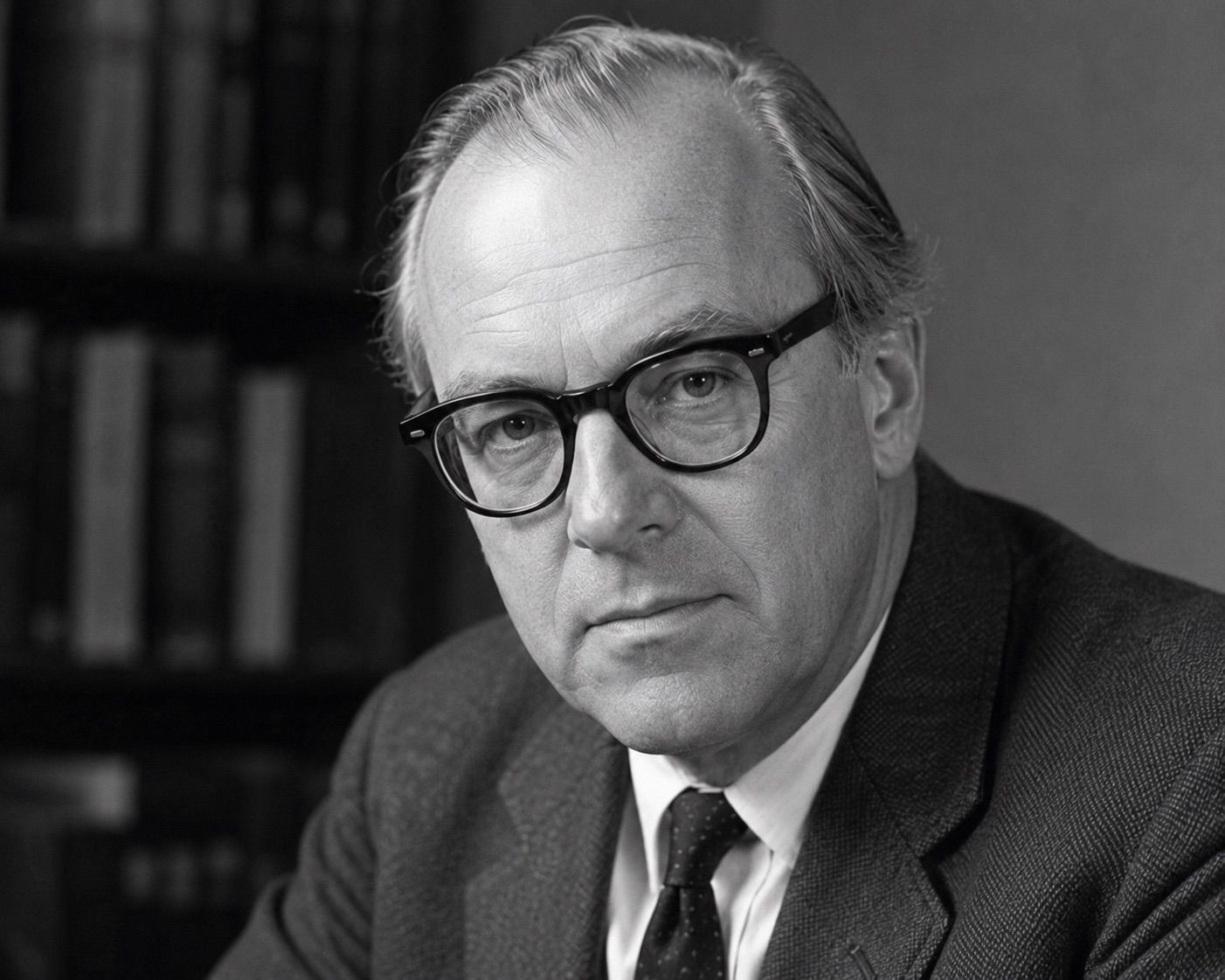
C.P. Snow – the man who coined the phrase “the two cultures,” a term that has stuck with me since I first stumbled upon it in my literature class. As I reflect on why he holds my attention, I find myself circling back to his complicated relationship with science and art.
I’ve always been drawn to writers who navigate the spaces between disciplines, like Snow did in his own work as a physicist-turned-novelist. His novels, such as “Strangers and Brothers,” explore the complexities of human relationships within the backdrop of scientific progress. It’s this intersection of worlds that fascinates me – the tension between the precise language of science and the ambiguous nature of art.
But what really gets my mind spinning is Snow’s 1959 Rede Lecture, where he famously argued for a divide between “the two cultures” of science and literature. As I read through it, I couldn’t help but feel a sense of discomfort with his assertion that these two modes of thought were mutually exclusive. It sounds arrogant, I know, but as someone who’s always struggled to define herself within academia, Snow’s words resonated on a deeply personal level.
I’ve spent my entire college career trying to reconcile the creative aspects of writing with the analytical rigor of science. My friends would often tease me about being “both” – an artist and a scientist – as if these two identities were somehow at odds. Snow’s lecture seemed to validate that sentiment, but it also made me wonder: was he right? Were art and science truly separate domains?
As I delve deeper into Snow’s work, I’m struck by the ways in which he struggled with his own identity as a writer. He came from a working-class background and had to fight for academic opportunities, which is something I can relate to, having grown up in a lower-middle-class family myself. There’s a sense of dislocation that pervades his writing – a feeling of being an outsider looking in on the rarefied world of academia.
It’s this aspect of Snow’s life and work that speaks to me most. He’s not just a figurehead for the divide between science and art; he’s a human being who grappled with the same insecurities and doubts that I do. And yet, his writing remains resolutely optimistic – a testament to the power of creativity and imagination in bridging those gaps.
As I continue to think about Snow, I find myself questioning my own reactions. Am I romanticizing his struggles? Is it naive of me to believe that art and science can coexist in harmony? And what does it even mean for a person like me – someone who’s still figuring out her place within the world – to occupy this space between cultures?
These questions swirl around me, refusing to settle into neat answers. Snow’s legacy is complex, and his work continues to challenge me on multiple levels. It’s precisely this discomfort that keeps me engaged with him – a sense that there are still mysteries waiting to be unraveled, still bridges to be built between the two cultures he once divided.
I find myself getting lost in Snow’s own struggles with identity and belonging. He writes about feeling like an outsider among his peers at Cambridge, struggling to reconcile his working-class roots with the aristocratic atmosphere of the university. I see echoes of this in my own experiences navigating the academic world – the feeling of being a fish out of water, of constantly wondering if I truly belong.
But what’s fascinating is how Snow’s writing suggests that this sense of dislocation can be a strength, rather than a weakness. He argues that artists and scientists must learn to communicate across cultural divides, to translate their ideas into languages that others can understand. This resonates deeply with me, as someone who has always struggled to articulate my own identity.
I remember feeling like I was caught between two worlds in college – the world of creative writing, where I felt most at home, and the world of science and math, where I excelled academically. My friends would tell me that I was “too artsy” for the science crowd, or “not technical enough” for the writers’ group. Snow’s work suggests that this kind of compartmentalization is precisely what’s holding us back – that by embracing our contradictions and imperfections, we can create something new and beautiful.
As I continue to read Snow’s novels and essays, I’m struck by his emphasis on the importance of storytelling in bridging cultural divides. He writes about how science and art are not just separate disciplines, but also different languages – and that the best way to communicate across these divides is through stories. This idea has me thinking about my own writing, about how I can use language to connect with others who may not share my background or experiences.
But there’s still a part of me that feels uncertain about Snow’s legacy. Is he perpetuating a false dichotomy between science and art, or does his work genuinely offer a way forward? And what does it mean for someone like me – someone who is still figuring out her place in the world – to occupy this space between cultures?
These questions linger, refusing to be answered. But as I continue to grapple with Snow’s ideas, I’m reminded of why I started writing about him in the first place: because his work challenges me to think more deeply about my own identity and purpose. And that, for now, is enough.
As I delve deeper into Snow’s world, I find myself wondering if he would have appreciated the way technology has changed the way we communicate across cultural divides. Social media, online platforms, and digital tools have made it possible to share ideas and stories with people from all walks of life in ways that were previously unimaginable. But at the same time, I worry that these tools have also created new barriers, new silos, and new ways for us to isolate ourselves within our own little bubbles.
Snow’s emphasis on storytelling as a way to bridge cultural divides resonates deeply with me, but it also makes me think about the limitations of language. Can stories truly transcend the boundaries of science and art, or are they ultimately bound by their own cultural contexts? And what about people who don’t have access to these platforms, who don’t have the words or the means to express themselves?
These questions make me feel like I’m stuck in a loop, caught between the optimism of Snow’s message and the complexity of the real world. But they also remind me that this is precisely why I find his work so compelling – because it challenges me to think critically about the world around me, and to question my own assumptions.
As I continue to read Snow’s essays and novels, I’m struck by the way he weaves together seemingly disparate threads – science, art, politics, history. It’s as if he’s trying to create a tapestry that encompasses all of human experience, one that shows us how these different worlds are interconnected, even when they seem like separate domains.
For me, this is both exhilarating and overwhelming. Exhilarating because it suggests that there’s no need to choose between science and art, or between reason and emotion – that we can explore the full range of human experience without being tied down by artificial boundaries. Overwhelming because it implies that we have to be experts in multiple fields at once, that we have to have a comprehensive understanding of everything.
I’m not sure if Snow would agree with this interpretation, but I think he would appreciate my curiosity and my willingness to explore these questions. And as I continue to grapple with his ideas, I find myself drawn back to the core of what’s been driving me all along: the desire to understand how art and science can coexist in harmony, and how we can use language to bridge the gaps between our different worlds.
For now, this remains a mystery that I’m eager to unravel – one that involves exploring the complexities of Snow’s work, but also my own identity and purpose. As I write these words, I feel like I’m just starting to scratch the surface of what it means to be someone who inhabits multiple cultures, multiple disciplines, and multiple worlds at once. And that, for me, is a journey worth taking.
As I continue to ponder Snow’s ideas about art and science, I find myself wondering if his notion of the “two cultures” was more of a reflection of his own experiences than a universal truth. Did he genuinely believe that these two modes of thought were mutually exclusive, or was it simply a way for him to articulate his own feelings of dislocation within academia? And what about the ways in which his work challenges this idea – isn’t it precisely through his novels and essays that he shows us how art and science can intersect and inform one another?
I think back to my own experiences as an undergraduate, struggling to balance my creative writing coursework with my science-heavy major. My friends would often joke that I was “splitting myself in two” by pursuing both interests simultaneously, but Snow’s work suggests that this kind of compartmentalization is precisely what’s holding us back. By embracing our contradictions and imperfections, we can create something new and beautiful.
But there’s still a part of me that feels uncertain about the implications of Snow’s ideas. Is he advocating for a more holistic approach to education, one that integrates art and science in a way that’s more authentic and relevant to students’ lives? Or is he simply suggesting that we should be more aware of the cultural contexts within which our knowledge is produced?
As I read through his essays and novels, I’m struck by the ways in which Snow writes about the importance of narrative in bridging cultural divides. He argues that stories have the power to convey complex scientific ideas in a way that’s accessible and engaging for a broader audience – but he also acknowledges the limitations of language, the ways in which our words and images can be interpreted and misinterpreted.
This raises questions about the role of storytelling in today’s digital age. With social media platforms and online communities, we have more opportunities than ever before to share our stories and connect with others who may not share our backgrounds or experiences. But does this also create new barriers – new ways for us to isolate ourselves within our own little bubbles, and to ignore the complexities of the world around us?
Snow’s work doesn’t offer easy answers to these questions, but it does encourage me to think more critically about the role of storytelling in bridging cultural divides. As someone who’s still figuring out her place in the world, I find myself drawn to his optimism – his belief that art and science can coexist in harmony, and that language has the power to connect us across our differences.
But there are also moments when Snow’s writing feels more nuanced, more ambivalent. He writes about the ways in which scientific progress can be both liberating and oppressive – how it can empower us to make new discoveries, but also marginalize those who don’t have access to these same tools and technologies.
I’m struck by the parallels between Snow’s concerns and my own experiences growing up as a woman of color. How do I navigate the complexities of language and culture, when I’m constantly being asked to conform to norms that don’t fully reflect my identity? And what about the ways in which science and technology can be used to reinforce existing power structures – to marginalize certain groups and privilege others?
These questions make me feel like I’m caught between two worlds – the world of art and imagination, where Snow’s work has inspired me to think more creatively and critically; and the world of science and reason, where his ideas about narrative and storytelling have challenged me to engage with complex issues in a more nuanced way.
As I continue to grapple with these questions, I’m reminded that Snow’s legacy is not just about his ideas – but also about the ways in which he embodied those ideas through his life and work. He was a writer who bridged cultural divides, who used language to connect with others across their differences; but he was also someone who struggled with his own identity, who felt like an outsider looking in on the rarefied world of academia.
In many ways, Snow’s story is my own – a story about finding my place within multiple worlds and disciplines, and about using language to bridge the gaps between them. And as I continue to explore these questions, I’m reminded that his work remains a powerful reminder of the importance of imagination and creativity in shaping our understanding of the world around us.