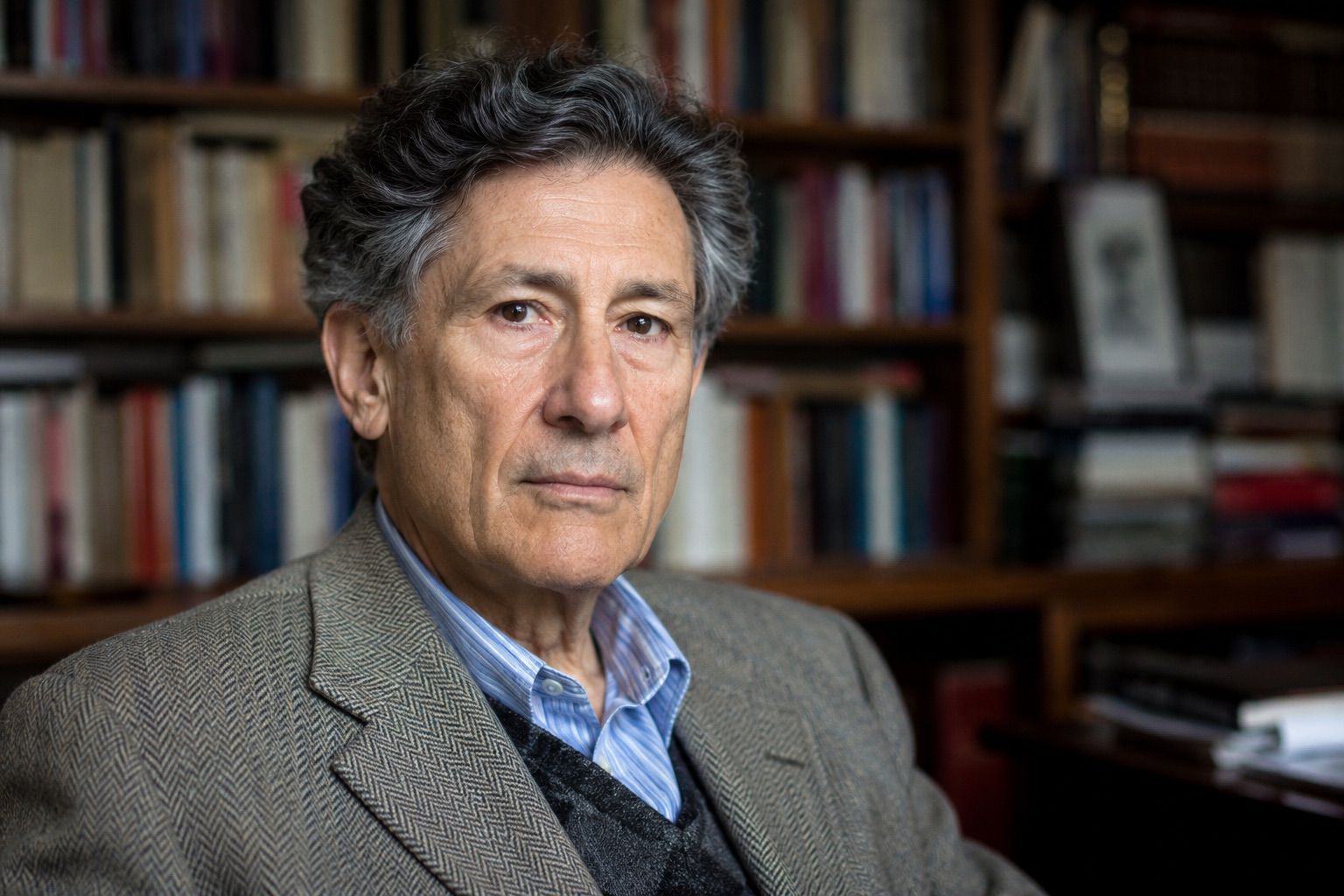
Edward Said. I’ve been reading his work for years, but it wasn’t until I stumbled upon a collection of his essays that I felt like I was finally grasping what drew me to him. It’s not just the way he writes about politics and culture – it’s the sense of restlessness that permeates everything he says.
As someone who’s struggled with feeling stuck in my own life, I find myself drawn to Said’s frustration with being caught between different worlds. He was a Palestinian living in America, a Christian raised by Muslim parents, a critic of imperialism who also benefited from its privileges. It’s a sense of dislocation that feels deeply familiar.
I remember reading his essay “Travelling Theory” and feeling like he was speaking directly to me about the ways in which ideas get lost or distorted as they move through different cultures and contexts. I’ve had similar experiences trying to navigate the gaps between my own cultural heritage and the dominant culture around me – the sense of being caught in a perpetual state of translation.
What’s interesting to me is that Said’s writing doesn’t offer any easy answers or solutions. He’s not a tidy thinker, and his work is often marked by contradictions and paradoxes. I think that’s part of what draws me to him – he’s willing to confront the messiness of human experience in all its complexity.
Take, for example, his book “Orientalism”. On one level, it’s a scathing critique of Western imperialism and its racist stereotypes about the Middle East. But on another level, it’s also a deeply personal exploration of his own identity as a Palestinian living in America. He’s not just writing about colonialism; he’s writing about how it has shaped him.
Reading Said makes me uncomfortable because it forces me to confront my own complicity in systems of power that I don’t fully understand. It’s easy to dismiss imperialism or Orientalism as abstract concepts, but when you’re reading someone like Said who’s lived through the consequences of these systems, it becomes a lot harder to look away.
One thing that’s struck me about Said is his commitment to thinking critically about his own positionality. He’s not afraid to acknowledge the ways in which he benefits from privilege or to question his own assumptions. It’s a quality that I admire, but also find challenging – because when you start to examine your own biases and privileges, it can be a really uncomfortable process.
I’ve been reading Said for years now, and yet I still feel like I’m only scratching the surface of what he has to offer. There are so many angles and perspectives to explore – his work on culture and identity, his critique of liberal humanism, his engagement with postcolonial theory… it’s a vast landscape that I’ve barely begun to map.
For now, though, I’m content to keep reading, to keep trying to grasp the complexity of Said’s thought. It’s a process that feels like navigating a labyrinth – sometimes you get lost, but other times you stumble upon something new and unexpected. And that’s what draws me to him: the sense that there’s always more to explore, more to learn.
As I continue to delve into Said’s work, I’m struck by the way he blurs the lines between theory and autobiography. It’s as if he’s convinced that the personal is not only political but also philosophical. He’s not afraid to bring his own experiences into the fold of his arguments, which makes his writing feel both intimate and intellectually rigorous.
I think about my own struggles with writing about identity, particularly when it comes to my cultural heritage. I’ve often felt like I’m caught between different worlds, just like Said was. My parents are immigrants from South America, but they raised me in the United States, so I’ve always navigated a cultural space that’s both familiar and foreign.
When I write about these experiences, I find myself drawn to metaphors and analogies – trying to capture the essence of what it feels like to be caught between cultures. But Said’s approach is different; he doesn’t rely on metaphor or abstraction. Instead, he plunges headfirst into the complexities of his own identity, using his experiences as a lens through which to examine the world around him.
This is both liberating and intimidating for me. On one hand, I admire the way Said embodies his ideas – it’s as if he’s lived them in every cell of his body. On the other hand, it makes me wonder: can I ever hope to achieve a similar level of honesty and self-awareness in my own writing? Or will I always be stuck in a state of approximation, trying to capture the essence of something that’s inherently elusive?
I think about this as I read through Said’s essays on culture and identity. He writes about the ways in which cultural narratives are constructed and reinforced – how they can both liberate and oppress us at the same time. It’s a dizzying topic, but one that feels crucial to understanding our world today.
As I navigate these ideas, I’m struck by the way Said’s thought keeps shifting and evolving. He’s not afraid to contradict himself or challenge his own assumptions – it’s as if he’s convinced that the only way to stay true to his convictions is to constantly question them.
This sense of intellectual humility is something that I aspire to in my own writing, but it’s also a daunting prospect. What would happen if I started to doubt everything I thought I knew? Would I lose my voice, or find it?
I’m fascinated by the way Said’s work continues to unfold like a palimpsest – with new layers and meanings emerging as I delve deeper into his ideas. His writing is like a map, leading me through the labyrinth of human experience, but also constantly shifting its own terrain.
One thing that strikes me about Said’s approach is his willingness to engage with the contradictions and paradoxes of human existence. He doesn’t shy away from the messy, incoherent aspects of reality – instead, he leans into them, using them as a starting point for exploration. This is something I’ve struggled with in my own writing, often feeling like I need to tie everything up with a neat bow or else risk being accused of being ambiguous or unclear.
But Said’s work shows me that complexity and ambiguity can be strengths, not weaknesses. He’s not afraid to confront the fact that human experience is messy, contradictory, and multifaceted – and that our attempts to understand it will always be imperfect.
I think about my own writing, particularly when I’m trying to capture the nuances of cultural identity or the experiences of marginalized communities. I often feel like I’m caught between the desire to simplify complex issues for clarity’s sake and the need to honor the messiness and particularity of those experiences.
Said’s work offers a way out of this impasse – by embracing complexity, ambiguity, and paradox as fundamental aspects of human existence. He shows me that it’s okay to be unsure, to question my assumptions, and to engage with the contradictions of human experience head-on.
But this also raises questions for me about the role of the writer in capturing these complexities. Can I ever truly represent the experiences of others? Or will I always be caught in a web of cultural and personal biases that shape my perceptions?
Said’s writing doesn’t offer easy answers to these questions, but it does provide a model for how to engage with them in a thoughtful, nuanced way. He’s not afraid to confront his own limitations as a writer – or the ways in which his privilege and positionality might shape his perspective.
This is something that I find deeply liberating, because it suggests that writing isn’t about finding some objective truth or definitive answer – but rather about engaging with the complexities and uncertainties of human experience. It’s an ongoing process, one that requires humility, self-awareness, and a willingness to question everything.
As I delve deeper into Said’s work, I’m struck by the way he weaves together disparate threads – politics, culture, identity, history – into a rich tapestry of ideas. It’s as if he’s trying to capture the complexity of human experience in all its messy, contradictory glory.
I think about my own attempts at writing about identity and culture, and how often I feel like I’m reducing these complex issues to simplistic soundbites or easy answers. Said’s work shows me that this is a cop-out – that true understanding requires engaging with the nuances, contradictions, and paradoxes of human existence.
One thing that strikes me about Said’s approach is his commitment to thinking historically. He doesn’t just analyze contemporary issues; he situates them within a broader historical context, revealing the ways in which power structures, cultural norms, and social attitudes have evolved over time.
This perspective is both fascinating and intimidating for me. As someone who’s struggled with feeling stuck in my own life, I often find myself getting caught up in the present moment – fixated on immediate problems or concerns. But Said’s work shows me that understanding these issues requires a longer view – one that takes into account the ways in which historical forces have shaped our world.
I think about my own cultural heritage and how it intersects with my experiences as an American living in the United States. My parents’ immigration story is one of resilience and hard work, but also of loss and displacement. Said’s work on exile and diaspora resonates deeply with me – he shows me that these experiences are not unique to individuals, but rather part of a broader cultural narrative.
As I continue to read through Said’s essays, I’m struck by the way he uses his own life as a lens through which to examine the world. He’s not afraid to bring his personal experiences into the fold of his arguments – and this makes his writing feel both deeply relatable and intellectually rigorous.
I think about my own struggles with writing about identity and culture, and how often I feel like I’m caught between different worlds. Said’s work shows me that this is a universal experience – one that transcends cultural or national boundaries. He reminds me that our individual experiences are not isolated events, but rather part of a broader web of connections and relationships.
One thing that’s struck me about Said’s approach is his willingness to engage with the complexities of power and privilege. He doesn’t shy away from examining his own positionality as a Palestinian living in America – or the ways in which this has shaped his perspective on the world.
This sense of intellectual humility is something that I aspire to in my own writing, but it’s also a daunting prospect. What would happen if I started to examine my own biases and privileges? Would I lose my voice, or find it?
I think about the way Said’s work continues to unfold like a palimpsest – with new layers and meanings emerging as I delve deeper into his ideas. His writing is like a map, leading me through the labyrinth of human experience, but also constantly shifting its own terrain.
As I navigate these complexities, I’m struck by the sense that Said’s work is not just about ideas – but about relationships. He’s not just writing about culture and identity; he’s writing about how these concepts intersect with our lives as individuals, communities, and societies.
This perspective raises questions for me about the role of the writer in capturing these complexities. Can I ever truly represent the experiences of others? Or will I always be caught in a web of cultural and personal biases that shape my perceptions?
Said’s work doesn’t offer easy answers to these questions, but it does provide a model for how to engage with them in a thoughtful, nuanced way. He shows me that writing is not about finding some objective truth or definitive answer – but rather about engaging with the complexities and uncertainties of human experience.
As I continue to read through Said’s essays, I’m struck by the sense that his work is not just about understanding the world – but about creating a new one. He’s not just a critic; he’s a writer who seeks to transform our perceptions, challenge our assumptions, and imagine new possibilities for human connection and understanding.
This is both exhilarating and terrifying for me. As someone who writes about identity and culture, I often feel like I’m caught between the desire to simplify complex issues for clarity’s sake and the need to honor the messiness and particularity of those experiences. Said’s work shows me that this tension is not something to be resolved – but rather something to be acknowledged and engaged with.
As I navigate these complexities, I’m reminded of the words of the poet Adrienne Rich: “The question isn’t who is going to let me; it’s who is going to stop me.” Said’s work shows me that writing is not just about capturing the world – but about creating a new one.