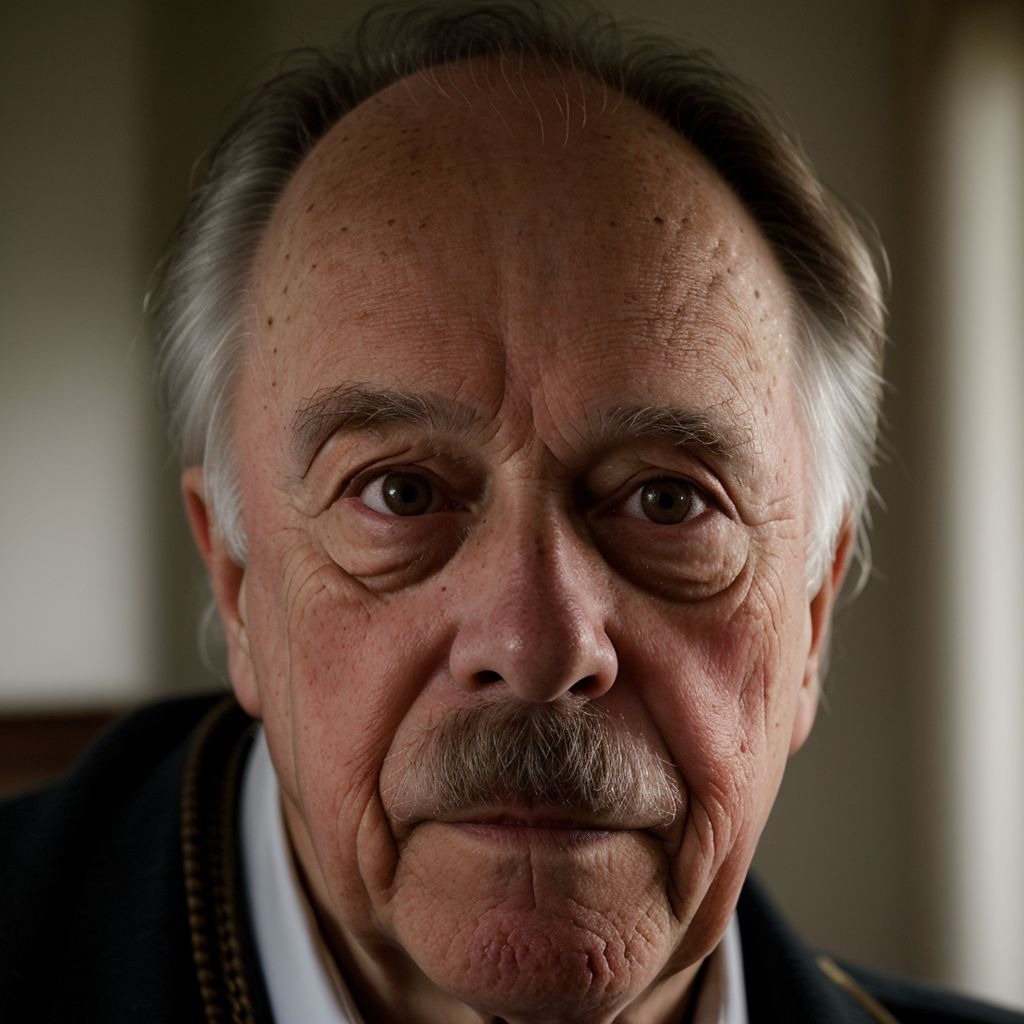
W.G. Sebald. I’ve spent countless hours reading his words, trying to untangle the threads of his writing. His prose is a labyrinth, and I’m still not sure I know my way out. At first, it was the odd structure that drew me in – the fragments, the anecdotes, the digressions. It felt like he was writing from a different planet, one where time and space didn’t quite work as they did on mine.
I remember feeling frustrated at first. His sentences seemed to twist and turn, making it hard to follow his train of thought. I’d read the same paragraph three times, trying to decipher what he meant. But then something would click – a phrase would leap out, or an image would settle into place – and I’d feel like I was seeing the world through new eyes.
I think that’s one of the things I love about Sebald: his willingness to be uncertain. He writes about the unknown with such conviction, as if uncertainty is a doorway rather than a dead end. His characters are often lost or searching, and yet they’re also fully alive. They have histories, desires, and fears that refuse to be pinned down.
As I read through his works – _The Rings of Saturn_, _Austerlitz_, _Vertigo_ – I started to notice something strange. He seems to be obsessed with the concept of “elsewhere.” Not just physically elsewhere (he loves walking, and his walks often take him far from home), but also emotionally, psychologically. His characters are always looking for a way out of their own lives, into some other realm where they can find meaning or escape.
This resonates with me, I think because I’ve spent so much of my own life feeling adrift. College was meant to be this defining experience, and yet it ended up feeling like a prolonged exercise in uncertainty. What did I want to do? Where did I want to go? The questions swirled around me like a maelstrom, making it hard to think straight.
Reading Sebald’s words has been like talking to an old friend who gets it – who understands that the unknown can be both thrilling and terrifying. He doesn’t offer easy answers or solutions; instead, he lingers in the ambiguities, exploring the ways they can shape us. I find myself wanting to walk alongside his characters, to see where their journeys take them.
But there’s also something unsettling about Sebald’s writing – a sense of foreboding that lurks beneath the surface. His stories often have an elegiac quality, as if they’re mourning the loss of something irreplaceable. I think this is part of why his books feel so immersive: we’re drawn into a world where time is running out, and every moment counts.
As I delve deeper into Sebald’s work, I’m starting to realize that it’s not just about the stories themselves – it’s about the spaces between them, too. The silences, the pauses, the moments when he seems to be looking directly at me (or maybe just himself?). It’s as if he’s trying to convey something essential about being human: that our experiences are always fragmented, that we’re constantly searching for meaning in the midst of chaos.
I’m not sure I fully grasp what Sebald is trying to tell me – or even if it’s possible to grasp it. But I do know this: his writing has become a kind of anchor for me, a reminder that uncertainty can be a doorway rather than a prison.
As I continue to read and reread Sebald’s work, I find myself drawn to the way he weaves together fragments of history, literature, and personal narrative. His books are like palimpsests, with layers of meaning that can be peeled back and reinterpreted. It’s as if he’s saying that our understanding of the world is always provisional, always subject to revision.
I think this is why his writing feels so relevant to me right now. As I navigate the post-college wilderness – a place where many of us find ourselves lost and uncertain about what comes next – Sebald’s words offer a sense of comfort and companionship. He reminds me that it’s okay not to have all the answers, that uncertainty can be a catalyst for growth rather than a source of anxiety.
But there’s also something unsettling about this acceptance of uncertainty. It feels like a kind of surrender, as if we’re acknowledging that our attempts to control or understand the world are ultimately futile. And yet…and yet, I think that’s exactly what Sebald is trying to show us: that it’s in embracing the unknown, rather than fighting against it, that we might discover new depths of meaning and connection.
I’m starting to wonder if this is why his books often feel so melancholic – not just because they’re mourning lost things or people, but because they’re acknowledging the impermanence of everything. That our experiences, our memories, our relationships: all these things are fragile, ephemeral, subject to erasure or forgetting.
It’s a disorienting thought, and one that makes me feel like I’m standing on shifting sands. But it’s also…liberating? Maybe that’s the wrong word – it’s more like a feeling of release, as if I’ve been holding my breath for so long that I’ve forgotten how to exhale.
I look back at Sebald’s writing and see him walking along the coast of Suffolk, lost in thought, his eyes scanning the horizon. And I feel like I’m right there with him – not just because we’re sharing a similar experience, but because he’s captured something fundamental about being human: our tendency to drift, to wander, to search for meaning in the midst of uncertainty.
As I continue to walk alongside Sebald’s characters, I start to notice that their searches are often driven by a sense of disconnection – from themselves, from others, from the world around them. They’re like ships without anchors, drifting on the tides of memory and experience. And yet, even in their disconnection, they find moments of connection: with nature, with art, with the past.
I think this is what I love most about Sebald’s writing: it shows me that connection can be found in the most unlikely places – in the silence between words, in the cracks between stones, in the faded photographs of strangers. It’s as if he’s saying that even in the midst of disconnection, there’s always a chance for something to bloom.
But what does this mean for me, now that I’m standing at the edge of my own post-college wilderness? Am I searching for connection in all the wrong places – in social media likes and follows, in fleeting relationships and superficial conversations? Or am I truly seeking out the kind of connections that Sebald writes about: the deep, abiding ones that come from shared experience, from listening to each other’s stories?
I’m not sure. All I know is that Sebald’s writing has given me a new way of seeing – or rather, a new way of feeling – about the world and my place in it. It’s like he’s shown me that even when everything feels fragmented and uncertain, there’s still beauty to be found in the spaces between.
As I look out at the horizon, I feel a sense of longing – not just for some distant place or experience, but for the feeling itself: the feeling of being adrift on the tides of uncertainty, with no anchor to hold onto except my own curiosity and wonder. It’s a strange kind of freedom, one that both exhilarates and terrifies me.
But maybe that’s exactly what Sebald is trying to show us – that this feeling of disconnection and uncertainty is not something to be feared or avoided, but rather something to be explored and cherished. It’s like he’s saying that even in the midst of chaos, there’s always a chance for something new to emerge: a new perspective, a new connection, a new way of being.
I’m not sure what this means for my own life, or where I’ll go from here. All I know is that Sebald’s writing has given me a map – not just a literal one, but a metaphorical one – and I’m ready to follow it, wherever it may lead.
As I continue to walk alongside Sebald’s characters, I start to notice the ways in which they’re all connected – not just through their shared experiences of disconnection, but also through their attempts to make sense of the world around them. They’re like a web of fragile threads, each one vibrating with its own unique frequency.
I think about my own life, and how it’s been a series of tentative connections – relationships that formed and dissolved, friendships that waxed and waned, all while I struggled to find my place in the world. It’s as if I’ve been trying to stitch together this patchwork quilt of experiences, each one sewn into the fabric of my identity.
Sebald’s writing shows me that even these tentative connections can be meaningful – not because they’re permanent or lasting, but because they’re a testament to our shared humanity. His characters are always reaching out to others, trying to touch base with some semblance of connection in a world that often feels isolating and fragmented.
I wonder if this is why his writing feels so comforting to me – it’s like he’s holding up a mirror to my own experiences, showing me that I’m not alone in my struggles or my desires. We’re all just trying to find our way through the labyrinth of life, even when it feels like we’re walking in opposite directions.
As I continue to read Sebald’s work, I start to notice something else – his fascination with the concept of memory and its relationship to identity. His characters often grapple with their own memories, trying to make sense of the past and how it shapes them in the present. It’s as if they’re attempting to excavate some hidden truth from the depths of their own experiences.
I think about my own memories – the way they’ve been scattered throughout my life like leaves on a windy day. Some of them are vivid, like snapshots from a family photo album; others are hazy and indistinct, like whispers in the darkness. And yet, even as I try to hold onto these memories, I know that they’re fragile – susceptible to erosion or forgetting.
Sebald’s writing shows me that this fragility is what makes memory so precious – it’s a reminder that our experiences are always provisional, always subject to revision or erasure. But it’s also what makes them so powerful – because even in their impermanence, they can still shape us, still define who we are today.
As I ponder these ideas, I start to feel a sense of restlessness – a desire to explore the world beyond Sebald’s pages, to see if his insights hold true for me in my own life. It’s like he’s given me a key, and now I’m standing at the threshold of a new journey, unsure what lies ahead but excited to find out.
But before I take another step forward, I pause – because I know that this journey will be mine alone, not Sebald’s. His writing has been a guide, a companion on my travels through the labyrinth of life. Now it’s time for me to follow my own path, to see where the threads of uncertainty and connection lead.
I look back at Sebald’s books, feeling a sense of gratitude for the way they’ve changed me – not just intellectually or emotionally, but fundamentally. He’s shown me that even in the midst of chaos, there’s always a chance for something new to emerge: a new perspective, a new connection, a new way of being.
As I close his books and step out into the unknown, I feel a sense of trepidation – mixed with excitement and wonder. It’s like I’m standing at the edge of a vast, uncharted territory, ready to explore its secrets and uncover its mysteries.
And yet, even as I take my first steps forward, I know that I’ll always carry Sebald’s writing with me – a reminder of the power of uncertainty, the beauty of connection, and the fragility of memory.