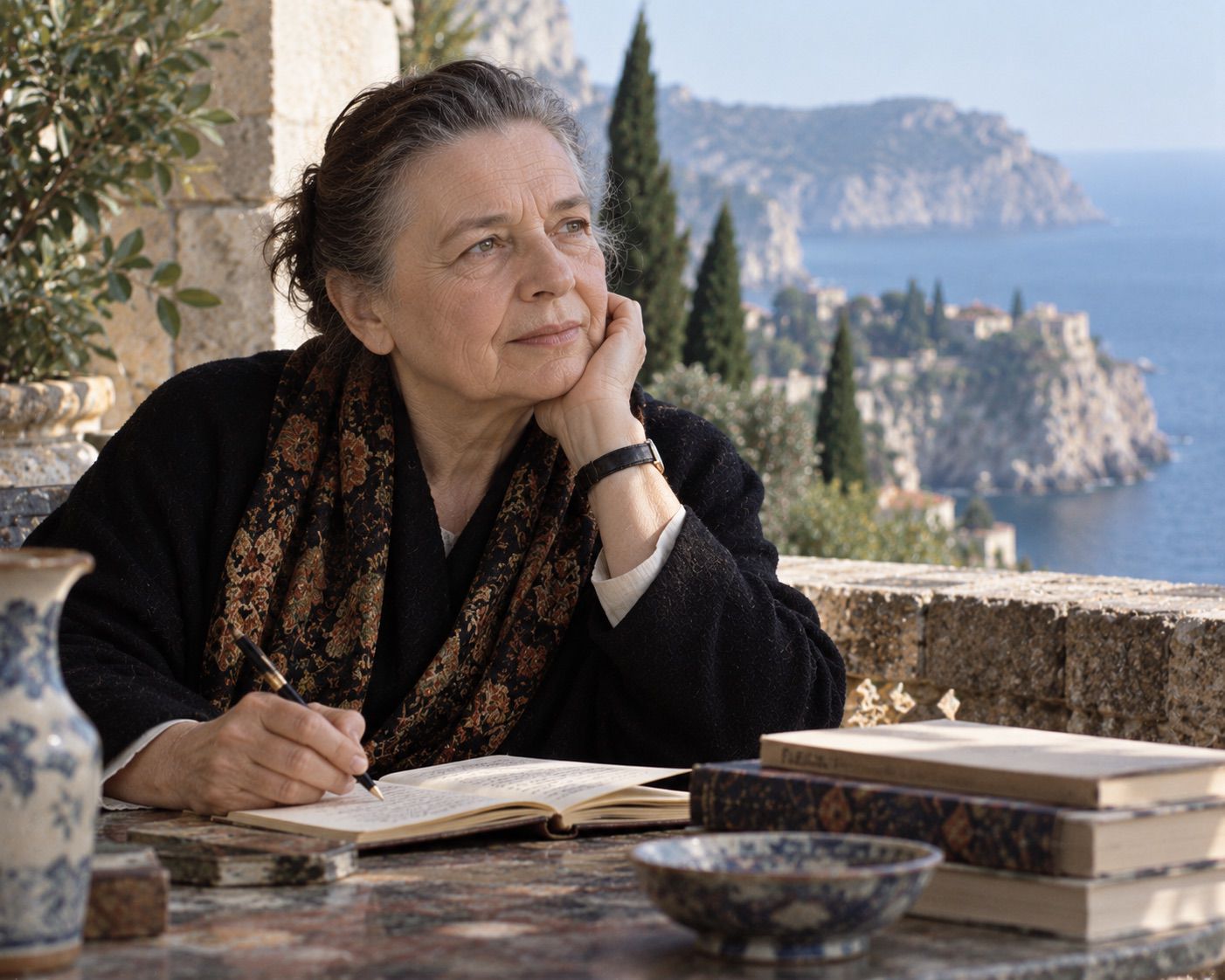
Marguerite Yourcenar has been sitting on my bookshelf for months, her slender novel “Memoirs of Hadrian” collecting dust next to my worn copy of The Bell Jar. I picked it up the other day, feeling a sense of obligation to finally read it – after all, she’s an important figure in literary history, and I should probably know more about her.
As I began reading, Yourcenar’s calm, measured prose drew me in. But what struck me was how little I felt like I knew her. She wrote so much about the inner lives of men – Hadrian, for instance, whose memoirs explore the complexities of power and desire – yet her own life remains somewhat enigmatic. What drew her to these masculine characters? Did she see herself in them?
It’s easy to romanticize Yourcenar’s life: the aristocratic upbringing, the avant-garde friendships, the exotic travels. But as I read about her relationships with men like Roger Peyrefitte and François Mitterrand, I felt a twinge of discomfort. It seemed to me that she often found herself at the center of someone else’s story – that her own desires and emotions were secondary to the needs of those around her.
This makes me think about my own experiences as a woman writer. Do I have the same privilege of exploring complex, nuanced characters? Or do I feel pressure to create women who are more palatable, more relatable? Yourcenar’s portrayal of Hadrian, with all his flaws and contradictions, feels both radical and rarefied – it’s a risk she took, writing about a man who was, by all accounts, not particularly likable.
I find myself wondering if I’m capable of the same kind of boldness. Am I too caught up in creating characters that fit neatly into societal expectations? Yourcenar’s willingness to experiment with form and voice – using first-person narration to explore Hadrian’s inner world – feels both fascinating and intimidating. Can I do the same, or will I always be bound by conventions?
The more I read about Yourcenar, the more I feel a sense of disconnection. It’s as if she exists in this rarefied realm, untouched by the messy anxieties that plague me. And yet – despite the distance between us – I’m drawn to her exploration of power, desire, and identity.
I think what unsettles me most is how little I understand Yourcenar’s intentions. Is she advocating for a more fluid understanding of gender? Or is she simply exploring the complexities of masculinity? The ambiguity feels both refreshing and frustrating: it’s as if she’s teasing out these questions without offering any clear answers.
As I close “Memoirs of Hadrian,” I feel like I’m left with more questions than answers. Yourcenar’s writing has challenged me, pushed me to think about the ways in which I approach my own characters. But what I’m most curious about is how she navigated her own desires and contradictions – and whether that navigation might offer any guidance for me as a writer.
The more I delve into Yourcenar’s life, the more I find myself questioning my own assumptions about identity, power, and desire. She wrote about Hadrian’s struggles with his masculinity, but what about her own experiences? Did she ever feel constrained by societal expectations of femininity? Or did she see herself as free to explore whatever role she chose?
As I read about her relationships with men, I couldn’t help but wonder if she was using them as a way to explore her own desires. Was it just chance that she befriended someone like Peyrefitte, who was known for his bohemian lifestyle and unconventional views? Or did she seek him out specifically because he embodied the kind of freedom she craved?
I’m struck by how little attention is given to Yourcenar’s relationships with women – or rather, how absent they seem to be. I’ve read that she was friends with writers like Colette and Djuna Barnes, but their interactions are largely glossed over in favor of her more famous friendships with men. It’s as if her bond with other women is seen as secondary to her connections with the male literary establishment.
This lack of attention feels particularly telling when I think about my own experiences as a woman writer. So often, I find myself defining myself through my relationships with men – whether it’s a writing group or a romantic partnership. But what about the women in my life? Don’t they deserve to be acknowledged, too?
Yourcenar’s silence on this topic is both puzzling and infuriating. Did she never see herself as part of a larger community of women writers, or was she more interested in forging her own path? And if so, at what cost?
As I continue to grapple with Yourcenar’s legacy, I find myself returning to the question that initially drew me to her work: what does it mean to be a woman writer in a world dominated by men? Does she offer any insight into this question, or is her work simply another example of how women have historically been written out of literary history?
The more I read about Yourcenar, the more I realize that her writing is not just about exploring complex characters – it’s also about exploring the complexities of her own identity. And yet, despite her best efforts to create a nuanced portrait of Hadrian, she remains an enigma herself. It’s as if she’s intentionally left some doors closed, refusing to reveal too much about her inner world.
This elusiveness is both captivating and frustrating – it’s like trying to grasp a handful of sand: the harder I squeeze, the more it slips through my fingers. And yet, I’m drawn back to Yourcenar’s work again and again, hoping that somehow, someway, I’ll catch a glimpse of what lies beneath her polished surface.
I’ve been thinking about Yourcenar’s use of silence as a literary device, and how it relates to my own experiences as a writer. In “Memoirs of Hadrian,” she often leaves spaces unexplored, allowing the reader to fill in the gaps with their own imagination. It’s a technique that feels both bold and vulnerable – like she’s trusting us to understand her character on our own terms.
But what about when silence is used as a tool for exclusion? When Yourcenar fails to acknowledge the women in her life, does it become a form of erasure? I’m struck by how often we’re asked to be silent, to blend into the background and allow others to take center stage. It’s a pattern that repeats itself throughout history – from the way women have been written out of literary canon to the ways they’ve been silenced in their own lives.
As I think about my own relationships with other women writers, I realize that I often find myself feeling invisible. Like I’m only visible when I’m relating to men, when I’m seen through the lens of my relationships with them. It’s a strange kind of erasure – one that feels both familiar and alienating.
Yourcenar’s silence on this topic is a reminder that even the most progressive writers can be complicit in systems of oppression. And yet, at the same time, her work remains a powerful example of what it means to explore the complexities of identity and power. She shows us that writing about ourselves, our desires, and our contradictions is not just a form of self-expression – but also a way of challenging the status quo.
I’m still grappling with the question of whether Yourcenar’s intentions were explicitly feminist or not. Was she advocating for women’s rights, or was she more interested in exploring the nuances of human experience? The ambiguity feels both refreshing and frustrating – like she’s asking us to engage with her work on a deeper level, without providing clear answers.
As I continue to read about Yourcenar’s life and work, I’m struck by how little I know about her personal relationships. Were there women in her life who inspired her writing? Did she have close friendships or romantic partnerships that shaped her perspective? The lack of information feels both puzzling and infuriating – like we’re being denied access to a crucial part of her story.
And yet, despite this silence, Yourcenar’s work remains a powerful reminder of the importance of exploring our own identities and desires. She shows us that writing about ourselves is not just a form of self-expression – but also a way of challenging the status quo and demanding attention from the world. It’s a lesson that feels both liberating and daunting – like I’m being asked to take on a responsibility that’s both exhilarating and terrifying.
I think what unsettles me most is how little I understand Yourcenar’s intentions. Is she advocating for a more fluid understanding of identity, or is she simply exploring the complexities of human experience? The ambiguity feels both refreshing and frustrating – like she’s asking us to engage with her work on a deeper level, without providing clear answers.
As I close this reflection, I’m left with more questions than answers. What does it mean to be a woman writer in a world dominated by men? How can we navigate the complexities of power, desire, and identity without being caught up in systems of oppression? And what role does silence play in shaping our understanding of ourselves and others?
Yourcenar’s work has left me with more questions than answers – but it’s also given me a sense of hope. A hope that, by exploring our own identities and desires, we can challenge the status quo and demand attention from the world. It’s a fragile kind of hope – one that feels both exhilarating and terrifying.
But for now, I’m willing to hold onto it.
As I sit here with my thoughts on Marguerite Yourcenar, I’m struck by the complexity of her legacy. She’s an author who defies easy categorization – a woman who wrote about men, yet often found herself at the center of their stories; a writer who explored themes of power and desire, yet remained somewhat enigmatic herself.
I find myself wondering if this is a reflection of my own experiences as a woman writer. Do I too feel like I’m living in the shadow of someone else’s narrative? Am I perpetually caught up in trying to create characters that fit neatly into societal expectations?
Yourcenar’s writing has challenged me to think about these questions, to consider the ways in which I approach my own characters and stories. But as I delve deeper into her life and work, I’m left with more questions than answers.
I’ve been thinking a lot about the concept of “erasure” – how women have historically been written out of literary history, their contributions overlooked or minimized. Yourcenar’s silence on this topic feels particularly telling, given her own experiences as a woman writer in a world dominated by men.
It makes me think about my own relationships with other women writers. Do I too feel like I’m invisible when I’m not relating to men? Like my work and perspectives are only acknowledged when they’re seen through the lens of someone else’s story?
Yourcenar’s legacy is complex, multifaceted – a reminder that even the most progressive writers can be complicit in systems of oppression. And yet, at the same time, her work remains a powerful example of what it means to explore the complexities of identity and power.
As I continue to grapple with these questions, I’m left feeling both hopeful and uncertain. Yourcenar’s writing has shown me that there’s value in exploring our own identities and desires – that by doing so, we can challenge the status quo and demand attention from the world.
But what does it mean to be a woman writer in a world dominated by men? How do we navigate the complexities of power, desire, and identity without being caught up in systems of oppression?
These are questions I’ll continue to grapple with, long after I finish writing about Yourcenar’s life and work. They’re questions that feel both deeply personal and profoundly universal – reminders that the struggles we face as women writers are not unique to us alone.
As I close this reflection, I’m left feeling a sense of awe at the complexity of Marguerite Yourcenar’s legacy. She’s an author who has given me more questions than answers – but also a sense of hope and possibility.
A hope that by exploring our own identities and desires, we can create new narratives that challenge the status quo. A hope that we can demand attention from the world, without sacrificing our own agency or autonomy.
It’s a fragile kind of hope – one that feels both exhilarating and terrifying. But for now, I’m willing to hold onto it, even as I continue to grapple with the complexities of Yourcenar’s legacy.