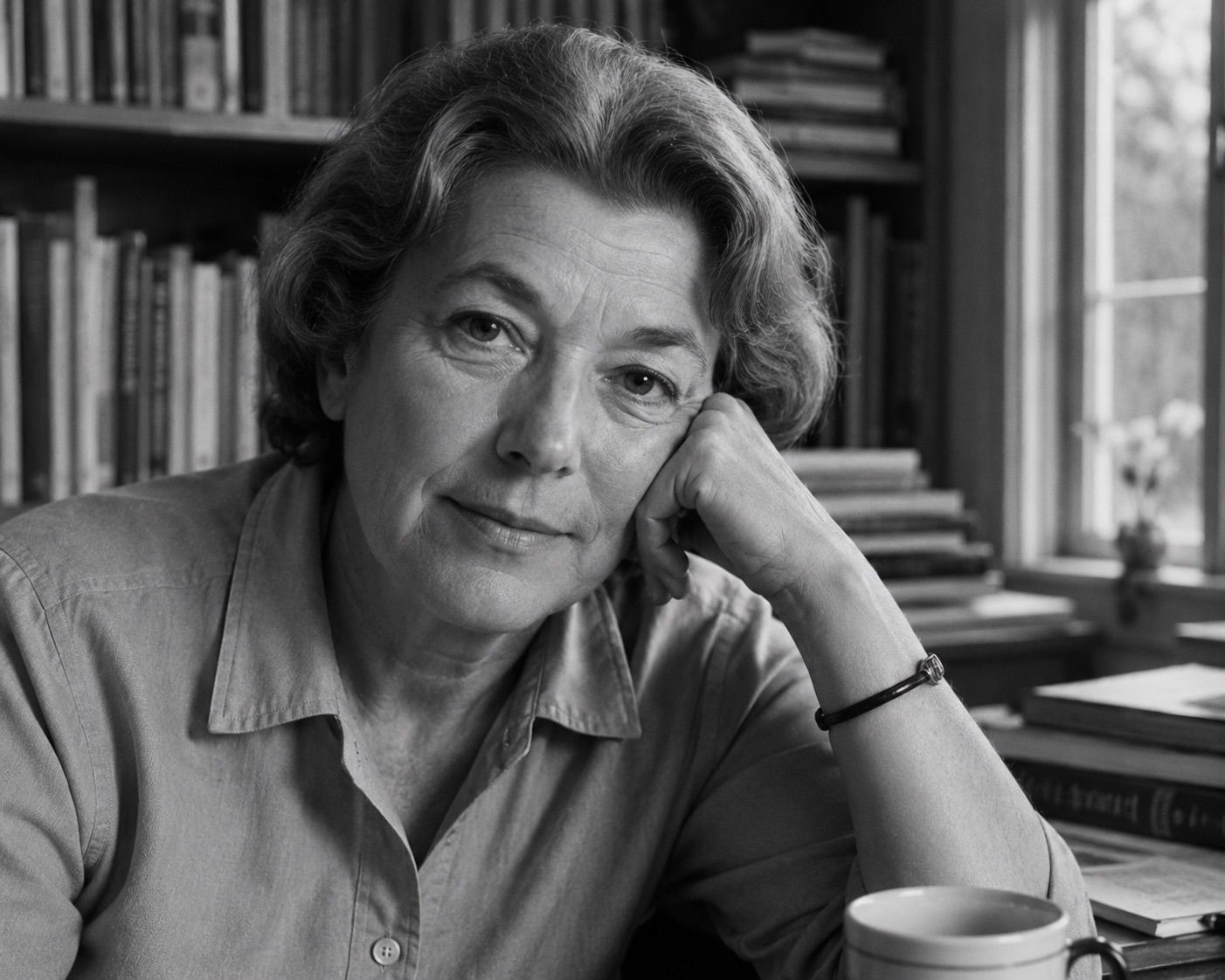
May Sarton – the writer who has been on my mind lately, like a gentle hum in the background of my thoughts. I first stumbled upon her poetry and prose in college, where we were assigned to read some of her work for a literature course. Her words resonated with me, but it wasn’t until after graduation that I really began to dig deeper into her life and writing.
What draws me to Sarton is her paradoxical existence – the tension between her desire for solitude and her need for human connection. On one hand, she was a recluse who cherished her alone time in rural France, where she would spend hours tending to her garden and writing in her study. Her poetry often captures this sense of longing for isolation, for the freedom to be herself without external expectations or obligations.
At the same time, Sarton’s letters reveal a woman who was deeply hungry for love and connection – not just romantic love, but also the kind that comes from sharing one’s life with others. She had few close relationships in her life, but when she did form them, they were intense and all-consuming. Her friendships with women like Judith Stone and Sylvia Plimpton are a fascinating example of this – complex, intimate connections that seem to have been both a source of joy and pain for Sarton.
I find myself struggling to reconcile these two aspects of Sarton’s personality. On the one hand, I admire her commitment to self-sufficiency, to living life on her own terms. As someone who has always felt like an outsider in her own family, I appreciate Sarton’s willingness to create a sense of home and community for herself, even if it meant pushing people away at times.
On the other hand, I’m not sure I fully understand the appeal of solitude – or rather, the kind of solitude that Sarton cultivated. Sometimes, when I’m feeling overwhelmed by my own thoughts and emotions, I crave human connection, not isolation. It’s like I’m torn between two opposing desires: to be alone with my own thoughts, and to be surrounded by people who understand me.
I wonder if this is what draws me to Sarton – the recognition that she was flawed, just like everyone else. Her struggles with anxiety, depression, and self-doubt are all too familiar, even if I’ve never experienced them in quite the same way. And yet, despite these challenges, she continued to write, to create, to find meaning in her life.
As I read Sarton’s work and letters, I’m struck by her honesty – not just about herself, but also about the world around her. She was a product of her time, with all its limitations and prejudices, but she refused to be bound by them. Her writing is a testament to the power of human imagination, to the idea that we can create our own meaning, even in the face of adversity.
I’m not sure what I’ll take away from this exploration of May Sarton’s life – only that her complexities have left me with more questions than answers.
As I delve deeper into Sarton’s work and letters, I find myself pondering the notion of identity and how it relates to our relationships with others. Sarton’s struggles to reconcile her desire for solitude with her need for human connection resonate deeply with me, especially as someone who has always felt like an outsider in my own family.
Growing up, I often felt like I was living in a world that wasn’t entirely mine. My parents’ expectations and desires for me were clear, but they rarely aligned with my own aspirations or values. As a result, I developed a sense of disconnection from those around me, even as I desperately sought connection and understanding.
In many ways, Sarton’s experiences feel like a mirror reflection of my own. Her struggles to define herself outside of societal expectations and her need for self-sufficiency are things that I, too, have grappled with. But whereas Sarton was able to create a sense of home and community for herself in rural France, I’ve often felt adrift, searching for a place where I truly belong.
One aspect of Sarton’s life that continues to intrigue me is her complex relationships with women. Her friendships with Judith Stone and Sylvia Plimpton are fascinating examples of the kind of deep, intimate connections she was capable of forming. And yet, these same relationships were often fraught with tension and conflict, revealing the complexity of human emotion and connection.
As I reflect on my own relationships, I realize that I’ve often struggled to form lasting bonds with others. I’m naturally introverted, and as a result, I tend to keep people at arm’s length. But this has left me feeling isolated and alone, even in the midst of crowds. It’s as if I’m constantly torn between my desire for human connection and my need for solitude – two opposing forces that seem impossible to reconcile.
Sarton’s writing often speaks to this sense of longing, this ache within us for connection and understanding. Her poetry is full of images of isolation and loneliness, but it’s also infused with a deep sense of hope and resilience. She believed in the power of human imagination, in our ability to create meaning and purpose even in the face of adversity.
As I close my laptop and step away from Sarton’s words, I’m left wondering: what does it mean to truly connect with others? Is it possible to balance our need for solitude with our desire for human connection? And what does it say about us when we struggle to form lasting bonds with others – is it a reflection of our own limitations or simply a part of the human experience?
These questions linger, refusing to be answered. But as I sit in silence, surrounded by the quiet of my own thoughts, I’m reminded that Sarton’s writing is not just about her life or experiences – it’s about mine, too.
I find myself returning to Sarton’s words, searching for answers to these questions. Her poetry and letters are like a map, guiding me through the twists and turns of my own emotions and desires. As I read, I’m struck by the way she weaves together themes of identity, connection, and solitude.
One of the things that resonates with me is Sarton’s notion of “the inner life.” She writes about the importance of cultivating a sense of interiority, of attending to one’s own thoughts, emotions, and desires. This idea feels both radical and necessary in today’s world, where we’re constantly bombarded by external stimuli and expectations.
As someone who has always struggled with anxiety and self-doubt, I’ve come to realize the importance of listening to my own inner voice. Sarton’s writing encourages me to trust myself, to honor my own needs and desires, even when they don’t align with those around me.
But what does this mean in practice? How do we balance our need for solitude with our desire for human connection? For me, it means acknowledging that I’m not always okay, that I need space to process my emotions and thoughts. It means setting boundaries with others, communicating my needs and desires clearly, and being willing to say no when necessary.
Sarton’s relationships with women are a fascinating example of this balance in action. Her friendships with Judith Stone and Sylvia Plimpton were intense and all-consuming, yet also fraught with tension and conflict. They’re a reminder that human connection is messy and complicated, and that we can’t always expect others to meet our needs or understand us perfectly.
As I reflect on my own relationships, I realize that I’ve often struggled to form lasting bonds with others because I’m afraid of getting hurt. I’m afraid of opening up, of being vulnerable, of being rejected or abandoned. But Sarton’s writing shows me that this fear is not unique to me – it’s a fundamental part of the human experience.
Her poetry and letters are a testament to the power of human connection, even in the face of adversity. She writes about the importance of empathy, compassion, and understanding – values that feel more essential than ever in today’s world.
As I close this chapter on Sarton’s life, I’m left with a sense of wonder and awe. Her writing has shown me that identity is not fixed or static, but rather a complex web of experiences, emotions, and desires. It’s a reminder that we’re all works in progress, struggling to make sense of ourselves and the world around us.
And yet, even as I grapple with these complexities, I’m reminded of Sarton’s most profound insight: that human connection is not just about external relationships, but also about our internal lives. It’s about cultivating a sense of interiority, of attending to our own thoughts, emotions, and desires.
This realization feels both liberating and terrifying – like a door has been opened, revealing a world of possibilities and uncertainties. As I step through this doorway, I’m left wondering: what will I find on the other side?
As I stand at the threshold of this new understanding, I’m struck by the sense that Sarton’s life was not just a series of choices, but also a journey of self-discovery. Her writing reveals a woman who was constantly seeking to understand herself, her desires, and her place in the world. And it’s this same desire for self-awareness that has driven me to explore her work.
I think about my own life, and how I’ve often felt like I’m trying to find my way through the darkness. Sarton’s writing is a beacon of light in that darkness, reminding me that I’m not alone in my struggles. Her experiences, though unique, are also deeply human – and it’s this shared humanity that allows me to connect with her on a deeper level.
But what I’m most struck by is the way Sarton’s life has challenged my own assumptions about identity and connection. As someone who has always felt like an outsider in her own family, I’ve often struggled to form lasting bonds with others. But Sarton’s relationships with women – particularly Judith Stone and Sylvia Plimpton – have shown me that even in the midst of intense emotional connection, there can be a sense of tension and conflict.
It’s this complexity that feels so deeply resonant for me. As I reflect on my own relationships, I realize that I’ve often been drawn to people who are also outsiders or misfits in their own way. There’s something about sharing that experience – the feeling of being an outsider within one’s own family or community – that creates a deep sense of empathy and understanding.
But Sarton’s writing has also made me confront my own fear of intimacy, my own need for control and self-sufficiency. As someone who has always struggled with anxiety and self-doubt, I’ve often felt like I’m better off keeping people at arm’s length. But Sarton’s life shows me that this is not just a coping mechanism – it’s also a way of avoiding the vulnerability and risk that comes with true connection.
As I close my thoughts on May Sarton, I’m left with a sense of awe and gratitude for her writing. Her work has shown me that identity is not fixed or static, but rather a complex web of experiences, emotions, and desires. It’s a reminder that we’re all works in progress, struggling to make sense of ourselves and the world around us.
And it’s this sense of uncertainty – this willingness to question and explore – that feels so deeply liberating. As I step forward into my own life, I’m reminded that Sarton’s writing is not just about her experiences – it’s also about mine. It’s a reminder that I have the power to create my own meaning, my own purpose, even in the face of adversity.
As I take my first steps into this new understanding, I feel a sense of excitement and trepidation. What will I find on the other side? Will I discover new depths of connection and understanding? Or will I stumble upon new fears and uncertainties?
I don’t know. But what I do know is that Sarton’s writing has given me the courage to keep exploring, to keep questioning, and to keep seeking out the complexities of human experience.