Latest Articles

Panama’s Bold Break from Empire: The Untold Story of a Quiet but Powerful Independence

Elias Rowen

Panama’s declaration of independence from Spain on November 28, 1821, stands as one of the most fascinating and understated independence movements in Latin American history. Unlike the sweeping battles that defined the struggles of nations like Mexico, Peru, and Colombia, Panama’s liberation was—incredibly—accomplished without bloodshed. It was a revolution of planning, persuasion, diplomacy, and sheer collective will. That peaceful triumph, achieved in a world engulfed in wars of liberation, tells a unique story about Panama’s identity, its strategic importance, and the wisdom of a people who understood that freedom could be won through unity rather than violence.

To understand the significance of Panama’s independence, you have to first imagine the world in which the isthmus found itself in the early 19th century. Panama was not simply a small, remote colonial holding; it was the beating heart of Spain’s empire in the Americas. The Isthmus of Panama was the narrow hinge connecting the vast wealth of South America with the rest of the world. Gold, silver, goods, and people passed through Panama’s ports and overland routes, making it a critical artery for Spanish power. But this value came at a cost: Panama bore the burden of decades of economic exploitation, heavy taxation, trade restrictions, and neglect.

By the time the independence movements swept through Latin America, the people of Panama watched their neighbors fight battles that consumed entire regions. Simón Bolívar pushed northward through New Granada. José de San Martín liberated the southern cone. Revolutionary ideas flowed across the continent like wildfire. And although Panama did not erupt into war, it simmered with frustration, aspiration, and the dawning realization that the Spanish empire was growing weaker by the year.

The spark for Panama’s independence wasn’t loud or violent—it was calculated. The people of Panama spent months quietly preparing, building consensus across influential families, clergy, political leaders, and merchants who understood both the promise and the peril of fighting Spain. The Spanish military presence had weakened significantly, leaving fewer soldiers stationed in the region. Supplies were short. Morale was low. And news of Spain’s declining power circulated widely.

Panama’s leaders saw an opening that may never come again.

Rather than take up arms, they crafted a strategy built on diplomacy. They reached out to local Spanish authorities, gauging their sentiment. Many soldiers and officials, unpaid and disillusioned, were unwilling to die for an empire already collapsing. The independence movement realized they could succeed by ensuring that no group felt threatened or cornered. If they could persuade the Spanish garrison to step aside—and convince the population that independence would bring stability, not chaos—they could avoid the bloodshed that ravaged other nations.

What unfolded next was a masterclass in peaceful revolution. Meetings were held in private homes under candlelight. Letters were exchanged discreetly. Community leaders quietly took stock of who supported independence, who opposed it, and who could be convinced. Instead of stockpiling weapons, they stockpiled consensus.

Then came the decisive moment.

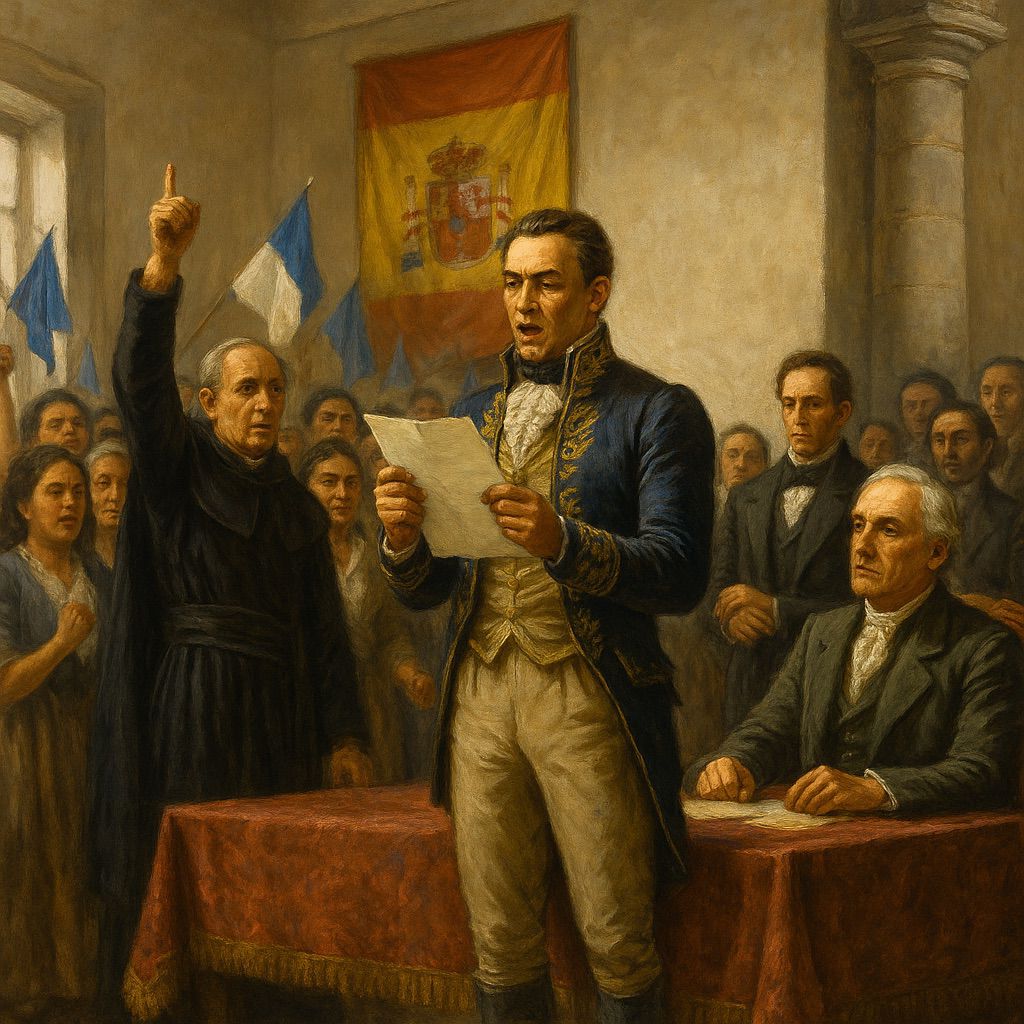
On November 28, 1821, Panama convened a historic gathering in the capital. A crowd of citizens filled the room—clergy, merchants, local elites, ordinary townspeople—all waiting to witness something they had only dared to imagine. The atmosphere was tense but filled with fragile hope. When the Act of Independence was read aloud, it declared, with clarity and resolve, that Panama was henceforth a free and sovereign entity. The announcement was met not with gunfire but with applause, tears, and a profound sense of relief. The Spanish forces, fully aware of their dwindling strength and seeing overwhelming local support for independence, surrendered peacefully.

It was a moment that rewrote the rules of revolution.

Panama’s leaders understood that independence alone would not secure their future. They faced a critical question that would shape the path of their young country: What next? Remaining entirely independent was one option. But with economic vulnerability, a small population, and the threat of re-occupation by Spain, Panama needed powerful allies. The most practical choice was immediate union with Gran Colombia—a republic under the leadership of Simón Bolívar that encompassed modern-day Colombia, Venezuela, Ecuador, and later Panama.

This decision was not an act of submission but of strategy. Panama’s geography made it one of the world’s most coveted regions. It was the key to global trade long before anyone imagined the canal. By aligning with Gran Colombia, Panama gained protection, stability, and the promise of shared progress. In Bolívar’s grand vision for Latin American unity, the isthmus played a central role. Bolívar famously believed Panama could one day become “the capital of the world,” a crossroads of commerce and diplomacy.

Panama’s peaceful independence became a source of pride that shaped generations. It proved that freedom could be won through reason rather than war. It showed that diplomacy, unity, and foresight could succeed where violence often failed. And it reinforced the idea that Panama’s destiny was tied not merely to its geography but to its ability to navigate political landscapes with intelligence and pragmatism.

For decades afterward, the legacy of this independence shaped Panama’s political identity. Even as it later separated from Gran Colombia in 1903—this time with the support of a rising global power, the United States—the memory of the tranquil independence of 1821 was preserved as a unique testament to the Panamanian spirit.

In many ways, the story of Panama’s independence mirrors its role in the world today: a nation defined by connection rather than conflict, by diplomacy rather than destruction, by a cultural richness shaped through centuries as a crossroads of the Americas. The independence of 1821 became the quiet foundation for the more dramatic transformations that would follow, including the creation of the Panama Canal, one of the most significant engineering achievements in human history.

But beyond politics, beyond treaties, beyond the shifting tides of empires, the moment that Panamanians declared themselves free was deeply human. Ordinary people—mothers, fathers, merchants, priests, and soldiers—chose hope over fear. They chose unity over division. They chose a future they would shape themselves rather than one imposed by a distant empire.

Standing in that crowded room on November 28, surrounded by the sound of voices rising in agreement, the people of Panama took control of their fate. The independence they claimed was more than a legal declaration; it was a collective heartbeat.

And in that heartbeat, a nation was born.
Related Posts

When Casablanca Captivated the World the Night a Legend Premiered in New York

Elias Rowen

On November 26, 1942, in the middle of a global war that was reshaping the world map, rewriting destinies, and redefining what humanity thought it understood about itself, something quietly remarkable happened in New York City. It didn’t happen on a battlefield or in a strategy room or in the smoke-filled offices of wartime diplomats. It happened in a movie theater—the Hollywood Theatre on Broadway—where the lights dimmed, the projector clicked to life, and a film called Casablanca flickered onto the screen for the first time. No one in the room that night could have known they were witnessing the birth of one of the most iconic films in cinematic history, a film whose lines, characters, and atmosphere would eventually carve themselves so deeply into global culture that even people who have never watched it can quote its dialogue. The premiere of Casablanca was not just an entertainment event—it was an emotional moment wrapped inside a historical turning point, a piece of art arriving at precisely the right time, when the world needed something to hold onto, something that spoke to love, sacrifice, fate, and resilience.

It’s easy today, in an era of giant blockbusters and billion-dollar film franchises, to underestimate how profoundly movies once shaped the emotional landscape of society. During the 1940s, cinema was not just entertainment; it was an escape, a cultural compass, a collective heartbeat. With millions of Americans consumed by wartime uncertainty—sons fighting overseas, families rationing resources, news arriving in painful waves—the movie theater became a place where people could breathe again, even if only for 90 minutes. Casablanca arrived into this world like a kind of elegant thunderstorm, bringing with it all the romantic longing, moral struggle, melancholy, and unexpected hopefulness that people were feeling but could not fully articulate.

Its premiere was strategically timed. Originally planned for early 1943, Warner Bros. moved up the release to align with the Allied invasion of North Africa, a moment when Morocco—a key setting of the film—was suddenly in the headlines. It was a brilliant marketing decision, but it was also more than that. It meant the film would land not as a nostalgic look backward but as a reflection of the present, a mirror held up to a world in which moral choices were no longer academic, love often demanded sacrifice, and the future hung in a fragile balance.

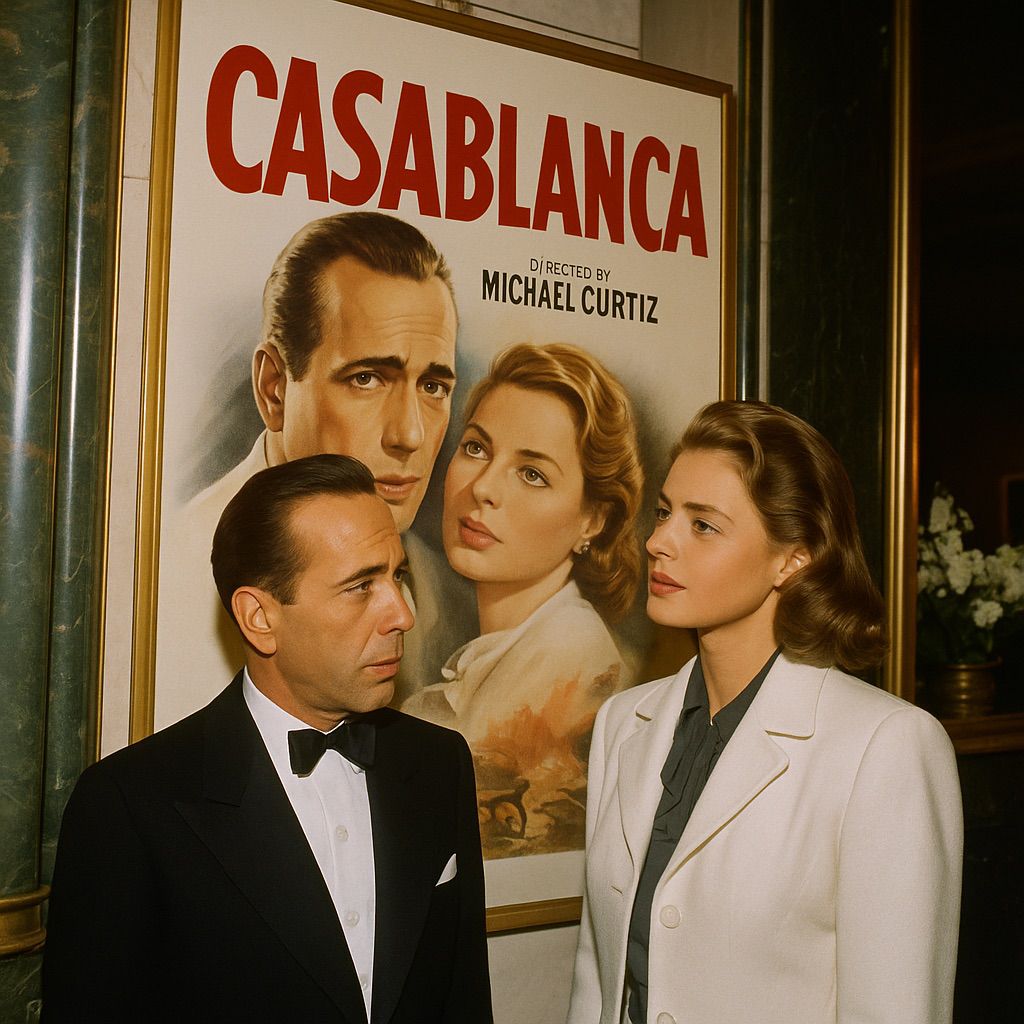
The theater itself buzzed with the kind of pre-show energy unique to the premieres of the era. Men in sharp suits and women in glamorous dresses filled the lobby, the warm glow of chandeliers reflecting off polished marble floors. Cigarette smoke curled in the air. Conversations drifted between gossip about Hollywood stars and whispered speculation about the war overseas. Reporters lingered by the entrance, hoping to capture a quote or glimpse from executives, actors, or anyone with a hint of insider information. The film’s stars—Humphrey Bogart and Ingrid Bergman—were not major red-carpet personalities yet, at least not in the way later Hollywood icons would be. Bergman was still rising, and Bogart, though well known, had not yet ascended to mythic stature. That transformation would come later, in large part because of this very film.

When the house lights dimmed and the first notes of Max Steiner’s haunting score filled the theater, the crowd settled in with a kind of nervous anticipation. They didn’t know what they were about to watch—no one did, not even many of the actors, who had filmed the movie without knowing how the story would end. The magic of Casablanca is that it never announces itself. It unfolds with the confidence of a film that trusts its audience to feel its meaning rather than be told. It begins not with bombast but with mood: a city where refugees drift like ghosts, where danger is constant and invisible, where hopes and dreams become currency. Rick’s Café Américain emerges as a microcosm of the world at war—a place where spies mingle with lovers, where deals are made in shadows, where music softens the edges of fear, and where the past hangs over every character like smoke in the air.

For the audience watching in New York, this world felt both exotic and familiar. They understood wartime dislocation. They understood the ache of separation, the uncertainty of waiting for news, the tension between survival and integrity. And when Humphrey Bogart’s Rick Blaine appeared on the screen—cool, guarded, cynical in a way that looked effortless—they saw not just a character but a reflection of their own unresolved emotions. Rick is a man who used to believe, who used to love, who used to hope, but who now hides behind toughness because it hurts too much to remember anything else. Bogart played him not as a smoldering romantic hero, but as a wounded soul trying—and failing—to outrun his past. That vulnerability resonated deeply in 1942, and it resonates still.

When Ingrid Bergman’s Ilsa Lund enters the café, luminous and conflicted, the emotional center of the film shifts. Her presence is a reminder of everything Rick has tried to bury: passion, idealism, and the pain of unfinished stories. For the audience at the premiere, watching Rick see Ilsa again was not merely cinematic drama—it was a moment that tapped into their own buried memories of people they had loved and lost to time, distance, or war. There is a reason the line “Here’s looking at you, kid” became immortal. It wasn’t just charm; it was a moment of surrender. It was the sound of a man lowering his emotional armor, if only for a heartbeat.

What makes Casablanca so powerful is that its love story isn’t just romantic—it’s philosophical. It’s a reminder that love sometimes demands sacrifice, that doing what is right can be more painful than doing what is easy, and that the greatest acts of heroism often happen in quiet, personal moments rather than on the battlefield. When Rick ultimately chooses principle over passion, helping Ilsa and Laszlo escape so they can continue fighting for a cause bigger than themselves, the audience at the premiere understood the gravity of that choice. They were living in a moment when personal sacrifice was a daily reality, when millions were making decisions shaped not by desire but by duty.

The film’s political message was subtle but unmistakable. Released at a time when America was still adjusting to its role in the war, Casablanca insisted that neutrality—emotional or political—was no longer sustainable. Rick’s evolution from a man who declares, “I stick my neck out for nobody,” to a figure willing to give up everything for the greater good mirrored the broader transformation of a nation that had entered the war reluctantly but now fought with full conviction. Audiences didn’t simply watch the change happen—they felt it, because it was happening in real life.

But beyond the politics, beyond the wartime context, beyond even the beautifully tragic love story, what stunned the premiere audience most was the film’s atmosphere. The smoky café, the intermingling of languages and loyalties, the piano playing “As Time Goes By,” the desperate whispers of people trying to obtain exit visas—it all felt alive, textured, and irresistibly real. Even viewers who had never traveled abroad could feel the weight of longing and danger in every frame. The cinematography, the performances, and the music fused into something that felt both immediate and timeless.

Max Steiner’s score alone could have carried the film into cinematic immortality. His ability to weave emotional themes into the narrative elevated each moment, creating a soundtrack that felt like a heartbeat. And of course, “As Time Goes By,” a song that predates the movie by nearly a decade, became forever linked with Casablanca’s sense of longing, nostalgia, and inevitability.

When the lights came up at the Hollywood Theatre after the premiere screening, something unusual happened. The applause wasn’t the typical polite reaction given to new films. It was warmer, more emotional, more reverent. People lingered, talking softly among themselves long after the credits rolled. Critics took notes in a daze. Reporters pressed forward. There was a sense—not fully formed, but alive—that something extraordinary had just taken place.

The days following the premiere confirmed it. Word spread quickly through New York and across the country. Reviews praised the screenplay, the performances, the direction, and the emotional weight of the film. Audiences returned for repeat viewings. Soldiers on leave saw it and wrote home about it. Couples associated it with the fragility and intensity of wartime romance. The studio, initially uncertain about the film, now recognized they had a sensation on their hands.

But what no one expected—not the studio, not the cast, not the critics, not even the premiere audience—was that Casablanca would become one of the most enduring films in cinematic history. Its lines became quotations. Its characters became archetypes. Its themes became universal emotional landmarks. Decades passed, yet the film never faded. It lived on through generations, through film courses, through cultural references, through late-night broadcasts, through DVD shelves, streaming menus, and curated collections. It is the film that film lovers recommend to non-film lovers. It is the film that writers reference when they want to evoke the beauty of melancholy. It is the film that continues to feel relevant no matter how much the world changes.

Part of its longevity lies in its humanity. Casablanca is not a movie about heroes and villains—it is a movie about people trying to survive morally in a world that doesn’t always reward integrity. It’s about longing, loyalty, loss, resilience, memory, and the bittersweet truth that love does not always lead to happy endings. These are themes that never grow old, because they are part of what it means to be human.

Standing outside the Hollywood Theatre in 1942, as the cold November air swept down Broadway and moviegoers spilled onto the sidewalks buzzing with emotion, no one could have predicted the film’s legacy. They only knew they had experienced something unusual—something that moved them deeply and left them changed in ways they couldn’t quite describe. In that sense, the premiere of Casablanca perfectly reflected the film itself: subtle, profound, emotionally resonant, and destined to matter far more than anyone realized in the moment.

Eighty years later, we can look back at that night and see it for what it truly was: not just a movie premiere, but the beginning of a legend. A night when art transcended its medium, when fiction captured truth, and when a film stepped quietly into the world and never left.

Related Posts

How the Last British Troops Left New York and Closed the Revolutionary Era

Elias Rowen

On November 25, 1783, something happened in New York City that would echo far beyond the streets, harbors, and fortifications that framed the moment. It was not a battle, nor a treaty signing, nor a soaring speech delivered from the steps of a grand building. It was, in a sense, the opposite: an ending, a departure, a quiet unraveling of what had once been one of the most powerful political and military presences on the continent. On that chilly afternoon, after years of war, occupation, fear, and uncertainty, the last British troops boarded their ships and sailed away from New York Harbor. The moment might have looked deceptively simple—troops marching, anchors lifting, sails unfurling—but beneath its surface churned a deep and unspoken recognition: the American Revolution had not only succeeded; it had become irreversible.

The British withdrawal from New York didn’t happen overnight. For most of the war, the city served as Britain’s main stronghold in North America, a fortified hub of military strategy, loyalist refuge, command operations, and political influence. The British flag had flown over New York since 1776, when General Howe’s forces overtook Washington’s Continental Army in a series of crushing defeats that forced the patriots into retreat. From that moment on, New York was more than a city—it was a symbol of British persistence, a reminder that the empire still had teeth, still had soldiers on the ground, still had a way of asserting itself despite setbacks elsewhere. Losing Boston might have been tolerable. Losing Philadelphia might have been frustrating. But New York? That would be a blow to imperial pride that few in London were willing to contemplate.

For the residents of the city, life under British occupation took on a strange dual existence. On one side were loyalists—men and women who believed the crown represented stability, prosperity, and order. On the other side were patriots—those who saw British control as a painful intrusion, a constant reminder of lost freedoms. Between them stood countless others simply trying to survive, to feed their families, to avoid drawing attention to themselves. Some residents fled. Others stayed, building lives amid the fog of war, raising children, running shops, navigating shortages, and whispering about the future in kitchens and taverns. British officers attended balls and dinners. Soldiers drilled in open squares. Loyalist merchants carried on with business. And somewhere, miles away, the Continental Army fought on, refusing to yield.

As the war dragged on, however, the British grip weakened. Cost, distance, casualties, and political fatigue in London all chipped away at morale. The surrender at Yorktown in 1781 wasn’t the official end of the war, but it signaled a shift so profound that the British government began reconsidering the entire effort. Peace negotiations eventually opened in Europe, and by 1783 the Treaty of Paris formally recognized American independence. Yet New York—still occupied, still bristling with British regiments—remained a loose thread in a tapestry that otherwise proclaimed freedom.

Preparing to evacuate an entire city wasn’t simply a matter of pulling up stakes. For the British, it meant organizing thousands of troops, supplies, wagons, artillery pieces, and tents. It meant dismantling command posts, clearing barracks, and methodically packing away the material remnants of power. It also meant deciding the fate of thousands of loyalists who feared what might happen once British protection was gone. Many had burned bridges with neighbors, declared allegiance to the crown, or fought directly against the patriots. Staying now was unthinkable. For these families, the evacuation was not a moment of closure—it was the beginning of exile. Ships filled with loyalists departed for Nova Scotia, the Caribbean, or Britain itself, carrying with them the heartbreak of displacement, the fear of the unknown, and the lingering bitterness of a war they believed had betrayed them.

By the time evacuation day arrived, an almost electric energy filled the air. New Yorkers had waited years for this moment, and though they didn’t know exactly how it would unfold, they felt the magnitude of what was coming. Crowds gathered. Children climbed onto crates and fences to gain a better view. Merchants closed their shops. Soldiers of the Continental Army, though weary, stood straighter that morning. And somewhere within the gathering excitement, anxiety lingered—would the British truly leave peacefully? Would there be last-minute violence? Would loyalists sabotage the departure? No one could be sure.

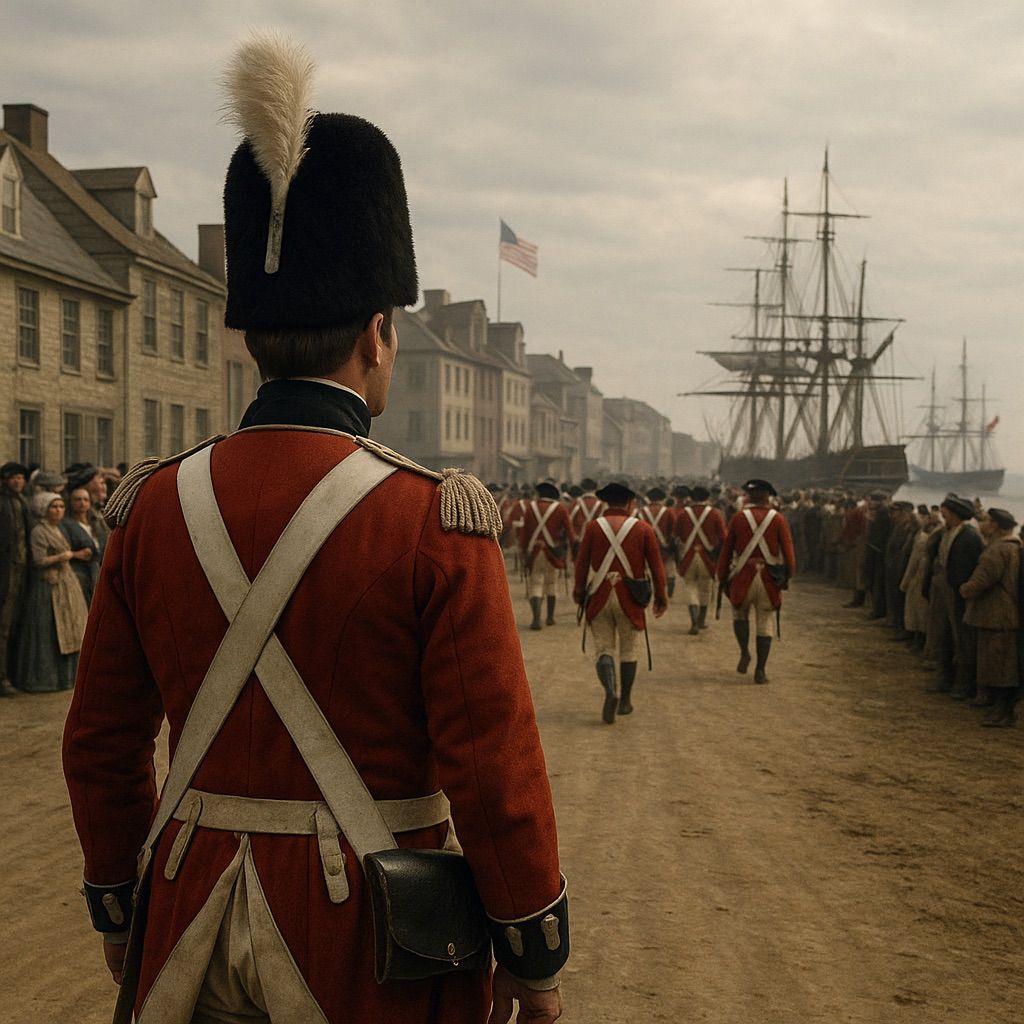
But as the morning progressed, a strange calm settled. The final red-coated regiments marched toward the waterfront, their uniforms crisp, their steps measured. They were not an army in collapse. They were professional soldiers following orders, carrying themselves with the dignity of men who knew they had fought valiantly, even if the outcome had slipped beyond their grasp. Cannon pieces were rolled into position on the ships. Crates were hoisted aboard. Officers gave final instructions. Then, slowly, the British troops boarded the vessels that would take them away from a city they had occupied for seven long years.

Perhaps the most symbolic moment of the day came as the British lowered their Union Jack from a flagpole at Fort George. Legend has it that the British had mischievously greased the pole to stop the Americans from raising their own flag. But a local young man, agile and determined, managed to climb it regardless, ripping out nails and clearing the obstruction before planting the American flag at the top. Whether the details unfolded exactly this way scarcely matters now—the moment represented something beyond logistics. It symbolized a transition, a reclaiming, a jubilant assertion of identity. With that flag unfurled in the November breeze, New York City officially became American once more.

Then, as crowds watched, the British fleet pulled away from the harbor. Some ships turned toward Canada. Others set course for the Caribbean or England. Their sails caught the wind, and the familiar red coats faded into the distance. In their wake, the harbor—once patrolled by the mightiest navy in the world—stood open and unguarded. The empire had departed. The city exhaled.

As the British ships receded, George Washington and his Continental troops entered the city in what became known as “Evacuation Day,” a celebration that continued annually for decades. Washington, who had once been forced to flee New York in humiliation, now marched in triumph. Crowds lined the streets, cheering, waving, throwing flowers. No one could deny the emotional weight of the moment. Washington’s presence signaled that the war was not just won on the battlefield but in the hearts of the people. He rode through the city not as a conqueror but as a liberator, a living symbol of perseverance, dignity, and quiet determination.

That night, Washington dined with local leaders, raising glasses to peace, unity, and the promise of a new nation. The celebrations spilled into streets and taverns. For a city that had endured occupation for so many years, the feeling of liberation was almost overwhelming. People danced. They sang. They embraced neighbors they hadn’t spoken to since the war began. They allowed themselves, perhaps for the first time, to imagine a future in which their city could flourish, not as a pawn in a geopolitical struggle, but as a cornerstone of a new republic.

The departure of the last British troops marked more than the end of a military occupation. It signaled the closing chapter of the American Revolution and the beginning of something entirely new—a shift from rebellion to nation-building. It was a moment of clarity, a collective acknowledgment that America was now responsible for its own destiny. No empire stood over it. No foreign troops lingered on its soil. Its capital, its trade, its identity, and its governance were in the hands of its own people.

Looking back now, Evacuation Day might seem overshadowed by more famous events like the signing of the Declaration of Independence or the victory at Yorktown. But in 1783, it carried a significance that every New Yorker could feel in their bones. It was proof that the war was truly over. Proof that the British acknowledged American independence not just on paper but in physical withdrawal. Proof that Washington’s perseverance had not been in vain. And proof that a city—burned, divided, occupied, and battered—could reclaim its spirit.

The city that the Continental Army entered in 1783 was not the glittering metropolis we know today. Buildings had been damaged. Some had burned. The population had shrunk. Businesses struggled. Infrastructure was weak. Yet beneath the scars lay something resilient: the will to rebuild. New York’s revival in the postwar years would be nothing short of astonishing, eventually growing into one of the most powerful and influential cities in the world. And in a way, that growth can be traced back to that single moment when British troops stepped aboard their ships and left the harbor behind.

Today, Evacuation Day is not widely celebrated. It faded over time, overshadowed by Thanksgiving, absorbed into the broader tapestry of American memory. But the significance of November 25, 1783, hasn’t vanished. It lives in the architecture of the city, in the archives of its history, and in the collective identity of a nation that was still in its infancy when the last red coat disappeared over the horizon. It remains a reminder of perseverance, of transformation, and of the quiet, powerful moments that truly define the shape of history.

The departure of the British marked an end—but it also marked a beginning. A new nation stood on the edge of possibility, free to shape its own destiny. And in that sense, the ships that left New York Harbor carried away more than soldiers. They carried away an era. What remained was something extraordinary: a chance to build a nation from the ground up, guided not by an empire across the sea but by the hopes, ambitions, and ideals of the people who called it home.

Related Posts

The Book That Reshaped the World: How Darwin’s ‘Origin of Species’ Sparked a Revolution in Human Understanding

Elias Rowen

When Charles Darwin published On the Origin of Species on November 24, 1859, he did far more than release a scientific book—he detonated an intellectual earthquake whose aftershocks continue to shape every corner of modern thought. It is difficult today, in a world where evolution is a familiar concept taught in classrooms and taken for granted in scientific circles, to fully grasp just how radical, how shocking, and how world-altering Darwin’s ideas were. To Victorian society, the book posed questions that cut to the heart of identity, morality, faith, and humanity’s place in the cosmos. But before it became a flashpoint for controversy and transformation, it was simply the culmination of a deeply personal, decades-long journey of doubt, curiosity, and relentless observation. The publication date is famous now, but the story behind it is even more fascinating—an interplay of private struggle, scientific bravery, and the quiet determination of a man who never saw himself as a revolutionary, yet became one almost by accident.

The seeds of Darwin’s great work were planted long before he ever put pen to paper. As a young man, Charles Darwin was not the stereotype of a bold explorer or a defiant intellectual. He was, by his own admission, shy, deeply sensitive, prone to illness, and searching for direction. Early attempts to mold him into a doctor or a clergyman failed—not because he lacked intelligence, but because his heart simply wasn’t in it. What captivated him instead were beetles, birds, rocks, fossils, and all the small wonders of the living world. He collected specimens like treasure, examined them with intense fascination, and found joy in cataloging the intricate details of nature. It was this quiet passion—not a desire for fame—that eventually placed him aboard HMS Beagle, the ship that would change everything.

The Beagle voyage from 1831 to 1836 exposed Darwin to landscapes and creatures that seemed, to his young and curious mind, almost impossibly varied. Giant tortoises lumbered across volcanic terrain in the Galápagos. Fossilized bones of long-dead giants emerged from Patagonian cliffs. Birds that appeared similar at a distance revealed astonishing variations upon closer inspection. Many of these observations were small—notes in a journal, sketches in a notebook—but for Darwin, they stirred questions that refused to be quieted. Why did species vary so drastically from one island to another? Why did fossils resemble living creatures yet differ in fundamental ways? Why did nature seem to produce endless, subtle variations, almost as if it were experimenting?

These questions did not lead him immediately to a grand theory. Instead, they simmered. Darwin returned to England and began the slow, meticulous work of cataloging his findings. His life settled into a pattern of quiet scholarship—marriage, children, experiments in his home gardens, endless correspondence with naturalists across Europe. Yet beneath the surface of this routine life, a storm brewed. As he reviewed the specimens and notes from the Beagle, patterns began to form. Nature was not static. Species were not fixed. Everything seemed to point toward the same unsettling idea: living things changed over time. Gradually. Relentlessly. According to laws and pressures that played out over millions of years.

For Darwin, this realization was thrilling—and terrifying. He knew that if he could see the implications, the world would eventually see them too, and the consequences would shake the foundations of science, religion, and culture. He moved deliberately, almost cautiously, developing his theory of natural selection not in bursts of inspiration but through steady, painstaking reasoning. To find evidence, he became a kind of scientific detective. He bred pigeons to understand variation. He studied barnacles for eight exhausting years, gaining insights into subtle differences between species. He cataloged plants, insects, and animals from every source available. All the while, he wrote notes—pages upon pages of them—slowly crafting the skeleton of a theory so bold it felt almost dangerous.

And he was right to be wary. Victorian society held tightly to the belief that species were fixed creations, designed individually and perfectly. The idea that humans shared ancestry with other animals was not just unflattering; it was unacceptable. Darwin feared backlash, not only from the church but from his colleagues, his family, and the public. Unlike many scientists hungry for recognition, he hesitated to publish, driven more by a desire for truth than by a thirst for fame. He once described the idea of revealing his theory as like “confessing to a murder.”

For more than twenty years, Darwin kept his growing manuscript largely to himself. But everything changed when another naturalist, Alfred Russel Wallace, independently developed a nearly identical theory of evolution. Wallace’s letter to Darwin in 1858 forced a moment of decision: publish now or risk losing the legacy of decades of work. Darwin, ever modest, insisted that Wallace receive full credit, and in a joint presentation at the Linnean Society, both men were acknowledged. But it was Darwin who undertook the monumental task of expanding the theory into a comprehensive book for the public, one that would synthesize all of his evidence, reasoning, and examples into a single, groundbreaking narrative.

When On the Origin of Species finally appeared in print in 1859, the response was immediate and explosive. The first edition sold out in a single day. Scientists were stunned, intrigued, scandalized. Clergy reacted with alarm and hostility. Newspapers published fierce arguments both defending and condemning the book. Darwin himself, too ill to handle the stress, watched the uproar unfold from home, feeling both relieved to have finally spoken his truth and overwhelmed by the shockwave it caused.

The book itself was written not like a manifesto but like a careful, measured conversation. Darwin avoided attacking religion directly, instead presenting his theory with humility and respect for traditional viewpoints while still making a compelling, evidence-driven case. He introduced the concept of natural selection—a simple but powerful mechanism where organisms better adapted to their environment survive and reproduce, passing on favorable traits. Over generations, small advantages accumulate, shaping species. This idea was both elegant and profound. It did not require divine intervention, nor did it rely on random chaos. It described a universe where complexity arose naturally, driven by adaptation and time.

The beauty of Darwin’s argument was not in its shock value but in its clarity. He built his case piece by piece, drawing from pigeons, barnacles, bees, orchids, fossils, and geographical distributions. These were not abstract concepts; they were real, observable patterns anyone willing to look could see. By grounding his ideas in nature itself, Darwin gave readers the tools to independently verify his claims. For many scientists, this was transformative. For others, it was unsettling, even threatening. Yet the genie was out of the bottle, and the world could never return to the comfortable certainty it once had.

What made Darwin’s publication so monumental was not just the scientific theory it introduced but the broader implications it carried. It challenged humanity’s sense of exceptionalism, suggesting that we were part of the natural world, not separate from it. It implied that life was interconnected, fluid, and ever-changing. It encouraged people to see the world as dynamic rather than static, driven by processes rather than miracles. And perhaps most importantly, it introduced a framework for understanding everything from disease and ecosystems to psychology and genetics. Without Darwin, modern biology would be unrecognizable.

Yet the years following publication were not triumphant for Darwin. His health worsened, leaving him bedridden for long stretches. The stress of public scrutiny weighed heavily on him. He watched as friends defended him in heated debates he was too sick to attend. He endured caricatures, mockery, and accusations of heresy. But he also witnessed the slow, undeniable shift in scientific consensus. Even those who disliked the implications of his theory could not ignore its explanatory power. It worked. It matched evidence. It predicted phenomena. It opened doors to fields that would not fully blossom until decades after Darwin’s death.

In time, the shock turned into acceptance. The backlash softened into curiosity. The theory Darwin had feared to release became the foundation of biological science. Today, evolution is not controversial in laboratories or universities. It is the backbone of medicine, ecology, anthropology, genetics, paleontology, and biotechnology. Its fingerprints are everywhere—from how bacteria develop antibiotic resistance to how species adapt to climate change. Darwin’s quiet, careful observations aboard the Beagle now shape global research, conservation efforts, and our understanding of life itself.

But the human side of Darwin’s story is just as important. He was not a firebrand or a provocateur. He was a gentle, thoughtful man who loved his family, nurtured his garden, and filled pages with sketches of worms, plants, and insects. He never saw himself as a revolutionary, yet his work changed the world more than any battle, treaty, or invention of his time. His courage was not loud but steady—a determination to follow truth wherever it led, even when it threatened the foundations of society.

That is perhaps the most lasting legacy of On the Origin of Species. It is not only a scientific milestone but a reminder of what curiosity can achieve. A reminder that great ideas often begin quietly, in notebooks and gardens, in long walks and quiet reflections. A reminder that truth, once understood, has a power all its own—one that can reshape cultures, challenge assumptions, and expand human understanding in ways no one could predict.

On the day Darwin’s book was published, the world did not change all at once. People still woke, ate, worked, prayed, and lived as they always had. But a crack had formed in the old worldview. Light entered through it. Over the years, that crack widened until the entire landscape of science and philosophy shifted. The publication was not the end of a journey but the beginning of one—one that all of humanity is still traveling.

More than a century and a half later, Darwin’s ideas continue to inspire awe. In every forest, every shoreline, every laboratory, the principles he uncovered remain alive. On the Origin of Species is no longer just a book. It is a lens through which we see the living world—a lens that reveals beauty, complexity, struggle, and resilience. It asks us to see life not as fixed and unchanging but as a vast, ongoing story shaped by countless forces over unimaginable spans of time.

And at the heart of that story is a simple truth: everything evolves.

Darwin’s publication was the moment we first understood that truth fully. And from that moment onward, humanity’s understanding of itself, and of the world it inhabits, would never be the same.

Related Posts

The Man Who Became Many: How Thespis of Icaria Became the World’s First Actor

Elias Rowen

When we imagine the origins of theater, it’s tempting to picture enormous marble amphitheaters, flowing robes, and poetic monologues echoing across ancient Greek hillsides. But long before theater became the cultural force we now study, celebrate, and imitate, there was a moment when it did not yet exist in any recognizable form — a moment when storytelling was not performed but recited, when performers were not characters but narrators, and when drama as we understand it had not yet been born. According to historical tradition, that pivotal shift happened in the 6th century BCE with a single man: Thespis of Icaria, the first recorded actor in human history. His decision to step out from the chorus and embody a character is considered one of the most significant breakthroughs in the evolution of performance, a spark that ignited the art of acting and forever changed the possibilities of human expression. But behind that grand legacy lies a deeply human story — one of ingenuity, experimentation, courage, and the timeless desire to give voice to perspectives beyond our own.

Thespis lived during what historians often refer to as the dawn of Athenian artistic life. Athens was not yet the philosophical, political, and theatrical powerhouse it would someday become, but its foundations were forming. Festivals honoring the gods, especially Dionysus — the deity of wine, fertility, and ecstatic celebration — played a central role in the cultural rhythm of the time. These festivals included processions, choral hymns, and communal ceremonies, all aimed at pleasing the divine and strengthening collective identity. Among these celebrations existed the dithyramb, a form of choral performance involving singing, chanting, and dancing. The dithyramb was powerful, emotional, and communal, but it lacked a particular element that we now consider essential to drama: individual perspective. The chorus moved as one voice, one body, one emotional mass. There was no individuality, no character, no narrative role that separated one performer from the rest.

What Thespis did — or what tradition credits him with doing — was boldly simple yet revolutionary. He stepped away from the chorus. He separated himself from the collective voice and spoke as an individual, not as himself but as a character. For the first time, the audience witnessed a performer adopting a different identity, telling a story not as a narrator but as a participant. He became a fictional persona. He created dialogue. He acted. And by doing so, Thespis broke open an entirely new form of storytelling. He didn’t just contribute to the performing arts — he created the role that actors across the world still occupy today.

Imagine the shock of that moment. The audience, accustomed only to choral unity, suddenly faced a single figure engaging them directly. It would have felt intimate, strange, perhaps even unsettling. But it was undeniably captivating. People saw, perhaps for the first time, that stories could be embodied rather than merely told. That characters could live before their eyes. That drama could be driven by conflict, emotion, and personality. Thespis was not just acting; he was redefining the boundaries of narrative. His performance became the earliest known example of a dramatic transformation — the unique human ability to step into another’s experience and express it fully.

Even more fascinating is the fact that Thespis likely invented several practical tools that actors still rely on today. Ancient sources claim he used masks, painted and expressive, to portray different characters. With one face he could be a warrior, with another a grieving mother, with another a god. The mask allowed him to shift personas quickly, and in doing so he introduced the concept of dramatic plurality — that a single performer could embody multiple identities. This innovation would become a staple of Greek theater, allowing limited casts to populate vast mythological worlds.

Thespis is also said to have traveled from village to village with a wagon, performing wherever he could find a crowd. This image — the wandering storyteller bringing drama to rural communities — adds a layer of earthy human reality to the legend. Before theater had its grand stone stages, before playwrights sculpted tragedies and comedies into enduring masterpieces, before the theatrical arts were formalized or financially supported, Thespis was essentially a traveling performer searching for an audience. His wagon became a symbol of portable theater, a reminder that performance does not need a temple or festival to be meaningful. It needs only a story and a willing listener.

But Thespis’s contributions weren’t merely technical; they were philosophical. By stepping into character, he changed the relationship between performer and audience. He invited people not just to witness a ritual but to experience empathy. When Thespis played a character, he allowed spectators to see the world through another’s eyes — to feel emotions that were not their own, to grapple with dilemmas they had not personally faced, to imagine lives they would never live. This ability to foster emotional connection lies at the core of drama, and it remains the reason theater continues to thrive across cultures and eras.

Historians debate just how much of Thespis’s story is factual and how much is myth—after all, records from the 6th century BCE are limited, and mythology often blends with reality in the retellings of great cultural origins. Some believe Thespis became legendary precisely because his innovations marked such a turning point. Others see him as a symbol for a broader transformative moment in Greek performance traditions. But whether Thespis was a singular genius or the celebrated representative of a collective shift, his name endures for a reason. The term “thespian”, meaning actor, is derived directly from him. Every stage performer, from Broadway stars to local community theater actors, carries a linguistic tribute to the man who first decided that stories could be lived as well as told.

Perhaps the most human part of Thespis’s legacy is the uncertainty around how his contemporaries viewed him. Was he praised? Criticized? Celebrated as an innovator or dismissed as a troublemaker who violated sacred ritual norms? Innovation often arrives wrapped in controversy. It’s entirely possible that when he first stepped out of the chorus, some gasped in disapproval, others laughed in delight, and others sensed they were witnessing the birth of something extraordinary. But whatever reactions he sparked, Thespis persisted. He believed in the power of performance, and he acted on that belief — literally.

Over time, what Thespis started evolved into something much larger. Aeschylus added a second actor. Sophocles introduced a third. The chorus shrank in importance while individual performers expanded their roles. Playwrights emerged who shaped tragedies and comedies into sophisticated art forms. Theaters grew into massive architectural wonders capable of seating thousands. The small act of stepping forward, taking on a role, and addressing an audience as someone else became the basis of one of humanity’s most enduring creative traditions.

Today, when we watch a film, attend a play, stream a series, or even listen to an audiobook, we are participating in a tradition that traces its roots back to that simple, audacious gesture by Thespis of Icaria. Every actor who disappears into a character, every writer who crafts dialogue, every director who shapes a performance — they are all part of a lineage that began with a single spark in ancient Greece.

We may never know the precise details of Thespis’s life. We don’t have photographs, recordings, or scripts. But we know his impact. We feel it every time an actor makes us laugh, cry, or think. We feel it whenever someone tells a story that resonates across time and culture. Thespis proved that humans are not just storytellers — we are story inhabitants. And for that reason, his legacy is not confined to history; it lives on in every performance, every stage, every screen, and every moment an actor becomes someone else.

Related Posts