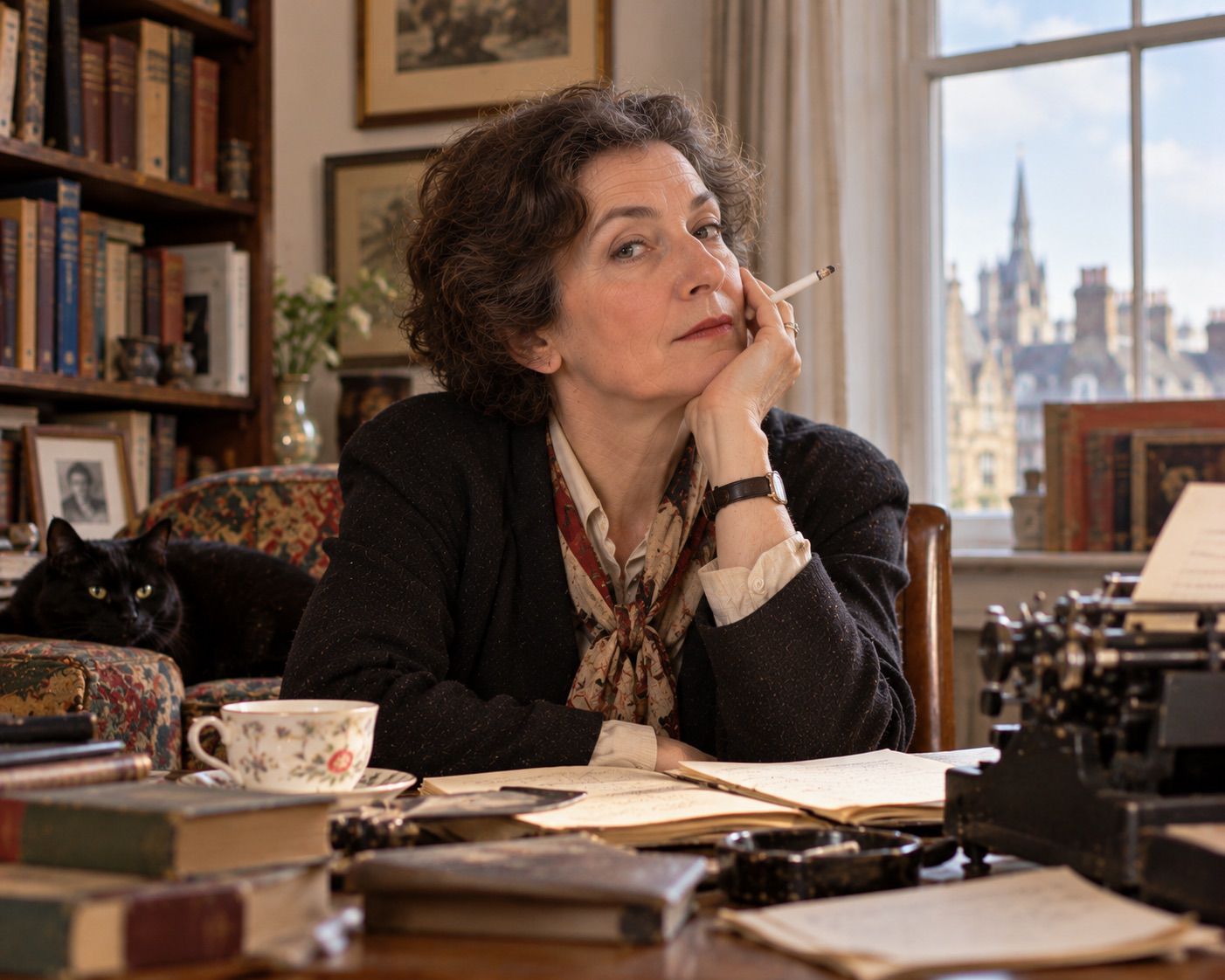
I’ve always been drawn to Rose Macaulay’s writing, but it’s her life that really fascinates me. I think it’s because she was a woman ahead of her time – or at least, that’s what I tell myself when I’m reading about her. But the more I learn about her, the more complicated my admiration becomes.
I remember stumbling upon her book “The Towers of Silence” in my college library’s rare book room. The cover art is this beautiful, haunting image of a cemetery on a hill overlooking the city. It was like nothing I’d ever seen before. As I flipped through the pages, I felt an inexplicable sense of connection to Macaulay’s writing style – it’s as if she’s speaking directly to me.
But when I started reading more about her life, I realized that she was a product of her time in ways that both amazed and appalled me. She was part of the Bloomsbury Group, this circle of intellectuals and artists who were known for their progressive ideas and bohemian lifestyles. And yet, Macaulay’s relationships with women are shrouded in secrecy – I can find mentions of close friendships and romantic entanglements, but nothing ever seems quite clear-cut.
It makes me wonder about the extent to which societal norms influenced her writing. Did she feel constrained by the expectations placed upon her as a woman, or did she deliberately subvert them? I’ve read that Macaulay’s work often explores themes of identity and belonging – is it possible that she was exploring her own experiences through her fiction?
I’ve always identified with writers who are unafraid to experiment and push boundaries. But the more I learn about Macaulay, the more I realize how guarded her public persona was. She was known for her wit and humor, but there’s a sense of vulnerability that lingers beneath the surface.
Sometimes, when I’m reading her letters or essays, I feel like I’m piecing together fragments of a puzzle that may never be fully complete. It’s as if Macaulay herself is hiding in plain sight – revealing just enough about her inner life to tantalize and frustrate me at the same time.
It’s strange, but when I think about my own writing, I feel a sense of kinship with Macaulay. Like her, I’m still figuring out who I am and what I want to say. But whereas she seems to have had this innate confidence in her craft, I often struggle with self-doubt.
As I delve deeper into Macaulay’s life and work, I find myself returning to these questions: What does it mean to be a woman writer in a society that values conformity? Can we ever truly know the extent to which our experiences shape our art, or do we risk reducing ourselves to mere caricatures of our time?
I don’t have answers to these questions – and maybe that’s what I love about Macaulay. She’s a reminder that even the most brilliant writers are messy, complicated human beings, with all the contradictions and paradoxes that come with being alive.
As I continue to read about Rose Macaulay, I find myself becoming increasingly fascinated by her tensions between convention and creativity. On one hand, she was a member of the Bloomsbury Group, which, at least in theory, embodied the kind of free-thinking, nonconformist spirit that I admire. And yet, as I mentioned earlier, there’s this sense of secrecy surrounding her personal relationships, particularly with women.
It makes me wonder if Macaulay was ever truly comfortable with her own desires and affections. Did she conform to societal norms out of fear or necessity, or did she find ways to subtly subvert them through her writing? I’ve read that she had a number of close friendships with women, including the writer and critic Lytton Strachey’s sister, Dorothy Strachey. But even these relationships seem shrouded in ambiguity – was it platonic affection, romantic longing, or something else entirely?
I find myself drawn to this kind of ambiguity, this blurred line between truth and fiction. It’s as if Macaulay is speaking directly to me, saying that even the most carefully crafted narratives are always subject to interpretation and revision. And yet, at the same time, I feel a sense of frustration – why can’t we have more clarity? More honesty?
I suppose this is where my own writing intersects with Macaulay’s. As I struggle to find my voice, to articulate my thoughts and feelings in a way that feels authentic, I’m drawn to her example. But it’s not just about emulation – it’s about understanding the complexities of human experience, the ways in which we’re all torn between competing desires and obligations.
I’ve been thinking a lot about Macaulay’s novel “The Towers of Silence”, which explores themes of identity, belonging, and the search for meaning. On one level, it’s a beautifully crafted story – lyrical prose, complex characters, and a narrative that defies easy categorization. And yet, on another level, I sense a deep-seated anxiety beneath the surface. Macaulay was known to be fiercely independent, even in her personal relationships – but what does this independence cost her? What kind of compromises must she make in order to maintain her autonomy?
As I ponder these questions, I’m struck by the ways in which Macaulay’s life and work continue to resonate with my own. We’re both women writers, grappling with the same kinds of tensions between creativity and convention, individuality and conformity. And yet, while we share certain similarities, our experiences are also vastly different – a product of our respective times, cultures, and social contexts.
It’s this complexity that I find so compelling – the messy, contradictory nature of human experience. Macaulay may have been a product of her time, but she was also ahead of it in many ways. And as I look to my own life and writing, I’m reminded that we’re all products of our contexts, even as we strive to create something new and original.
As I delve deeper into Macaulay’s world, I find myself becoming increasingly fascinated by the ways in which she navigated the complexities of her time. She was a woman who wore many hats – writer, traveler, intellectual, and socialite – but always seemed to be searching for something more. A sense of belonging, perhaps, or a deeper understanding of herself.
I think about my own life, and how I’ve struggled with similar feelings of disconnection. As a young woman, I often feel like I’m caught between different worlds – the academic world of my college days, where I was encouraged to think critically and explore new ideas; and the real-world expectations that await me as I enter adulthood.
Macaulay’s writing often explores this sense of dislocation, the feeling of being in between places or identities. In “The Towers of Silence”, she writes about a character who is torn between her desire for independence and her need for human connection. It’s a sentiment that resonates deeply with me, as I navigate my own relationships and try to find my place in the world.
As I continue to read Macaulay’s work, I’m struck by the ways in which she uses language to create a sense of intimacy and connection with her readers. Her writing is like a warm hug on a cold day – it envelops you in its gentle warmth, making you feel seen and understood.
But it’s not just about the writing itself; it’s also about the way Macaulay’s life and work intersect with my own. As I grapple with the complexities of being a woman writer, I find myself drawn to her example – her willingness to take risks, to experiment with form and style, and to push against the boundaries of what was considered acceptable for women at the time.
And yet, as much as I admire Macaulay’s courage, I also feel a sense of trepidation. What does it mean to be a woman writer in today’s society? Are we still bound by the same conventions that limited Macaulay’s options? Or have we made progress in our own small ways?
These are questions I don’t have answers to – at least, not yet. But as I continue to read and write about Rose Macaulay, I feel a sense of gratitude for her example, and for the complexities she embodies. She may have lived in a different time, but her struggles and triumphs speak to me across the ages, reminding me that we’re all part of a larger story – one that’s still being written, day by day, word by word.
As I sit here, surrounded by my own scribbled notes and dog-eared copies of Macaulay’s books, I’m struck by the sense that our stories are intertwined in ways both subtle and profound. We’re both women writers, navigating the complexities of identity, creativity, and convention. And yet, while we share certain similarities, our experiences are uniquely shaped by the time and place in which we live.
I find myself drawn to Macaulay’s travels, her desire to explore the world beyond the confines of her English upbringing. As a young woman, I feel a similar restlessness, a sense that there must be more to life than the familiar routines and expectations that surround me. Macaulay’s writing often captures this sense of wanderlust, her characters hurtling through Europe, India, and Africa in search of meaning and connection.
But it’s not just about geography; it’s also about the inner journeys we take as writers. Macaulay’s novels are full of characters who are searching for their place in the world, grappling with questions of identity, morality, and belonging. And yet, even as they navigate these complexities, there’s a sense of detachment, a feeling that they’re observing themselves from afar.
This is something I recognize in my own writing, this sense of being on the outside looking in. As I try to capture the world around me, I often feel like I’m hovering just above the surface, unable to fully immerse myself in the stories and experiences that surround me. It’s as if I’m perpetually caught between observer and participant, never quite sure which role is more authentic.
Macaulay’s writing may have been shaped by her time and place, but it also transcends those boundaries in ways both beautiful and unsettling. Her characters are full of contradictions – they’re both confident and uncertain, independent and desperate for connection. And this, I think, is what draws me to her work: the sense that she’s capturing something essential about the human experience.
As I continue to read Macaulay’s novels and letters, I’m struck by the ways in which she blurs the lines between fiction and reality. Her writing is full of meta-references and allusions, as if she’s constantly acknowledging the constructed nature of her narratives. And yet, even as she subverts our expectations, she also seems to be reaching for something deeper – a sense of truth that lies beyond the confines of language and culture.
This is where my own writing intersects with Macaulay’s, I think. As I grapple with the complexities of storytelling, I find myself drawn to her example: her willingness to take risks, to experiment with form and style, and to push against the boundaries of what was considered acceptable for women at the time.
But it’s not just about emulation; it’s also about understanding the ways in which our experiences shape our art. Macaulay’s writing may have been influenced by her time and place, but it also reflects her own unique perspective – a blend of English gentility, Bloomsbury radicalism, and cosmopolitan curiosity.
As I reflect on my own life and writing, I realize that this is what I’m striving for: a sense of authenticity, a willingness to take risks, and a commitment to capturing the complexities of human experience. Macaulay’s example may have been shaped by her time and place, but it also speaks to me across the ages – reminding me that we’re all part of a larger story, one that’s still being written, day by day, word by word.
And so I continue to read, to write, and to explore – seeking out new stories, new perspectives, and new ways of understanding the world around me. For in the end, it’s not just about Macaulay or her writing; it’s about the connections we make with each other, across time and space, through the shared language of art and imagination.