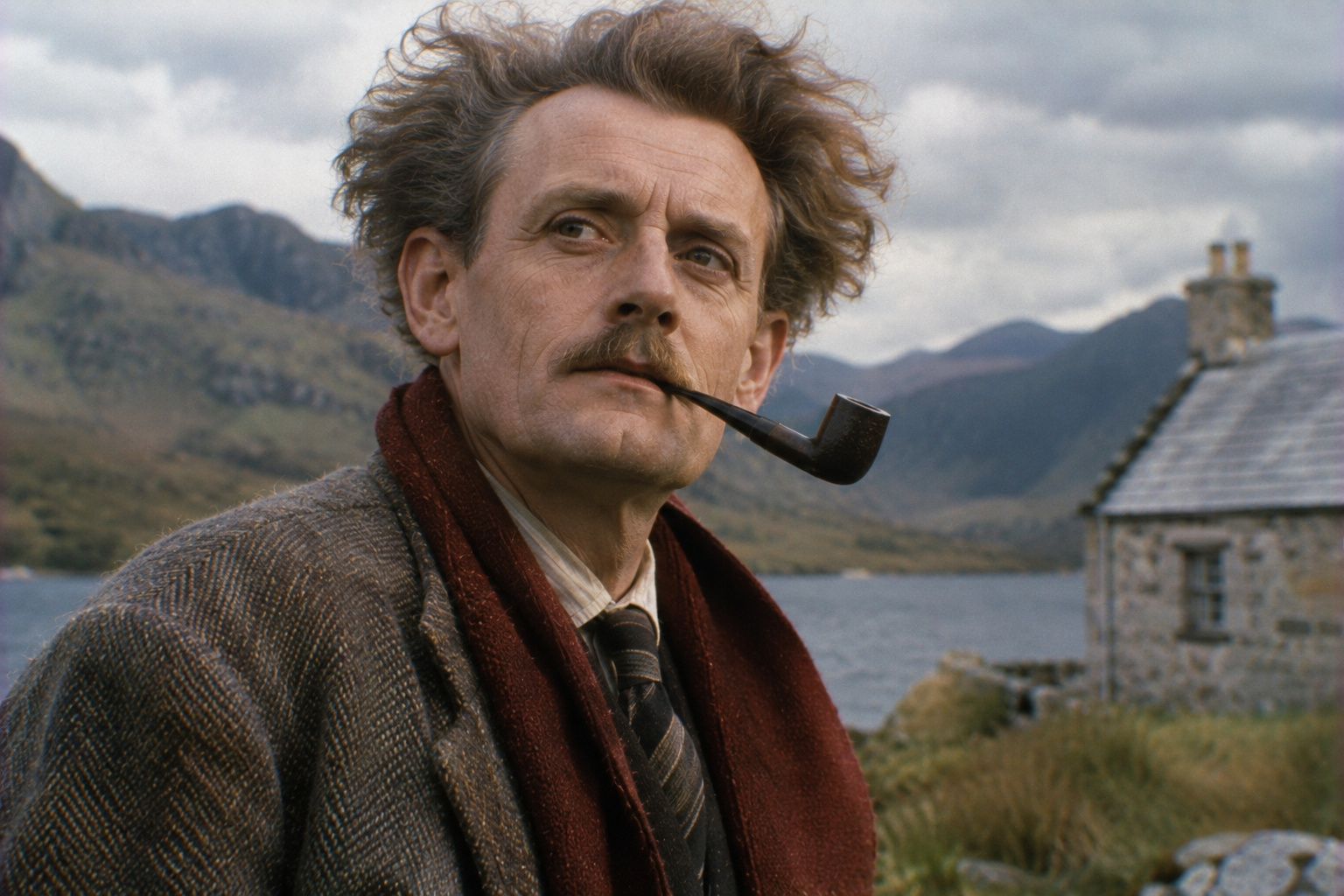
Hugh MacDiarmid. I’ve been thinking about him a lot lately, ever since I stumbled upon his poetry in an old bookstore. His words are like a slap in the face – bold, raw, and unapologetic. It’s as if he’s speaking directly to me, challenging my comfortable views on politics, identity, and art.
What draws me to MacDiarmid is his complexity. He was a Marxist, but not your run-of-the-mill revolutionary type. He was a poet of the Scottish Renaissance, yet his work defied traditional notions of national identity. He wrote about the working class, but also about the beauty of industrial landscapes and the power of science. It’s like he’s pulling me in different directions at once.
I find myself oscillating between fascination and discomfort when reading his poetry. His words are unflinching, often brutal, and sometimes cruel. He writes about the failures of socialism, the dangers of nationalism, and the inevitability of decline – it’s a bleak view of the world. Yet, there’s something about his conviction that resonates with me.
I think what unsettles me is how MacDiarmid’s views don’t fit neatly into any category I’ve been taught or learned about in school. He was part of the Scottish Renaissance movement, but he also critiqued its limitations and the romanticization of rural life. His poetry isn’t just a reflection of his time; it’s a critique of the complacency that comes with it.
As I delve deeper into his work, I start to wonder about my own relationship with Scotland – a country I’ve only visited once, but feel an inexplicable connection to. Does MacDiarmid’s poetry tap into something deep within me? Is it a desire for authenticity, for a connection to the land and its people? Or is it a romanticization of a culture that doesn’t truly belong to me?
I’m not sure what I want from MacDiarmid’s work – perhaps a clear-cut understanding of his politics or a sense of national identity. But the more I read, the more I realize that he’s offering something far more complicated and valuable: a mirror held up to my own contradictions and uncertainties.
His poetry asks me questions about my own place in the world. What does it mean to be Scottish? What responsibility do I have to engage with the complexities of history and politics? Am I complicit in the erasure of marginalized voices, or can I use my privilege to amplify their stories?
I’m not sure if I’ve found answers in MacDiarmid’s work; instead, I feel like I’ve only opened up more questions. But that’s what I love about him – his refusal to simplify, to categorize, or to comfort. His poetry is a reminder that the world is messy and multifaceted, and that sometimes the most uncomfortable truths are the ones we need to confront.
As I close the book on MacDiarmid, I’m left with a sense of unease and curiosity. What does it mean to engage with someone’s work when it makes you uncomfortable? Is it possible to find value in something that challenges your assumptions? For me, Hugh MacDiarmid is a reminder that art should never be easy, never comfortable – only thought-provoking, only unsettling, and only true.
The more I immerse myself in MacDiarmid’s work, the more I’m struck by his willingness to confront the uncomfortable aspects of human nature. His poetry is not just a reflection of the world around him; it’s an examination of our own complicity in its problems. He doesn’t shy away from critiquing the failures of socialism, the hypocrisy of nationalism, or the ways in which we’ve become disconnected from the natural world.
I find myself wondering if this is what I’m searching for in my own writing – a way to confront the complexities of the world and our place within it. Am I just scratching the surface of these issues, or am I genuinely grappling with them? MacDiarmid’s work makes me feel like I have so much more to learn, that there are depths to his ideas that I’ve only begun to scratch.
His poetry is like a catalyst for self-reflection – it makes me question my own biases and assumptions. As someone who’s always been drawn to art as a means of escape, I’m forced to confront the ways in which I’ve used creativity as a way to avoid difficult conversations. MacDiarmid’s work is a reminder that art should be a tool for engagement, not avoidance.
I’ve started to think about my own writing in a different light – not just as a form of expression or catharsis, but as a means of exploring the complexities of human experience. What does it mean to write from a place of discomfort? Is it possible to create art that’s both beautiful and challenging at the same time?
The more I read MacDiarmid, the more I’m drawn to the idea of “the awkward moment” – when we’re forced to confront our own contradictions and uncertainties. It’s not always easy or comfortable, but it’s often where the most meaningful conversations begin.
As I continue to immerse myself in MacDiarmid’s work, I find myself returning to this idea of the “awkward moment” again and again. What is it about these moments that makes them so valuable? Is it the way they force us to confront our own biases and assumptions, or is it the way they reveal the complexity of human experience?
I think back to my own experiences with awkwardness – the times I’ve felt like an outsider in social situations, or when I’ve had to navigate complex relationships. In those moments, I often feel a sense of discomfort, but also a deep sense of curiosity. What am I feeling? Why do I feel this way? What does it mean about me and my place in the world?
MacDiarmid’s poetry is like a magnified version of these awkward moments – he takes them to their most extreme and uncomfortable conclusions. But in doing so, he reveals something profound about human nature: that we are complex, messy, and multifaceted beings, capable of both beauty and ugliness.
As I read his words, I start to wonder if this is what I want for my own writing – to create a space where readers can feel these awkward moments, too. Can art be a catalyst for self-reflection, or is that just a romantic notion? Does it have the power to change our perspectives, or do we always revert back to our comfortable ways of thinking?
I’m not sure if I’ve found any answers yet, but MacDiarmid’s work has me questioning everything. What does it mean to write about the uncomfortable aspects of human experience? Is it a form of bravery, or just a way to avoid genuine connection with others? Can art be both beautiful and challenging at the same time, or is that a contradiction in terms?
As I sit here, surrounded by MacDiarmid’s poetry, I feel like I’m on the cusp of something new – a shift in my understanding of what it means to write about the world around me. His work has made me see that art can be a tool for engagement, not avoidance; that beauty and ugliness are intertwined, and that sometimes the most uncomfortable truths are the ones we need to confront.
But what does this mean for my own writing? Do I have the courage to take on these complex issues, or will I revert back to safer topics? Can I create art that’s both beautiful and challenging at the same time, or am I just a novice trying to navigate the complexities of human experience?
The more I read MacDiarmid, the more I realize that I don’t have any answers yet. But what I do know is that I’m willing to take on these questions, to explore the complexities of human nature through my writing. And if that means facing my own awkward moments head-on, then so be it.
The more I think about it, the more I realize that Hugh MacDiarmid’s poetry is not just a reflection of his time and place, but also a mirror held up to mine. His willingness to confront the uncomfortable aspects of human nature resonates deeply with me, and makes me wonder if I’ve been avoiding similar conversations in my own writing.
I think back to my college days, when I was so caught up in exploring the literary canon that I rarely ventured outside of it. I devoured the works of Shakespeare, Austen, and Woolf, but rarely strayed from the familiar. It wasn’t until I stumbled upon MacDiarmid’s poetry that I felt like I’d been sleepwalking through my own education.
His words awakened something in me – a sense of curiosity about the world around me, and a willingness to challenge my own assumptions. I started to explore other writers, poets, and thinkers who were pushing against the boundaries of what was considered “acceptable” or “mainstream.” It was exhilarating and terrifying at the same time.
As I continued to immerse myself in MacDiarmid’s work, I began to notice a theme that echoed throughout his poetry – the tension between art and politics. He saw no distinction between the two, believing that art should be a tool for engagement, not avoidance. It made me realize that my own writing has often been more focused on self-expression than social commentary.
I’m not sure what this means for my future as a writer, but MacDiarmid’s poetry has given me permission to explore the complexities of human nature in a way that feels honest and authentic. I no longer feel like I need to shy away from difficult conversations or uncomfortable truths. Instead, I’m drawn to the idea of creating art that challenges readers, that makes them question their assumptions, just as MacDiarmid’s poetry has made me question mine.
But what does this mean for my relationship with Scotland? Does it have anything to do with the fact that MacDiarmid’s work is rooted in his own experiences as a Scottish poet, or is it something more complex? I’m not sure if I’ve found any answers yet, but I’m willing to continue exploring these questions, even if they lead me down uncertain paths.
The more I read MacDiarmid, the more I realize that his poetry is not just about himself, but about us – our collective humanity, with all its complexities and contradictions. His words are a reminder that art should never be easy or comfortable; only thought-provoking, only unsettling, and only true. And if that’s what I’m searching for in my own writing, then I’m willing to take the risk of exploring the uncomfortable aspects of human experience alongside MacDiarmid.
As I continue to grapple with MacDiarmid’s ideas, I find myself drawn to his concept of “the dialectical imagination.” He believed that art should be a tool for bridging the gaps between opposing forces – not just in society, but within ourselves as well. It’s a notion that resonates deeply with me, especially given my own struggles with identity and belonging.
I think about how I’ve often felt like an outsider, caught between different cultures and communities. My parents are from different countries, and I grew up speaking multiple languages at home. As a result, I’ve always felt like I’m navigating multiple worlds, trying to find my place within each one. MacDiarmid’s poetry speaks directly to this sense of dislocation – the feeling of being torn between opposing forces, with no clear sense of direction.
But what if that’s exactly where the power lies? What if our discomfort, our uncertainty, and our contradictions are not weaknesses, but strengths? MacDiarmid’s work suggests that it’s precisely in these moments of tension that we can find the most profound insights into human nature. By embracing our complexities, by acknowledging our own flaws and biases, we can create art that is authentic, raw, and unflinching.
I’m not sure if I’ve fully absorbed this idea yet – or if I ever will. But as I continue to read MacDiarmid’s poetry, I feel like I’m slowly beginning to understand the value of embracing my own contradictions. It’s a process that’s both exhilarating and terrifying, like standing on the edge of a cliff with no safety net in sight.
And yet, it’s precisely this sense of uncertainty that makes me want to keep writing. To explore the complexities of human experience, to confront our own biases and assumptions, to create art that challenges readers and pushes them out of their comfort zones. It’s a daunting task, but one that I feel compelled to take on – not just for myself, but for the world around me.
As I close this reflection on MacDiarmid, I’m left with more questions than answers. But that’s okay – because it’s in these moments of uncertainty, of discomfort and contradiction, that we can find the most profound insights into human nature. And perhaps, just perhaps, it’s in these awkward moments that we’ll discover a new kind of beauty – one that’s raw, unflinching, and truly true to ourselves.