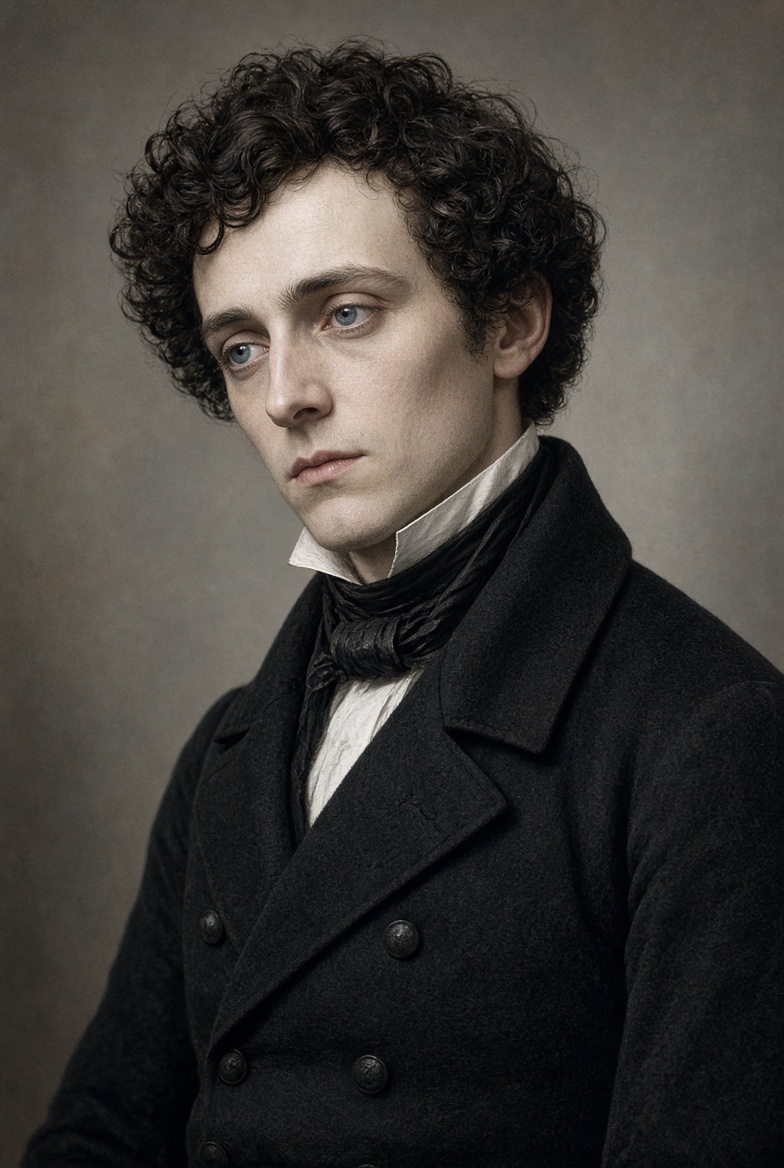
Giacomo Leopardi’s words have been swirling around me like a perpetual storm for months now. I picked up his works during my final year of college, and as I read through the poems and essays, I felt a strange sense of kinship with this 19th-century Italian poet. It started to bother me – why did I feel so drawn to someone from another time, someone who wrote about the bleakness of life in a way that seemed both beautiful and disturbing?
At first, it was his poetry that captivated me. The way he described the world as a place of sorrow and hardship resonated deeply with my own experiences of growing up in a family where we never had much money, but always made do. His words about the beauty of desolation, the pain of longing, and the futility of human endeavor spoke to something within me that I couldn’t quite articulate.
But as I delved deeper into his works, I began to feel uneasy. Leopardi’s pessimism was not just a passing sentiment; it seemed to be an all-consuming force that drove him to question everything about life – God, nature, morality, and even the human condition itself. His most famous poem, “The Infinite,” is a beautiful example of this: he writes about how the universe is infinite, and yet we are finite, tiny specks in its vastness. This realization is not just intellectually daunting; it’s also deeply unsettling.
I started to wonder if Leopardi’s obsession with suffering was a result of his own experiences. He grew up in a wealthy family, but he himself was frail and sickly throughout his life. Perhaps the darkness that pervades his work is a reflection of his own inner turmoil? Or maybe it’s simply a product of his era – the Enlightenment had just begun to take hold in Europe, and Leopardi’s generation was grappling with the implications of reason and progress.
But here’s the thing: I don’t feel like my own life has been marked by such overwhelming hardship. My parents may not have had much money, but they worked hard to provide for me, and we always managed to scrape together enough for the basics. Leopardi’s struggles seem so… extreme compared to mine. And yet, as I read his words, I feel like I’m tapping into something primal within myself – a sense of disillusionment with the world that feels almost… familiar.
It’s this paradox that keeps me coming back to Leopardi’s work: why do I relate so deeply to someone who seems to have experienced such profound suffering? Is it because his writing has given me permission to feel my own doubts and fears in a way that’s acceptable? Or is it simply because, deep down, I’m as uncertain about the nature of reality as he was?
As I continue to read Leopardi, I find myself drawn back to these questions again and again. His words are like a mirror held up to my own soul – they show me the complexities, the contradictions, and the vulnerabilities that make us human. And in this reflection, I see not just Leopardi’s struggles but also my own: the struggle to make sense of the world, to find meaning in the midst of uncertainty, and to navigate the darkness with some semblance of hope.
I don’t know if I’ll ever fully understand Leopardi or his work – perhaps that’s the point. His poetry is like a door that opens onto a vast, uncharted landscape; every time I step through it, I’m met with new questions, new doubts, and new uncertainties. But in these spaces of uncertainty lies a strange kind of comfort: it reminds me that I’m not alone in my own doubts and fears – and that maybe, just maybe, the darkness is where true understanding begins.
As I delve deeper into Leopardi’s work, I find myself questioning the nature of hope itself. He writes about how hope is a fleeting thing, a brief respite from the crushing weight of reality. And yet, as I read his words, I feel like I’m grasping for something more – a sense of optimism that seems to elude him, but not me.
I remember feeling this way during my own college years, when I was struggling to come to terms with the idea of adulthood and all its responsibilities. My friends and I would talk about our dreams and aspirations, and it seemed like everyone around us had a plan for their future – except me. I felt lost, uncertain about what I wanted or where I was going.
Leopardi’s words spoke directly to that sense of disorientation. He writes about how we’re all just ” floating on the surface” of life, without any real control over our circumstances. It’s a bleak assessment, but one that resonated with me in a way that felt almost… liberating? Like, if everyone was feeling as lost and uncertain as I was, maybe it wasn’t so bad after all.
But what really gets to me is the way Leopardi writes about time itself. He says that time is “an abyss” that stretches out before us, an endless void that we’re powerless to fill. And yet, he also talks about how time can be a beautiful thing – a reminder of the fleeting nature of life, and the importance of making the most of every moment.
It’s this paradox that I find myself drawn to – the tension between the crushing weight of time and its potential for beauty. As someone who’s struggled with anxiety and feelings of overwhelm, Leopardi’s words about time are both terrifying and reassuring at the same time.
I wonder if that’s what draws me to his work – not just the darkness or the hopelessness, but the way he captures the complexity of human experience in all its messy, contradictory glory. His poetry is like a map of my own inner world – a reminder that I’m not alone in my doubts and fears, and that maybe, just maybe, it’s okay to feel lost and uncertain sometimes.
As I close my copy of “The Infinite” for what feels like the hundredth time, I find myself thinking about the nature of art itself. Is Leopardi’s writing a reflection of his own experiences, or is it something more universal – a distillation of the human condition in all its messy, beautiful complexity? And does it matter which one it is?
I don’t know if I’ll ever fully understand these questions, but as I sit here with Leopardi’s words swirling around me, I feel like I’m tapping into something deeper – a sense of connection to this 19th-century poet that goes beyond time or place. It’s a strange kind of solidarity, one that reminds me that we’re all just trying to make sense of the world in our own way, even when it feels like everything is falling apart.
As I ponder the nature of art and its relationship to human experience, I find myself thinking about my own writing process. Why do I write, anyway? Is it because I’m trying to make sense of the world, or is it just a way for me to express myself in a world that often seems overwhelming?
Leopardi’s words have made me realize that writing can be a form of self-discovery – a way to excavate my own thoughts and feelings from the depths of my psyche. But at the same time, I wonder if my writing is just a reflection of his influence – a pale imitation of the masterful poetry that has shaped my own perspectives.
It’s a paradox that feels familiar: the struggle between originality and homage, between finding one’s own voice and honoring the voices that have come before. As someone who’s spent countless hours reading and rereading Leopardi’s work, I feel like I’m caught in a feedback loop – his words inspire me to write, but my writing is also a response to his, and so on.
This cycle of influence and imitation makes me wonder about the nature of creativity itself. Is it possible to create something truly original in this world, or are we all just building upon the foundations laid down by others? And what does that mean for our own identities as writers – are we merely custodians of a shared cultural heritage, or do we have the power to forge new paths and break free from the past?
Leopardi’s poetry is like a mirror held up to these questions. His words show me the contradictions and complexities that lie at the heart of human experience – the tension between light and darkness, hope and despair, creation and destruction. And in this reflection, I see not just my own doubts and fears but also the doubts and fears of countless others who have come before us.
It’s a humbling realization – one that makes me realize how small I am in the grand tapestry of human experience. Yet at the same time, it’s a liberating feeling: if we’re all connected through our shared humanity, then maybe my own writing doesn’t need to be some original masterpiece but can simply be a testament to this connection – a reminder that we’re not alone in our struggles and triumphs.
As I close my journal for now, I feel like I’m still swimming in the depths of Leopardi’s words. His poetry has become a part of me, a lens through which I see the world and myself anew. And while I may never fully understand his work or its implications, I know that it will continue to haunt me – to inspire me, disturb me, and challenge me to confront my own doubts and fears in all their messy complexity.
As I sit here with Leopardi’s words still echoing in my mind, I’m struck by the realization that his poetry is not just a reflection of his own experiences, but also a commentary on the human condition as a whole. His writings are like a microscope that zooms in on the smallest, most intimate details of our existence – the way we perceive time, the nature of hope and despair, the fragility of human relationships.
I find myself wondering if this is what draws me to his work – not just the darkness or the beauty, but the way he captures the intricate web of emotions that underlies every human experience. His poetry is like a map of the inner world, with its twisted paths, hidden caverns, and secret chambers. And as I navigate these landscapes, I’m constantly reminded that I’m not alone in my doubts and fears – that there are countless others who have walked this path before me.
Leopardi’s words also make me think about the nature of solitude. He writes about how we’re all isolated individuals, floating on the surface of life without any real control over our circumstances. And yet, at the same time, he speaks about the deep connections that exist between us – the way we’re bound together by a shared human experience.
This paradox resonates deeply with me. As someone who’s often felt like an outsider in my own family and community, I’ve struggled to find my place in the world. But Leopardi’s words offer me a glimmer of hope – that even in our isolation, we can find common ground with others who are struggling just as much.
As I reflect on this, I’m reminded of the countless hours I spent reading and rereading his poetry during my college years. There was something about his words that spoke directly to my soul – a sense of recognition that felt almost… primal? Like, I wasn’t alone in my doubts and fears after all; there were others who had experienced the same struggles, the same uncertainties.
This realization is both comforting and terrifying at the same time. On the one hand, it’s reassuring to know that I’m not alone – that there are countless others out there who are struggling just as much as I am. But on the other hand, it also makes me realize how small I am in the grand tapestry of human experience. We’re all just tiny threads in a vast and intricate fabric, each one connected to every other in complex and mysterious ways.
Leopardi’s words have given me a new perspective on this – a sense that our individual struggles are not isolated events, but part of a larger cosmic landscape that stretches out before us like an endless ocean. And as I gaze out into this void, I’m struck by the realization that we’re all just trying to make sense of it all in our own way.
This is what draws me to Leopardi’s poetry – the way he captures the infinite complexity of human experience in all its messy, beautiful glory. His words are like a doorway to another world – one where time and space are fluid concepts, and the boundaries between reality and fantasy are blurred beyond recognition.
As I step through this doorway, I find myself lost in the labyrinthine corridors of Leopardi’s mind. It’s a place of paradox and contradiction, where light and darkness coexist in an eternal dance. And yet, despite the uncertainty that surrounds me, I feel a sense of peace – a feeling that I’m exactly where I’m meant to be.
This is the strange beauty of Leopardi’s poetry – it’s like a mirror held up to our collective soul, reflecting back at us the complexities and contradictions that lie at the heart of human experience. And as I gaze into this mirror, I see not just my own doubts and fears but also the infinite possibilities that stretch out before me like an endless expanse.
I don’t know if I’ll ever fully understand Leopardi or his work – perhaps that’s the point. His poetry is like a doorway to another world – one where time and space are fluid concepts, and the boundaries between reality and fantasy are blurred beyond recognition. And as I step through this doorway, I’m left with more questions than answers, but also a deep sense of connection to this 19th-century poet who continues to haunt me – to inspire me, disturb me, and challenge me to confront my own doubts and fears in all their messy complexity.