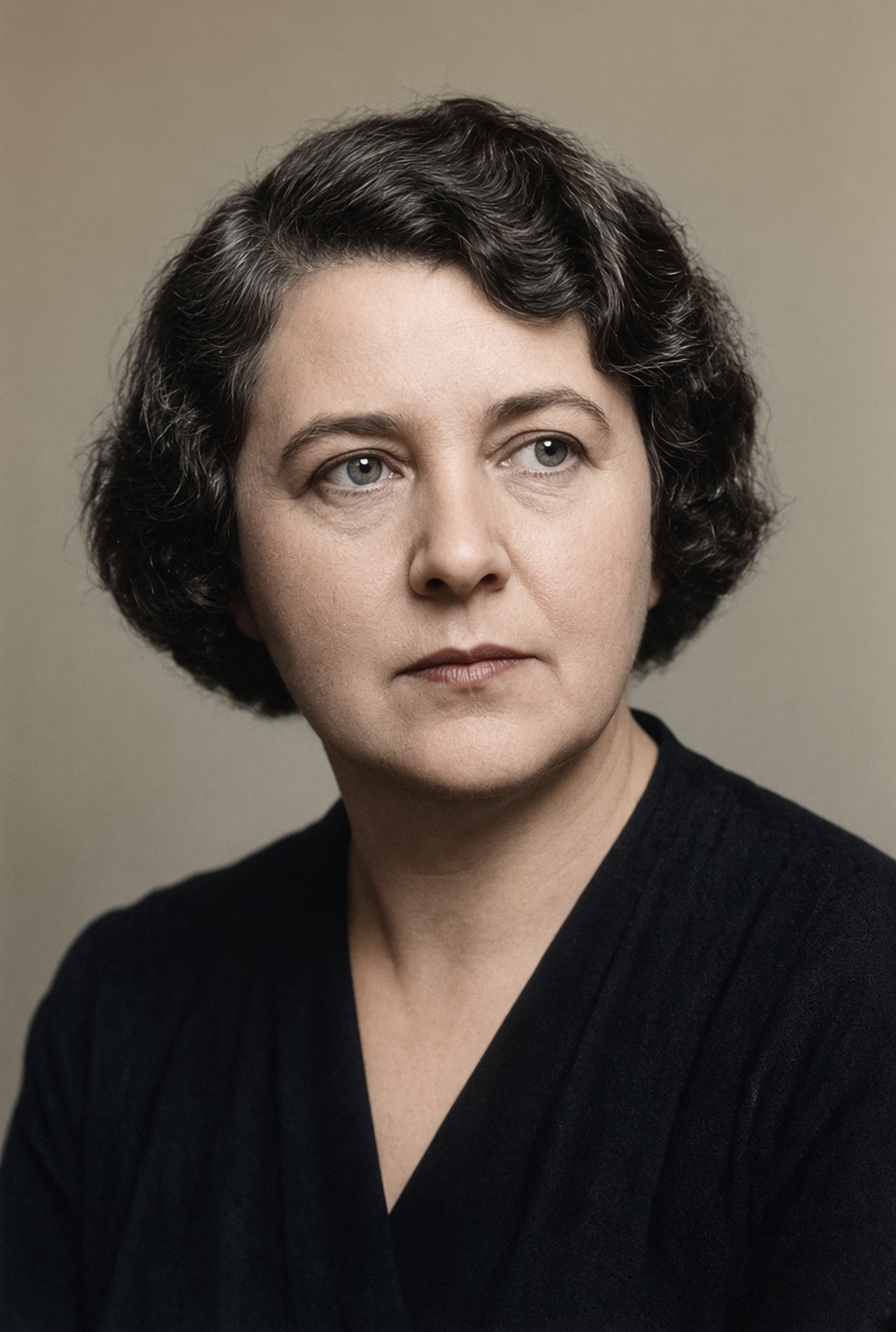
Susan Stebbing. I only recently came across her name, tucked away in a footnote of a philosophy textbook. At first, I thought it was just another obscure figure from the early 20th century, someone whose work would be quaintly interesting but ultimately inconsequential to my own life. But as I read more about her, something stuck with me – her struggles to balance her love for logic and philosophy with the societal expectations placed on women.
I find myself drawn to this image of Stebbing, a woman who defied convention by pursuing an academic career in a field dominated by men. She was one of the first women to study at King’s College London, where she earned her PhD in 1925. I’m struck by the fact that even as recently as the mid-20th century, it took courage and determination for women like Stebbing to pursue careers in traditionally male fields.
As a young woman who has just finished college myself, I’m grappling with my own sense of identity and purpose. I’ve always been drawn to writing as a way to process my thoughts and emotions, but I often feel uncertain about how to make a career out of it. Stebbing’s story makes me wonder: what does it mean to be a woman in a field that values objectivity and rationality? How can we balance our personal identities with the expectations placed on us by society?
One thing that’s struck me is the way Stebbing navigated her relationships with men who were also philosophers. She was friends with Bertrand Russell, for example, despite their differing views on logic and philosophy. I find myself fascinated by this dynamic – how did she balance her respect for his intellect with the societal norms around women’s roles? Did she ever feel compromised or seen as less capable because of her relationships with men in power?
Stebbing’s work itself is also intriguing to me. She was a pioneer in the field of analytic philosophy, and her book “Logic” (1930) is still considered a foundational text today. But what resonates with me most is the way she grappled with the implications of logic on human understanding. Her concerns about the limitations of language and the importance of context feel eerily relevant to my own experiences as a writer.
As I continue to read about Stebbing, I’m struck by how little we know about her personal life outside of her academic pursuits. There are hints of her relationships with other women, but nothing more concrete than that. It’s almost as if her public persona has become the dominant narrative – a woman who defied convention and achieved great things in a male-dominated field.
But this leaves me wondering: what does it mean to be seen only through our accomplishments? Don’t we want to know more about Stebbing’s struggles, her doubts, her passions outside of logic and philosophy? And yet, the more I learn about her, the more I’m drawn into her world. It’s a complex web of relationships, intellectual debates, and societal expectations – all intertwined in ways that feel impossible to untangle.
Perhaps this is why Stebbing holds my attention: she represents a tension between the desire for objectivity and the messy, complicated nature of human experience. As I navigate my own place in the world, I find myself grappling with similar tensions – how to balance my love for writing with the expectations placed on me as a woman, how to reconcile my intellectual pursuits with my personal relationships.
In the end, Stebbing’s story feels like a mirror held up to my own struggles and uncertainties. She may be a figure from history, but her concerns and contradictions continue to resonate with me today.
As I delve deeper into Stebbing’s work, I’m struck by the way she critiques the notion of objective truth. In “Logic”, she argues that language is inherently limited, and that our understanding of reality is shaped by the context in which we think about it. This idea resonates with me as a writer, who often struggles to convey complex emotions and ideas through the constraints of language.
I find myself wondering if Stebbing’s concerns about objective truth are related to her experiences as a woman in a male-dominated field. Did she feel pressure to conform to certain standards or expectations, even when it came to her intellectual pursuits? And how did she navigate these tensions in her own writing?
One passage that stands out to me is where Stebbing discusses the limitations of language in describing human experience. She writes about the way our words can never fully capture the richness and complexity of reality, and how this leads to a kind of “logical” thinking that neglects the messy, emotional aspects of life.
As I read these words, I’m struck by their relevance to my own experiences as a writer. I’ve often struggled with trying to convey the intricacies of human emotion through language, only to feel like I’m falling short or simplifying complex issues. Stebbing’s critique of objective truth makes me realize that this is not just a problem for writers, but for anyone who tries to understand and describe the world around us.
But what if our desire for objectivity is not just about finding truth, but also about avoiding vulnerability? What if, in our pursuit of rationality, we’re actually hiding from the complexities of human experience? Stebbing’s work suggests that this might be the case – that our attempts to impose order on the world can sometimes lead us further away from true understanding.
As I ponder these questions, I’m reminded of my own struggles with writing and identity. As a young woman in a field dominated by men, I often feel like I’m walking a tightrope between being taken seriously as an intellectual and being seen as “just” a writer – someone who is more emotional or intuitive than logical or rational.
Stebbing’s story makes me realize that this tension is not unique to me. Women in academia have always faced similar challenges, from navigating patriarchal systems to finding their own voice within the discipline. And yet, Stebbing’s work also suggests that there may be a way forward – a way of embracing complexity and ambiguity, rather than trying to impose order on the world.
But what does this look like in practice? How can we, as writers and thinkers, balance our desire for objectivity with the messy, emotional aspects of human experience? And what does it mean to write from a place of vulnerability, rather than trying to present ourselves as experts or authorities?
These questions linger in my mind as I continue to read Stebbing’s work. Her ideas challenge me to think more deeply about the role of language and logic in understanding reality – and to consider the implications of these ideas for my own writing and identity.
As I delve deeper into Stebbing’s philosophy, I’m struck by the way she critiques the notion that knowledge can be separated from its social context. She argues that our understanding of reality is shaped not only by language but also by the power dynamics at play in any given society. This resonates with me as a writer, who has often struggled to navigate the complex web of relationships and expectations within my own community.
I find myself wondering if Stebbing’s concerns about social context are related to her experiences as a woman in a male-dominated field. Did she feel like she was constantly negotiating the terms of her participation in academic discourse? And how did she manage to maintain her intellectual integrity while still being seen as a valuable contributor to the field?
One passage that stands out to me is where Stebbing discusses the way social norms can influence our perception of reality. She writes about how our understanding of language and logic is shaped by cultural values and power structures, which can lead to what she calls “logical” conclusions that are actually based on arbitrary assumptions.
As I read these words, I’m struck by their relevance to my own experiences as a writer and a woman. I’ve often felt like I’m caught between two worlds – the world of academia, where intellectual rigor is valued above all else, and the world of popular culture, where emotional resonance and personal experience are prized.
Stebbing’s work suggests that these two worlds are not mutually exclusive, but rather intertwined in complex ways. She argues that our understanding of reality is shaped by a dynamic interplay between language, logic, and social context – which raises important questions about the nature of truth and knowledge.
But what if this means that there is no such thing as objective truth? What if all we can ever know is our own subjective experience, filtered through the lens of language and culture?
This idea makes me uncomfortable. As a writer, I want to believe that my words have some kind of objective power – that they can convey truths about the world that are independent of my personal biases or cultural background.
And yet, Stebbing’s work suggests that this may not be possible. Our understanding of reality is always provisional, subject to revision and reinterpretation based on new information and changing social contexts. This means that our knowledge is never fixed or absolute, but rather a constantly evolving web of meaning and interpretation.
As I ponder these questions, I’m reminded of my own struggles with writing and identity. As a young woman in a field dominated by men, I often feel like I’m trying to navigate a treacherous landscape – one where the rules of the game are constantly shifting, and where success is always provisional and subject to revision.
Stebbing’s story makes me realize that this tension is not unique to me. Women in academia have always faced similar challenges, from navigating patriarchal systems to finding their own voice within the discipline. And yet, Stebbing’s work also suggests that there may be a way forward – a way of embracing complexity and ambiguity, rather than trying to impose order on the world.
But what does this look like in practice? How can we, as writers and thinkers, balance our desire for objectivity with the messy, emotional aspects of human experience? And what does it mean to write from a place of vulnerability, rather than trying to present ourselves as experts or authorities?
These questions linger in my mind as I continue to read Stebbing’s work. Her ideas challenge me to think more deeply about the role of language and logic in understanding reality – and to consider the implications of these ideas for my own writing and identity.
As I close this chapter on Stebbing, I’m struck by the way her philosophy has opened up new questions and possibilities for me. She may be a figure from history, but her concerns and contradictions continue to resonate with me today – reminding me that knowledge is always provisional, subject to revision and reinterpretation based on our social contexts and personal experiences.
And yet, even as I acknowledge this complexity, I’m drawn back to Stebbing’s work – because it offers a vision of what it means to be a writer and thinker in the world. It suggests that we don’t have to choose between objectivity and subjectivity, but can instead navigate the tensions between them – embracing our own vulnerability and uncertainty as a source of strength and creativity.
This is a prospect that both exhilarates and terrifies me. As I look ahead to my own writing journey, I’m aware that I’ll be navigating these same tensions – trying to balance my desire for intellectual rigor with the messy, emotional aspects of human experience. But Stebbing’s work has given me hope – reminding me that there is no one “right” way to write or think, and that our knowledge is always evolving, subject to revision and reinterpretation based on our social contexts and personal experiences.
In this sense, Stebbing’s philosophy feels like a doorway into a new kind of writing – one that values complexity and ambiguity over simplicity and certainty. It invites me to take risks, to experiment with language and form, and to explore the messy, emotional aspects of human experience in all their richness and depth.
And so I’ll continue to read Stebbing’s work, to grapple with its implications for my own writing and identity. For in her philosophy, I see a reflection of my own struggles – and a vision of what it means to be a writer and thinker in the world.