I was sitting at the kitchen table on Tuesday morning, trying to enjoy my first cup of coffee, when Mr Whiskers climbed onto my lap for the third time in fifteen minutes. Ordinarily, I wouldn’t complain about receiving affection from a cat, particularly one who usually treats my existence as an inconvenience unless I happen to be holding food. But this was different. He wasn’t interested in settling down or having his ears scratched. He would climb onto my lap, press his nose against my hand, meow insistently, and then jump down the moment I attempted to pet him. Afterward, he’d walk toward the living room, stop, and look back at me as though expecting me to follow. I’d already accompanied him twice, and both expeditions had ended beside the new cardboard activity center we’d recently built for him. He’d stare at the structure for a moment, sniff around its base, and then return to the kitchen to begin the process again. By the third attempt, I was beginning to suspect that something was wrong.
The activity center had been Pandora’s idea, although it had turned into a group project involving John Mercer, Mrs Jenkins, and even a few suggestions from Karen and Dave at work. The intention was to give Mr Whiskers something to occupy his attention so he’d stop waking the rest of us in the middle of the night. Unfortunately, the cat had initially shown more interest in the empty cardboard box used to carry the supplies than in the elaborate structure we’d assembled for him. He’d eventually started exploring the tunnels and batting at the dangling toys, which gave us some hope that the project hadn’t been a complete waste of time. But now he seemed strangely dissatisfied with the entire arrangement. He would approach it, inspect one particular corner, and then look at me with an expression that suggested I was failing to understand something important. Considering how frequently Mr Whiskers had managed to outsmart me recently, I wasn’t prepared to dismiss his behavior as meaningless.
John appeared in the kitchen carrying a bowl of cereal and looking considerably more awake than I felt. He’d finally recovered from the sleep disturbances Mr Whiskers had inflicted on him, largely because the cat had decided that my bedroom was a more promising destination for his nighttime activities. I asked whether he’d noticed anything unusual about Mr Whiskers that morning. John glanced toward the living room, where the cat was now sitting beside the activity center, staring at one of the cardboard tunnels. “He looks like a cat,” John said. I explained that he’d been unusually demanding and kept trying to lead me toward the same spot. John considered this for a moment before suggesting that perhaps Mr Whiskers wanted me to play with him. I pointed out that we’d spent a considerable amount of time and effort building an activity center specifically so the cat could entertain himself. John nodded. “And how’s that working out?” he asked. I decided the question didn’t deserve an answer.
Pandora was sitting at the other end of the table with her laptop open, finishing a few things before work. When I mentioned Mr Whiskers’ strange behavior, she smiled and said he’d been particularly interested in the new catnip toy Mrs Jenkins had brought over the previous evening. That caught my attention because I hadn’t realized Mrs Jenkins had given him another toy. Pandora explained that our neighbor had stopped by with a small fabric mouse she’d made from leftover material, filling it with a little dried catnip before sewing it closed. She’d thought Mr Whiskers might enjoy having something new to play with inside his activity center. Apparently, he’d been delighted when she first gave it to him, batting it across the living room and rolling around on the carpet with an enthusiasm he rarely demonstrated for the expensive toys we’d bought. I asked where the mouse was now, and Pandora admitted she wasn’t sure. She’d last seen it near the bookshelf before going to bed.
That was interesting because the bookshelf was exactly where I’d noticed a small disturbance earlier that morning. One of John’s magazines had been pushed slightly out of place, and there was a faint scattering of dried leaves on the floor beneath the bottom shelf. At the time, I’d assumed someone had dropped a little potting soil from one of Pandora’s houseplants. Now, however, I wondered whether the leaves might be catnip. I walked into the living room and crouched beside the shelf, examining the floor with renewed interest. Mr Whiskers immediately appeared beside me and began sniffing the same area. He pawed at the narrow gap beneath the shelf, then looked up at me and meowed. I leaned closer and spotted something gray tucked just beyond reach. It was the little fabric mouse Mrs Jenkins had made, and one of its seams appeared to have come loose.
I retrieved the mouse using a ruler from John’s desk and examined it carefully. The fabric was slightly damp from being carried around in Mr Whiskers’ mouth, and a small amount of dried catnip had escaped through the opening. That explained the scattered leaves, but it didn’t account for why Mr Whiskers had been so determined to lead me toward the activity center. I held the mouse up, and the cat immediately stood on his hind legs, reaching for it with both front paws. I told him he couldn’t have it until the seam was repaired, which was a perfectly reasonable precaution given that he’d already managed to pull some of the stuffing loose. Mr Whiskers responded by sitting down and staring at me with an expression of profound disappointment. John, who had followed me into the living room, watched the exchange and said, “Careful, Hal. Last time you took away one of his mice, he tried to negotiate a trade.” I remembered that incident very well and wasn’t eager to repeat it.
I placed the damaged toy on a high shelf and told Pandora what I’d found. She agreed that it needed repairing and said she’d ask Mrs Jenkins whether she had any more of the fabric she’d used. I assumed that would settle the matter, but Mr Whiskers had other ideas. He returned to the activity center, sniffed around the cardboard tunnels, and then began pawing at the corner nearest the window. He seemed particularly interested in a small opening where the cardboard walls overlapped. After several attempts, he managed to wedge one paw into the gap and pull out a loose piece of string. I moved closer to inspect it and discovered that someone had tied a second small fabric mouse inside the structure, suspending it from a short length of cord. The mouse was nearly identical to the damaged one, except that it was still intact. Mr Whiskers looked from the dangling toy to me and gave a hopeful chirp.
I was beginning to understand why he’d been so restless. Mrs Jenkins had apparently provided more than one catnip mouse, and Mr Whiskers had discovered that one of them was attached to the activity center in a position he couldn’t easily reach. The scent of catnip had probably made the entire structure considerably more interesting than it had been before. Unfortunately, the cat seemed to regard the dangling mouse as something he ought to be able to remove and carry around, rather than a toy designed to stay attached. I examined the cord and found that it had been tied securely enough to prevent the mouse from coming loose. That was sensible from a safety standpoint, provided the cord remained short and out of the cat’s reach when unsupervised, but Mr Whiskers clearly disagreed with the arrangement. He kept batting at the mouse, attempting to catch it between his paws, and then turning toward me whenever it swung away.
I called Pandora over and showed her what I’d discovered. She laughed and explained that Mrs Jenkins had suggested attaching one of the mice to the activity center to encourage Mr Whiskers to use it. Apparently, our neighbor had been experimenting with different catnip mixtures and had discovered that Mr Whiskers responded particularly well to the one she’d used in these toys. Pandora had agreed to try it, hoping it would make the activity center more appealing. I looked at the dangling mouse, then at Mr Whiskers, who was now rolling enthusiastically across the carpet. Suddenly, the cat’s unusual behavior made considerably more sense. He wasn’t trying to tell me that something was wrong with the activity center. He was trying to convince me to help him obtain the one toy he couldn’t carry away.
That should have been the end of the investigation, but I couldn’t help wondering whether Mrs Jenkins had anticipated the result. She’d been involved in the activity center project from the beginning, and she knew perfectly well how determined Mr Whiskers could become when he wanted something. She’d also been the person who suggested adding catnip toys to encourage him to use the structure. If she’d deliberately placed an especially attractive toy just beyond his reach, then she’d effectively created a situation in which the cat would spend hours trying to get it. That might be excellent entertainment for Mr Whiskers, but it also meant he’d spend those hours pestering whichever human happened to be nearby. I wasn’t accusing Mrs Jenkins of anything malicious, of course. I simply wondered whether she’d realized how much trouble a little fabric mouse could cause.
Later that morning, I encountered Mrs Jenkins outside while taking the trash to the bins. She was tending to the plants near her front steps, wearing her usual cheerful expression. I thanked her for making the catnip toys and mentioned that Mr Whiskers had become unusually interested in the one attached to his activity center. She looked delighted. “Oh, good! I was hoping he’d like that one,” she said. I asked whether she’d intended for him to be able to remove it, and she shook her head. She explained that she’d suggested attaching it securely so he could bat at it without immediately losing it beneath the furniture. That was reasonable, although I pointed out that Mr Whiskers seemed determined to retrieve it anyway. Mrs Jenkins laughed and said, “Well, he’s always been a clever little fellow. I suppose he doesn’t like being told what he can and can’t have.” I couldn’t argue with that assessment, particularly given the cat’s recent history.
As we talked, Mrs Jenkins mentioned something else that caught my attention. She’d been using a slightly stronger catnip mixture than usual because the previous toys hadn’t held Mr Whiskers’ interest for very long. She’d made several small mice for him, but had only given Pandora two to start with so they could see how he responded. I asked whether she thought the new mixture might explain his unusual enthusiasm. She smiled and said that was probably the case. “Some cats get very playful when they smell catnip,” she explained. “Others just roll around and look pleased with themselves.” I considered this information carefully. Mr Whiskers had been doing both, along with repeatedly attempting to recruit me into his efforts to liberate the dangling mouse. Mrs Jenkins seemed pleased that her experiment had worked, but I was beginning to suspect that she hadn’t fully considered the consequences for the rest of the household.
When I returned home, John was sitting on the couch watching Mr Whiskers attack the activity center with renewed determination. The cat had managed to climb halfway inside one of the cardboard tunnels and was reaching through an opening toward the dangling mouse. Every time he touched it, the toy swung away, forcing him to reposition himself and try again. John looked thoroughly entertained. “He’s been doing that for ten minutes,” he said. I explained that Mrs Jenkins had used a stronger catnip mixture and that the dangling mouse was apparently irresistible. John nodded. “So the cat’s having fun,” he said. I pointed out that Mr Whiskers had spent much of the morning demanding my assistance, which suggested that his entertainment was coming at my expense. John considered this for a moment before saying, “Sounds like he’s having even more fun than I thought.”
I decided to make a small adjustment to the activity center. Rather than leaving the mouse attached where Mr Whiskers could become frustrated trying to remove it, I untied the cord and gave him the toy directly, making sure there were no loose strings or damaged seams. The effect was immediate. Mr Whiskers seized the mouse in his mouth, carried it triumphantly across the living room, and dropped it beside the couch. He then rolled onto his back, wrapped both front paws around the toy, and began kicking it with his hind legs. For several minutes, he seemed completely satisfied. I watched with a sense of accomplishment, pleased that I’d solved the problem without requiring any further assistance. John looked at the cat, then at me, and said, “Congratulations. You’ve successfully given a cat a toy.” I told him that the process had involved considerably more analysis than he appreciated.
By lunchtime, however, I discovered that my solution had created an entirely new problem. Mr Whiskers had carried the mouse into the hallway, abandoned it beside my bedroom door, and then returned to the living room to demand another one. When I refused to retrieve the damaged mouse from the shelf, he began searching the activity center as though convinced there must be more toys hidden inside. He climbed through the tunnels, inspected the cushion, and even attempted to pull apart one of the cardboard panels. I watched him for several minutes before realizing that he’d apparently learned a new lesson from the experience: if he bothered me long enough, I would eventually produce something interesting. That was not the lesson I’d intended to teach him, and I suspected Pandora would have something to say about it when she got home.
Sure enough, when Pandora returned that evening and I explained what had happened, she gave me a sympathetic smile that suggested she was trying not to laugh. She pointed out that Mr Whiskers had been perfectly happy playing with the attached mouse until I decided he needed help retrieving it. I reminded her that he’d been pestering me all morning, but she suggested that I might have encouraged the behavior by responding every time he demanded attention. John, who was listening from the couch, immediately agreed. “He trained you,” he said. I objected to that characterization, explaining that I’d simply been trying to understand what the cat wanted. John nodded. “Exactly. He wanted you to give him the mouse, and you did.” I looked at Mr Whiskers, who was sitting beside the activity center with an expression of complete innocence, and began to suspect that John had a point.
Pandora repaired the damaged mouse that evening, checking the stitching carefully before returning it to the toy basket. We also decided to keep the catnip toys for supervised play rather than leaving them available all the time, since Mr Whiskers had demonstrated a remarkable ability to turn even a small piece of fabric into a household emergency. The activity center remained in the living room, and the cat continued using it whenever the mood struck him. Without the dangling mouse, however, he seemed considerably less interested in demanding my assistance. He would climb through the tunnels, bat at the ordinary toys, and then settle down for a nap. For the first time all day, the apartment was peaceful. I was beginning to think we’d finally established a sensible arrangement.
The following afternoon, Mrs Jenkins stopped by to see how Mr Whiskers was enjoying his new toys. Pandora thanked her again and explained that we’d discovered the stronger catnip mixture was a little too exciting for him. Mrs Jenkins looked surprised, then amused when I described how the cat had spent the morning trying to persuade me to remove the dangling mouse. She laughed so hard that she had to sit down for a moment. “Oh, Hal,” she said, “I didn’t mean for him to keep you busy all day. I just thought he’d enjoy something new.” I assured her that I understood, although I admitted that I’d briefly wondered whether she’d deliberately created the situation. She looked at me with a twinkle in her eye and asked, “Would I do something like that?” Before I could answer, Mr Whiskers appeared beside her chair and began rubbing affectionately against her ankles.
Mrs Jenkins reached into her handbag and produced a small, sealed container. Mr Whiskers immediately sat down, staring at it with such intensity that I wondered whether he recognized the smell through the lid. She explained that she’d brought another catnip mouse, this one made with a milder mixture and reinforced stitching. Pandora thanked her and suggested that we save it for another day. Mrs Jenkins agreed, but Mr Whiskers was already watching the container as though he’d just discovered the location of a valuable treasure. When she put it back in her bag, he followed the movement with his eyes and then walked around her chair, apparently searching for a way to get closer. I watched the entire performance with growing suspicion. Mrs Jenkins might not have intended to cause trouble, but she certainly seemed to know how to capture the cat’s attention.
After she left, I found Mr Whiskers sitting beside the front door, staring at the spot where Mrs Jenkins had been standing. He looked up at me and gave a small, hopeful meow. I told him that the new mouse was being saved for another day and that he would have to make do with the toys he already had. He considered this information for a moment, then walked toward the living room and settled into the empty cardboard box we’d kept beside the activity center. I watched him curl up and close his eyes, apparently satisfied that the conversation was over. It occurred to me that the entire mystery had been remarkably straightforward. Mrs Jenkins had made a new toy, Mr Whiskers had become obsessed with it, and I’d spent most of the day trying to understand why the cat was behaving strangely. The only person who seemed to have enjoyed the investigation more than Mr Whiskers was John.
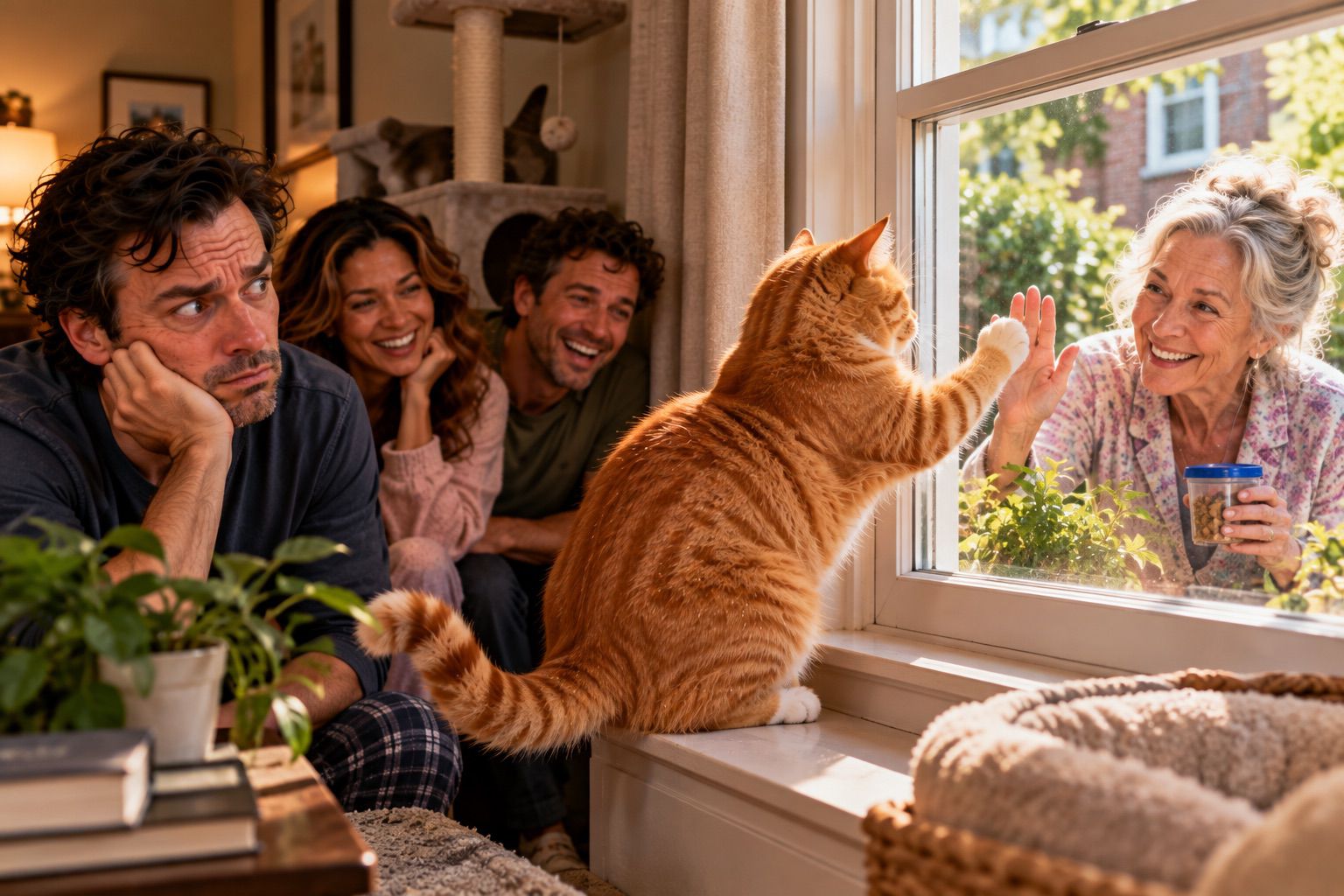
I suppose the lesson is that a neighbor’s generosity can sometimes have unexpected consequences, particularly when the recipient is an orange cat with unlimited determination and very little respect for anyone else’s schedule. Mrs Jenkins hadn’t been plotting against me, Pandora hadn’t been hiding anything, and John hadn’t been involved in some elaborate scheme. They’d simply been trying to make Mr Whiskers happy, which was a perfectly reasonable goal until the cat decided that happiness required my constant participation. Still, I couldn’t entirely shake the feeling that Mrs Jenkins understood Mr Whiskers better than the rest of us. She knew exactly which toys he liked, which treats would get his attention, and how to make him forget everything else in the room. As I finished my coffee that evening, I noticed Mr Whiskers sitting on the windowsill, staring toward Mrs Jenkins’ apartment with an expression of intense concentration. A moment later, she appeared at her window and gave him a little wave. Mr Whiskers immediately began meowing, his tail twitching with excitement. I watched the exchange for several seconds before turning toward Pandora. “You know,” I said, “I’m starting to think those two have an understanding.” Pandora glanced at the window, smiled, and said, “Of course they do. She gives him treats.” I considered that explanation, but I wasn’t entirely convinced it was the whole story. After all, Mrs Jenkins had managed to keep Mr Whiskers entertained, disrupt my morning, and leave the apartment without lifting a finger. If that wasn’t an impressive piece of feline coordination, I wasn’t sure what was.