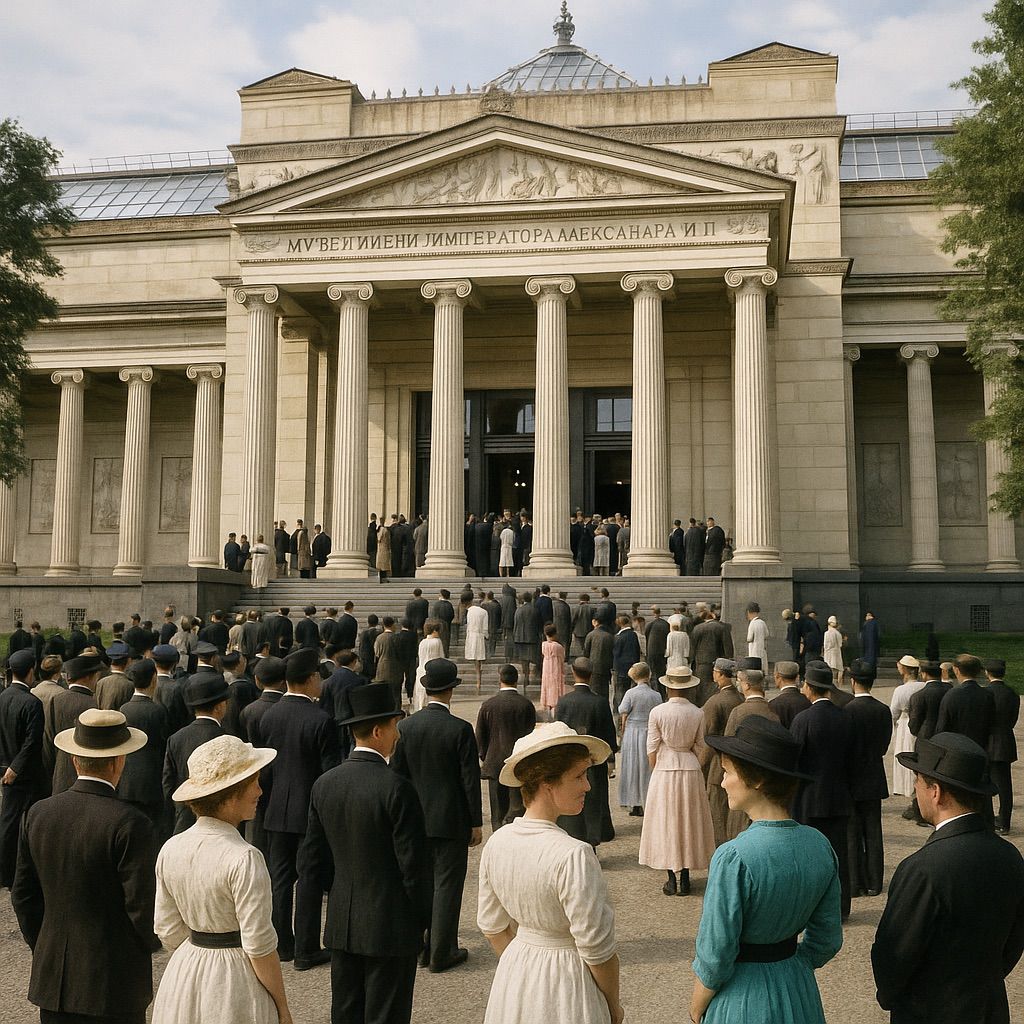
When the Pushkin Museum of Fine Arts first opened its doors in Moscow on May 31, 1912, the city was on the brink of a transformation it could not yet name. Russia was still an empire, its monarchies and ministries humming with old-world rituals and finely polished decorum. The First World War was two years away, the Revolution five. Moscow was a place of horse-drawn carriages and electric lamps awkwardly sharing the same streets. There was a sense, even then, that the world was shifting under the feet of its citizens, but no one yet knew which future was coming or what shape it would take.
And yet, on that spring day, as visitors stepped into the newly opened Museum of Fine Arts—later to be renamed in honor of Alexander Pushkin—they felt something unmistakably modern. A museum dedicated not to imperial triumphs, nor to military relics, nor to scientific oddities, but to art. A museum designed to educate, to inspire, to bring the finest works of world civilization to a city that had so often felt geographically and culturally distant from the West. It was, from the beginning, a museum with a mission—to bridge worlds, collapse distances, and offer its visitors a way to see humanity through the shared language of creativity.
The museum’s founder, Professor Ivan Tsvetaev, had been dreaming of such a museum for decades. A classical philologist with an unshakable belief in the educational power of art, Tsvetaev had spent nearly his entire career arguing that Russia deserved a world-class institution dedicated to the study of ancient cultures. He imagined a place where students could stand face-to-face with the artistic achievements of Greece, Rome, Egypt, and the Renaissance—not merely through textbook illustrations or crude plaster casts, but through faithful reproductions and, eventually, originals. His idea was not universally popular. Some saw it as too ambitious, too academic, or too costly. But Tsvetaev had something even more powerful than institutional support: he had persistence, and he had patrons.
Among those patrons was one of Russia’s most influential families, the Shchukins, whose wealth and cultural passion helped fund some of the most cutting-edge artistic movements of the early twentieth century. Moscow at the time was a city of contradictions—deeply traditional on the surface, yet bubbling with a quiet avant-garde energy that had begun to attract artists, thinkers, and dreamers. The opening of the museum reflected that tension. It was a temple of classical art built in a city where modernism, futurism, and expressionism were beginning to crack the veneer of old-world restraint.
As the public stepped inside the museum for the first time, they were greeted by vast halls filled with casts of masterpieces. To modern eyes, the idea of a museum full of reproductions might seem strange, but at the time it was revolutionary. These casts were painstakingly created from originals across Europe and the Mediterranean, allowing ordinary Russians to stand before works they might otherwise never see. The building itself, with its neoclassical façade and its soaring columned atrium, was more than an architectural achievement—it was a statement of aspiration, a promise that Russia would no longer view culture as something imported but as something integral to its identity.
The museum’s early visitors—students, scholars, aristocrats, curious families—reacted with a mixture of awe and something more intimate: a sense of being connected to a broader story of human expression. To walk through the museum was to travel through time, from ancient Egypt’s solemn statues to Greece’s harmonic proportions to the textured realism of the Renaissance. For many Russians, these works represented not only beauty but a glimpse of a world beyond their own borders—a world often romanticized, debated, or misunderstood, but rarely encountered firsthand.
The timing of the museum’s opening added to its poignancy. Within just a few years, Russia would descend into the chaos of war and revolution. The old empire would crumble, and the new Soviet state would emerge with a radically different vision of culture and society. And yet, through all the upheaval, the museum endured. Its collections grew. Its mission shifted but survived. Even as the Soviet government reshaped artistic life with rigid ideological expectations, the Pushkin Museum retained its identity as a guardian of world art and a sanctuary of aesthetic freedom.
One of the most remarkable aspects of the museum’s early decades was the influx of new works that found their way into its halls—sometimes through official channels, sometimes through serendipity, sometimes through the complicated movement of private collections. The museum became a repository of treasures confiscated, purchased, donated, or otherwise transferred during the turbulent years of revolution and nationalization. Masterpieces by Rembrandt, Botticelli, and Rubens joined the collection. Entire rooms were dedicated to ancient artifacts from excavations that had stretched across continents.
And then came the twentieth century’s great test of cultural endurance: the Second World War. As German forces approached Moscow in 1941, the museum initiated a massive evacuation effort. Paintings, sculptures, manuscripts, and archaeological materials were carefully cataloged, crated, and transported to the Urals, where they would remain until the war was over. The empty halls of the Pushkin Museum stood silent through the darkest years of the conflict, waiting for the return of the works that defined its heart and purpose.
When the war ended and the collections were returned to Moscow, the museum became a symbol of resilience—proof that art could outlast destruction, that culture could survive not only politically turbulent times but global catastrophe. The museum’s reopening was not just a cultural milestone; it was a moment of healing for a country that had lost millions of lives and countless treasures. To walk through its galleries in the late 1940s was to feel the weight of history and the possibility of renewal at once.
But the Pushkin Museum did not remain static. In the decades that followed, it embraced modern and contemporary art more fully. Exhibitions of French Impressionists, once controversial, became celebrated. Works by Picasso, Matisse, and Van Gogh found their place among the museum’s most famous holdings. The museum became known not only for its classical collections but for the extraordinary breadth of its modern and post-impressionist works—many of which had been brought to Russia by visionary collectors like Sergei Shchukin and Ivan Morozov.
By the late twentieth century, the Pushkin Museum was more than a museum. It was an international cultural institution, a place where exhibitions drew crowds not only from Russia but from all over the world. It became a site of diplomacy and exchange, a stage for collaborations with major museums in Europe, Asia, and the Americas. As Moscow transformed into a modern global city, the museum stood as a reminder that culture—far from being a static artifact—was a living dialogue between peoples and eras.
Walking through the museum today, you can still feel echoes of its beginning. The marble floors and grand staircases remember the footsteps of those first visitors in 1912. The casts of ancient sculptures still stand in their original positions, quiet companions to the originals now displayed alongside them. And yet the museum also feels wonderfully alive—filled with schoolchildren, art lovers, scholars, families, and tourists who come seeking beauty, history, and understanding.
There is a special kind of silence that fills the Pushkin Museum—not the silence of solemnity, but the silence of engagement, the pause that happens when someone confronts a painting or sculpture that moves them in a way they can’t quite explain. It is the silence of connection, of discovery, of being transported beyond the boundaries of time and geography. That silence is part of what Tsvetaev hoped for when he envisioned the museum: a place where people could come face-to-face with the great achievements of human creativity and leave changed in ways they couldn’t yet articulate.
The legacy of the Pushkin Museum’s opening is not just its architecture or its collections but its belief in the transformative power of art. Its founders understood something timeless—that art is not a luxury or an ornament to society but a fundamental expression of what it means to be human. Through wars, revolutions, political upheavals, and generational shifts, the museum has remained steadfast in its purpose: to preserve, to teach, to inspire.
And it all began on that spring day in 1912 when a new kind of museum opened its doors in Moscow—one that would go on to touch millions of lives, shape cultural understanding, and serve as one of the great artistic pillars of the modern world. The Pushkin Museum was not just an institution. It was a promise. A promise that beauty would endure. That knowledge would be shared. That art, in all its complexity and power, would remain accessible to all who sought it.
More than a century later, that promise continues to hold.