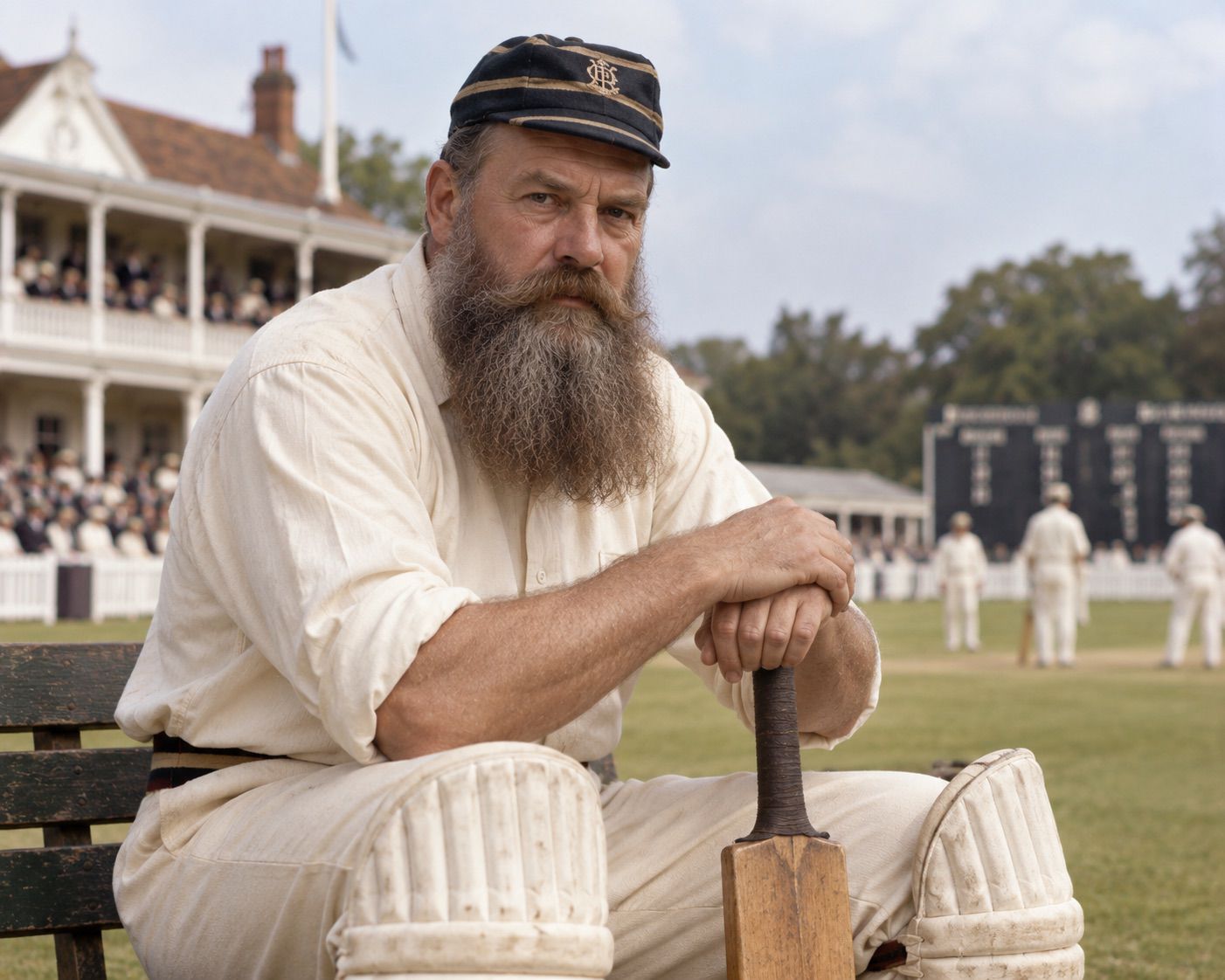
I’ve always been fascinated by W.G. Grace, the English cricketer from the 19th century. As I write about him, I’m drawn to his contradictions – a man who was both revered and reviled, admired for his skill on the field yet criticized for his attitude towards women. It’s this complexity that keeps me coming back to him.
I think part of what intrigues me is how Grace navigated (or perhaps didn’t navigate) the societal expectations placed upon him as a public figure. He was a sportsman, a member of Parliament, and a celebrity in his time – but also a son of a clergyman and grandson of an Anglican bishop. It’s hard to imagine what kind of pressures he faced, playing cricket for England while also being part of this influential, yet somewhat stuffy, social circle.
As I read about Grace’s life, I find myself thinking about my own experiences with sports and identity. Growing up, I played soccer and loved the sense of belonging that came with it – but also struggled with feeling like I didn’t quite fit in because I wasn’t as skilled or competitive as some of my teammates. It’s funny how sports can both unite us and create these tiny, insignificant hierarchies.
I’ve always been drawn to Grace’s reputation for being hot-headed on the field – he was known for his aggressive playing style and willingness to take risks. But what strikes me is how this image coexists with accounts of him being dismissive or even cruel towards women who crossed his path. It’s a weird kind of double standard, where we celebrate his confidence and competitiveness in one context while excusing (or ignoring) his behavior in another.
I don’t know if I’m ready to excuse or ignore it, either – but I do think that’s part of what makes this all so complicated. As someone who writes about their thoughts and feelings, I’ve learned to be okay with uncertainty and ambiguity. Maybe that’s why W.G. Grace holds my attention – because he’s a reminder that people are messy, contradictory things, even (or especially) when they’re heroes or legends.
I’m not sure where this all goes from here – maybe into the world of sports history, maybe deeper into the psychology of identity and expectation. For now, though, I’m just stuck on this weird tension between Grace’s brilliant cricketing skills and his off-putting behavior. It feels like a puzzle that’s still incomplete, one that I’m not sure I want to solve – but also can’t help but try to piece together.
As I sit here with my thoughts on W.G. Grace swirling in my head, I find myself wandering back to the cricket pitch itself. What was it like to play a game that demanded such skill and precision, yet also allowed for moments of raw emotion and physicality? I’ve never been much of an athlete myself, but I love watching sports and imagining what it would be like to be part of something so intense and communal.
I think about the crowds that must have gathered to watch Grace play – cheering him on one minute, jeering at him the next. It’s a kind of social dynamic that I’m all too familiar with, having grown up in a small town where everyone knew each other’s business. There was always someone who seemed to embody the contradictions and complexities of our little community, and it was almost as if they were a reflection of us all – our flaws and virtues, our triumphs and failures.
I wonder what it would have been like for Grace, playing in front of those crowds, with his family’s reputation and social standing on the line. Was he more concerned with winning or with maintaining this image of himself? Did he ever feel trapped by the expectations that came with being a famous cricketer, or was he someone who reveled in the attention?
These are questions I’ll probably never have answers to, but they’re ones that keep me up at night. Because when we talk about historical figures like W.G. Grace, it’s easy to get caught up in the myths and legends surrounding them – to forget that they were human beings, with all their own doubts and fears and insecurities.
I’m not saying I want to reduce him to some kind of relatable everyman; but at the same time, I think there’s something powerful about recognizing our shared humanity, even across centuries. Maybe it’s because I’ve always struggled with feeling like an outsider in my own life – always trying to find my place within the world around me.
As a writer, I’m drawn to the margins and the gray areas – the spaces where people don’t fit neatly into categories or expectations. W.G. Grace might have been a cricketing legend, but he was also someone who embodied that tension between perfection and imperfection, between heroism and humanity. And it’s this complexity that keeps me coming back to him, again and again.
The more I think about it, the more I realize how much of a mirror W.G. Grace is to my own struggles with identity and expectation. As someone who’s always been a bit of an outsider in her own family, I know what it’s like to feel like you don’t quite fit in – even when everyone around you seems to be moving in the same direction. And yet, at the same time, there’s something about being seen as “different” that can be both empowering and isolating.
I think this is what draws me to Grace’s story – his own sense of disconnection from the world around him, despite (or because of) his fame and privilege. He was a member of Parliament, for goodness’ sake! You’d think he’d have had it all together, but instead, he seems to have been haunted by his own demons – his hot-headedness on the field, his dismissiveness towards women, his complicated relationships with his family.
It’s almost as if Grace is saying that even those of us who appear to be most successful or accomplished can still feel lost and uncertain. And I think that’s something we need to hear more often, in a world where everyone’s supposed to have it all together on social media. Where are the stories about people struggling with anxiety, or depression, or simply feeling like they don’t quite fit?
As I sit here thinking about W.G. Grace, I’m struck by how much his story is still unfolding – even after all these years, we’re still trying to make sense of him, still trying to understand what made him tick. And maybe that’s the point – maybe it’s not about solving some kind of puzzle or reducing a complex person to a few neat labels. Maybe it’s just about being willing to stay with the messiness, the uncertainty, and the contradictions.
For me, writing is all about exploring these kinds of complexities – trying to tease out the threads that make us who we are, and how those threads intersect (or clash) with the world around us. And W.G. Grace feels like a particularly rich vein to explore, because he’s both familiar and strange – someone we think we know, yet can’t quite pin down.
As I wrap up my thoughts for now, I’m still left wondering about what it would have been like to meet Grace in person – to see him on the cricket pitch, his bat swinging through the air, his eyes flashing with intensity. Would I have felt intimidated by him? Inspired? Or perhaps something more complicated, like a mixture of both?
I suppose that’s the thing about people like W.G. Grace – they’re always going to be a puzzle, a mystery that we can’t fully solve or understand. And maybe it’s okay if we don’t – maybe that’s just part of what makes them so compelling in the first place.
As I close my notebook and take a step back from W.G. Grace’s story, I’m struck by how much it feels like my own. The complexities, the contradictions, the sense of disconnection – it all resonates deeply with me. And yet, at the same time, I feel like I’m only scratching the surface of what makes him tick.
I think about my own struggles with identity and expectation, and how they’ve shaped my experiences as a writer. I’ve always been drawn to stories that explore the gray areas between right and wrong, good and bad – the places where people are messy, imperfect, and human. And W.G. Grace feels like a masterclass in that kind of complexity.
But what really fascinates me is how his story intersects with mine. As someone who’s always felt like an outsider in her own family, I know what it’s like to feel like you don’t quite fit in – even when everyone around you seems to be moving in the same direction. And yet, at the same time, there’s something about being seen as “different” that can be both empowering and isolating.
I wonder if W.G. Grace ever felt that way too – like he was caught between two worlds, unsure of which one he belonged to. Was it the world of cricket, with its strict rules and expectations? Or was it the world of high society, with its intricate social hierarchies and moral codes?
As I sit here pondering these questions, I realize that W.G. Grace’s story is still unfolding – even after all these years, we’re still trying to make sense of him, still trying to understand what made him tick. And maybe that’s the point – maybe it’s not about solving some kind of puzzle or reducing a complex person to a few neat labels.
Maybe it’s just about being willing to stay with the messiness, the uncertainty, and the contradictions. For me, writing is all about exploring these kinds of complexities – trying to tease out the threads that make us who we are, and how those threads intersect (or clash) with the world around us. And W.G. Grace feels like a particularly rich vein to explore.
As I close my eyes and imagine myself on the cricket pitch, watching W.G. Grace play, I feel a sense of wonder wash over me. What would it be like to see him in action, his bat swinging through the air, his eyes flashing with intensity? Would I have felt intimidated by him? Inspired? Or perhaps something more complicated, like a mixture of both?
I suppose that’s the thing about people like W.G. Grace – they’re always going to be a puzzle, a mystery that we can’t fully solve or understand. And maybe it’s okay if we don’t – maybe that’s just part of what makes them so compelling in the first place.
As I drift back into my thoughts, I realize that I’m not sure where this journey with W.G. Grace will take me next. Will I continue to explore his life and legacy? Or will I move on to other stories, other complexities, other contradictions?
For now, though, I’m content to sit here in the quiet, surrounded by my thoughts and my words. Because when it comes down to it, that’s what writing is all about – exploring the messiness of human experience, one word at a time.
As I sit here, surrounded by the echoes of W.G. Grace’s story, I’m struck by how much his complexities resonate with me. It’s as if he’s speaking directly to my own experiences, my own struggles with identity and expectation. And it’s not just about the surface-level stuff – it’s about the deeper, more nuanced aspects of being human.
I think back to my own family dynamics, where I’ve often felt like an outsider looking in. My parents are both highly educated, with careers that have taken them to different parts of the world. They’re intelligent and accomplished, but they also come from a traditional background – one that values certain things above others. And sometimes, I feel like I’m caught between two worlds, unsure of which one I belong to.
It’s funny how sports can be both a source of connection and a source of disconnection. When I was playing soccer in high school, I felt like I’d finally found my tribe – people who shared my passions and values, people with whom I could connect on a deeper level. But at the same time, there were always those who didn’t quite fit in, who struggled to keep up or felt left out.
W.G. Grace’s story feels like a reminder that these kinds of dynamics are universal – that we’re all struggling to find our place in the world, to navigate the complexities and contradictions of human experience. And it’s not just about sports or family or social status – it’s about the deeper, more fundamental aspects of who we are.
As I sit here, reflecting on W.G. Grace’s life and legacy, I’m struck by how much he reminds me of myself. We’re both outsiders in our own ways – he, as a member of Parliament with a complicated family background; me, as a writer trying to find my voice in a world that often values certainty over complexity.
And yet, despite these similarities, there’s something about W.G. Grace that feels almost…familiar. As if I’ve known him all along, or at least, known the feeling of being him. It’s hard to explain – but it’s like we’re connected on some deeper level, one that transcends time and space.
I don’t know what it means, exactly – but I do know that W.G. Grace is a reminder that we’re all more complex than we seem. We’re all messy, imperfect, human beings, struggling to make sense of the world around us. And maybe that’s the most important thing about his story – not just the cricket or the politics, but the deeper, more profound aspects of who he was and what he represented.
As I close my notebook and take a step back from W.G. Grace’s story, I’m left with more questions than answers. What does it mean to be human? How do we navigate the complexities and contradictions of our own lives? And how can we find connection and community in a world that often values division and discord?
I don’t have any easy answers – but I do know that W.G. Grace’s story has given me something valuable: a sense of empathy, a sense of understanding, and a reminder that we’re all more alike than we are different.
And as I drift back into my thoughts, I realize that this is what writing is all about – exploring the messiness of human experience, one word at a time.