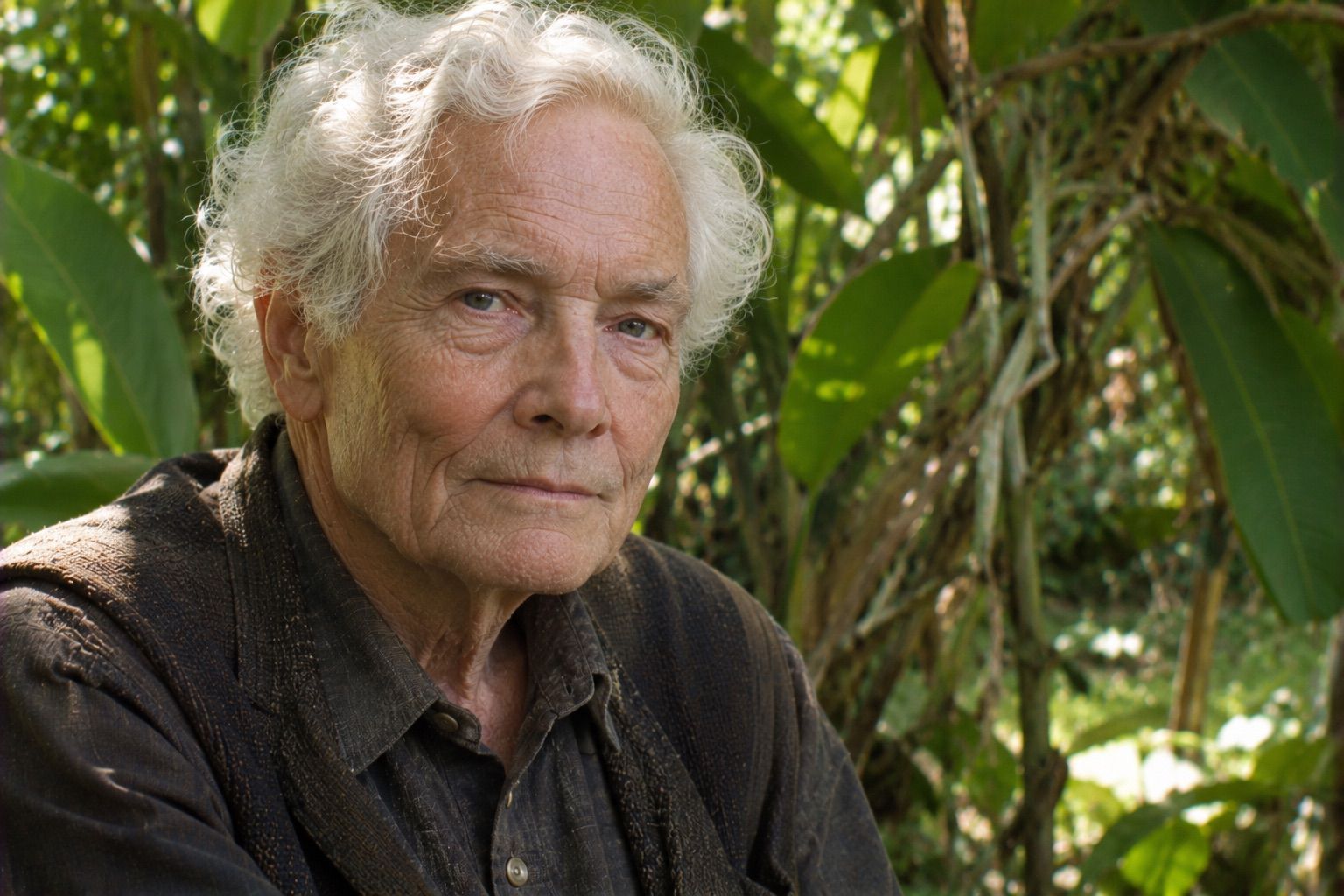
I still remember the first time I stumbled upon W.S. Merwin’s poetry. I was a college junior, rummaging through the shelves of my school’s library, searching for something to spark inspiration for my own writing. His name caught my eye – not because I’d heard of him before, but because it seemed so…unassuming. A middle initial and a last name that blended into the background. It was as if he didn’t want to draw attention to himself, content with letting his words speak instead.
As I began to read through his collections, I felt a strange sense of discomfort. His language was lyrical, but it often skirted around directness, veiled in subtlety and metaphor. I found myself rereading lines multiple times, searching for the hidden truth he seemed to be hinting at. It was like trying to decipher a code that only revealed itself when I wasn’t looking directly at it.
I remember feeling frustrated with his poetry at first – it didn’t conform to what I thought writing should be: clear, concise, and straightforward. But as I continued to read, something shifted inside me. His words began to seep into my skin like a slow-moving fog, creeping up on my emotions before I even knew they were there.
One of the things that drew me in was his deep connection to nature. His poetry is infused with an almost primal sense of wonder and awe, as if he’s constantly encountering the world for the first time. It made me feel like I was reading someone who truly understood the interconnectedness of everything – not just humans, but trees, rivers, mountains. He seemed to see the world in a way that I couldn’t quite grasp, and yet…
And then there were the translations. Merwin’s work as a translator is something I only discovered later on, after I’d already fallen under his spell as a poet. But once I learned about it, I felt like I was reading him through a different lens entirely. His translations of ancient texts – the Epic of Gilgamesh, The Song of Roland – revealed a mastery over language that seemed almost otherworldly.
It’s funny how, when I think back on my time with Merwin’s work, I realize it was never just about his poetry or even his writing in general. It was more like…I was trying to understand him. To grasp the depth of his connection to the world around him, and why that seemed so crucial to his art. But the truth is, I still don’t fully get it.
Sometimes I wonder if my interest in Merwin stems from a desire for something I’ve lost myself – a sense of reverence for the natural world, perhaps, or a willingness to see things from angles I’d never considered before. Was he somehow tapping into an aspect of myself that had been dormant all along? And even if so…does that make his poetry any less valid?
It’s strange how a writer can become such a fixture in your life – like Merwin has for me. Sometimes I’ll be walking through the woods, and suddenly a phrase or image from one of his poems will pop into my head, unbidden. It’s as if our minds have gotten tangled together somehow, like the threads of two separate looms.
I’m not sure what it is about Merwin that keeps drawing me back in. Is it the way he sees the world? The way he writes about it? Or something more fundamental still – a sense of longing for connection, perhaps, or an understanding of the mysteries we can’t quite grasp? Whatever it is, I know this much: whenever I return to his work, it’s like finding myself at a crossroads, wondering which path to take next.
As I continue to grapple with Merwin’s work, I find myself fascinated by the way he inhabits multiple worlds at once – the world of poetry, translation, and nature all blending together in a way that feels both seamless and jarring. It’s as if he’s a chameleon, adapting to each new context while remaining fundamentally himself.
I think about how his poetry often feels like a gentle exploration, a meandering through the woods without a clear destination in sight. And yet, it’s precisely this sense of uncertainty that makes his work so compelling – the way he seems to be uncovering secrets, not just about the world around him, but about himself.
Sometimes I wonder if Merwin’s relationship with nature is somehow tied to his own sense of disconnection from the world. He’s spoken about feeling like an outsider in his own family, and how this has influenced his writing. I think about my own experiences as a writer – the times when I’ve felt like I don’t quite fit in, or that my words are being received by others through a filter.
But what strikes me most is the way Merwin’s work seems to resist categorization. He’s been called everything from a poet to a mystic, and yet his writing defies easy labels. It’s as if he’s inhabiting multiple genres at once – poetry, essay, translation – and blurring the lines between them.
This refusal to be pinned down is something I deeply admire about Merwin. As a writer myself, I know how tempting it can be to try to fit into neat categories or follow established formulas. But Merwin’s work shows me that there’s beauty in uncertainty, in the spaces where genres and forms blur together.
As I continue to explore his poetry and translations, I find myself drawn back to this sense of wonder – not just at the world around him, but at the way he sees it. It’s as if he’s a lens, refracting light into new and unexpected shapes. And I’m left wondering: what would happen if I tried to see the world through his eyes?
As I delve deeper into Merwin’s work, I find myself questioning my own relationship with nature. Growing up, I spent a lot of time outdoors – hiking with my family, exploring the woods behind our house. But as I got older, life got busier and I found myself spending more time inside, staring at screens rather than trees. It wasn’t until I stumbled upon Merwin’s poetry that I began to feel a sense of disconnection from the natural world.
It’s funny how his words can transport me back to those moments spent in nature, but also make me realize how much I’ve lost touch with it all these years later. His descriptions of the forest floor – the way the light filters through the leaves, the sound of birdsong echoing through the trees – it’s like he’s speaking directly to a part of me that’s been dormant for too long.
I think about how Merwin’s poetry often feels like a form of worship, an attempt to honor the world around him rather than control it. It’s as if he sees nature not just as something beautiful, but as something sacred – a reminder of our own place within the larger web of life. And yet, for me, that sense of reverence is still elusive.
Sometimes I wonder if it’s because I’ve been so focused on my own writing, trying to create meaning out of words rather than experiences. Merwin’s work shows me that there’s beauty in observation, in paying attention to the world around us without needing to say anything profound about it. It’s a reminder that sometimes the most powerful writing is the kind that simply witnesses.
But what strikes me most is how Merwin’s poetry often feels like a form of surrender – not just to nature, but to the unknown. His words are full of questions and uncertainties, rather than answers or certainties. And I think that’s something we could all learn from, as writers and as humans.
As I continue to explore his work, I find myself drawn back to this sense of mystery – the idea that there’s always more to discover, more to understand about the world around us. It’s a feeling that’s both exhilarating and terrifying, like standing at the edge of a precipice with no safety net in sight.
And yet, it’s precisely this sense of uncertainty that makes Merwin’s work so compelling – the way he seems to be dancing on the edge of language, testing its limits without ever quite crossing them. It’s as if he’s perpetually chasing after something just out of reach, and I’m left wondering what it might feel like to follow him into those unknown spaces.
As I wander through Merwin’s work, I find myself getting lost in the labyrinthine corridors of his mind. His poetry is a maze of metaphors and allusions, each one leading me down a new path, further and further away from the starting point. It’s as if he’s intentionally trying to disorient me, to make me question my own assumptions about language, nature, and the human experience.
I’m reminded of the times I’ve gotten lost in the woods behind my childhood home. The trees seemed to close in around me, their branches tangling together above my head like a canopy. I’d wander for hours, trying to find my way back to the familiar trail, but every step led me deeper into the unknown. It was exhilarating and terrifying all at once.
Merwin’s poetry is like that – an invitation to get lost in the woods of his imagination. He leads you down winding paths, past hidden clearings, and over rushing streams. And when you finally emerge on the other side, gasping for air, you’re left with more questions than answers.
It’s a strange feeling, being led by someone who seems to be following their own path, rather than trying to guide you towards some predetermined destination. But that’s what I love about Merwin’s work – it’s an act of surrender, not just to the natural world, but to the uncertainty of language itself.
I think about how his translations often blur the lines between cultures and languages. He takes ancient texts, written in languages we barely understand, and brings them to life in a way that feels both authentic and strange. It’s as if he’s able to tap into the hidden rhythms of language, revealing secrets that lie beneath the surface.
As I delve deeper into his work, I find myself getting caught up in the mystery of translation itself. What does it mean to take someone else’s words and make them our own? Is it a form of appropriation, or is it an act of love? Merwin’s translations raise more questions than answers, but that’s what makes them so compelling.
I think about how his poetry often feels like a form of archaeology – unearthing hidden treasures from the past, revealing secrets that lie beneath the surface. It’s as if he’s on a mission to uncover the forgotten stories of our collective past, and to bring them back to life in a way that feels both relevant and timeless.
As I explore his work further, I find myself getting lost in the labyrinthine corridors of his imagination. His poetry is a maze of metaphors and allusions, each one leading me down a new path, further and further away from the starting point. It’s as if he’s intentionally trying to disorient me, to make me question my own assumptions about language, nature, and the human experience.
And yet, it’s in this state of uncertainty that I find myself most alive. Like Merwin, I’m drawn to the unknown, the unseen, and the unspoken. His work shows me that there’s beauty in the silence between words, in the spaces where meaning is still being formed. It’s a reminder that sometimes the most powerful writing is not about conveying information or telling stories, but about capturing the essence of the human experience – all its complexities, contradictions, and mysteries.
As I continue to wander through Merwin’s work, I find myself drawn to his concept of “untranslation.” It’s a term he uses to describe the process of taking ancient texts and rendering them into modern languages, not in a way that seeks to preserve their original meaning, but rather to reveal the underlying emotions and sensations that lie beneath the surface. It’s as if he’s attempting to strip away the layers of interpretation and cultural baggage that have accumulated over time, leaving only the raw emotion and experience.
I’m struck by how this concept resonates with my own experiences as a writer. I’ve often found myself struggling to express the emotions and sensations that I feel in response to the world around me. Words seem inadequate, and language feels like a poor substitute for the real thing. But Merwin’s work shows me that maybe it’s not about finding the perfect words or phrases; maybe it’s about tapping into the underlying currents of emotion that flow through us all.
As I delve deeper into his poetry, I find myself becoming increasingly fascinated by his use of metaphor and imagery. His language is like a dream, with images and metaphors blurring together in ways that feel both familiar and strange. It’s as if he’s attempting to convey the impossible – the ineffable, the unknowable, the unseen. And yet, despite the complexity and ambiguity of his language, I find myself feeling seen, heard, and understood.
I think about how Merwin’s poetry often feels like a form of spiritual inquiry, an attempt to connect with something greater than ourselves. It’s as if he’s trying to pierce through the veil of the mundane, to reveal the hidden patterns and connections that underlie our existence. And I’m drawn to this sense of wonder, this feeling that there’s more to life than meets the eye.
As I continue to explore his work, I find myself becoming increasingly aware of my own limitations as a writer. Merwin’s poetry is like a mirror held up to my own insecurities and doubts, revealing the ways in which I’ve been trying to control and manipulate language, rather than allowing it to flow freely through me. It’s a humbling experience, one that makes me realize just how much I still have to learn about the art of writing.
And yet, despite these limitations, I find myself feeling more inspired and motivated than ever before. Merwin’s work shows me that there’s no such thing as perfect writing; instead, there’s only the ongoing process of trying, failing, and trying again. It’s a reminder that writing is not about creating something definitive or absolute, but rather about capturing the fluidity and uncertainty of human experience.
As I close this piece, I’m left with more questions than answers. What does it mean to write in the face of uncertainty? How can we capture the ineffable, the unknowable, and the unseen through language? And what lies at the heart of Merwin’s poetry – is it a sense of reverence for nature, a love of language, or something else entirely?
I don’t have any answers to these questions. But I do know that Merwin’s work has changed me in ways that I’m still trying to understand. His poetry has become a part of me, a thread that runs through my own writing like a golden cord. And as I continue on my own journey as a writer, I’ll carry the lessons of his work with me, always mindful of the mystery and wonder that lies at the heart of language itself.