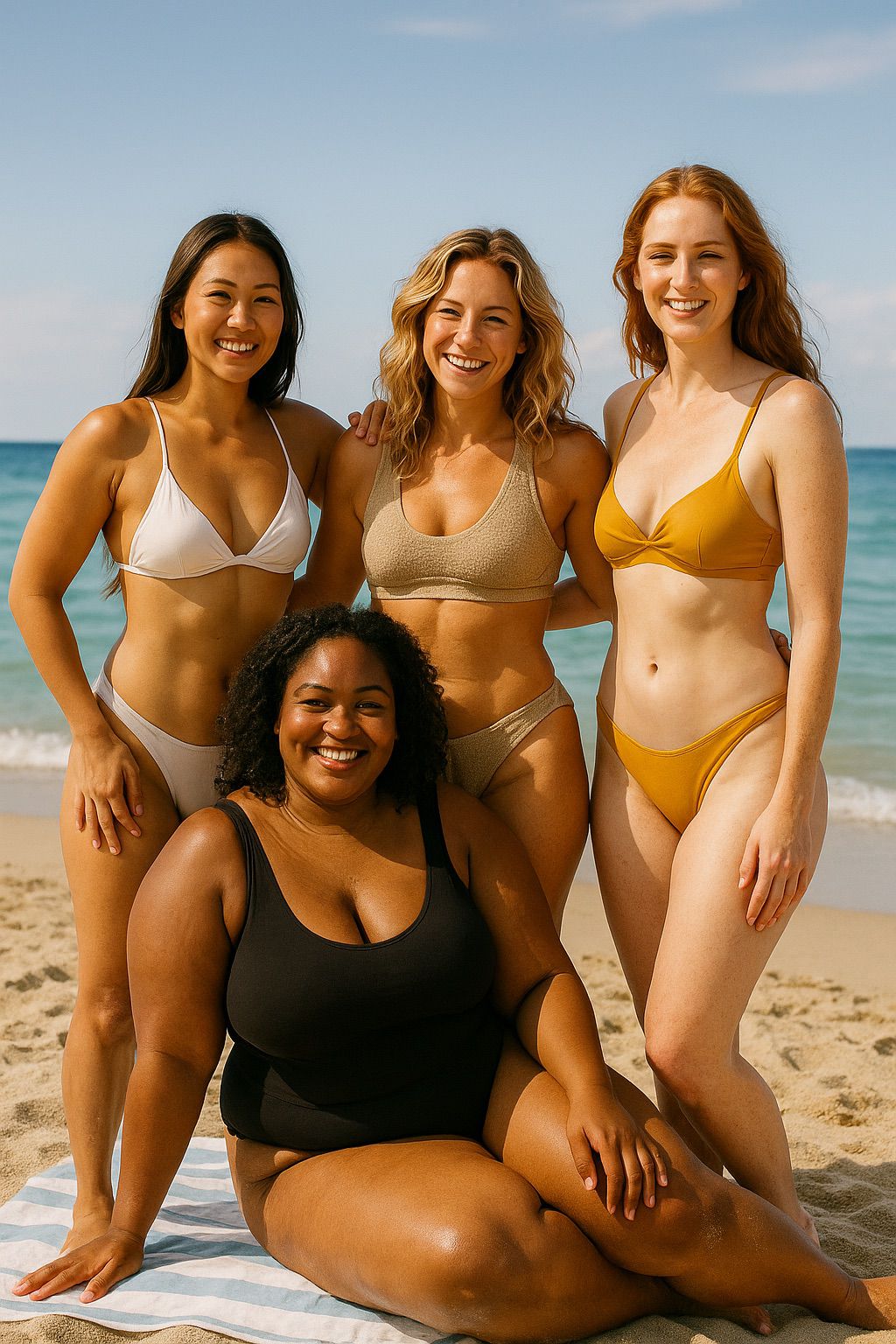
Every year, as the weather warms and the calendar tips toward summer, the same slogans appear like clockwork across magazines, social media feeds, and advertising campaigns: “Get your bikini body ready.” “Torch fat fast.” “90 days to your summer abs.” It’s a drumbeat that has echoed for decades, whispering that worth is measured in inches, that confidence is earned through deprivation, and that the only way to “deserve” the beach is to mold your body into some unattainable shape. But here’s the truth that too many voices leave out: the so-called “bikini body” is a myth. There is no universal figure that makes someone worthy of sand, salt, and sun. The idea is toxic not just because it sets impossible expectations, but because it robs women of the joy of simply existing in their bodies as they are. And yet, year after year, the pressure persists, cloaked in hashtags, “fitspo” posts, and influencers offering “quick fixes.” To dismantle this narrative, we need to expose the myths for what they are and replace them with something more powerful: a reality rooted in strength, health, self-acceptance, and the confidence that radiates from within.
The biggest myth of all is that fitness should be pursued only for appearance. The marketing machine surrounding bikinis thrives on this idea: that every crunch, every run, every “detox” is just a step toward shrinking your waistline for the sake of a photo. This is not only harmful but misleading. Real fitness is not a countdown to swimsuit season; it is a lifelong relationship with your body and its capabilities. Exercise is not punishment for what you ate—it’s celebration of what you can do. Women who find strength in lifting weights, joy in yoga flows, exhilaration in running, or calm in swimming understand something the bikini-culture ads never tell you: movement isn’t about erasing yourself, it’s about expanding what you’re capable of.
Another myth is that there is a single “ideal” body that defines beauty. This illusion has shifted over time—curves in one era, waif-like thinness in another, hyper-toned abs in yet another—but the one thing that never changes is the exclusion. For every body type that becomes “in,” countless others are pushed out. The beach, however, has always told a different story. Step onto the sand, and you’ll see people of every shape, size, and age. All of them are beach bodies because they’re bodies at the beach. The myth thrives only when we zoom in on photoshopped ads or hyper-filtered feeds. The reality is that beauty is diverse, vibrant, and much more interesting than the flat ideal we’ve been sold.
The “quick-fix” culture feeds into these myths with false promises. Detox teas, fad diets, extreme workout challenges—they all sell the illusion that you can transform your body in weeks if you just “commit.” What they rarely admit is that these approaches often lead to burnout, nutrient deficiencies, and an endless cycle of guilt and rebound. Real health doesn’t come in a bottle or a 30-day shred. It comes slowly, gradually, in the habits you build and the compassion you show yourself along the way. Fitness is not about sprinting toward an arbitrary deadline but about walking steadily, consistently, toward a life where your body feels energized, supported, and alive.
Confidence is another piece of the puzzle. The myth says confidence is achieved only once you’ve “earned” the right to wear a bikini, once your abs are visible or your thighs have narrowed. The reality? Confidence is not tied to measurements—it’s tied to mindset. There are women in every size and shape who radiate power on the beach, not because they look a certain way, but because they carry themselves with ease, joy, and authenticity. They remind us that confidence doesn’t come after the body changes—it comes when you stop waiting to live fully until you’ve changed. If you hold off on joy until you fit someone else’s ideal, you’ll miss entire summers. If you decide you’re worthy now, you unlock freedom you didn’t know was waiting.
This isn’t to say that fitness goals themselves are bad. Wanting to get stronger, improve endurance, or even feel more comfortable in your own skin are valid pursuits. The myth is in why we pursue them—and who benefits. If your goals are driven by shame, comparison, or marketing manipulation, they’ll always leave you chasing a moving target. But if your goals come from love—love for how it feels to lift groceries without strain, to run after your kids without gasping, to surf a wave, dance longer, or sleep better—then they empower instead of diminish you. The shift is subtle but profound: working out because you love your body, not because you hate it.
When women talk honestly about fitness, the conversation becomes richer. We share stories of discovering muscles we didn’t know we had, of realizing food is not the enemy but the fuel, of the mental clarity that comes after a swim, of the pride in finishing a tough set of reps. These are the moments that matter. These are the realities drowned out by “summer body” slogans. Real fitness is measured in energy, joy, resilience, and yes, sometimes sweat-soaked sports bras and sore muscles—but never shame. The more we normalize these conversations, the more the myths crumble.
Humanizing this issue matters because it’s not abstract—it’s lived daily. Think of the teenage girl scrolling through Instagram, seeing post after post of “perfect” bodies, wondering if she’ll ever belong. Think of the new mother pressured to “bounce back” within weeks of giving birth, as though nurturing life wasn’t enough. Think of the woman who skips the beach trip with friends because she doesn’t want anyone to see her stomach, missing out on memories she’ll never get back. These are not hypothetical—they’re the lived costs of toxic bikini culture. And the antidote is not more pressure, but compassion. It’s friends saying, “Come on, we’re going anyway.” It’s campaigns that celebrate diversity. It’s the quiet decision each woman makes to step onto the sand as she is, knowing her worth is not negotiable.
The beach itself teaches the lesson better than any lecture. Waves crash with no care for waistlines. Sand clings to everyone indiscriminately. The sun shines equally, whether you’re toned, soft, curvy, or lean. Nature does not demand perfection; it simply invites you to participate. To discover that truth is to reclaim the beach not as a runway for comparison but as a playground for living. When you reframe the goal from “looking right” to “feeling alive,” the myths lose their power.
So let’s rewrite the narrative. A bikini body is not something you earn. You already have one. Fitness goals are not about deadlines—they’re about building a life where strength, energy, and joy become your companions. Confidence is not a size, it’s a decision. And the reality? The best moments at the beach have nothing to do with how you look. They’re about diving into waves, laughing until your stomach hurts, sharing watermelon with friends, and watching the horizon stretch endlessly ahead. That’s what you’ll remember. That’s what matters.
If you want to chase goals, let them be goals rooted in reality. Goals like running farther, not shrinking smaller. Eating foods that nourish, not punish. Resting when your body whispers, not ignoring it until it screams. Lifting not to impress but to feel powerful in your own skin. These are goals worth pursuing because they lead not to fleeting photos but to lasting strength. And when you step onto the sand, those goals carry you further than any crash diet or quick fix ever could.
The myth of the bikini body has overstayed its welcome. The reality waiting for us is far brighter, more inclusive, and more powerful. It’s a reality where every woman belongs at the beach, where fitness is celebration, where health is measured not by abs but by laughter, energy, and resilience. The waves are calling, the sand is warm, and the sun is waiting. The only thing you need to bring is yourself. That’s enough. That has always been enough.