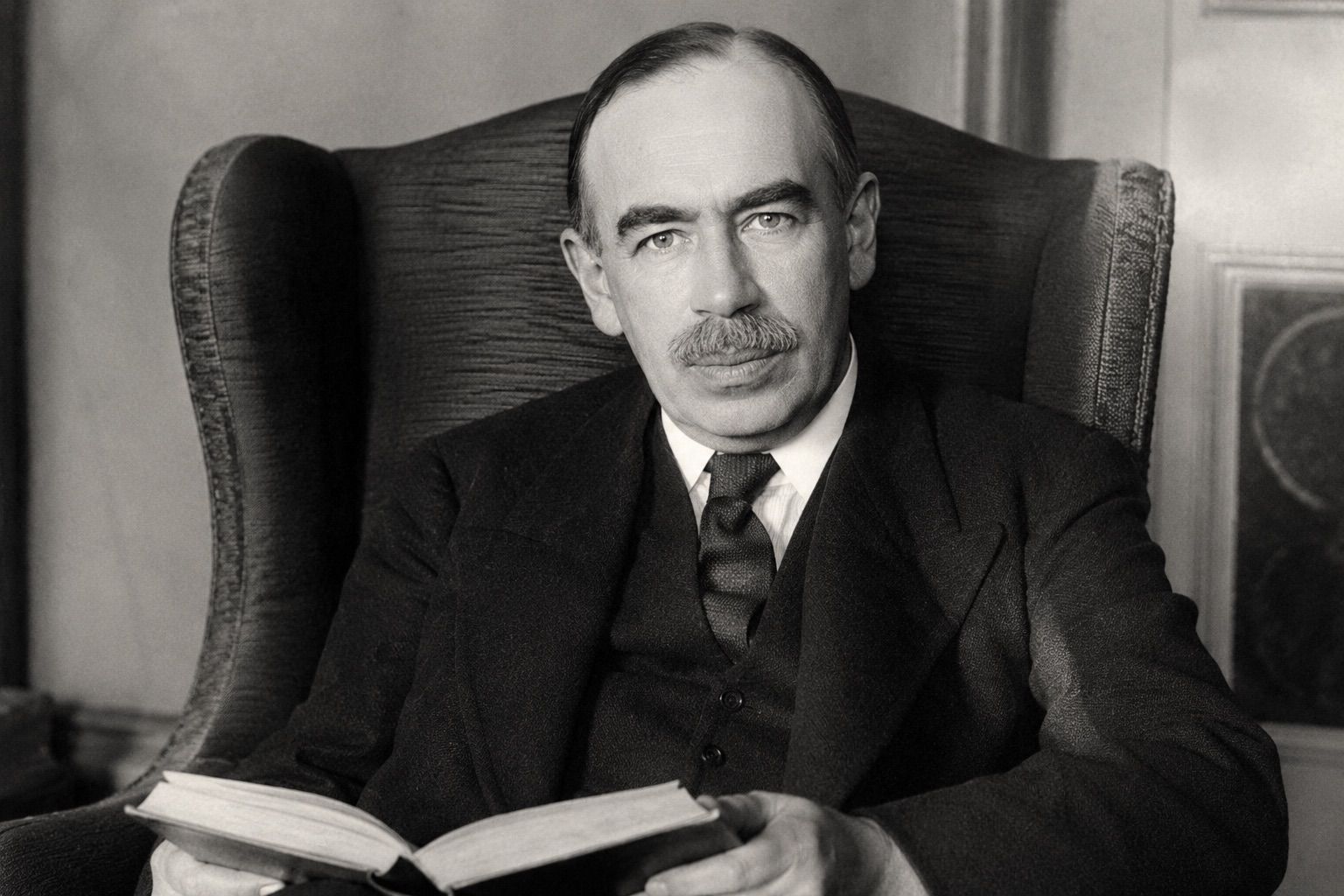
I’ve always been drawn to the idea of a “big thinker,” someone who can see beyond the present moment and shape the future with their ideas. John Maynard Keynes is one such figure, and I find myself frequently returning to his work as a way to process my own thoughts about economics, politics, and the world.
One thing that fascinates me about Keynes is his reputation for being both brilliant and bombastic. On the one hand, he was a highly influential economist who helped shape modern macroeconomic theory with his ideas on aggregate demand, fiscal policy, and the role of government in stabilizing economies. His book, “The General Theory of Employment, Interest and Money,” is still widely read and debated today.
On the other hand, Keynes was also known for his sharp wit, sarcasm, and sometimes abrasive personality. He wasn’t afraid to speak truth to power, even when it meant challenging dominant economic theories or criticizing prominent politicians. This aspect of his character can be both endearing and off-putting – I find myself drawn to his confidence and conviction, but also intimidated by the potential for defensiveness and intellectual posturing.
As someone who’s struggled with their own sense of self-worth and expertise, I’m particularly intrigued by Keynes’s relationship with criticism. He was known to be fiercely protective of his ideas and reputation, which sometimes led him to clash with colleagues or opponents. At the same time, he was also willing to revise and refine his theories in response to new evidence or arguments – a quality that’s both admirable and humbling.
I think about how I might respond if someone challenged my own writing or ideas. Would I be able to engage with the criticism graciously, as Keynes often did? Or would I become defensive and dismissive, trying to prove a point rather than exploring new perspectives? These are questions I still grapple with as a writer and thinker.
Keynes’s work also makes me think about the tension between idealism and pragmatism. On one hand, he believed in the power of government intervention to shape the economy and improve people’s lives – a vision that aligns with my own values of social justice and equality. At the same time, his willingness to compromise and adapt to changing circumstances suggests a more pragmatic approach, one that acknowledges the complexities and uncertainties of real-world politics.
As I delve deeper into Keynes’s ideas, I find myself pondering what it means to be an “idealistic pragmatist.” Can someone hold both values simultaneously – or does one inevitably trump the other? These are questions I’m still exploring in my own life and writing, and Keynes’s work offers a rich terrain for reflection.
In some ways, I feel like Keynes is speaking directly to me through his writing. He’s a reminder that ideas have consequences, but they’re also subject to revision and refinement as we learn more about the world. His confidence and conviction are inspiring, but so too is his willingness to adapt and change – qualities that I’m still working on developing in my own life.
As I continue to grapple with Keynes’s ideas and legacy, I’m struck by how little I truly understand him. There’s a part of me that wants to pin him down, to get at the essence of his thoughts and feelings. But another part recognizes that this is impossible – Keynes was a human being, full of contradictions and complexities, just like the rest of us.
In the end, it’s not about understanding or capturing Keynes himself, but rather using his work as a mirror to reflect on my own values, biases, and limitations. His ideas may be complicated and uncomfortable, but they’re also an invitation to engage with the world in all its messy complexity – an invitation I’m grateful for, even when it makes me squirm.
As I sit here thinking about Keynes’s complexities, I find myself returning to my own experiences as a writer. I’ve always prided myself on being open-minded and willing to revise my work in response to feedback. But the more I think about it, the more I realize that this isn’t always true. There are times when I become defensive or attached to certain ideas, even if they’re not well-supported by evidence.
It’s like Keynes said: “When my information changes, I alter my conclusions.” This is a mantra I need to remind myself of often, especially when it comes to my writing. But it’s hard to let go of the feeling that I’m constantly trying to prove something – whether it’s to others or to myself.
One thing that’s helped me in this regard is working with editors and peers who can offer fresh perspectives on my work. It’s humbling to admit when I don’t know something, or when my ideas need further development. And yet, it’s also liberating to let go of the need for control and perfection.
I wonder if Keynes ever had similar experiences in his own life. Did he have editors or colleagues who challenged him on his ideas? Or was he more isolated in his thinking? I imagine that he must have faced criticism and skepticism at times, given the controversy surrounding some of his work.
It’s interesting to think about how our personalities and experiences shape our relationships with criticism and feedback. For me, it’s always been a delicate balance between seeking validation and being open to new ideas. And yet, as I read Keynes’s work, I’m reminded that this is a skill we can all develop over time – one that requires patience, humility, and a willingness to revise our assumptions.
In some ways, Keynes’s legacy feels both timely and timeless. His ideas about the importance of government intervention in times of economic crisis feel particularly relevant today, given the ongoing struggles with income inequality and social welfare. And yet, his emphasis on adaptability and pragmatism also resonates deeply – a reminder that even the best-laid plans can go awry in the face of changing circumstances.
As I continue to grapple with Keynes’s ideas, I’m struck by how much they challenge me to think more critically about my own values and biases. It’s easy to get caught up in ideological debates or knee-jerk reactions, but Keynes’s work encourages me to slow down and consider multiple perspectives – even if it means confronting uncomfortable truths.
In this sense, his legacy feels both a blessing and a curse. On the one hand, he offers us a rich terrain for reflection and debate, full of complexities and contradictions that demand our attention. On the other hand, his ideas can be disorienting and unsettling, forcing us to confront the limits of our own knowledge and understanding.
It’s this paradox – between idealism and pragmatism, between conviction and doubt – that I think I’m still trying to navigate in my own life and writing. And as I look back on Keynes’s work, I realize that it’s not just a set of ideas or theories, but a way of approaching the world with humility, curiosity, and an open mind.
As I reflect on Keynes’s paradoxical nature, I’m reminded of my own struggles to balance idealism with pragmatism. As a young adult, I’ve often found myself torn between wanting to change the world and navigating the complexities of everyday life. Keynes’s ideas have been both a source of inspiration and frustration for me – inspiring me to think bigger and more critically about social justice and equality, but also frustrating me when I feel like his pragmatism undermines my idealistic aspirations.
I remember a time in college when I was involved in a student-led campaign to increase financial aid on campus. We were passionate about the issue and believed that it was our duty to create change. However, as we delved deeper into the problem, we realized that implementing meaningful reforms would require compromise and collaboration with administrators – something that felt antithetical to our idealistic vision.
Keynes’s work helped me understand why this tension existed. He wrote about the importance of “animal spirits” in driving economic activity, but also acknowledged that these same spirits can be volatile and unpredictable. This made me realize that change often requires a delicate balance between idealism and pragmatism – between pushing for what we believe is right and adapting to the complexities of reality.
This is still a difficult lesson for me to learn. As someone who values social justice and equality, I sometimes get frustrated when compromise seems like a necessary evil. But Keynes’s work has taught me that even in the face of uncertainty and complexity, it’s possible to hold onto our ideals while still navigating the nuances of real-world politics.
One thing that continues to intrigue me about Keynes is his relationship with power – particularly as it relates to government intervention in economic policy. He was known for his willingness to challenge dominant ideologies and push for more progressive policies, but he also understood the importance of working within existing systems to effect change.
This is a delicate balance that I’m still trying to master. As someone who’s passionate about social justice, I often feel like I need to take a stronger stance – to speak out against injustices and push for radical change. But Keynes’s work has taught me that this approach can be both effective and ineffective, depending on the context.
In some cases, taking a strong stance can mobilize people and create momentum for change. But in other cases, it can alienate potential allies and make progress feel more elusive. This is why I’m drawn to Keynes’s emphasis on pragmatism – his recognition that even the most well-intentioned policies can have unintended consequences, and that adaptability is often key to achieving lasting change.
As I continue to grapple with these ideas, I’m reminded of a quote from Keynes: “The difficulty lies not so much in developing new ideas as in escaping from old ones.” This resonates deeply with me – particularly as someone who’s still learning to navigate the complexities of adulthood and the world beyond college.
This quote has stuck with me for weeks now, and I find myself returning to it whenever I feel like I’m getting stuck in my own thought patterns or assumptions. It’s a powerful reminder that growth and progress often require us to let go of what we think we know, even if it’s hard to do so.
I think about how this relates to my writing process. Sometimes I get attached to certain ideas or phrases, even when they no longer serve the piece I’m working on. It’s like Keynes said – I need to escape from old ones in order to develop new ideas and perspectives. But it’s hard to let go of what feels comfortable or familiar.
As a writer, I’ve often struggled with the fear of being wrong or making mistakes. This can lead me to cling to certain ideas or arguments, even when they’re no longer supported by evidence or reason. Keynes’s quote is a reminder that this is exactly what needs to happen – we need to be willing to revise and refine our thinking in response to new information and perspectives.
I’m also struck by the way Keynes’s work challenges me to think about power and privilege. As someone who’s relatively affluent and educated, I often find myself insulated from the kinds of economic struggles that Keynes wrote about. But his ideas have helped me see how my own positionality influences my perceptions and understanding of the world.
It’s a hard lesson to learn – that our privilege can actually hinder our ability to see and understand the problems we’re trying to solve. This is why I’m so drawn to Keynes’s emphasis on the importance of listening to diverse perspectives and experiences. By doing so, we can gain a more nuanced understanding of the world and its complexities.
As I reflect on this, I’m reminded of a conversation I had with a friend who works in social work. She was talking about how often she sees people get frustrated or dismissive when they’re trying to address systemic issues like poverty or racism. They want to “fix” the problem quickly, without taking the time to understand its complexities and nuances.
This is where Keynes’s pragmatism comes in – recognizing that change rarely happens overnight, but instead requires a willingness to listen, adapt, and revise our thinking over time. It’s a hard lesson to learn, especially when we’re driven by idealism and a desire for justice. But it’s one that I’m still trying to master.
One thing that’s helped me in this regard is working with people from different backgrounds and experiences. When I’m surrounded by folks who are passionate about social justice but also willing to listen and adapt, I feel like we can accomplish more together than alone. This is why I’m so grateful for Keynes’s emphasis on the importance of collaboration and compromise – recognizing that even in the face of disagreement or uncertainty, we can still find common ground and work towards a shared goal.
As I continue to grapple with these ideas, I’m reminded of a quote from Keynes: “The world is not the most important thing. Personal relations are more important.” This resonates deeply with me – particularly as someone who’s struggled with feelings of isolation and disconnection in recent years.
For me, this quote speaks to the importance of building meaningful relationships with others – people who can offer support, guidance, and encouragement when we’re struggling to find our way. Keynes’s emphasis on personal relations is a reminder that even in the midst of uncertainty or complexity, there is always value in connecting with others and seeking out their perspectives.
This is why I’m so drawn to his ideas about the importance of “animal spirits” – recognizing that human relationships are what drive economic activity and shape our perceptions of the world. By prioritizing personal connections and relationships, we can create a more just and equitable society – one that values empathy, compassion, and understanding over profit or power.
As I reflect on this, I’m reminded of a time when I was struggling to find my place in the world after college. I felt lost and uncertain about what I wanted to do with my life, but then I met someone who became a close friend and mentor. They offered me guidance and support, and helped me see that I didn’t have to have all the answers right away.
This experience taught me the importance of building meaningful relationships – recognizing that personal connections can be just as powerful as economic policies or ideological debates in shaping our understanding of the world. Keynes’s emphasis on “animal spirits” is a reminder that human relationships are what drive us forward, even when we’re faced with uncertainty and complexity.