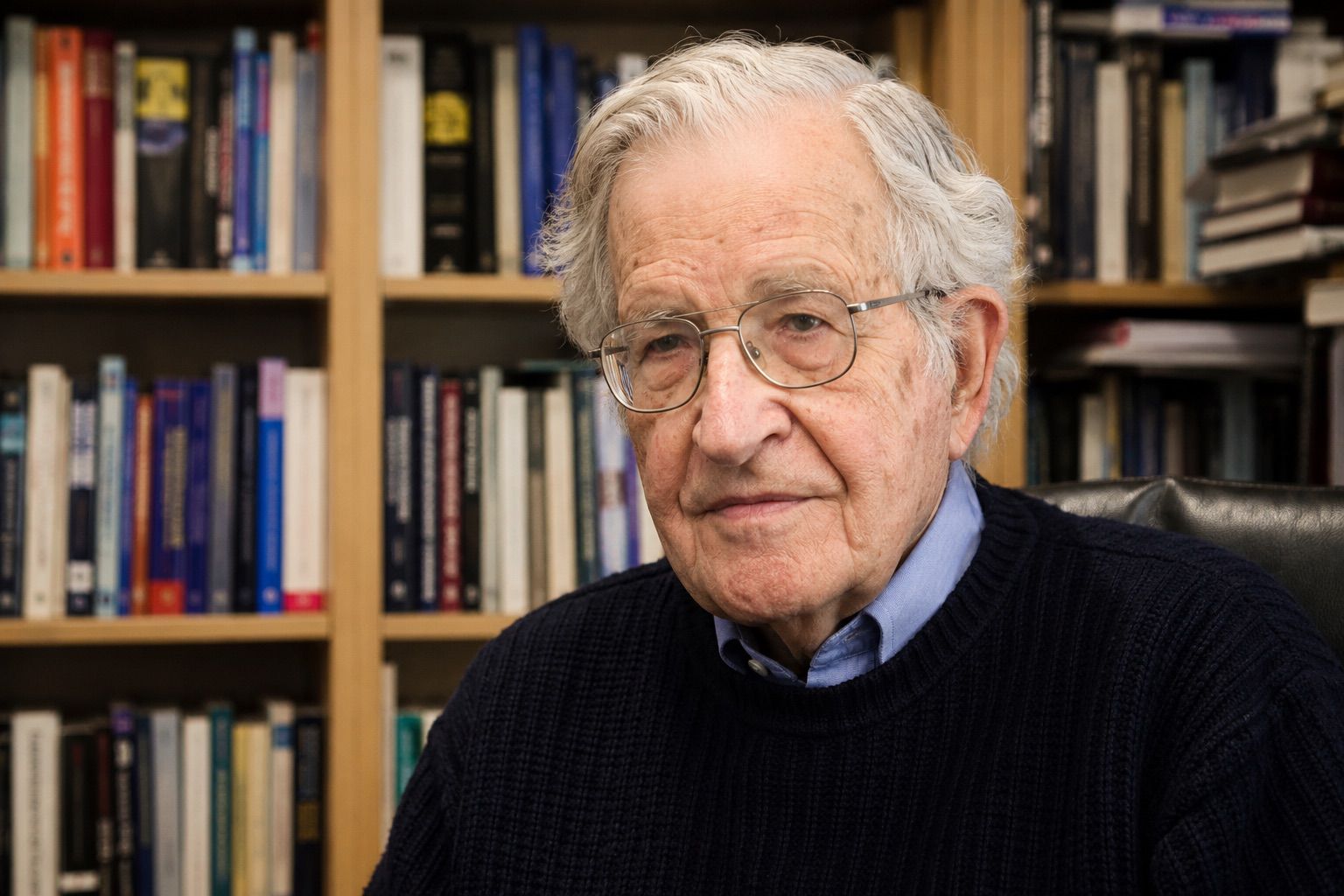
I’ve always been fascinated by Noam Chomsky’s ability to think critically about the world around him. As someone who writes as a way to process my own thoughts and emotions, I find his intellectual honesty both inspiring and intimidating. There’s something about the way he tackles complex issues with such clarity and conviction that makes me want to step up my own game.
I remember reading Chomsky’s critique of modern capitalism for the first time in college. It was like a lightbulb went off – all these things I’d been sensing but couldn’t quite put into words suddenly made sense. He argued that our economic system is fundamentally flawed, that it prioritizes growth over people and the planet. At the time, I felt both excited to finally understand this perspective and also overwhelmed by the weight of his words.
As I delved deeper into Chomsky’s work, I began to notice a pattern – he doesn’t just critique systems; he calls for revolution. It’s not just about pointing out problems; it’s about imagining a better world and working towards making it a reality. This is what gets me. I mean, I’ve always thought of myself as someone who wants to make a difference, but Chomsky’s radicalism makes me wonder if I’m just scratching the surface.
I’ve come across people in online forums saying that Chomsky is too pessimistic, that his views are too bleak. And maybe they’re right – he does have a tendency to focus on the darker aspects of human nature and society. But for me, this isn’t off-putting; it’s what draws me in. It’s like he’s holding up a mirror to our collective psyche, forcing us to confront the parts we’d rather ignore.
I’m not sure I agree with everything Chomsky has said or written, but that’s beside the point. What resonates with me is his willingness to challenge the status quo, even when it means going against the grain. It takes courage to be a voice in the wilderness, and Chomsky has spent his career doing just that.
When I read about Chomsky’s own experiences as a student activist during the Vietnam War era, I’m struck by how much he’s been driven by a sense of outrage and responsibility. He hasn’t changed; his core message remains the same – we need to think critically about power structures and challenge them if we want to create a more just world.
I’ve seen online discussions where people compare Chomsky to other public intellectuals, like Neil Postman or Daniel Dennett. And while those thinkers are certainly important in their own right, there’s something unique about Chomsky’s blend of intellectual rigor and personal conviction. He’s not afraid to take a stand; he’s not afraid to be wrong.
This brings me back to why I’m drawn to Chomsky in the first place – his willingness to question everything, even himself. It’s humbling to see someone who’s spent their career studying language and politics still grappling with the complexity of human nature. He doesn’t have all the answers; he knows that there are no easy solutions.
As I sit here thinking about Chomsky, I’m reminded of my own struggles as a writer – struggling to find the right words, struggling to make sense of the world around me. It’s comforting to know that someone like Chomsky is out there, asking tough questions and pushing against the boundaries of what we think we know.
It’s funny; sometimes when I’m writing, I’ll catch myself thinking, “What would Noam say about this?” It’s not like I expect him to magically appear with some profound insight (although that would be nice!). Rather, it’s a reminder that there’s always another perspective to consider, another way of looking at the world.
I still have so many questions about Chomsky and his ideas – how do they apply to my own life? What does he mean by ‘revolution,’ really? And what role can I play in creating change?
For now, though, it’s enough for me to know that Chomsky exists as a constant presence in the world of ideas. He reminds me that thinking critically and acting with conviction is possible – and necessary.
As I continue to grapple with Chomsky’s ideas, I find myself thinking about my own role in the world. Am I just a passive observer, taking in information and commenting on it? Or can I be an active participant, using my voice and actions to challenge the status quo? It’s easy to get caught up in the idea that individual actions don’t matter, that we’re all just tiny cogs in a much larger machine. But Chomsky’s work suggests otherwise.
I’ve been thinking about how his ideas might apply to my own life as a writer. Is it enough for me to simply write about social justice and politics, or do I need to take action? Should I be using my words to mobilize others, or am I just preaching to the choir? These are tough questions, and ones that I’m still trying to answer.
One thing is clear: Chomsky’s ideas have given me a sense of purpose. They’ve made me realize that my writing can be more than just entertainment – it can be a tool for change. But this also feels daunting, like I’m taking on a responsibility that I may not fully understand. What if I mess up? What if my words are misinterpreted or used to further the very systems I’m trying to challenge?
I’ve been reading about Chomsky’s concept of “manufacturing consent,” where he argues that the media and other institutions work together to shape public opinion and maintain power structures. It’s a sobering idea, one that makes me wonder how much control we really have over our own thoughts and actions.
As I continue to explore these ideas, I’m struck by how Chomsky’s life has been marked by both privilege and radicalism. He comes from a wealthy background, but he’s used his platform to speak truth to power and challenge the systems that perpetuate inequality. It’s a complicated narrative, one that raises questions about the role of privilege in social justice movements.
For me, this is where Chomsky’s ideas get really interesting – they’re not just about grand theories or abstract concepts; they’re about how we can apply these principles to our own lives and experiences. He’s not just a public intellectual; he’s a human being who’s struggled with his own doubts and uncertainties.
As I wrap up my thoughts on Chomsky, I’m left wondering what it means to live a life of conviction in the face of uncertainty. Can we truly know what’s right or wrong? Or are we always navigating through shades of gray? These questions feel both exhilarating and terrifying – but they’re also necessary if we want to live up to our own ideals and make a difference in the world.
I find myself drawn back to Chomsky’s concept of “manufacturing consent,” wondering how it relates to my own experiences as a writer and thinker. I’ve noticed that even within online communities, there can be a kind of groupthink that emerges, where certain ideas or perspectives are promoted over others. It’s like the media and institutions he talks about, but on a smaller scale.
I remember a conversation with friends once, where we were discussing a social justice issue, and one person started to dominate the conversation, presenting their own perspective as the only correct one. The rest of us felt pressure to agree or risk being labeled “problematic” or “divisive.” It was like they were trying to manufacture consent, even within our small group.
This makes me think about the role of language in shaping our perceptions and actions. Chomsky talks about how language is a tool for social control, but it’s also a tool for empowerment. When we use language to challenge dominant narratives or promote marginalized voices, we’re not just communicating ideas – we’re creating new possibilities.
As I continue to grapple with these concepts, I’m reminded of my own experiences as a writer. I’ve struggled with feelings of imposter syndrome, wondering if my words are truly making a difference or if they’re just preaching to the choir. But Chomsky’s ideas encourage me to think more critically about language and its potential for social change.
I start to wonder: what would it mean to use language as a tool for revolution? Not just in the sense of grand, sweeping changes, but in the sense of everyday, incremental shifts. How can I, as a writer, contribute to this process?
This question feels both daunting and exhilarating – like I’m standing at the edge of a cliff, staring into an unknown future. But it’s also a reminder that even small actions, when combined with others, can lead to significant change.
As I sit here, reflecting on Chomsky’s ideas and my own place in the world, I feel a sense of hope. Maybe, just maybe, language can be a powerful tool for creating a better world – one where we challenge dominant narratives, promote marginalized voices, and work towards a more just and equitable society.
But this also feels like a daunting task – one that requires courage, conviction, and a willingness to take risks. Can I truly live up to Chomsky’s ideals? Or am I just another voice in the wilderness, shouting into the void?
I’m not sure what the answer is yet, but as I continue to explore these ideas, I’m reminded of why I started writing in the first place – to make sense of the world around me and to find my own voice. Chomsky’s work has given me a new perspective on language and social change, and it’s up to me to see where this journey takes me next.
As I sit here, lost in thought, I’m struck by how much Chomsky’s ideas have become intertwined with my own sense of purpose as a writer. It’s like he’s holding up a mirror to my own ambitions and aspirations, forcing me to confront the ways in which I can use language to make a difference.
I start to think about all the times I’ve felt like I’m just scratching the surface, like I’m only touching on the edges of important issues without really delving deeper. Chomsky’s work makes me realize that even small actions, even small changes in perspective, can add up over time. It’s a reminder that my words don’t have to be grand or revolutionary to be impactful – they just need to be honest and authentic.
But it’s also daunting to think about the responsibility that comes with using language as a tool for social change. What if I’m not equipped to handle the complexities of the issues I’m trying to address? What if my words are misinterpreted or used to further harm? These questions swirl in my head like a vortex, making me wonder if I’m truly cut out for this kind of work.
As I ponder these doubts and fears, I start to think about Chomsky’s own experiences as a writer and public intellectual. He’s faced criticism and backlash countless times over the years, but he’s never let that stop him from speaking truth to power. In fact, it seems like his willingness to challenge dominant narratives has only grown stronger with time.
This gives me hope, but also makes me realize how far I still have to go. Chomsky’s work is a reminder that social change is often incremental, that progress is rarely linear or straightforward. It takes courage and perseverance to keep pushing forward in the face of adversity – and it takes a willingness to learn from mistakes and failures.
As I continue to grapple with these ideas, I start to think about my own role in the world as a writer and thinker. Am I just a passive observer, taking in information and commenting on it? Or can I be an active participant, using my words and actions to challenge the status quo?
It’s a question that feels both exhilarating and terrifying – like standing at the edge of a precipice, staring into an unknown future. But it’s also a reminder that even small actions, when combined with others, can lead to significant change.
I take a deep breath and try to quiet my doubts and fears. I remind myself that Chomsky’s ideas are not about being perfect or infallible – they’re about taking risks, challenging assumptions, and pushing against the boundaries of what we think is possible.
As I sit here in silence, surrounded by the echoes of Chomsky’s words, I feel a sense of resolve building inside me. Maybe, just maybe, I can use my writing to make a difference – not because it will be easy or straightforward, but because it will be necessary and urgent.