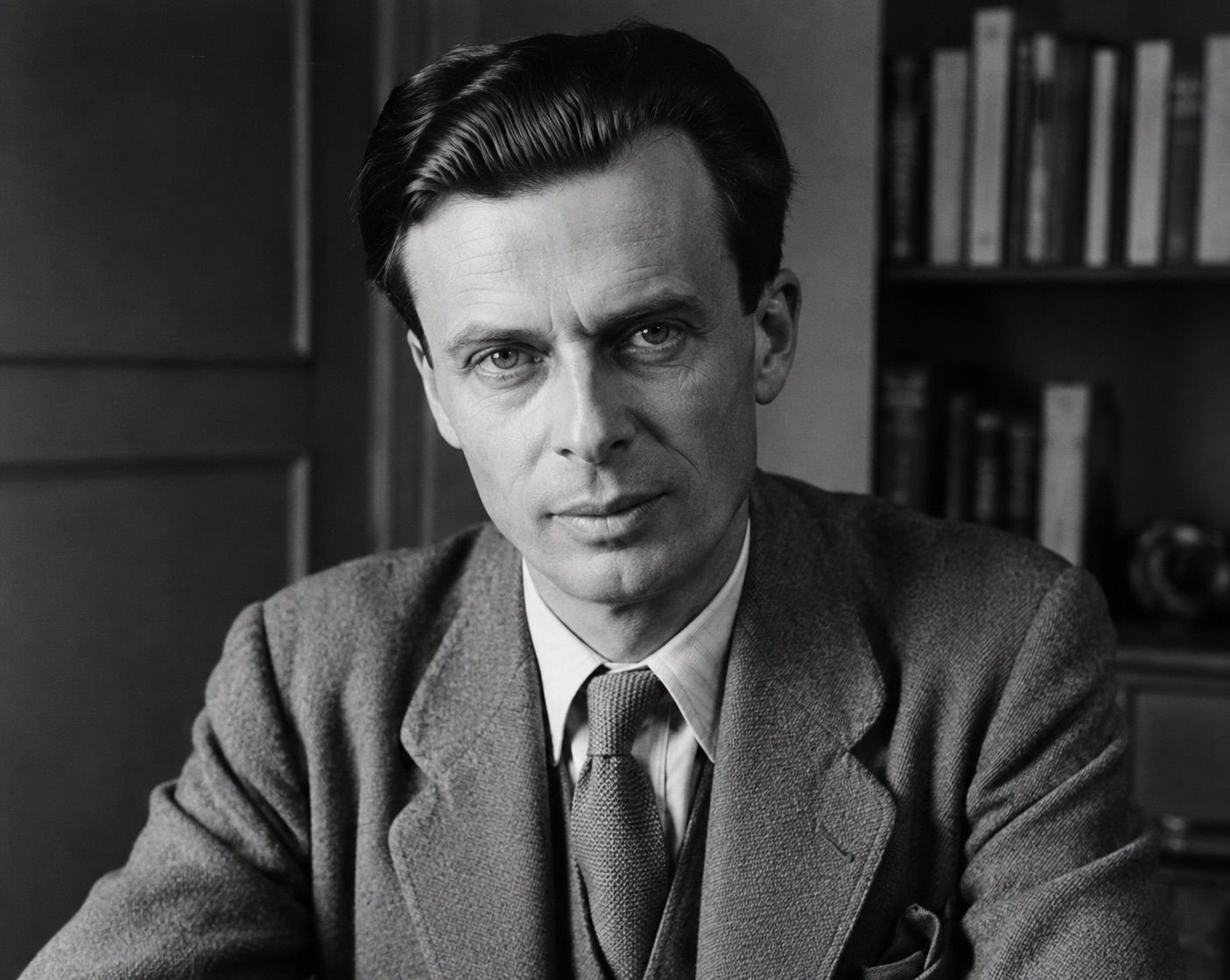
Aldous Huxley’s words have been hovering at the edges of my consciousness for years, like a persistent hum in the background of my mind. I’ve read his essays and novels, but it’s not just the ideas he presented that intrigue me – it’s the sense of unease that lingers long after I finish reading him. As someone who writes as a way to process thoughts and emotions, I’m drawn to the complexity and nuance of Huxley’s work.
One of the things that fascinates me about Huxley is his skepticism towards progress. In “Brave New World,” he depicts a future where people are conditioned to be happy, but at the cost of individuality and freedom. This resonates with me because I’ve always felt like there’s something…off about our society’s obsession with happiness and productivity. It’s as if we’re perpetually striving for some idealized version of success, without ever stopping to consider what that means or whether it’s truly worth it.
Huxley’s critique of modernity feels eerily relevant today, when social media platforms seem designed to keep us connected but also isolated, and the pursuit of self-improvement has become a multi-billion-dollar industry. I’ve caught myself scrolling mindlessly through my feeds, comparing my life to the curated highlight reels of others, feeling like I’m somehow failing in comparison. And then I read Huxley’s words about how we’re living in a ” Brave New World” – where people are conditioned to be happy, but at what cost? It’s a nagging question that refuses to go away.
Another aspect of Huxley’s work that interests me is his exploration of the relationship between science and spirituality. In “The Doors of Perception,” he writes about his experiences with mescaline and the way it expanded his perception of reality. This has always struck me as particularly relevant in today’s world, where science and technology are advancing at an unprecedented rate – but what does this mean for our understanding of ourselves and the world around us?
As someone who’s still figuring out their own spiritual path (or lack thereof), I’m drawn to Huxley’s willingness to explore the unknown and the unprovable. He was a man who questioned authority, who sought truth in unexpected places, and who refused to be bound by conventional thinking. This kind of intellectual courage is something I admire and aspire to – but it also makes me uncomfortable.
I think what unsettles me most about Huxley’s work is its refusal to offer easy answers or solutions. He’s not a utopian or a dystopian; he’s a realist who sees the complexities and contradictions of human nature. And this, I realize, is something that I’m still grappling with in my own writing – how to navigate the gray areas between black and white, how to confront the ambiguities and uncertainties of life without resorting to simplistic or dogmatic thinking.
As I sit here, trying to make sense of Huxley’s influence on me (or lack thereof), I realize that it’s not just about his ideas or his writing style – it’s about the way he challenges me to think more deeply, more critically, and more compassionately. His work is a reminder that truth is always multiple, always context-dependent, and always subject to revision. And this, I suppose, is what draws me back to him time and again – not as a guru or a authority figure, but as a fellow traveler in the search for meaning and understanding.
As I delve deeper into Huxley’s work, I’m struck by his emphasis on the importance of living in the present moment. In “The Doors of Perception,” he writes about how mescaline allowed him to experience time in a non-linear fashion, where past and future were equally present. This resonates with me because, as someone who’s struggled with anxiety and perfectionism, I’ve often found myself getting caught up in worries about the future or regrets about the past.
Huxley’s idea that our perception of time is a product of our cultural conditioning is both liberating and terrifying. It makes me wonder if my own experiences of time are somehow skewed by societal expectations or personal fears. Am I truly living in the present, or am I simply going through the motions of daily life, waiting for some mythical future moment to arrive? And what does it mean to be truly present, anyway?
I think about how often I’ve found myself getting lost in thought, replaying conversations or scenarios from the past, or worrying about hypothetical futures. It’s as if my mind is constantly trying to flee the present moment, seeking refuge in some safer, more predictable realm. But what would it mean to truly inhabit this moment, without judgment or attachment? To experience time as a fluid, ever-changing tapestry, rather than a linear progression of past-present-future?
Huxley’s work challenges me to confront these questions and others like them. He reminds me that truth is not something to be discovered, but something to be experienced – and that this experience can only occur in the present moment. This is both exhilarating and daunting, because it requires a level of vulnerability and surrender that I’m still struggling to cultivate.
As I continue to explore Huxley’s ideas, I find myself drawn to his concept of “seeing” versus “knowing.” In his writing, he distinguishes between these two modes of perception: seeing involves observing the world around us with a sense of wonder and curiosity, whereas knowing implies a more rigid, conceptual understanding. For me, this distinction resonates deeply – because I often find myself caught between these two states, oscillating between the desire to understand and explain the world, and the need simply to experience it.
Huxley’s work encourages me to lean into this uncertainty, to trust in my own seeing rather than striving for some predetermined notion of knowing. And yet, this feels like a scary proposition – because what if I’m wrong? What if my perceptions are flawed or incomplete? The thought sends shivers down my spine, but also fills me with a sense of excitement and possibility.
As I ponder the idea of “seeing” versus “knowing,” I’m struck by how it relates to my own writing process. So often, I find myself trying to impose order on the chaos of experience, attempting to distill complex emotions and thoughts into neat, coherent narratives. But what if that’s not the point? What if the act of seeing – of observing, of paying attention, of being present in the moment – is more important than the act of knowing?
Huxley’s writing has a way of unsettling my certainties, of forcing me to confront the limits of my understanding. And yet, it’s precisely this uncertainty that I find so compelling. It’s as if he’s saying that the truth is not something to be grasped or possessed, but rather something to be discovered through the act of seeing.
I think about how often I’ve gotten caught up in trying to explain things – to myself, to others, to the world at large. I’ll spend hours researching, reading, and thinking, all in an attempt to grasp some elusive truth. But what if that’s just a form of avoidance? What if, by trying to know too much, I’m actually preventing myself from seeing?
Huxley’s work suggests that this is precisely the case – that our need for knowledge can often serve as a barrier to true understanding. And so, I find myself drawn to his emphasis on the importance of perception over cognition. It’s not about accumulating facts or figures; it’s about paying attention to the world around me, and allowing myself to be transformed by what I see.
This is a scary prospect, because it requires a level of vulnerability and openness that I’m still learning to cultivate. But as I continue to explore Huxley’s ideas, I begin to realize that this is exactly what his work has been trying to tell me all along – that the act of seeing is not just about perceiving the world around us, but also about being changed by it.
I think about how often I’ve felt like I’m stuck in a kind of intellectual gridlock – unable to see beyond my own preconceptions and assumptions. But what if Huxley’s work is offering me a way out of this impasse? What if his emphasis on seeing over knowing is not just a philosophical nicety, but a practical tool for living in the world?
As I ponder these questions, I’m struck by the realization that Huxley’s ideas are not just about intellectual curiosity – they’re also about spiritual practice. His writing has a way of pointing me towards the unknown, towards the mysteries and uncertainties of life. And it’s precisely this direction that I find so compelling.
In many ways, Huxley’s work is an invitation to embark on a journey of discovery – not just about the world around us, but also about ourselves. It’s a reminder that truth is not something fixed or static; rather, it’s a dynamic, ever-changing process that requires us to be open, receptive, and willing to see.
As I continue to explore Huxley’s ideas, I find myself feeling both exhilarated and terrified by the prospect of what lies ahead. But as I look deeper into his work, I begin to realize that this is precisely what his writing has been trying to tell me all along – that the act of seeing is not just about perceiving the world; it’s also about being transformed by it.
I find myself getting lost in the idea of transformation, and how it relates to Huxley’s concept of “seeing” versus “knowing”. It’s as if he’s suggesting that our perception of reality is not just a matter of understanding facts or concepts, but also of being altered by what we experience. And this, I think, is where things get really interesting.
Because when I think about it, my own writing process has always been a bit of a journey in itself. I’ll start with an idea or a concept, and then find myself getting lost in the details, trying to explain them away with words and rationalizations. But what if that’s not the point? What if the real purpose of writing is not to convey knowledge or understanding, but rather to undergo some kind of transformation ourselves?
Huxley’s work suggests that this is precisely the case – that our relationship with language is not just about conveying meaning, but also about being changed by it. And this is a pretty radical idea, if you think about it. Because when we write, we’re not just expressing thoughts or feelings; we’re also creating something new, something that didn’t exist before.
This is where I start to get really interested in Huxley’s concept of the “doors of perception”. For him, this phrase refers to the way in which our perception of reality can be altered by various means – from mescaline to meditation. But what if this idea extends beyond the realm of psychoactive substances or spiritual practices? What if our writing itself has the power to open doors of perception, to allow us to see things in new and unexpected ways?
I think about how often I’ve found myself getting stuck in a rut, feeling like my writing is stale or unoriginal. But what if that’s not because I’m lacking talent or inspiration? What if it’s because I’m just not allowing myself to see the world in new ways? What if my writing is actually holding me back from experiencing reality in all its complexity and beauty?
Huxley’s work challenges me to consider this possibility – to think about how my writing might be a barrier to true perception, rather than a tool for it. And this is a scary thought, because it implies that I’ve been doing it wrong all along. But it’s also an exhilarating one, because it suggests that there’s still so much to learn and discover.
As I continue to explore Huxley’s ideas, I find myself drawn to his concept of the “interior journey”. For him, this refers to the process of exploring our own thoughts, feelings, and perceptions – rather than trying to impose some external framework or structure on them. And what if this is precisely what my writing has been lacking? What if it’s not about conveying knowledge or understanding, but rather about navigating the complexities of my own interior world?
I think about how often I’ve found myself getting caught up in external validation – seeking praise or recognition from others for my writing. But what if that’s just a way of avoiding the real challenge? What if the true task of writing is not to impress others, but rather to explore and understand ourselves?