I’m staring at Mr Whiskers while he sleeps in a patch of sunlight on the windowsill, and I’m trying very hard not to assign significance to it. This is harder than it sounds. Yesterday I learned an important lesson about observation after Karen noticed Mr Whiskers tracking a tiny insect across the kitchen floor while I noticed Karen noticing Mr Whiskers and somehow managed to turn the entire thing into an investigation. There was no conspiracy, no coded communication, and no unexplained phenomenon. There was an insect. Later there was also a piece of egg stuck to my sock that everyone noticed before I did, but I don’t think that’s relevant beyond establishing that yesterday was not particularly good for my reputation. The important thing is that I learned something. Not everything Mr Whiskers does means something. Sometimes a cat sitting quietly is simply a cat sitting quietly, which is precisely what I’m telling myself now as I watch him sprawled in the sun looking more relaxed than any living creature has a right to look.
The problem is that Pandora keeps talking to him. She does this all the time, and normally I don’t think much about it because everybody talks to pets. I’ve had entire conversations with Mr Whiskers myself, although mine tend to involve practical matters such as why he needs to move, why he cannot have what I’m eating, or why scratching the couch remains prohibited despite several years of inconsistent enforcement. Pandora’s conversations are different. She tells him things. A few minutes ago she walked past the windowsill, scratched him beneath the chin, and said, “Don’t worry, it’ll be fine.” Mr Whiskers opened one eye, looked at her, and went back to sleep. That’s all that happened. I know that’s all that happened because I’m committed to observing facts before drawing conclusions. The fact is that Pandora told our cat not to worry. Another fact is that Mr Whiskers appeared completely unsurprised by this information. There are probably dozens of innocent explanations for that exchange, and I’m going to give Pandora every opportunity to provide one without turning this into something it isn’t.
“What won’t he worry about?” I ask. Pandora stops on her way toward the kitchen and looks back at me. “What?” I point toward Mr Whiskers. “You told him not to worry and that everything would be fine.” She looks at the cat, then at me, and says she was just talking to him. I explain that I understand she was talking to him; my question concerns the subject of the conversation. Pandora gives me the expression she uses when she thinks I’ve taken a perfectly ordinary event and placed it on an unnecessarily large investigative whiteboard. “There was no subject,” she says. “I was talking to the cat.” I nod because that’s a reasonable answer, although technically it isn’t an answer at all. If I told Pandora not to worry and that everything would be fine, she’d reasonably assume I was referring to something. Apparently adding whiskers eliminates the requirement for context.
I let it go. That’s important. The old me might have pursued the matter, but the new me understands that healthy relationships require trust and that sometimes people say meaningless things to cats. I return my attention to my coffee and make it almost three full minutes before Pandora’s phone buzzes. She picks it up, reads something, smiles, types a response, and puts the phone facedown on the table. None of this is suspicious. People receive messages. People smile at messages. People put phones facedown. I know this because I am a rational adult capable of distinguishing ordinary behavior from evidence. Then Mr Whiskers gets down from the windowsill, walks across the room, and sits beside Pandora. She looks down at him and says, “You too, huh?” Mr Whiskers meows once. Pandora laughs. I slowly lower my coffee.
I’m not saying they’re communicating. I’m saying there was a statement, followed by a vocal response, followed by apparent acknowledgment of that response. If this had occurred between two humans, nobody would question whether communication had taken place. The fact that one participant is orange shouldn’t automatically invalidate the exchange. Still, yesterday taught me not to jump to conclusions, so I ask the simplest possible question. “What did he say?” Pandora stares at me for several seconds before asking whether I’m serious. I tell her I’m mostly serious, which apparently is the wrong answer because she starts laughing again. Mr Whiskers looks at me while she’s laughing, and I don’t appreciate the timing. I tell him that if he has something to say, he can say it to my face. Pandora reminds me that he is a cat. “Then this should be easy for him,” I say. She walks into the kitchen without responding.
A little later John Mercer stops by, and this is where the situation becomes more complicated. John hasn’t been inside five minutes when Mr Whiskers walks directly over to him and sits beside his feet. John looks down and says, “Hey, buddy,” in the casual tone of somebody greeting an associate whose presence was expected. I watch closely. John scratches Mr Whiskers behind the ears. Mr Whiskers leans into his hand. No obvious transfer of information occurs, but I remind myself that effective covert communication probably wouldn’t be obvious. Then John looks toward the kitchen and asks Pandora, “We still good?” Pandora answers, “Yep.” That’s it. Two words. Perfectly ordinary words except that I have absolutely no idea what they refer to. Mr Whiskers remains positioned between them.
I ask what they’re still good for. John looks at Pandora, and Pandora looks at John. It’s brief, but I see it. “What?” John asks. I repeat the question. He says it’s nothing. Pandora says, “Hal.” There is a particular way Pandora says my name when she thinks I’m about to create a problem that doesn’t currently exist, and ordinarily it causes me to reconsider my direction. This time, however, we have moved beyond a cat looking relaxed. We now have Pandora reassuring the cat, Pandora exchanging unexplained messages on her phone, the cat apparently responding to her, John arriving and immediately establishing physical contact with the cat, and John asking Pandora whether they’re “still good.” I’m not accusing anyone of anything. I’m simply observing that if you wrote those facts down in sequence, they would not look great.
John tells me he’s stopping by again later and asks Pandora whether she needs anything. She says no. I ask why he’s coming back later. He says he’ll explain later. I point out that “I’ll explain later” is almost never something said by a person who wants to appear less suspicious. John laughs and tells Pandora, “Good luck,” before leaving. I watch the door close behind him and turn toward her. She refuses to look at me because she’s smiling. Mr Whiskers has returned to the windowsill and is once again lying in the sun with the serene expression of an animal whose portion of the operation has apparently concluded.
At this point I have two choices. I can interrogate Pandora, thereby confirming whatever theory she currently has about my inability to leave ordinary things alone, or I can wait and observe. Yesterday taught me the value of observation, so I choose the second option. For the next hour I behave completely normally while paying attention to absolutely everything. Pandora moves around the apartment doing ordinary Pandora things. Mr Whiskers changes sleeping positions twice. Nothing happens. I begin feeling ridiculous. Maybe there really is nothing going on. Maybe John’s coming back because he forgot something. Maybe Pandora’s message was unrelated. Maybe “we still good?” referred to something completely mundane. Maybe Mr Whiskers is relaxed because he’s a cat sleeping in sunlight and has no mortgage.
Then Pandora looks at the clock.
Mr Whiskers gets up.
I look at Pandora.
She looks at Mr Whiskers.
Mr Whiskers walks toward the door.
Now, that’s interesting.
“Why did he do that?” I ask. Pandora says cats move around. I point out that he moved toward the door immediately after she checked the time. Pandora tells me those two events are not necessarily connected. That’s true, but neither are thunder and lightning if you’re determined enough to be difficult about it. I watch Mr Whiskers sit beside the door. Thirty seconds later there’s a knock.
I knew it.
Pandora tells me not to start.
“I haven’t started anything.”
“You’re standing behind the couch.”
“I’m observing.”
“From behind the couch?”
“It provides a wider angle.”
Pandora opens the door, and John is standing there holding a paper bag. Mr Whiskers immediately walks toward him. I don’t say anything because I don’t need to. The evidence is now entering the apartment carrying supplies.
John places the bag on the kitchen counter. Pandora joins him. They begin whispering. Actual whispering. I’m too far away to hear everything, but I catch my name at least once. Mr Whiskers sits beneath them looking up. John reaches into the bag. Pandora sees me watching and tells him to wait. He looks toward me. They both stop talking.
There are moments in life when paranoia stops being paranoia and becomes pattern recognition.
“What is in the bag?”
“Nothing,” Pandora says.
I stare at the bag.
John says, “Well, technically not nothing.”
“John.”
“Sorry.”
I walk toward them. Pandora steps between me and the counter. I stop. She tells me to go sit down. I ask why. She says because she needs ten minutes. I ask what happens in ten minutes. She tells me I’ll find out. Mr Whiskers meows.
I point at him. “And he already knows.”
Pandora looks down at the cat.
That hesitation is all I need.
“He does.”
“He doesn’t know anything.”
“You’ve been talking to him all morning.”
“I talk to him every morning.”
“You told him everything was going to be fine.”
“I tell him lots of things.”
“John came over and immediately checked in with you.”
“Because—”
“And now he’s back with an unidentified bag, you’re whispering about me, and the cat was waiting at the door before he arrived.”
John looks genuinely impressed. “Actually, that last part is kind of weird.”
“Thank you.”
“Don’t encourage him,” Pandora says.
She takes my arm and leads me toward the living room while John stays in the kitchen. I tell her this is exactly what somebody would do if they were attempting to isolate the subject while an accomplice completed preparations. Pandora tells me the “subject” needs to sit on the couch and stop investigating his own life for ten minutes. I sit because at this point refusing would look unreasonable. Mr Whiskers follows me and jumps onto the couch. He sits beside me.
Now I’m trapped with their operative.
I look at him.
He looks at me.
“You know what’s happening.”
Mr Whiskers blinks.
“Don’t do that.”
He blinks again.
Pandora calls from the kitchen that she can hear me interrogating the cat. I tell her I’m not interrogating him. I’m giving him an opportunity to cooperate voluntarily. John laughs from the kitchen. There is more whispering, followed by the unmistakable sound of plates being moved. Then I smell something sweet.
I recognize it immediately.
Cake.
My entire theory collapses so quickly that for a moment I’m actually disappointed.
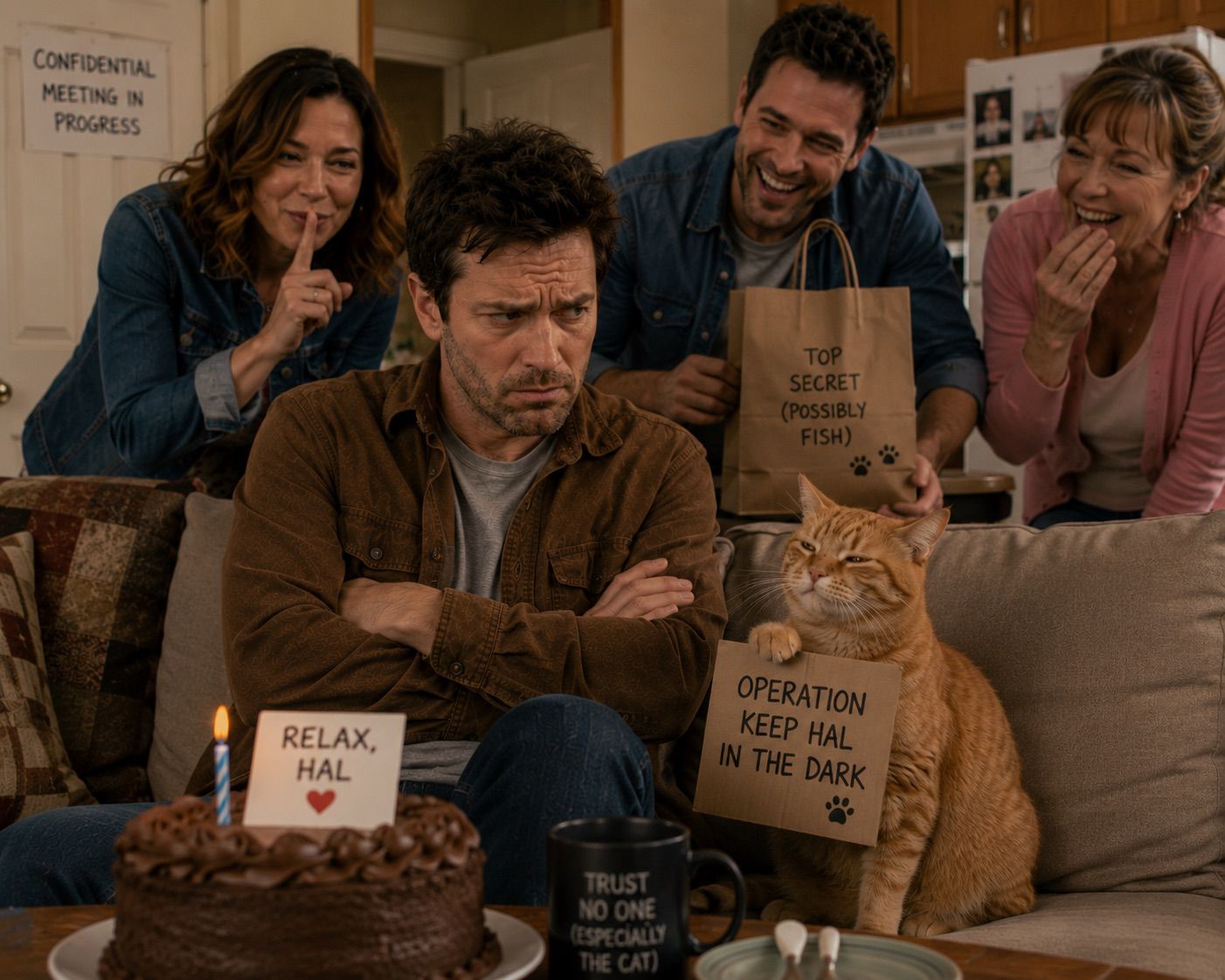
Pandora walks into the living room carrying a small cake, and John follows her with plates. Apparently they’ve been planning a little surprise for me because I’ve been stressed lately, and Karen helped Pandora pick it up earlier. That’s why Pandora had been messaging. That’s why John asked whether they were “still good.” That’s why he came back with the bag. That’s why they were whispering. Pandora tells me she wasn’t planning anything elaborate; she just wanted to do something nice without me finding out beforehand.
I look at the cake.
Then at John.
Then at Pandora.
Then at Mr Whiskers.
“Fine,” I say.
Pandora smiles. “Fine?”
“I may have misinterpreted certain elements.”
John nearly drops the plates laughing.
Pandora asks which elements.
I tell her the investigation was based on incomplete information and that any competent analyst would revise his conclusions when presented with new evidence. She says most competent analysts probably wouldn’t include a cat in the conspiracy chart. I point out there was no chart. She says that’s only because she didn’t give me enough time.
I can’t really argue with that.
Pandora cuts the cake while John continues finding the entire situation much funnier than necessary. Mr Whiskers sits beside my feet, looking up at the plates with sudden intense interest. Everything has a perfectly ordinary explanation. Nobody is plotting against me. John isn’t an inside man. Pandora isn’t coordinating my schedule. Karen isn’t feeding information into some domestic intelligence network. Mrs Jenkins isn’t masterminding anything from next door. Mr Whiskers isn’t carrying messages between them. He’s just a cat who happened to be present while several people tried to surprise me with cake.
I actually feel a little embarrassed.
Then Pandora gives John a piece.
She takes one for herself.
She gives me mine.
And before she sits down, she reaches into the paper bag, pulls out a small packet of cat treats, and gives one to Mr Whiskers.
I stop with my fork halfway to my mouth.
Mr Whiskers eats the treat.
Pandora scratches him beneath the chin and says, “Good job keeping him distracted.”
John laughs.
Pandora laughs.
I slowly put my fork down.
Mr Whiskers looks at me.
There it is.
I knew that cat was involved.