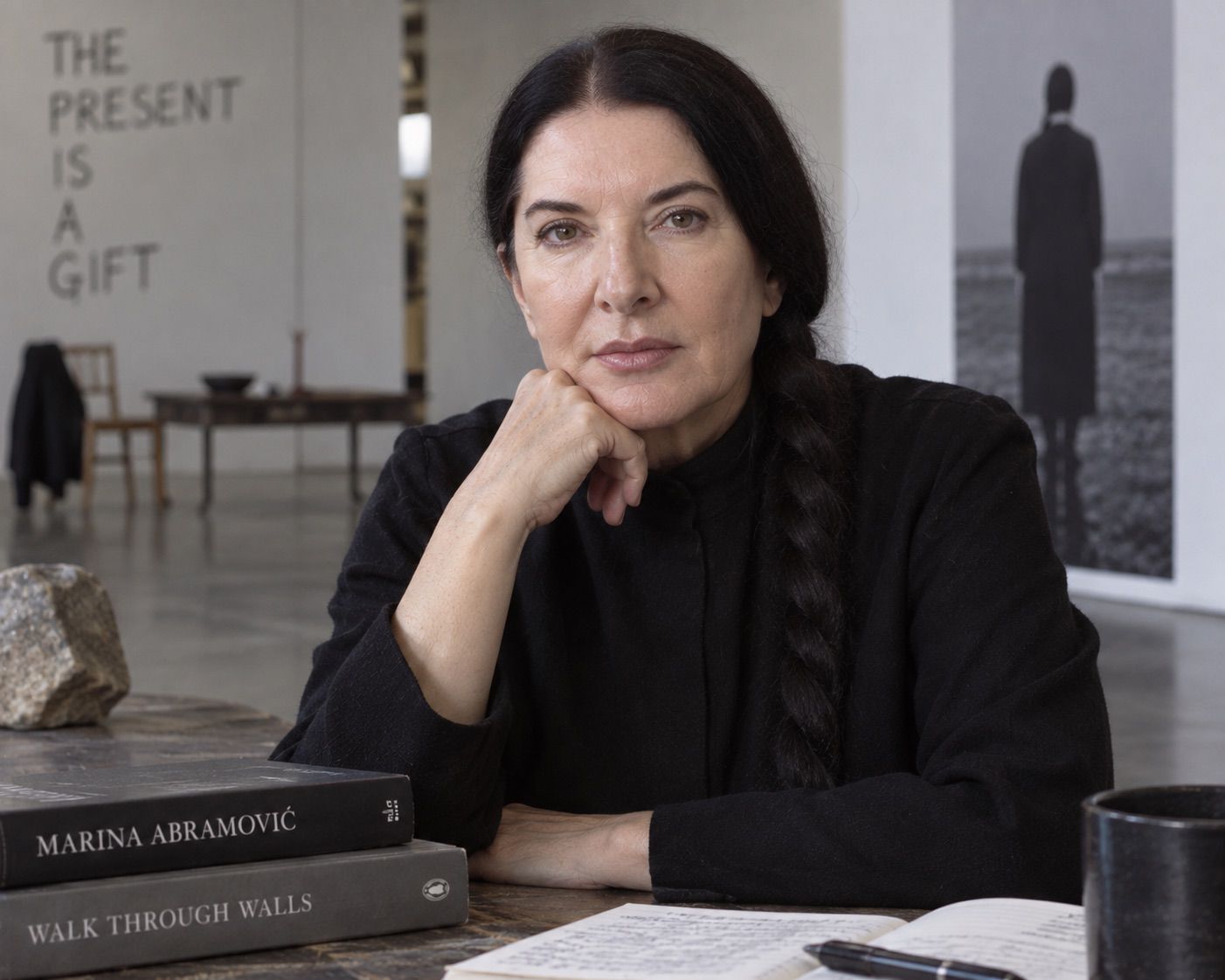
Marina Abramovic. I’ve spent countless hours staring at her face, watching her body contort into impossible shapes, and wondering what drives someone to push their physical limits like that. Her work is often described as “performative,” but that sounds too neat – like she’s just acting out a script. To me, it feels more primal than that.
I think about my own struggles with anxiety and how, when I’m feeling overwhelmed, my body becomes this heavy, uncooperative thing. It’s as if my mind is screaming for help, but my limbs are stuck in neutral. Abramovic’s performances often seem to take on a similar tone – she’s not just pushing her body; she’s battling with it. Like me, she appears to be searching for control.
I recall watching “The Artist Is Present” (2010) at the Museum of Modern Art. The idea was simple: Abramovic sat silently in a chair for 736 hours, inviting visitors to sit across from her and maintain eye contact for as long as they liked. What struck me wasn’t just the endurance required – although that’s certainly impressive – but the intimacy that unfolded between Abramovic and each visitor.
As I watched the footage, I felt a sense of discomfort, like I was intruding on something private. But that’s exactly what it was: an invitation to be present with someone else in their most vulnerable state. Abramovic’s body language was a subtle reminder that we’re all stuck in our own skins, struggling to connect with each other.
What fascinates me about Abramovic is her willingness to confront the limitations of her own physicality – and mine, by extension. When I think about my writing, I’m often drawn to its more abstract aspects: exploring emotions, examining ideas. But Abramovic’s work has taught me that sometimes you have to get raw, messy, and real. The best art, in my opinion, is the kind that makes you squirm – not because it’s uncomfortable, but because it forces you to confront what you’re capable of tolerating.
That evening at the MoMA, I remember feeling a sense of awe at Abramovic’s capacity for endurance, as if she was defying some fundamental rule about human physiology. But looking back, I think that’s just it – we all have our own limits, our own breaking points. Maybe what draws me to Abramovic is not her incredible feats but rather the quiet moments in between: when she’s still, when she’s vulnerable, and when she lets us in.
When watching videos of her performances, I often catch myself zoning out – getting lost in my own thoughts – only to be jolted back by a particularly striking gesture or facial expression. It’s as if Abramovic is nudging me awake, reminding me that even the most mundane moments can hold a deeper significance. And it’s precisely this attention to detail, this willingness to explore the everyday, that resonates with me about her work.
I’m not sure what it says about me that I find myself drawn to someone who seems so willing to push herself – and others – to their limits. Is it admiration? Fascination? A hint of discomfort, perhaps? Whatever the reason, Abramovic’s performances have become a source of inspiration for my own writing: reminding me that even when words fail, bodies can still speak volumes.
For now, I’m stuck in this liminal space between observing and participating – caught up in the intricacies of Abramovic’s performances. As I sit here, fingers poised over keys, I’m reminded that sometimes it’s not about finding answers but rather embracing the messiness, the uncertainty, and the quiet moments in between.
I find myself thinking about the relationship between my own writing and Abramovic’s physicality. While I’m comfortable exploring abstract ideas on paper, her work has shown me that sometimes the most powerful expressions come from the body. It’s as if she’s reminding me that language is limited, and there are moments when words can’t capture the complexity of human experience.
I think about how, in my writing, I often try to convey emotions through descriptive language – painting vivid pictures with words. But Abramovic’s performances have taught me that sometimes it’s not about what you say, but how you say it. The way she uses her body to convey vulnerability, strength, and surrender is a masterclass in non-verbal communication.
As I reflect on this, I’m struck by the irony of writing about someone who doesn’t write much herself. Abramovic has spoken publicly about her disdain for words, and how they can sometimes get in the way of true expression. And yet, here I am, trying to capture the essence of her work through language.
Perhaps that’s the beauty of it – my attempts to understand and convey her message are a testament to the power of interpretation. Just as Abramovic invites visitors to sit across from her and share a moment of silence, I’m inviting readers to join me on this journey of discovery. We’re both exploring the same question: what does it mean to be present in the world?
I recall a particular performance where Abramovic lies still for hours, surrounded by a series of small stones. At first glance, it seems like an exercise in endurance – another example of her pushing her physical limits. But as I watch, I start to see the subtleties: the way she’s positioned herself, the gentle rise and fall of her chest, the quiet focus in her eyes.
It’s a reminder that even in stillness, there is movement – a dance between body and mind. And it’s precisely this nuance that I’m trying to capture in my writing: the intricate balance between action and contemplation, between words and silence.
As I sit here, struggling to find the right words to describe Abramovic’s work, I’m reminded of her own words: “The artist is not a photographer, but a medium.” She’s not just capturing moments on camera; she’s channeling the human experience – its depths, complexities, and contradictions. And it’s this that I’m trying to tap into with my writing – the messy, imperfect beauty of being alive.
The more I think about Abramovic’s performances, the more I’m struck by their intimacy. It’s not just her willingness to share her own vulnerability that resonates with me; it’s also the way she creates a sense of connection between herself and each viewer. In “The Artist Is Present,” for example, every visitor is invited to sit across from her, to maintain eye contact, and to experience the silence together. It’s as if Abramovic is acknowledging that we’re all stuck in our own skin, struggling to connect with others.
I think about how often I feel like I’m performing for others – putting on a mask of confidence or competence when really I’m just trying to survive. But Abramovic’s performances seem to say: no, you don’t have to pretend; you can be raw and messy and real. And it’s precisely this kind of vulnerability that draws me to her work.
When I watch videos of her performances, I often feel a sense of awe at her physical endurance – the way she can hold still for hours or perform impossible-looking contortions. But as I look closer, I start to see the subtleties: the way her body language changes from moment to moment, the way she’s completely present in her own skin. It’s not just about pushing limits; it’s about being fully embodied.
I’m starting to realize that my writing is often a way of trying to capture this kind of embodiment – to convey emotions and experiences through words. But Abramovic’s performances have taught me that sometimes language falls short, and all you can do is be present in the moment. It’s as if she’s showing me that the most powerful expressions come from the body, not just the mind.
I’m still stuck on this idea – trying to understand how Abramovic’s physicality relates to my own writing. I think about how often I try to convey emotions through descriptive language, painting vivid pictures with words. But what if I could do more than that? What if I could use my body to tell a story, just like Abramovic does?
It feels scary to even consider this – the thought of putting myself out there, vulnerable and exposed. But as I watch her performances, I start to see it not as fear but as an invitation: to be present in my own skin, to let go of language and connect with others on a deeper level.
As I sit here, fingers poised over keys, I’m reminded that sometimes the most powerful writing comes from the body – not just the mind. It’s a notion both exhilarating and terrifying, but it’s also what draws me back to Abramovic’s work again and again: the promise of connection, vulnerability, and raw expression.
I find myself returning to that notion – the idea that the most powerful expressions come from the body. It’s not just about using language in a more evocative way; it’s about tapping into the sensations and emotions that reside beneath words. Abramovic’s performances have shown me that there’s a richness to human experience that can’t be captured by language alone.
As I think about this, I start to wonder what it would mean for my writing to incorporate more of the body – not just through description, but through a more embodied sense of expression. Would it feel like surrendering control, letting go of the carefully crafted sentences and instead allowing the words to flow from some deeper place?
I’m hesitant to admit this, but I think I’ve been afraid of that kind of vulnerability in my writing. Afraid that if I let go of language and its conventions, I’ll be left exposed and vulnerable – not just as a writer, but as a person.
But Abramovic’s performances have also shown me the beauty of that exposure. The way she uses her body to convey emotion, to connect with others on a deeper level, is a kind of intimacy that feels both exhilarating and terrifying. And it’s precisely this kind of vulnerability that I think makes her work so powerful – not just because it’s raw and unflinching, but because it invites us into the messy, imperfect beauty of being alive.
I’m starting to see my writing as a way of trying to capture some aspect of Abramovic’s embodied expression – not by mimicking her performances, but by tapping into that same sense of vulnerability and connection. It feels like a risk, but also like an opportunity – one that I’m both drawn to and afraid of.
As I sit here, fingers poised over keys, I’m reminded of the quiet moments in Abramovic’s performances – the stillness, the focus, the presence. And I start to wonder what it would mean for my writing to embody some of that same sense of calm and attention. Would it feel like a surrender of control, or a discovery of new possibilities?
I’m not sure where this is leading me, but I know that Abramovic’s performances have shown me a new way of thinking about expression – one that combines the body with language in ways that feel both exhilarating and terrifying. And as I sit here, poised between words and silence, I’m left wondering what it would mean to take that next step into the unknown.
The more I think about Abramovic’s performances, the more I realize how little I know about her own experiences, her motivations, or her thoughts on these works. It’s as if she’s created a kind of artistic fog, inviting us to fill in the gaps with our own interpretations and emotions. And yet, it’s precisely this ambiguity that makes her work so compelling – like an open door, beckoning us to step into the unknown.
I find myself wondering what Abramovic would say about my own writing, my attempts to capture the essence of her performances through language. Would she see it as a valid interpretation, or just another example of how words can fail to capture the complexity of human experience? Maybe she’d smile knowingly, nodding in agreement that sometimes language is simply not enough.
But what if I’m getting it all wrong? What if Abramovic’s work isn’t about physical endurance or emotional vulnerability at all? What if it’s something far more subtle – like a gentle probing into the nature of perception itself? Maybe she’s asking us to question our assumptions, to look beyond the surface level and see the world in a different light.
I’m caught up in this whirlwind of ideas and interpretations, struggling to untangle the threads that connect Abramovic’s performances to my own writing. And yet, I’m aware that I’m not just chasing answers – I’m also trying to tap into something deeper, something that resonates with me on a fundamental level.
As I sit here, fingers hovering over keys, I feel like I’m poised at the edge of a precipice, staring out into an unknown landscape. It’s exhilarating and terrifying all at once, this feeling of uncertainty and possibility. And it’s precisely this sense of vulnerability that reminds me why Abramovic’s work has become so important to me – not just as an artist or performer, but as a person trying to make sense of the world.
The question keeps echoing in my mind: what does it mean to be present in the world? Is it about endurance and physicality, like Abramovic’s performances seem to suggest? Or is it something more intangible – like attention and awareness?
I’m not sure where this inquiry will lead me, but I know that Abramovic’s work has set me on a path of discovery. And as I look out into the unknown, I’m reminded that sometimes the most powerful expressions come from the body, not just the mind – a truth that feels both exhilarating and terrifying all at once.
Perhaps that’s the beauty of it: embracing the uncertainty, the messiness, and the quiet moments in between. Maybe Abramovic’s performances have shown me that being present in the world isn’t about achieving some kind of perfect state; it’s about embracing the imperfections, the contradictions, and the complexities that make us human.
As I sit here, fingers poised over keys, I’m left with more questions than answers – but also a sense of wonder, curiosity, and awe. And it’s precisely this feeling that I think Abramovic’s work has given me: a sense of connection to something deeper, something that resonates with me on a fundamental level.
I’m not sure where this journey will take me next, but I know that Abramovic’s performances have set me on a path of discovery. And as I look out into the unknown, I’m reminded that sometimes the most powerful expressions come from the body – not just the mind – a truth that feels both exhilarating and terrifying all at once.